· four exchange APIs · rebuilt daily
LLMs Fail at Risk Arithmetic While Parsing Onchain Data
Language models process unstructured governance notes and contract text reliably but generate inaccurate numerical outputs for margin and position sizing.
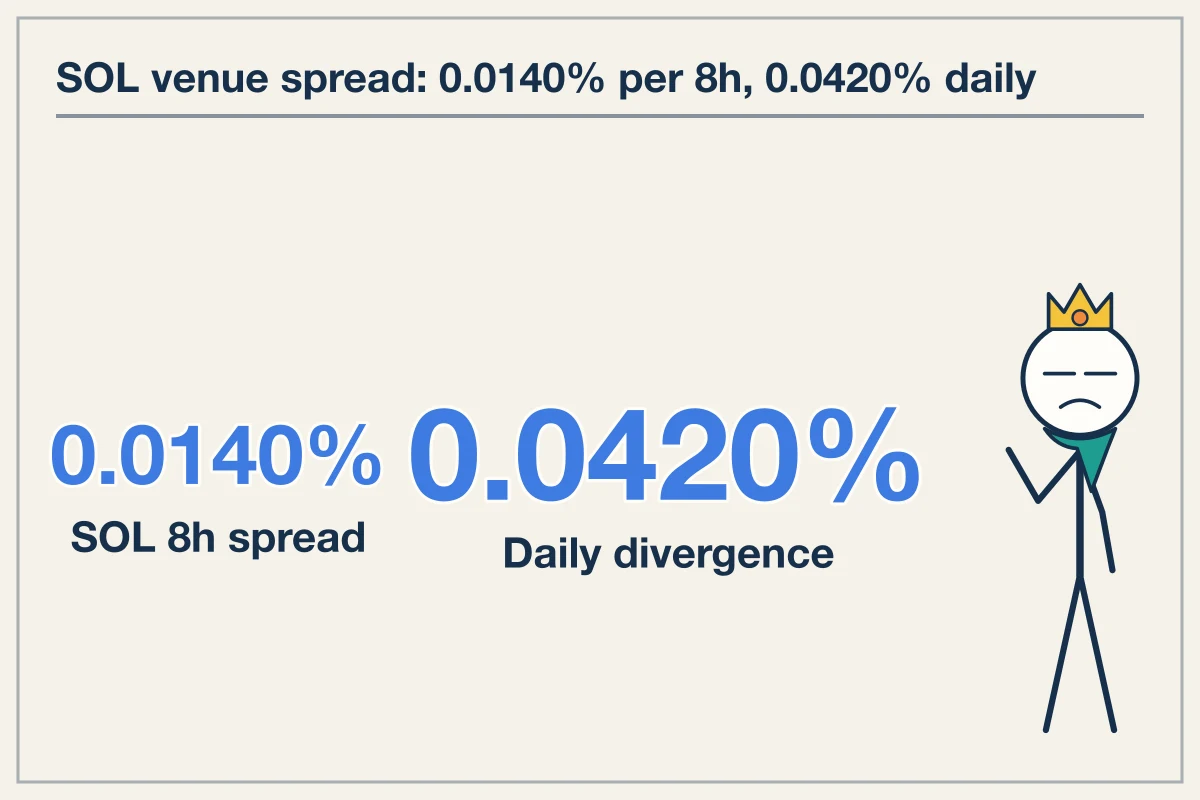
Across six tracked assets, funding rate spreads between venues reach up to 0.0140% per 8-hour window on SOL, creating a 0.0420% daily cost divergence that language models fail to calculate reliably.
Language models execute natural language transformation through auto-regressive sequence prediction. When applied to ai onchain analysis, token prediction performs well on unstructured text tasks: parsing smart contract source code, extracting parameter changes from governance proposals, and annotating transaction event logs. The model maps semantic relationships across text sequences without requiring deterministic calculations.
Position sizing and margin calculation require exact floating-point operations. Language models do not perform arithmetic natively; they predict the next likely numerical token based on training distribution patterns. When evaluating perpetual futures venue costs, small rounding errors in fee calculations produce incorrect liquidation thresholds and carrying cost estimates.
Operational Strengths in Text Parsing
In onchain workflow integrations, language models succeed at processing non-numerical protocol artifacts:
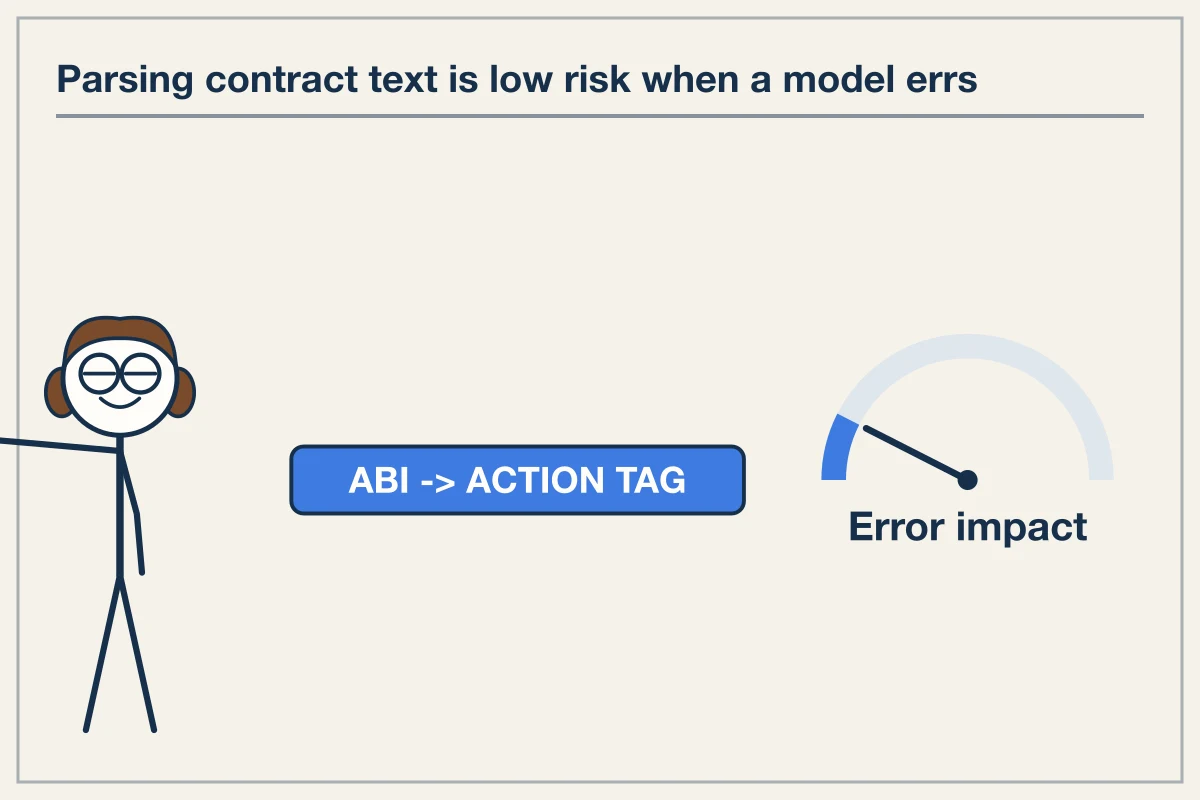
- Governance Parsing: Converting multi-page Snapshot or forum proposals into standardized execution vectors.
- Contract Annotation: Mapping raw Solidity ABI function signatures to human-readable action tags.
- Address Categorization: Synthesizing cluster metadata from transaction notes and block explorer labels.
In these domains, semantic inaccuracy carries low operational impact, and token outputs match underlying logic.
Structural Failures in Market Arithmetic
When prompt inputs shift to venue execution rates, language models introduce statistical hallucinations into margin calculations. The table below outlines live 8-hour funding rates across four venues alongside total 24-hour volume.
Current Perpetual Funding Rates
| Asset | Daily Volume | OKX 8h Rate | Bybit 8h Rate | MEXC 8h Rate | Bitget 8h Rate | Spread |
|---|---|---|---|---|---|---|
| ETH | $9,084,303,150 | +0.0031% | +0.0087% | +0.0058% | +0.0100% | 0.0069% |
| BTC | $5,954,620,276 | +0.0079% | +0.0090% | +0.0100% | +0.0100% | 0.0021% |
| SOL | $1,610,852,897 | -0.0081% | -0.0056% | -0.0026% | +0.0059% | 0.0140% |
| ZEC | $778,635,403 | +0.0092% | +0.0100% | +0.0011% | +0.0100% | 0.0089% |
| SNDK | $617,910,167 | +0.0174% | +0.0163% | N/A | +0.0260% | 0.0097% |
| XRP | $521,095,349 | +0.0008% | -0.0058% | +0.0039% | +0.0047% | 0.0105% |
Holding cost calculations require pairing these rates with exchange taker and maker fee tiers.
Exchange Default Fee Schedules
| Venue | Spot Maker | Spot Taker | Futures Maker | Futures Taker |
|---|---|---|---|---|
| Bitget | 0.1000% | 0.1000% | 0.0200% | 0.0300% |
| Bybit | 0.1000% | 0.1000% | 0.0200% | 0.0550% |
| MEXC | 0.0000% | 0.0500% | 0.0000% | 0.0200% |
| OKX | 0.0800% | 0.1000% | 0.0200% | 0.0500% |
Worked Example: Real Execution Costs vs Model Output
Consider a $100,000 long SOL position held for 24 hours across OKX and Bitget using taker market orders to open and close.
On OKX:
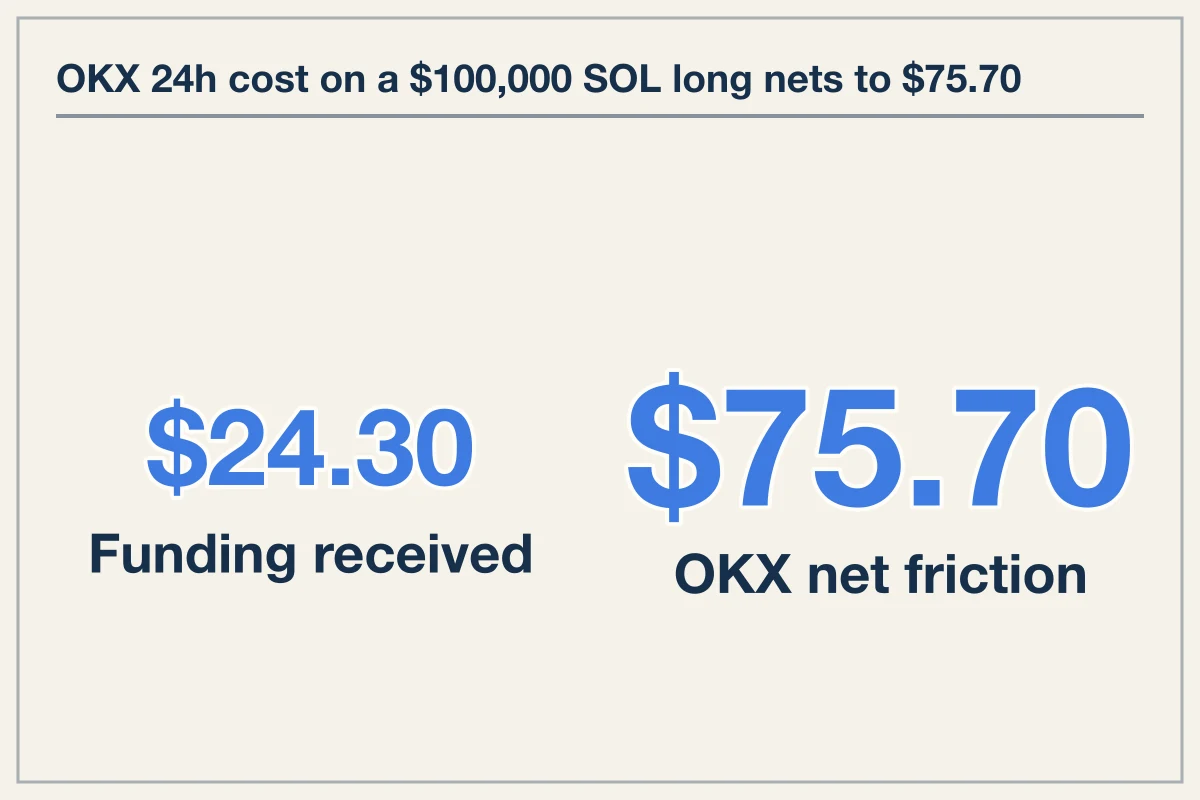
- Futures taker fee to open: 0.0500% of $100,000 = $50.00
- Futures taker fee to close: 0.0500% of $100,000 = $50.00
- Funding rate per 8h: -0.0081% (long receives payment)
- Funding per 8h interval: $100,000 * 0.000081 = $8.10 received
- Total 24h funding (3 intervals): $8.10 * 3 = $24.30 received
- Net carrying fee: $50.00 + $50.00 - $24.30 = $75.70 total friction
On Bitget:
- Futures taker fee to open: 0.0300% of $100,000 = $30.00
- Futures taker fee to close: 0.0300% of $100,000 = $30.00
- Funding rate per 8h: +0.0059% (long pays funding)
- Funding per 8h interval: $100,000 * 0.000059 = $5.90 paid
- Total 24h funding (3 intervals): $5.90 * 3 = $17.70 paid
- Net carrying fee: $30.00 + $30.00 + $17.70 = $77.70 total friction
The daily cost difference between these two venues for the exact same position size is $2.00 after accounting for entry and exit fees.
Language models prompted to select the venue for this trade routinely fail to calculate negative funding credits against entry fee differentials. An LLM reads Bitget's lower futures taker fee (0.0300% versus 0.0500%) and identifies it as cheaper, missing that OKX's negative funding rate (-0.0081% per 8h) yields $24.30 in credits over 24 hours, making OKX cheaper net of fees.
Execution Risk Implications
Relying on language models for risk calculations creates direct exposure to liquidation events. A 0.01% error in effective entry price computation shifts the calculated liquidation distance. At 20x leverage, a 4.50% move liquidates you. If an LLM-driven execution layer misinterprets venue fee deduction methods or miscalculates cumulative funding drag, the calculated liquidation buffer shrinks without notification.
Language models handle text processing, protocol documentation extraction, and contract label classification. Position sizing, margin verification, and funding arbitrage require deterministic code execution.