· four exchange APIs · rebuilt daily
AI Fraud Scales Mass Attacks But Out Of Band Checks Prevent Loss
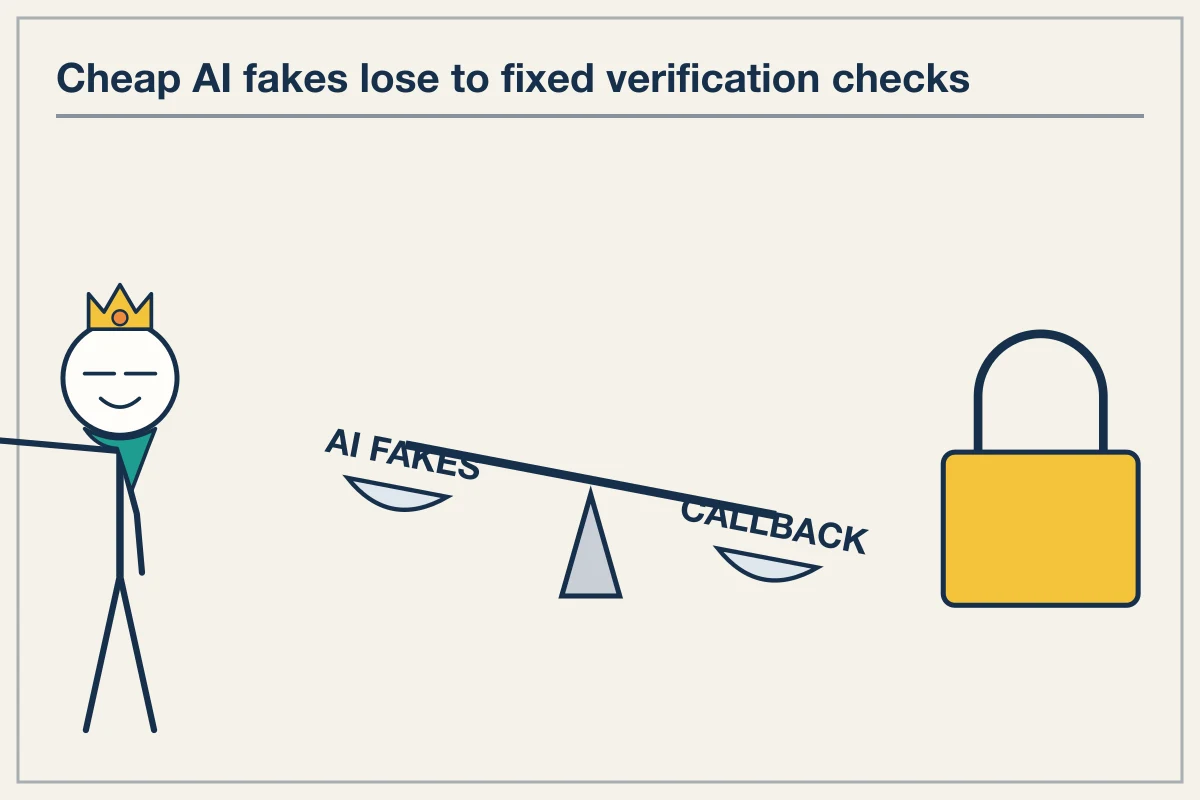
Generative AI reduces scam deployment costs while deterministic checks like out-of-band callbacks and bookmarked URLs remain completely effective.
Generative AI models lower the marginal cost of creating synthetic audio, video, and text to zero, allowing fraud operators to scale target reach without increasing overhead. Attack vectors that previously required manual effort now run concurrently across thousands of channels, but defensive security relies on structural verification rather than visual or auditory perception.
Synthetic Media Vectors in Execution Security
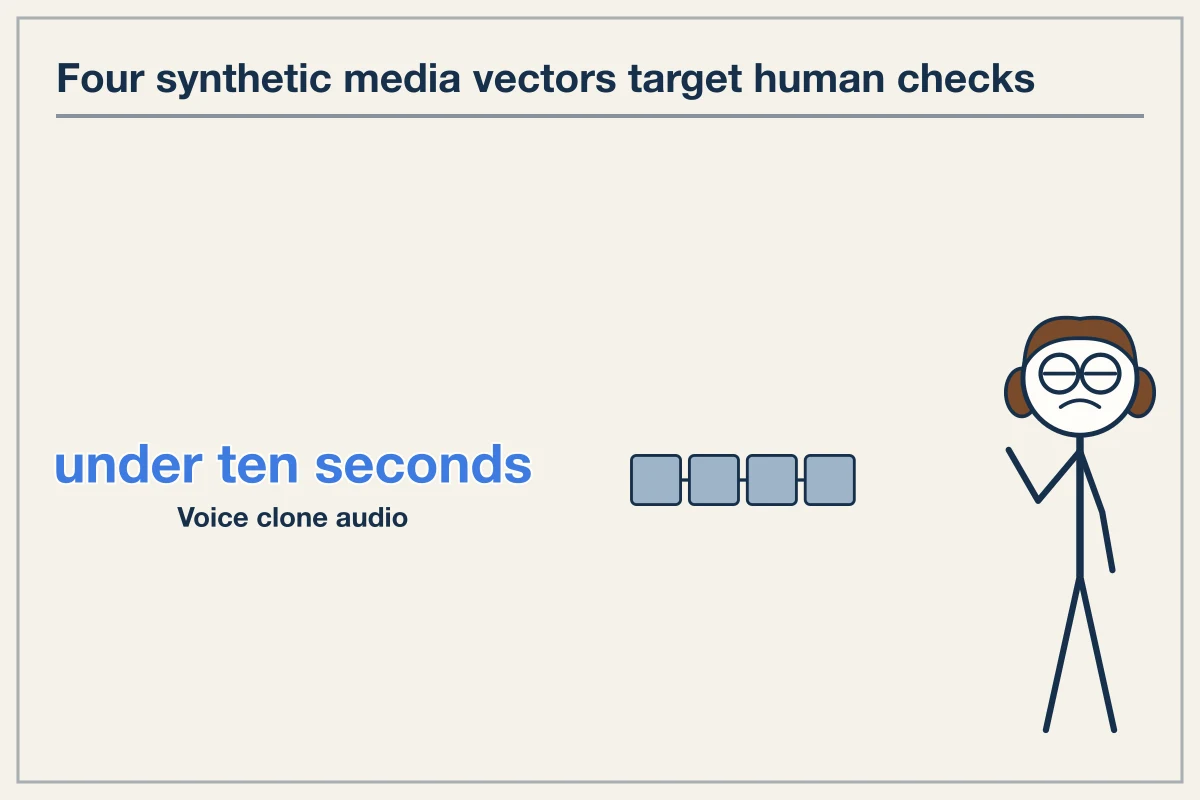
Modern scam pipelines target the human verification layer through four primary vectors:
Cloned Voice Calls
Audio synthesis models generate real-time voice clones using under ten seconds of source audio scraped from public media or previous calls. Fraud operators use these models during emergency distress scenarios to request immediate capital transfers or emergency API key resets.
Synthetic Video Endorsements
Generative video models map lip movements and facial expressions onto existing footage of prominent figures. These deepfake clips stream via hijacked YouTube channels or social feeds to promote fake token launches or malicious smart contracts.
Automated Support Impersonation
Large language models populate Telegram, Discord, and social media platforms to identify users posting about technical issues. The AI agents initiate direct messages, mimic exchange documentation phrasing, and direct users to credential-harvesting tools.
Cloned Web Interfaces
Automated site scraping tools create exact visual replicas of trading interfaces within minutes of a target domain launch. These frontends capture private keys, seed phrases, and session tokens directly from input fields.
Deterministic Verification Mechanics
Generative quality does not alter the underlying network and cryptographic mechanisms that protect account balance. Three simple operational checks prevent unauthorized account access regardless of model fidelity.
Out-of-Band Callbacks
Inbound audio streams over WebRTC or VoIP carry no cryptographic proof of identity. An out-of-band callback requires terminating the inbound call and originating a fresh outbound connection to a pre-verified, hardcoded telephone number or hardware token challenge. This forces the signal through authenticated telecom routes that an inbound AI voice stream cannot hijack.
Bookmarked URL Navigation
Phishing sites rely on typo-squatted domain names, paid search placement, or social direct links. Directing navigation through hardcoded browser bookmarks bypasses external routing controls entirely. If the domain name does not match the exact string, the browser never sends credentials over TLS.
Isolated Hardware Signing
Seed phrases and private keys derive account authority through elliptic curve cryptography. Hardware wallets sign transactions inside an air-gapped secure element. Input fields on websites never receive seed phrase data. A user who never inputs a seed phrase into a web interface eliminates the threat vector of synthetic sites, regardless of site appearance.
Operational Venue Costs and Capital Loss Risk
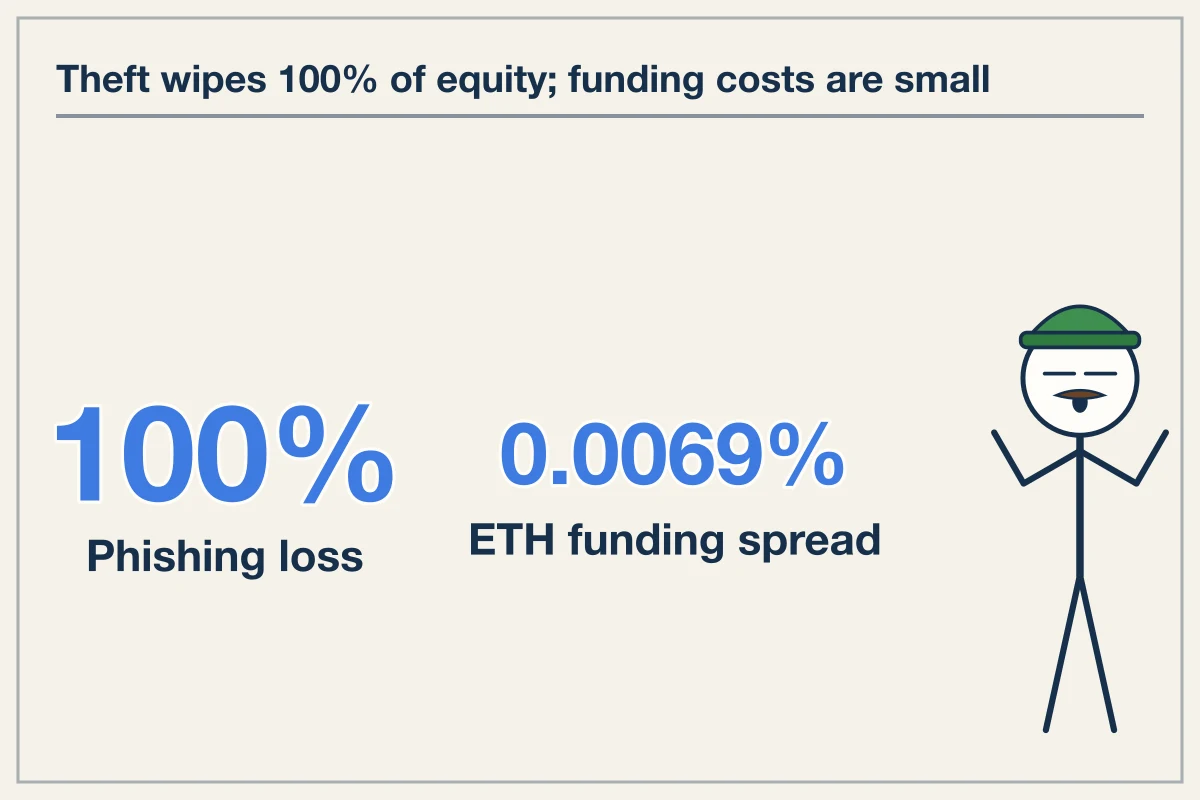
Phishing and credential theft result in a 100% loss of account equity. By comparison, venue selection governs predictable execution costs through funding rate spreads and fee schedules.
Live 8-Hour Funding Spreads
Funding rates adjust every eight hours across venues, creating distinct holding costs for long and short positions.
| Asset | OKX | Bybit | MEXC | Bitget | Spread | 24h Volume |
|---|---|---|---|---|---|---|
| ETH | +0.0031% | +0.0081% | +0.0061% | +0.0100% | 0.0069% | $9,102,560,442 |
| BTC | +0.0081% | +0.0080% | +0.0100% | +0.0100% | 0.0020% | $5,972,242,352 |
| SOL | -0.0077% | -0.0056% | -0.0025% | +0.0059% | 0.0136% | $1,636,283,758 |
| ZEC | +0.0097% | +0.0100% | +0.0006% | +0.0100% | 0.0094% | $777,378,029 |
| SNDK | +0.0148% | +0.0084% | N/A | +0.0235% | 0.0151% | $710,536,735 |
| XRP | +0.0004% | -0.0070% | +0.0037% | +0.0047% | 0.0117% | $528,068,174 |
Futures Fee Overhead
Default fee structures vary across venues for spot and perpetual futures markets.
| Venue | Spot Maker | Spot Taker | Futures Maker | Futures Taker |
|---|---|---|---|---|
| Bitget | 0.0010 | 0.0010 | 0.0002 | 0.00030 |
| Bybit | 0.0010 | 0.0010 | 0.0002 | 0.00055 |
| MEXC | 0.0000 | 0.0005 | 0.0000 | 0.00020 |
| OKX | 0.0008 | 0.0010 | 0.0002 | 0.00050 |
Applied Cost Arithmetic
Consider a $100,000 notional long position in SNDK held for 24 hours (three funding intervals) using taker execution.
On Bitget:
- Futures taker fee: $100,000 multiplied by 0.0003 equals $30.00.
- 24-hour funding rate: 3 multiplied by +0.0235% equals +0.0705%.
- Funding paid: $100,000 multiplied by 0.000705 equals $70.50.
- Total 24-hour baseline holding cost: $30.00 plus $70.50 equals $100.50.
On Bybit:
- Futures taker fee: $100,000 multiplied by 0.00055 equals $55.00.
- 24-hour funding rate: 3 multiplied by +0.0084% equals +0.0252%.
- Funding paid: $100,000 multiplied by 0.000252 equals $25.20.
- Total 24-hour baseline holding cost: $55.00 plus $25.20 equals $80.20.
Holding the SNDK long position on Bybit saves $20.30 over 24 hours compared to Bitget due to lower funding fees, despite Bybit's higher taker fee.
Cryptographic Boundaries Over Visual Realism
The cost delta between exchanges remains bounded by basis spreads and published fee schedules. A single operational failure against synthetic fraud bypasses these fee calculations entirely by causing total loss of balance.
When an attacker obtains API keys with withdrawal permissions or extracts a seed phrase via a cloned interface, the account drawdown is 100%. Maintaining strict separation between interactive browser sessions and hardware key signing guarantees that synthetic voice, deepfake video, and automated text generation fail at the execution boundary.