· four exchange APIs · rebuilt daily
Asian Crypto Regulatory Split Shifts Carry Costs to Venue Spreads
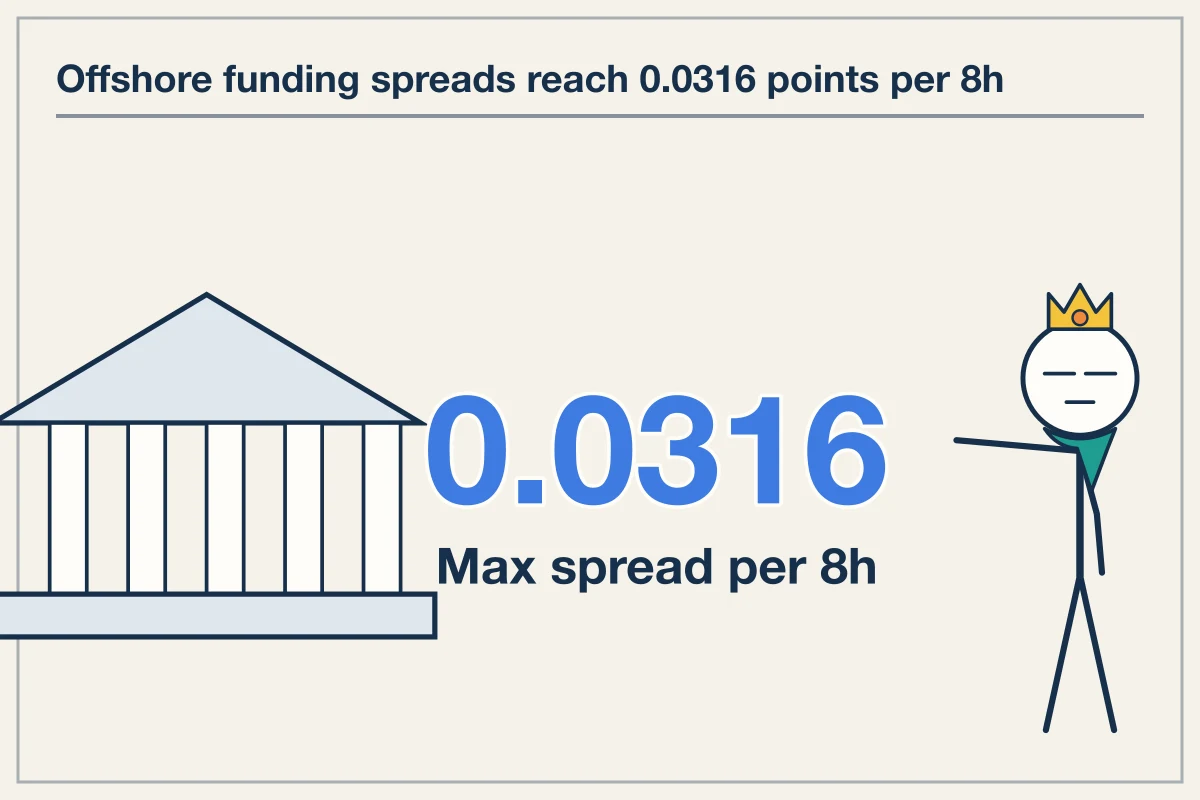
Regulatory divergence in Singapore and Hong Kong pushes Asian perp traders to offshore venues where funding spreads reach 0.0316 percentage points per 8h.
Regulatory Divergence in Asian Jurisdictions
Regulatory policies in Singapore and Hong Kong have split retail spot access from high-leverage perpetual futures trading. Singapore restricted retail access to leverage, credit lines, and staking yields through central authority guidelines. Hong Kong established a framework for retail spot trading on licensed local venues while restricting retail derivative access.
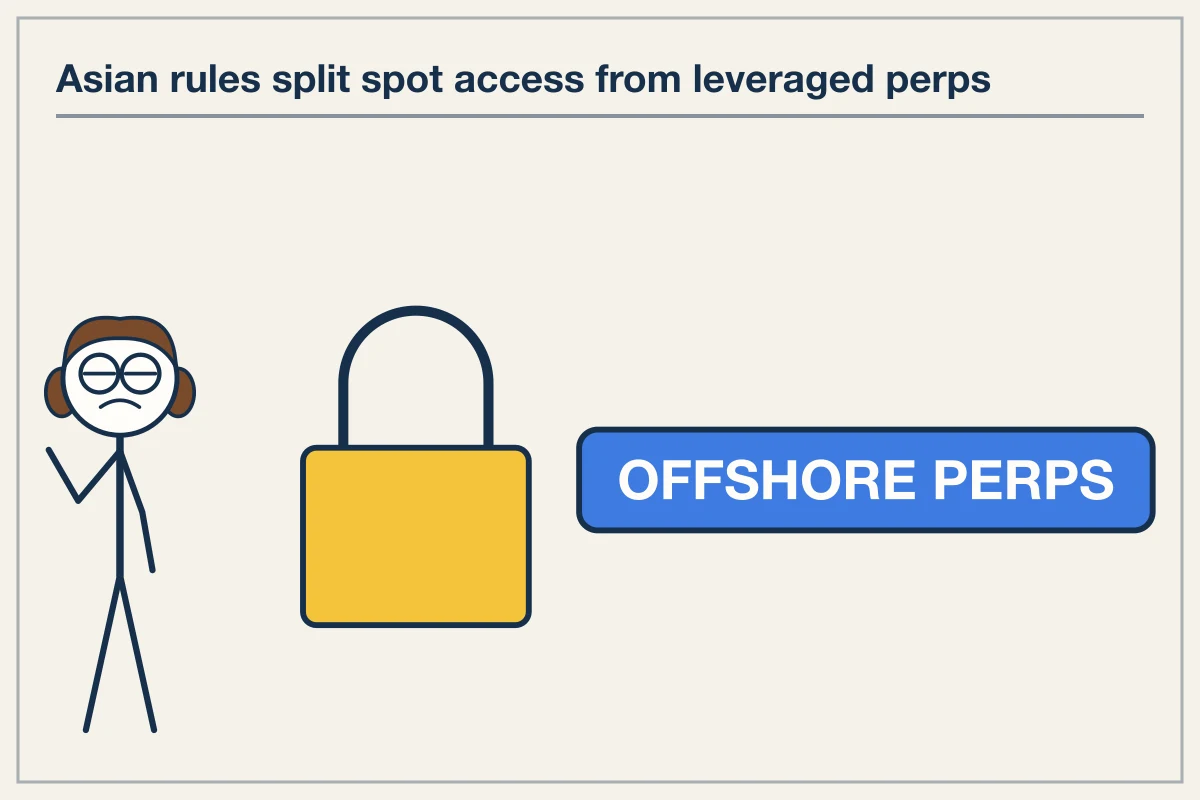
Active perpetual traders operating in Asian time zones route execution to offshore order books to access high-leverage contracts. This structural split moves operational focus from exchange compliance features to venue fee schedules and real-time funding rate spreads.
Futures Fee Schedule Comparison
Exchange fee schedules vary between default maker and taker tiers. The table below outlines default futures and spot fee rates across major offshore venues offering perpetual contracts to Asian market participants.
| Venue | Futures Maker | Futures Taker | Spot Maker | Spot Taker |
|---|---|---|---|---|
| MEXC | 0.0000% | 0.0200% | 0.0000% | 0.0500% |
| Bitget | 0.0200% | 0.0300% | 0.1000% | 0.1000% |
| OKX | 0.0200% | 0.0500% | 0.0800% | 0.1000% |
| Bybit | 0.0200% | 0.0550% | 0.1000% | 0.1000% |
Execution costs compound on high-frequency turnover or large position sizes. Opening and closing a 100,000 position using taker orders on Bybit incurs a combined fee of 110 units, calculated as 100,000 multiplied by 0.00055 for entry plus 100,000 multiplied by 0.00055 for exit.
The same round-trip taker transaction on OKX costs 100 units (100,000 multiplied by 0.0005 twice). On Bitget, the transaction costs 60 units (100,000 multiplied by 0.0003 twice). On MEXC, the taker fee costs 40 units (100,000 multiplied by 0.0002 twice). The taker fee spread between MEXC and Bybit creates a direct 70 unit cost differential per 100,000 traded before accounting for slippage or funding.
Live Funding Rate Differentials
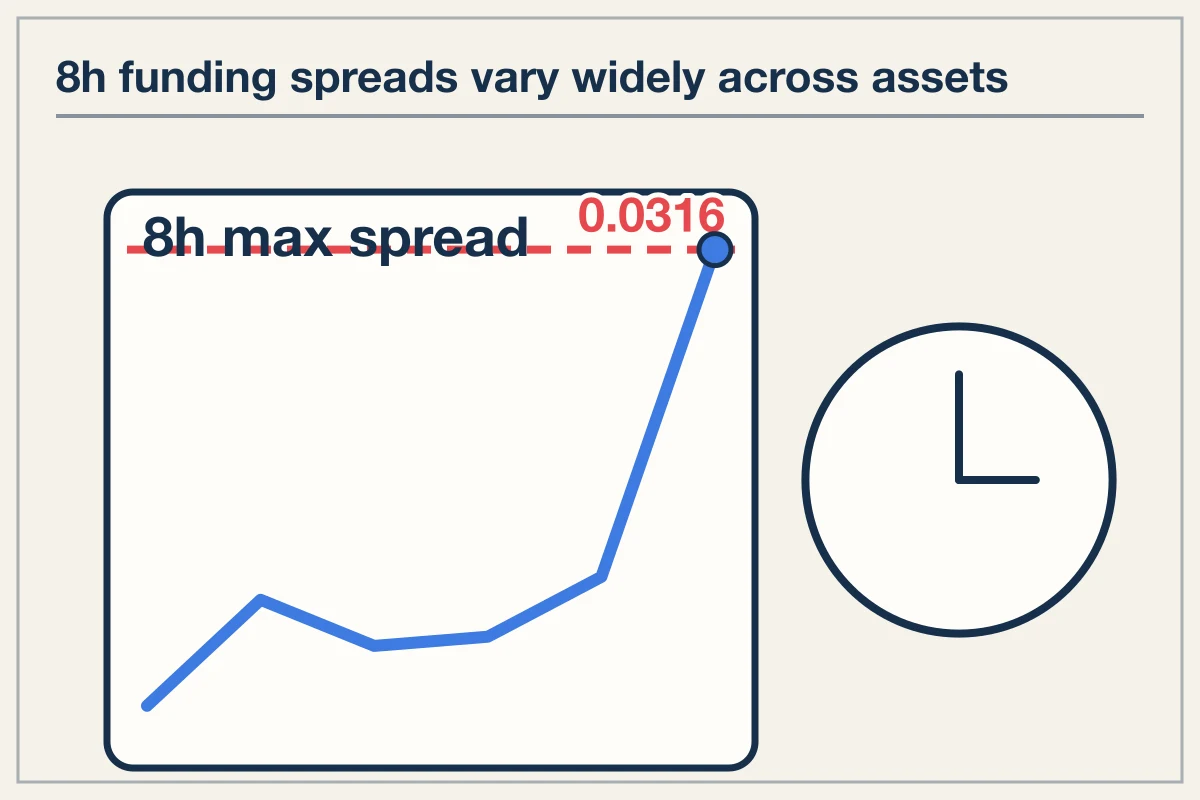
Funding rate payments occur every 8 hours across perpetual contracts. The table below lists normalized 8-hour funding rates and 24-hour trading volumes across major perpetual pairs.
| Asset | MEXC (8h) | Bitget (8h) | OKX (8h) | 8h Max Spread | 24h Volume |
|---|---|---|---|---|---|
| BTC | +0.0098% | +0.0100% | +0.0100% | 0.0002% | 9,184,740,733 |
| ETH | +0.0025% | +0.0100% | +0.0100% | 0.0075% | 8,682,705,858 |
| SOL | +0.0055% | +0.0100% | +0.0081% | 0.0045% | 1,829,920,894 |
| SNDK | N/A | +0.0074% | +0.0125% | 0.0051% | 1,322,711,228 |
| TRUMP | N/A | +0.0050% | -0.0041% | 0.0091% | 1,034,112,811 |
| XAU | +0.0000% | +0.0000% | +0.0316% | 0.0316% | 756,937,823 |
Long Position Carry Cost Dynamics
The choice of trading venue impacts daily carry costs depending on contract funding rates.
For ETH perpetuals, holding a 100,000 long position on OKX or Bitget costs 10 units in funding per 8-hour window (100,000 multiplied by 0.0001). Holding the same long position on MEXC costs 2.50 units per 8-hour window (100,000 multiplied by 0.000025). Across 24 hours (three funding periods), the holding cost is 30 units on OKX or Bitget versus 7.50 units on MEXC, saving 22.50 units per day per 100,000 position.
For XAU perpetuals, the funding spread reaches 0.0316 percentage points per 8 hours. Holding a 100,000 long XAU position on OKX costs 31.60 units per 8-hour interval (100,000 multiplied by 0.000316), amounting to 94.80 units per 24-hour period. On Bitget or MEXC, the XAU funding rate is 0.0000%, resulting in 0.00 units in carry costs.
For TRUMP perpetuals, directional sign divergence changes who pays funding. On Bitget, a long position pays +0.0050% per 8 hours, costing 5 units per 100,000 position. On OKX, the funding rate is negative at -0.0041%, meaning short positions pay long positions. A 100,000 long position on OKX receives 4.10 units per 8 hours. The effective spread between holding a TRUMP long on Bitget versus OKX is 9.10 units per 8 hours, or 27.30 units per 24 hours.
Margin Buffers and Liquidation Mechanics
Leverage reduces the price threshold required to trigger liquidation. At 20x leverage, initial margin is 5.0% of nominal position size. A 4.5% adverse price move, accounting for maintenance margin requirements, liquidates the position. At 10x leverage, initial margin is 10.0%, and a 9.5% adverse price move triggers liquidation.
Carrying costs directly erode liquidation buffers over time. On a 100,000 XAU long position at 20x leverage, initial margin is 5,000 units. Carrying this position on OKX costs 94.80 units per 24 hours in funding payments. Over 10 days, cumulative funding payments equal 948 units, consuming 18.96% of the initial margin balance without any movement in underlying index price.
Execution Impact for Asia Traders
Asian market participants face a fragmented workflow: fiat onboarding via local spot channels, followed by order execution on offshore derivative books. Because venue liquidity and contract mechanisms vary, holding long-term positions requires monitoring venue funding spreads against entry taker fees. Higher taker entry fees on venues like Bybit (0.0550%) require larger price movements to break even compared to lower fee venues like MEXC (0.0200%), while holding costs over extended periods depend primarily on relative funding rate distributions.