· four exchange APIs · rebuilt daily
Maker vs taker fees futures drag breaks at two basis points of slippage

The finding
Paying taker fees on perpetual futures costs between $100 and $350 extra per $1,000,000 of traded volume compared to maker fees across tier-one venues.
On Bybit, the taker rate of 0.055% is nearly triple the maker rate of 0.02%.
MEXC waives maker fees entirely while charging 0.02% for taker orders.
A limit order that misses execution or slips by more than 3.5 basis points negates the entire fee saving.
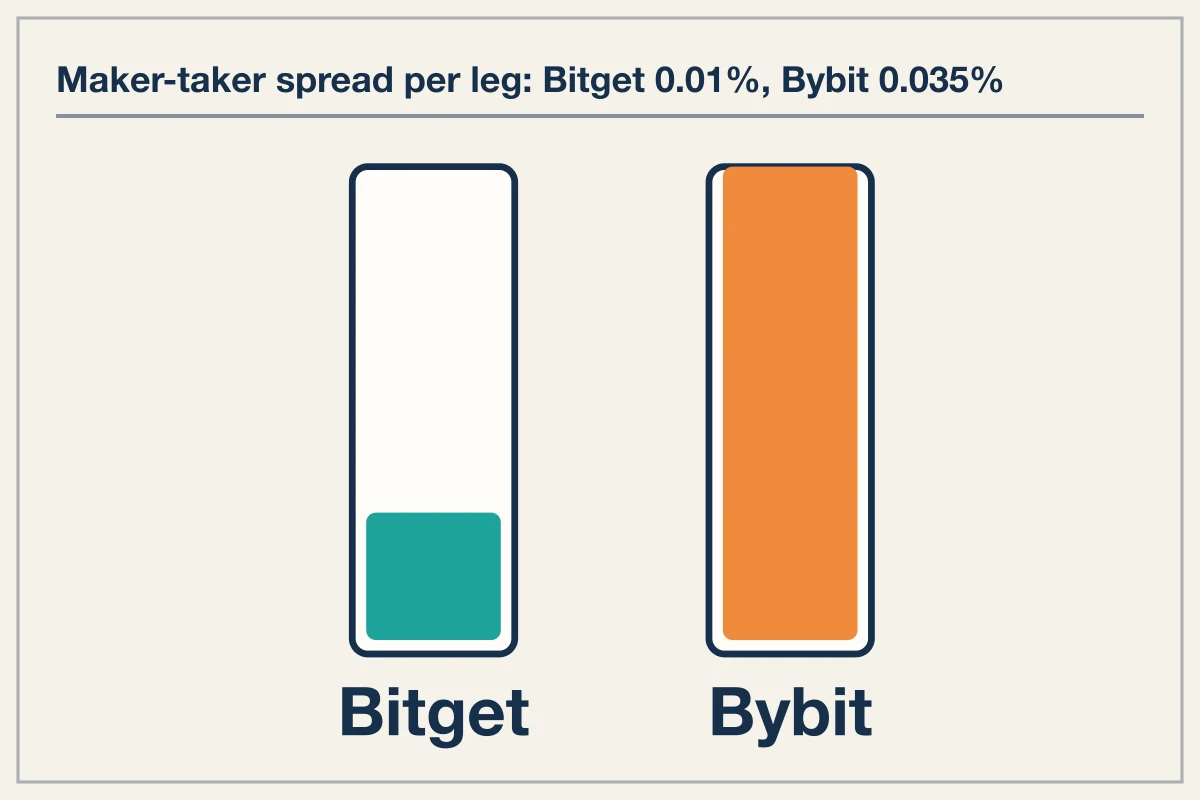
Understanding maker vs taker fees futures impact requires comparing baseline exchange fee schedules against order book slippage. Across major perpetual venues, the fee spread between adding and removing liquidity ranges from 0.01% to 0.035% per trade leg.
Base rates across perpetual venues
Exchange fee schedules set a baseline fee drag on every trade leg. Across major perpetual futures exchanges, default maker rates range from 0.00% to 0.02%, while default taker rates range from 0.02% to 0.055%.
| Exchange | Futures Maker | Futures Taker | Fee Spread per Leg | Round-Trip Taker Cost per $100k |
|---|---|---|---|---|
| Bitget | 0.02% | 0.03% | 0.01% | $60 |
| MEXC | 0.00% | 0.02% | 0.02% | $40 |
| OKX | 0.02% | 0.05% | 0.03% | $100 |
| Bybit | 0.02% | 0.055% | 0.035% | $110 |
The gap between maker and taker fees determines how much execution delay you can afford. On Bitget, the spread is 0.01% per trade leg. On Bybit, the spread expands to 0.035% per leg. On a round-trip order where both entry and exit cross the order book, a trader on Bybit pays 0.11% in total taker fees, compared to 0.04% in total maker fees.
Worth knowing
Entering and exiting a $100,000 position with taker orders on Bybit incurs a total fee of $110, which equals 1.1% of initial margin at 10x leverage.
How maker vs taker fees futures impact total execution cost
When evaluating maker vs taker fees futures performance, turnover volume amplifies small percentage differences into substantial balance deductions.
Consider a trader generating $1,000,000 in monthly futures volume across ten $100,000 round-trip trades.
On Bybit, executing all orders as taker costs $550 in total fees ($1,000,000 multiplied by 0.00055). Executing all orders as maker costs $200 ($1,000,000 multiplied by 0.0002). The net execution drag difference between limit orders and market orders is $350 per $1,000,000 traded.
On OKX, the same $1,000,000 taker volume costs $500 versus $200 for maker orders, leaving a $300 difference.
On Bitget, taker volume costs $300 versus $200 for maker orders, yielding a $100 difference.
On MEXC, taker volume costs $200 while maker volume incurs $0, creating a $200 difference.
Where this goes wrong
Chasing limit fills in fast-moving markets frequently causes non-execution or forced market orders at adverse prices, costing far more than the 0.035% fee spread.
The slippage threshold where taker orders become cheaper
A maker order saves money only if it fills at your intended price. If the market moves away while a limit order rests in the order book, the price slippage often exceeds the fee savings.
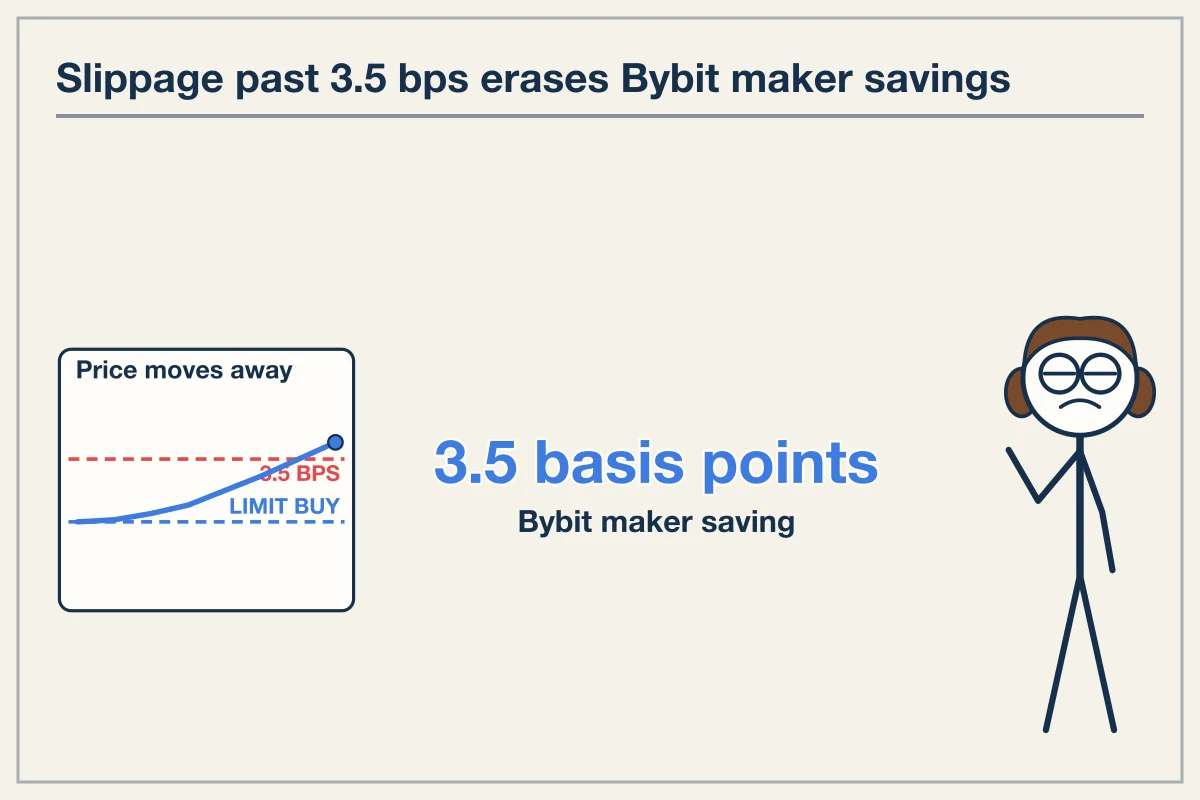
On Bybit, the maker savings are 0.035% (3.5 basis points) per leg. If you place a post-only limit buy order and the market moves up, forcing you to modify the order or take liquidity 4 basis points higher, the net entry cost is higher than if you had taken liquidity immediately.
On Bitget, the maker savings are 0.01% (1 basis point) per leg. A price movement of just 0.01% against your limit order neutralizes the entire fee advantage of using a maker order.
For strategies with high turnover or momentum signals, taking liquidity guarantees execution. The 0.01% to 0.035% fee spread represents the maximum premium paid for instant execution certainty.
Funding rates versus fee drag
Holding positions across multiple 8-hour funding intervals shifts the total cost structure. Over longer holding periods, funding rate spreads between venues routinely dwarf the entry and exit fee differences.
| Asset | Venue | Funding Rate per 8h | 3-Day Holding Drag per $100k |
|---|---|---|---|
| ETH | Bybit | +0.0018% | $16.20 |
| ETH | OKX | +0.0066% | $59.40 |
| ETH | MEXC | +0.0071% | $63.90 |
| ETH | Bitget | +0.0100% | $90.00 |
Holding an ETH long position on Bitget incurs +0.0100% per 8-hour interval. Over three days (9 settlement periods), funding costs total 0.09%, or $90 on a $100,000 position. On Bybit, the ETH funding rate is +0.0018% per 8 hours, totaling 0.0162% or $16.20 over three days.
The $73.80 funding difference between Bitget and Bybit over three days is larger than the $35 taker fee difference for entering a $100,000 trade on Bybit versus Bitget ($55 taker fee on Bybit minus $20 taker fee on MEXC or $30 on Bitget).
For short-term scalpers, maker versus taker fee schedules dominate total trading expenses. For swing traders holding positions past multiple funding settlements, funding rate differentials outweigh order type fee spreads.
What to do instead
Calculate venue selection by combining funding rate costs over your expected holding period with round-trip taker fees rather than comparing maker fee schedules in isolation.
What is the difference between maker and taker fees in crypto futures?
Maker fees apply when an order adds liquidity to the order book, such as a resting limit order. Taker fees apply when an order removes liquidity immediately by matching against an existing order, such as a market order.
When are taker orders cheaper than maker orders in perpetual futures?
Taker orders become cheaper when the price slippage or opportunity cost of waiting for a limit order to fill exceeds the fee spread. On venues like Bitget where the fee spread is 0.01%, a price move of more than 1 basis point while waiting for a fill makes immediate taker execution more cost-effective.
How much do perpetual futures fees cost at $1,000,000 in turnover?
At $1,000,000 in traded volume, total taker fees range from $200 on MEXC to $550 on Bybit under default rates. Total maker fees for the same volume range from $0 on MEXC to $200 on Bybit, OKX, and Bitget.
How do funding rates impact the choice between maker and taker venues?
Funding rates accumulate every 8 hours on open positions. Over several settlement periods, a funding rate difference of a few basis points per day accumulates to more than the single-time cost difference between maker and taker order fees.