· four exchange APIs · rebuilt daily
Distance to Liquidation Expires Faster Than Price Points Indicate
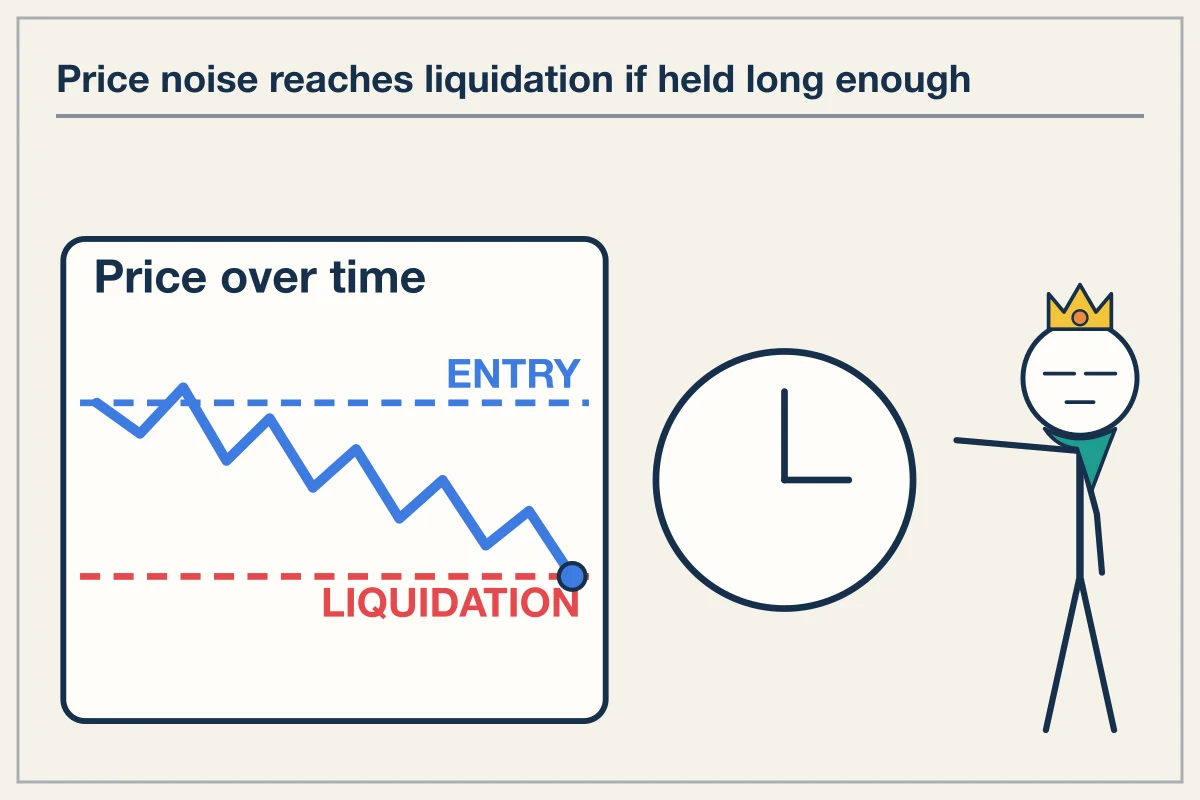
Liquidation is a time-dependent probability where leverage and funding decay erode your price buffer long before the index reaches your liquidation order.
Liquidation Distance as Probability Over Time
A 20x position with a 0.5% maintenance margin liquidates after a 4.5% adverse price move, but treating that threshold as a static price boundary miscalculates trading risk. Price distance measures space; liquidation risk measures time. In active perp markets, short-term price distributions exhibit heavy tails. The longer a position remains open, the higher the cumulative probability that random price noise touches the liquidation boundary.
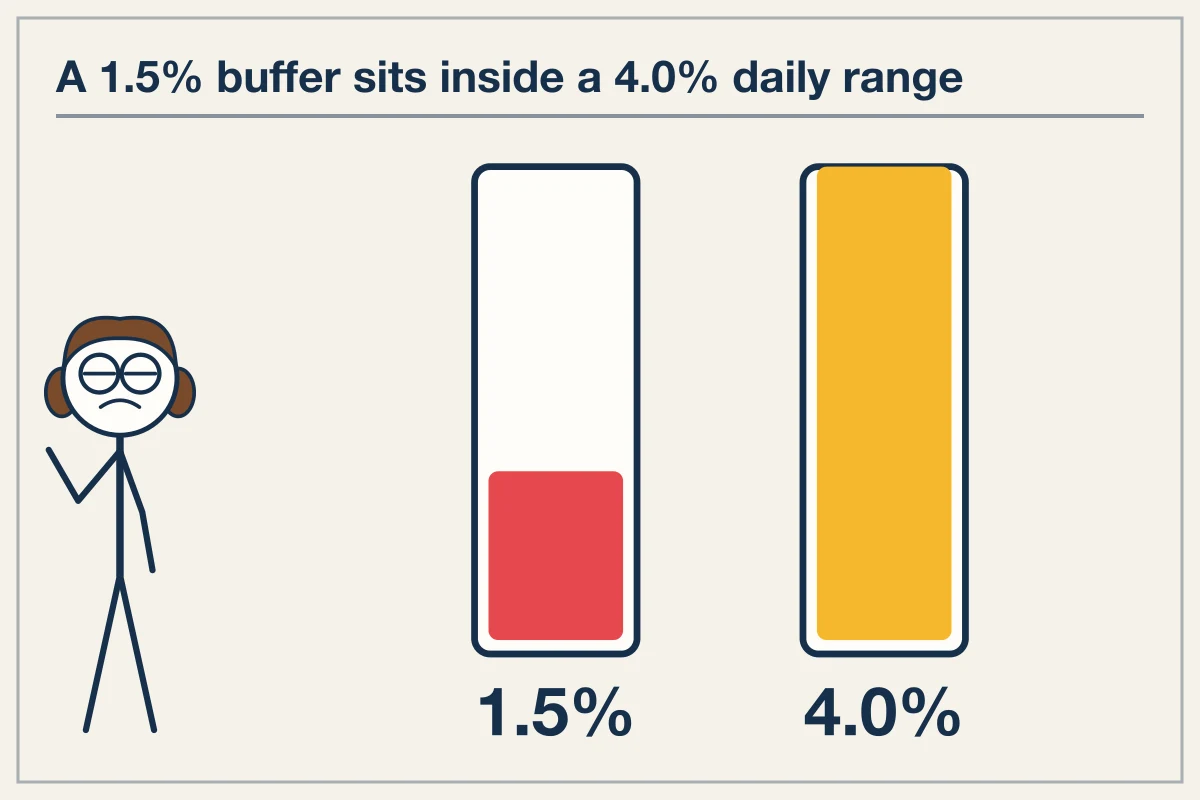
Leverage scales price distance linearly while compressing the time required to breach it. When leverage increases from 10x to 50x, the distance to liquidation contracts from 9.5% to 1.5%. Intraday asset volatility does not scale down to accommodate tighter position bounds. If an asset displays a standard 24-hour volatility range of 4.0%, a 1.5% buffer sits entirely within normal intraday price swings. The liquidation order triggers without a structural market move.
Mathematical Mechanics of Position Buffers
Position distance to liquidation depends on initial margin, maintenance margin rate, and fee deductions.
For a 10,000 USDT position size with a 0.5% maintenance margin requirement:
- At 10x leverage: Initial margin is 1,000 USDT. Maintenance margin is 50 USDT. The tolerable loss buffer is 950 USDT. An adverse move of 9.5% triggers liquidation.
- At 20x leverage: Initial margin is 500 USDT. Maintenance margin is 50 USDT. The tolerable loss buffer is 450 USDT. An adverse move of 4.5% triggers liquidation.
- At 50x leverage: Initial margin is 200 USDT. Maintenance margin is 50 USDT. The tolerable loss buffer is 150 USDT. An adverse move of 1.5% triggers liquidation.
- At 100x leverage: Initial margin is 100 USDT. Maintenance margin is 50 USDT. The tolerable loss buffer is 50 USDT. An adverse move of 0.5% triggers liquidation.
At 100x leverage, execution fees directly consume a significant fraction of your total buffer. Entering a 10,000 USDT taker trade on Bybit costs 0.055% or 5.50 USDT. That single entry fee instantly reduces your 50 USDT buffer down to 44.50 USDT. Your actual liquidation distance shrinks from 0.50% to 0.445% before price moves a single tick.
Venue Fee Structure and Cumulative Funding Drag
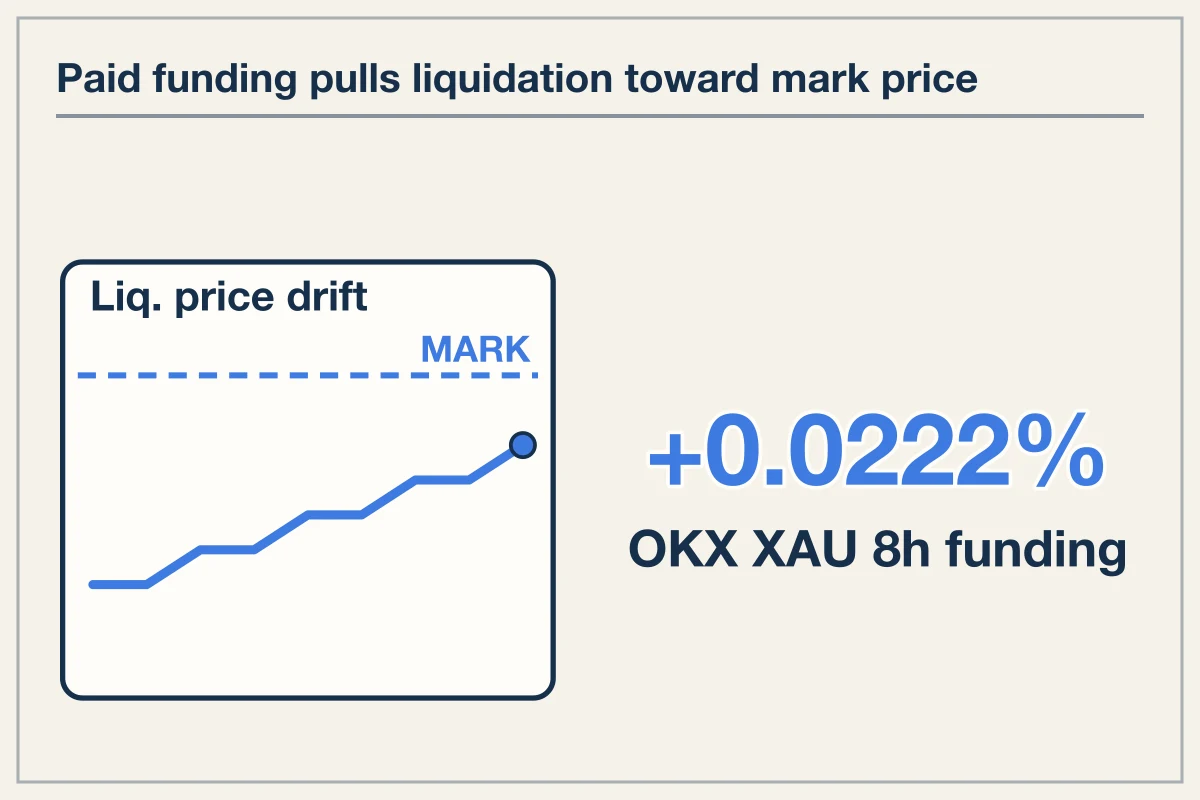
Funding fees and trading fee schedules vary across venues, altering the decay rate of margin collateral. Paying positive funding extracts margin directly from the position account equity, pulling the liquidation price closer to the current mark price every eight hours.
| Venue | Futures Taker Fee | Futures Maker Fee | ETH 8h Funding | SOL 8h Funding | XAU 8h Funding |
|---|---|---|---|---|---|
| Bitget | 0.030% | 0.020% | +0.0100% | +0.0055% | +0.0121% |
| MEXC | 0.020% | 0.000% | +0.0022% | -0.0039% | +0.0082% |
| OKX | 0.050% | 0.020% | +0.0015% | -0.0101% | +0.0222% |
| Bybit | 0.055% | 0.020% | N/A | N/A | N/A |
Consider a 10,000 USDT long ETH position held at 20x leverage with 500 USDT initial margin. The distance to liquidation at entry is 4.5%, or 450 USDT.
Holding this ETH position on Bitget incurs a funding rate of +0.0100% per 8-hour period. Over 30 days (90 funding periods), total funding payments equal 90 multiplied by 0.0100% of 10,000 USDT, which equals 90 USDT.
Holding the same ETH long on OKX incurs a funding rate of +0.0015% per 8-hour period. Over 30 days, total funding payments equal 90 multiplied by 0.0015% of 10,000 USDT, which equals 13.50 USDT.
The 30-day funding differential between Bitget and OKX is 76.50 USDT. On Bitget, the 90 USDT funding payment consumes 20% of the original 450 USDT liquidation buffer. Without any underlying market price movement, the effective price buffer to liquidation contracts from 4.50% to 3.60%.
In SOL perps, OKX prints a negative funding rate of -0.0101% per 8h, while Bitget charges +0.0055% per 8h. A long SOL position on OKX receives 1.01 USDT per 8h interval per 10,000 USDT notional, expanding the collateral buffer over time. The same long position on Bitget pays 0.55 USDT per 8h, systematically shrinking the distance to liquidation.
Volatility Drift and Execution Mechanics
Calculating liquidation distance as a static percentage assumes constant orderbook liquidity and zero execution slippage. Exchange engines execute liquidations when mark price touches the maintenance margin boundary. If market depth thins, the liquidation engine closes the position at aggressive taker rates, incurring additional slippage fees that wipe out remaining equity.
Higher leverage compresses distance to liquidation into the noise band of standard market volatility. Position survival depends on evaluating expected holding duration against funding rate erosion and asset volatility distributions rather than relying on a static liquidation price target.