· four exchange APIs · rebuilt daily
Exchange Custody Trades Operational Risk for Execution Access
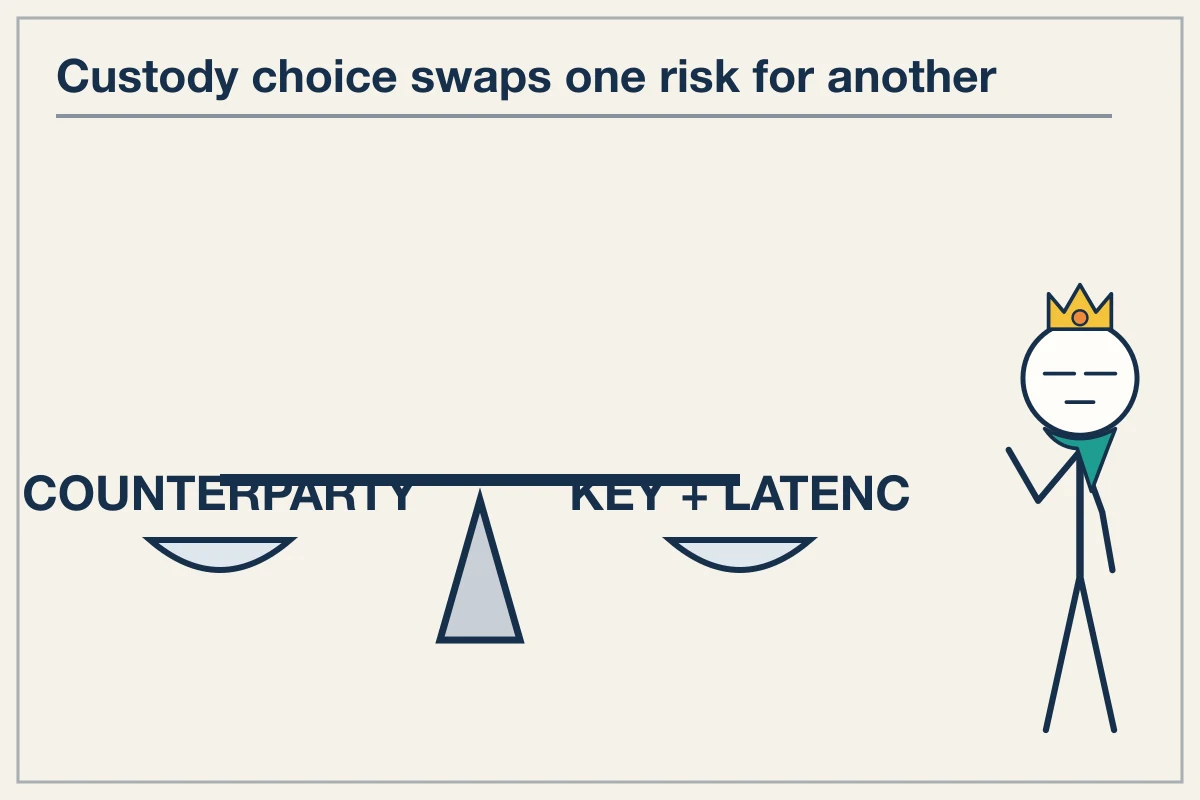
Self-custody removes counterparty default risk entirely while transferring total key management liability and latency overhead to the asset owner.
Custody Architecture and On-Chain Settlement
A 100% allocation of trading capital on a centralized exchange exposes the entire deposit to single-entity counterparty risk, whereas self-custody isolates assets to a private key at the cost of execution latency.
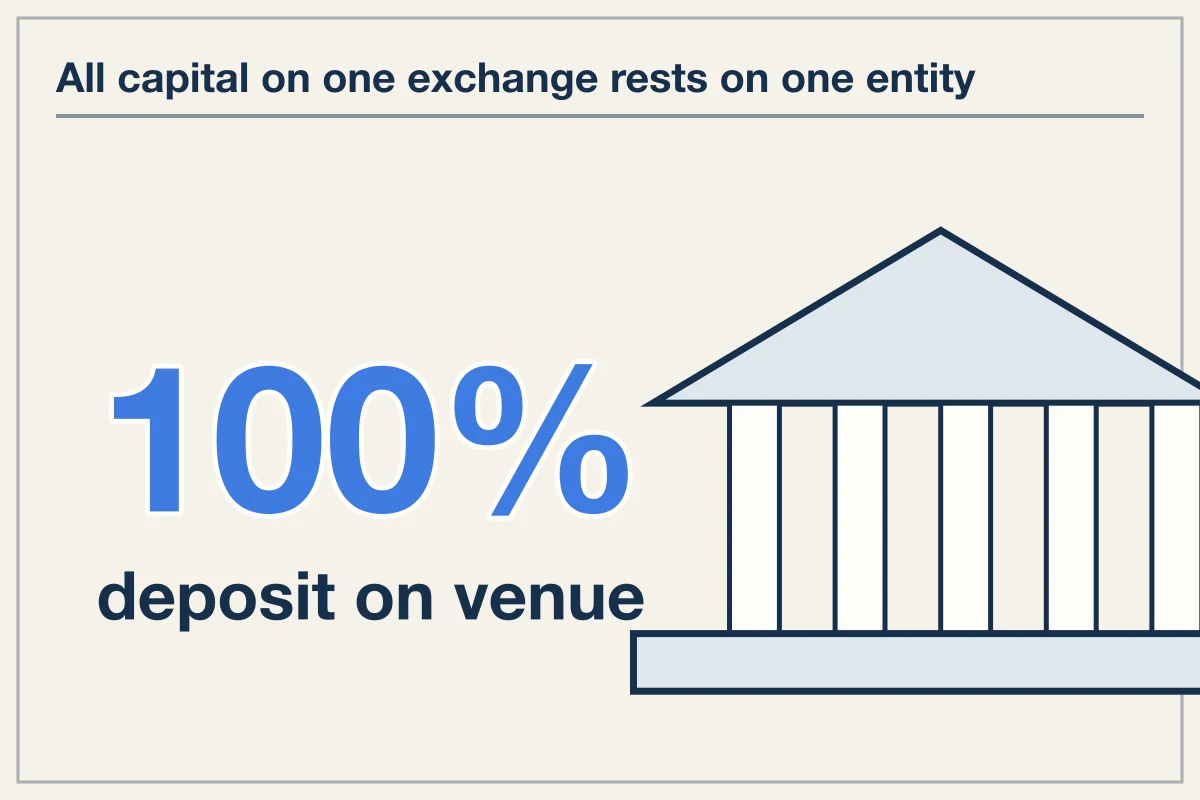
On a centralized exchange, depositing collateral transfers operational control of the assets to the venue. The exchange updates an off-chain database matching engine. The underlying tokens sit in pooled exchange wallets. Order execution occurs in server memory without immediate on-chain settlement.
In self-custody, an asymmetric cryptographic key pair controls the assets directly on a distributed blockchain. The public key forms the destination address. The private key authorizes state changes via digital signatures. No external entity can freeze, rehypothecate, or halt transactions originating from a valid signature, provided the private key remains secure.
Proof-of-Reserves Capabilities and Limitations
Centralized venues publish Proof-of-Reserves (PoR) using Merkle trees or zero-knowledge proofs to demonstrate asset backing.
Proof-of-Reserves proves that at a specific snapshot timestamp, the exchange held cryptographic control of private keys matching a specified set of on-chain assets, and that a user account balance was included in the Merkle root calculation.
Proof-of-Reserves does not prove balance sheet solvency. It omits four structural operational factors:
- Off-chain liabilities, corporate debt, and unrecorded operational obligations.
- Encumbered assets where keys are controlled but funds are pledged as collateral to third parties.
- Continuous real-time solvency between audit publishing intervals.
- Legal claim seniority of account balances during corporate bankruptcy liquidation.
Failure Mode Comparison
Exchange custody and self-custody exhibit distinct failure states.
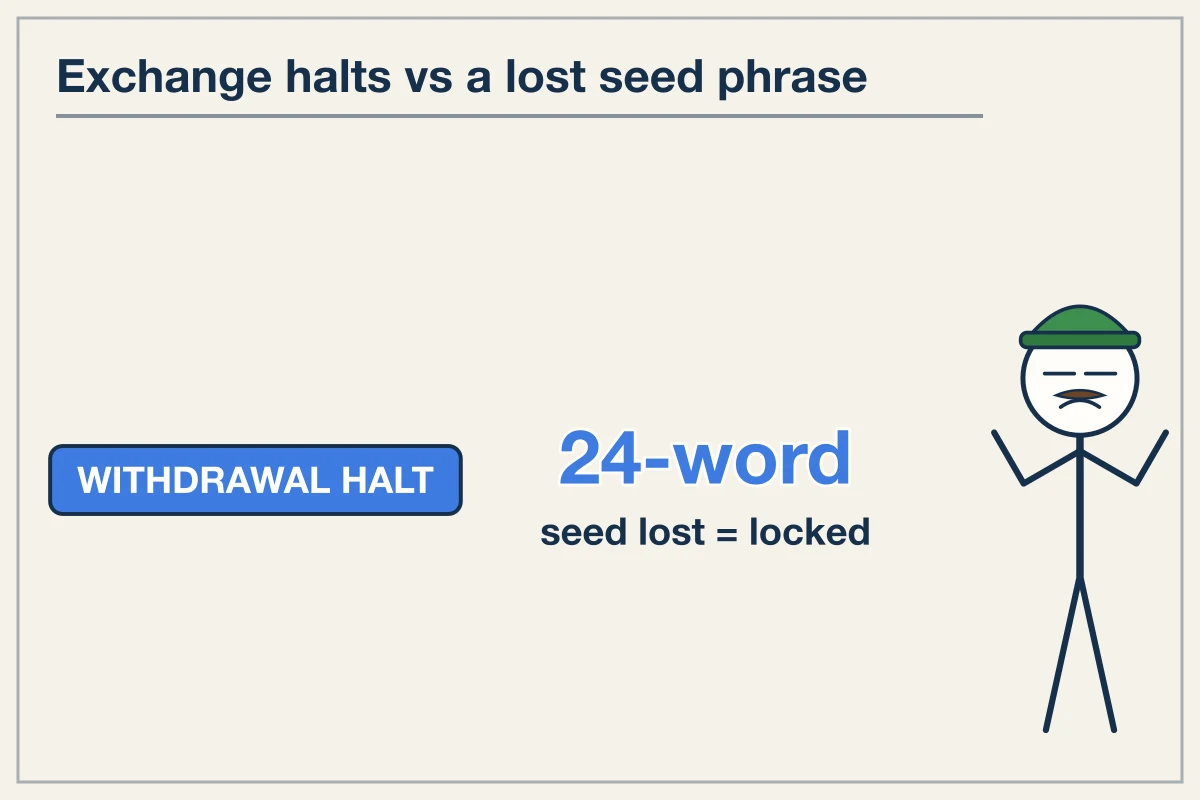
Exchange custody failure modes include:
- Withdrawal Halts: A venue disables outgoing network transfers during severe market volatility or operational shortfalls.
- Insolvency: Deposited assets face haircuts or multi-year legal freezes during corporate bankruptcy.
- Account Restrictions: Individual access is blocked by compliance flags, API credential leaks, or account takeovers.
Self-custody failure modes include:
- Key Material Loss: Misplacing a 12-word or 24-word seed phrase permanently locks assets without a recovery path.
- Wallet Exploits: Executing malicious smart contract approvals drains non-custodial addresses instantly.
- Physical Hardware Damage: Destruction of hardware devices lacking off-site seed backups results in total loss of access.
Execution Fees and Funding Rate Differentials
Maintaining margin on-exchange requires evaluating venue-specific fee schedules alongside position holding costs. The default futures fee schedules for major trading venues are detailed below.
| Exchange | Spot Maker | Spot Taker | Futures Maker | Futures Taker |
|---|---|---|---|---|
| Bitget | 0.0010 | 0.0010 | 0.0002 | 0.0003 |
| Bybit | 0.0010 | 0.0010 | 0.0002 | 0.00055 |
| MEXC | 0.0000 | 0.0005 | 0.0000 | 0.0002 |
| OKX | 0.0008 | 0.0010 | 0.0002 | 0.0005 |
Live 8-hour normalized funding rates across assets determine the daily cost or yield of open perpetual positions.
| Asset | OKX 8h Funding | MEXC 8h Funding | Bitget 8h Funding | 8h Spread | 24h Volume |
|---|---|---|---|---|---|
| ETH | +0.0018% | +0.0033% | +0.0100% | 0.0082% | $8,923,967,722 |
| BTC | +0.0075% | +0.0100% | +0.0100% | 0.0025% | $5,787,837,950 |
| SOL | -0.0096% | -0.0035% | +0.0055% | 0.0151% | $1,609,439,878 |
| ZEC | +0.0031% | +0.0011% | +0.0100% | 0.0089% | $779,034,939 |
| XRP | -0.0015% | +0.0019% | +0.0040% | 0.0055% | $519,573,211 |
| XAU | +0.0204% | +0.0064% | +0.0103% | 0.0140% | $496,958,488 |
Capital Routing and Liquidation Exposure
Consider a trader holding a $100,000 ETH long position for 24 hours across venues.
On OKX, entering as a futures taker incurs a 0.0005 fee: $100,000 0.0005 = $50.00 entry fee. Holding the long position over 24 hours (3 funding cycles at +0.0018% per 8 hours): $100,000 0.0018% * 3 = $5.40 funding payment. Total 24-hour cost on OKX equals $55.40.
On Bitget, entering as a futures taker incurs a 0.0003 fee: $100,000 0.0003 = $30.00 entry fee. Holding over 24 hours (3 funding cycles at +0.0100% per 8 hours): $100,000 0.0100% * 3 = $30.00 funding payment. Total 24-hour cost on Bitget equals $60.00.
On MEXC, entering as a futures taker incurs a 0.0002 fee: $100,000 0.0002 = $20.00 entry fee. Holding over 24 hours (3 funding cycles at +0.0033% per 8 hours): $100,000 0.0033% * 3 = $9.90 funding payment. Total 24-hour cost on MEXC equals $29.90.
To limit counterparty exposure, a trader can retain $80,000 in self-custody while placing $20,000 on MEXC as collateral for a 5x leveraged position ($100,000 notional). This cuts maximum exchange loss to $20,000. However, maintaining this split introduces operational lag. A rapid market sell-off requiring a margin top-up forces an on-chain deposit. If network confirmation takes 15 minutes, a sudden adverse price movement will liquidate the exchange margin before the transfer arrives.
Every dollar held on an exchange buys instant execution at the cost of counterparty vulnerability, while self-custody removes counterparty risk but shifts complete technical execution and key protection burdens onto the trader.