· four exchange APIs · rebuilt daily
Four backup errors turn self-custody account balances to zero
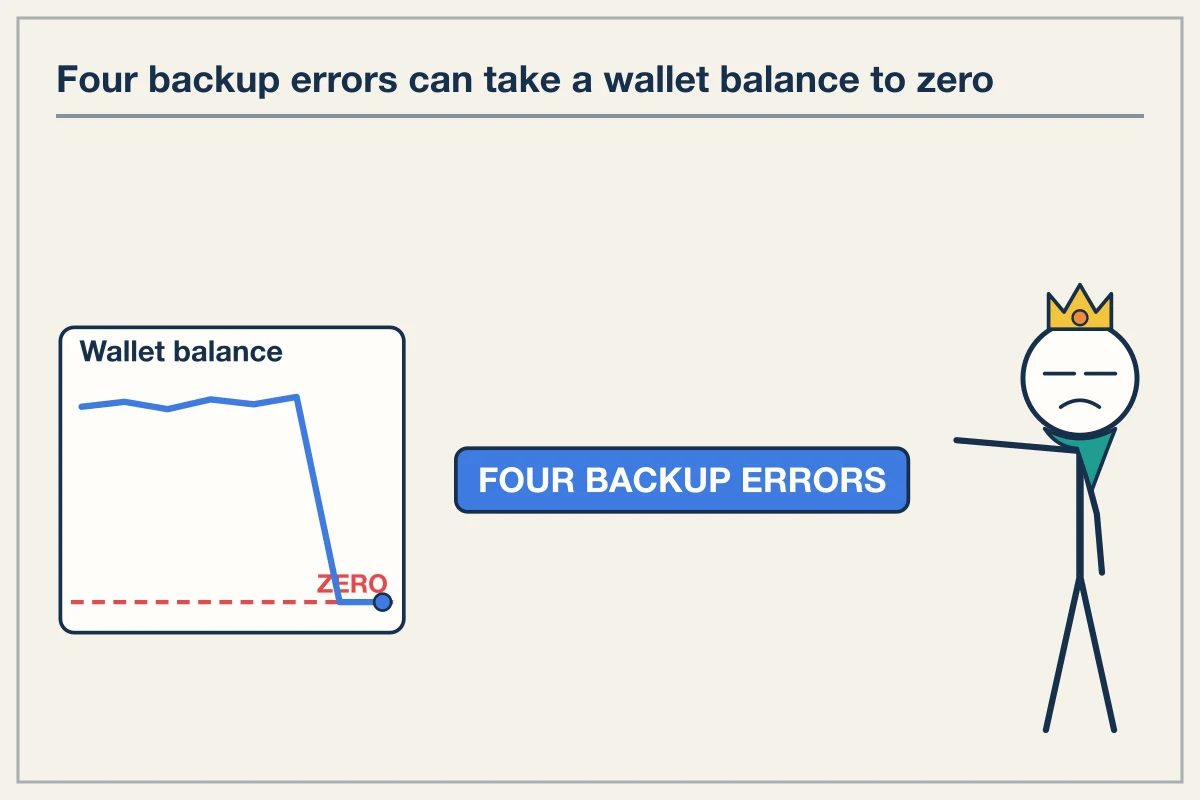
Storing BIP39 seed phrases in cloud storage or single physical sites exposes account capital to unrecoverable loss through key exposure or physical destruction.
BIP39 recovery phrases convert 128 to 256 bits of entropy into 12 or 24 words that deterministically derive all private keys for a wallet.
Deterministic Key Derivation and Zero-Reset Architecture
Non-custodial wallets use cryptographic hash functions and elliptic curve derivation, specifically secp256k1, to compute master private keys from seed phrases. The system contains no central database, user accounts, or recovery server.
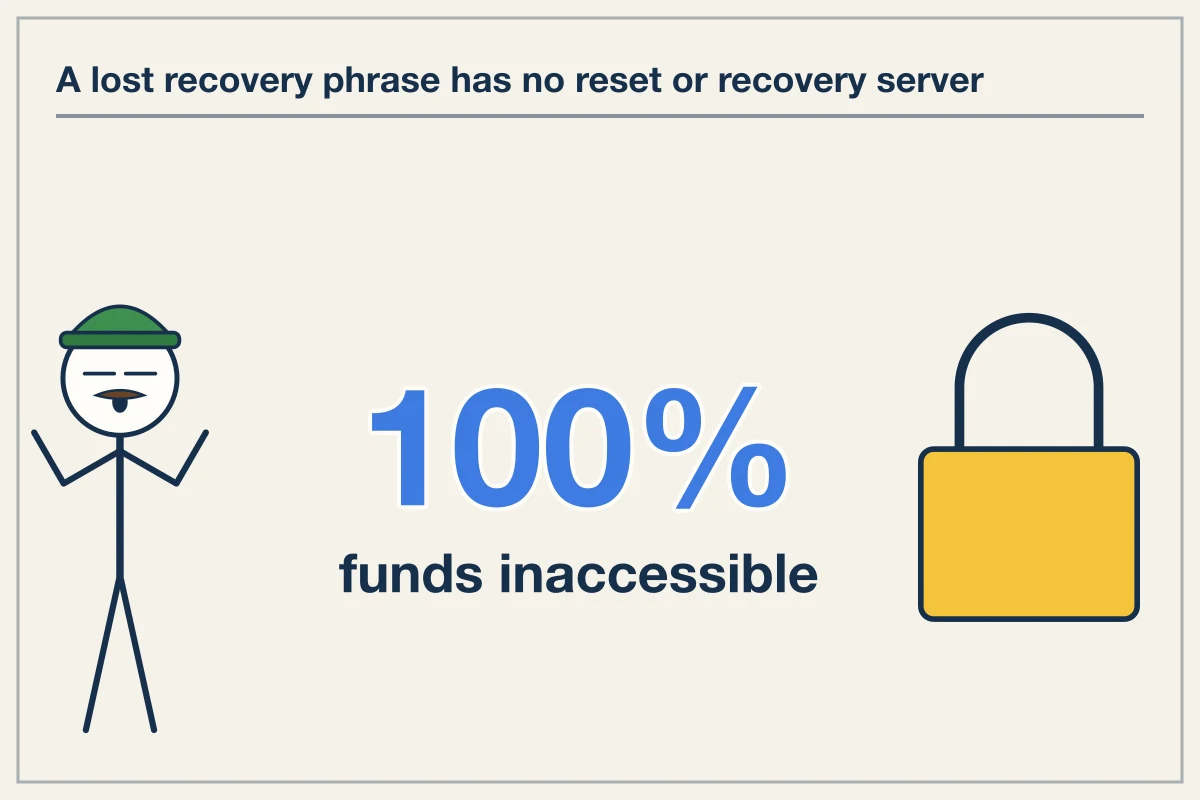
If a recovery phrase is lost or compromised, 100% of the funds linked to those derived private keys become permanently inaccessible or subject to immediate theft. No network validator, software developer, or venue operator holds an administrative override key to reset access.
Four Recovery Failure Mechanisms
Four operational errors consistently result in total balance loss for non-custodial position holders.
Cloud Storage Photographs
Saving an unencrypted photo or screenshot of a seed phrase to cloud services exposes private keys to automated scrapers. Optical character recognition software scans cloud backup storage for 12-word and 24-word strings matching BIP39 wordlists. Once indexed by an attacker, automated scripts extract private keys and drain non-custodial assets in seconds.
Web Input and Keylogging
Typing a recovery phrase into any web browser form or application exposes the key to memory inspection, clipboard reading, and malicious browser extensions. Web forms requesting recovery phrases are malicious phishing sites designed to capture active seed inputs.
Unwritten Passphrases
The BIP39 standard permits an optional passphrase, often referred to as a 25th word. This passphrase acts as a salt in key derivation functions. Modifying a single character generates an entirely different set of addresses. Remembering a passphrase without a physical record introduces human memory failure into the cryptographic key path. Forgetting the passphrase renders the seed phrase useless.
Single Physical Locations
Storing a single paper or metal backup in one building creates a single point of failure. Physical events like fires, floods, or structural destruction permanently erase access. Distributing metal backups across multiple secure locations mitigates localized physical loss.
Hardware Isolation and Threat Model Shifts
Hardware security modules and hardware wallets alter the threat model by isolating key derivation and signing routines inside dedicated secure elements.
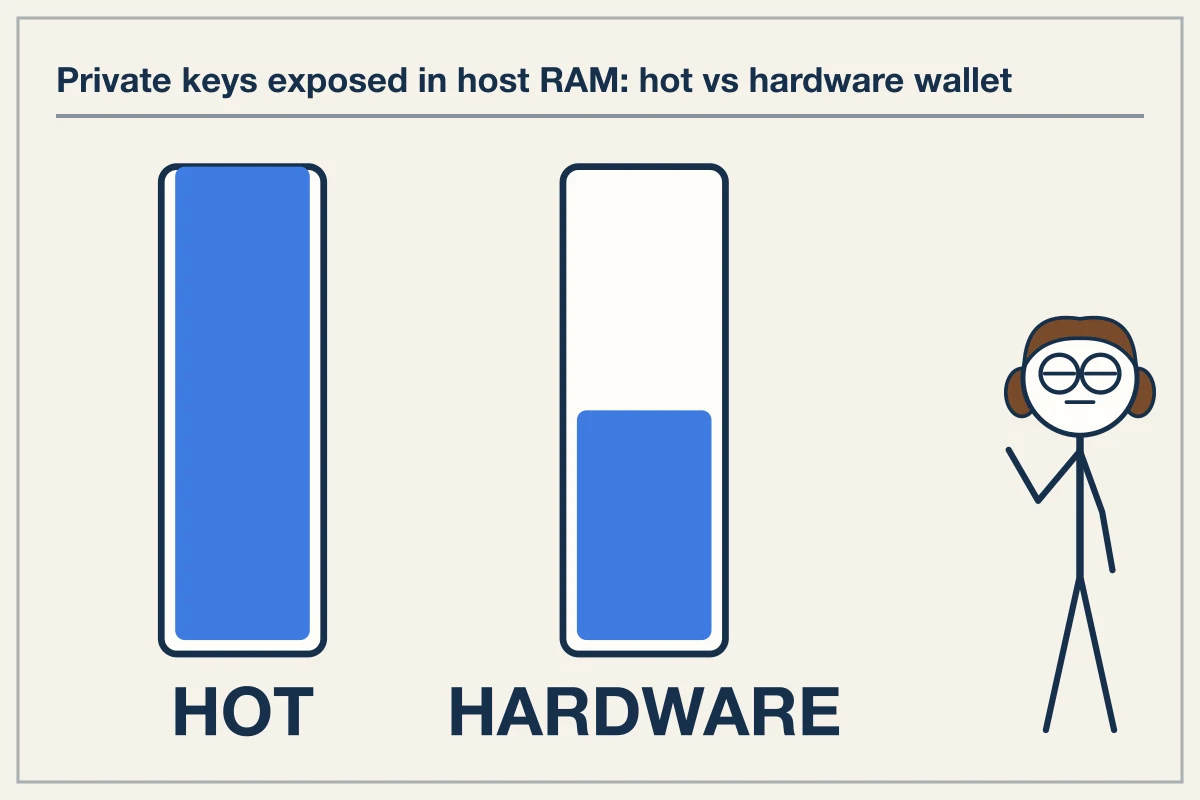
Hot wallets store private keys in system RAM or local disk storage. Malware with system privileges can scan memory structures to extract plain-text keys.
Hardware devices generate and retain private keys within air-gapped or restricted microcontrollers. Transaction payload details pass into the device, where signatures are generated internally. Plain-text seed phrases and private keys never enter host RAM, isolating funding operations from web-based keyloggers or compromised operating system memory.
Venue Cost Structure and Holding Arithmetic
Traders maintaining collateral across non-custodial and centralized exchange accounts incur daily carrying costs driven by variable funding rates and taker fee schedules.
Consider a trader holding a $100,000 nominal long BTC perpetual position. Funding settlement occurs every 8 hours, yielding 3 funding payments per 24-hour cycle.
At OKX, the 8-hour BTC funding rate is +0.0075%. The daily funding paid on a $100,000 position equals $100,000 multiplied by 0.000075 multiplied by 3, which equals $22.50 per day.
At Bitget and MEXC, the 8-hour BTC funding rate is +0.0100%. The daily funding paid equals $100,000 multiplied by 0.0001 multiplied by 3, which equals $30.00 per day. Holding the position on OKX saves $7.50 daily compared to Bitget or MEXC.
An entry execution using taker orders incurs additional fixed expenses based on exchange schedules. At MEXC, the futures taker fee rate is 0.0002, costing $20.00 on a $100,000 entry. At OKX and Bybit, the futures taker fee rate is 0.0005, costing $50.00 on the same order.
Live Normalised 8-Hour Funding Rates
| Ticker | OKX | MEXC | Bitget | Spread | Lowest Long Cost Venue | 24h Volume |
|---|---|---|---|---|---|---|
| ETH | +0.0021% | +0.0038% | +0.0100% | 0.0079% | OKX | $8,968,381,972 |
| BTC | +0.0075% | +0.0100% | +0.0100% | 0.0025% | OKX | $5,837,216,870 |
| SOL | -0.0094% | -0.0032% | +0.0055% | 0.0149% | OKX | $1,622,059,986 |
| ZEC | +0.0042% | +0.0015% | +0.0100% | 0.0085% | MEXC | $783,342,224 |
| XRP | -0.0009% | +0.0024% | +0.0040% | 0.0049% | OKX | $526,722,171 |
| XAU | +0.0204% | +0.0062% | +0.0103% | 0.0142% | MEXC | $502,580,909 |
Futures Fee Structure Defaults
| Exchange | Spot Maker | Spot Taker | Futures Maker | Futures Taker |
|---|---|---|---|---|
| Bitget | 0.0010 | 0.0010 | 0.0002 | 0.0003 |
| Bybit | 0.0010 | 0.0010 | 0.0002 | 0.00055 |
| MEXC | 0.0000 | 0.0005 | 0.0000 | 0.0002 |
| OKX | 0.0008 | 0.0010 | 0.0002 | 0.0005 |
Exposing seed phrases to hot environments or single physical sites guarantees loss when hardware or network boundaries fail. Transferring capital onto derivative venues requires factoring both key storage security and venue carry fees into position management.