· four exchange APIs · rebuilt daily
Funding and Taker Fees Drive an 89 Dollar Daily Gap per 100k
Evaluating offshore perpetual venues requires checking contracting entities, funding rate spreads, baseline fees, and liquidation mechanics before depositing.
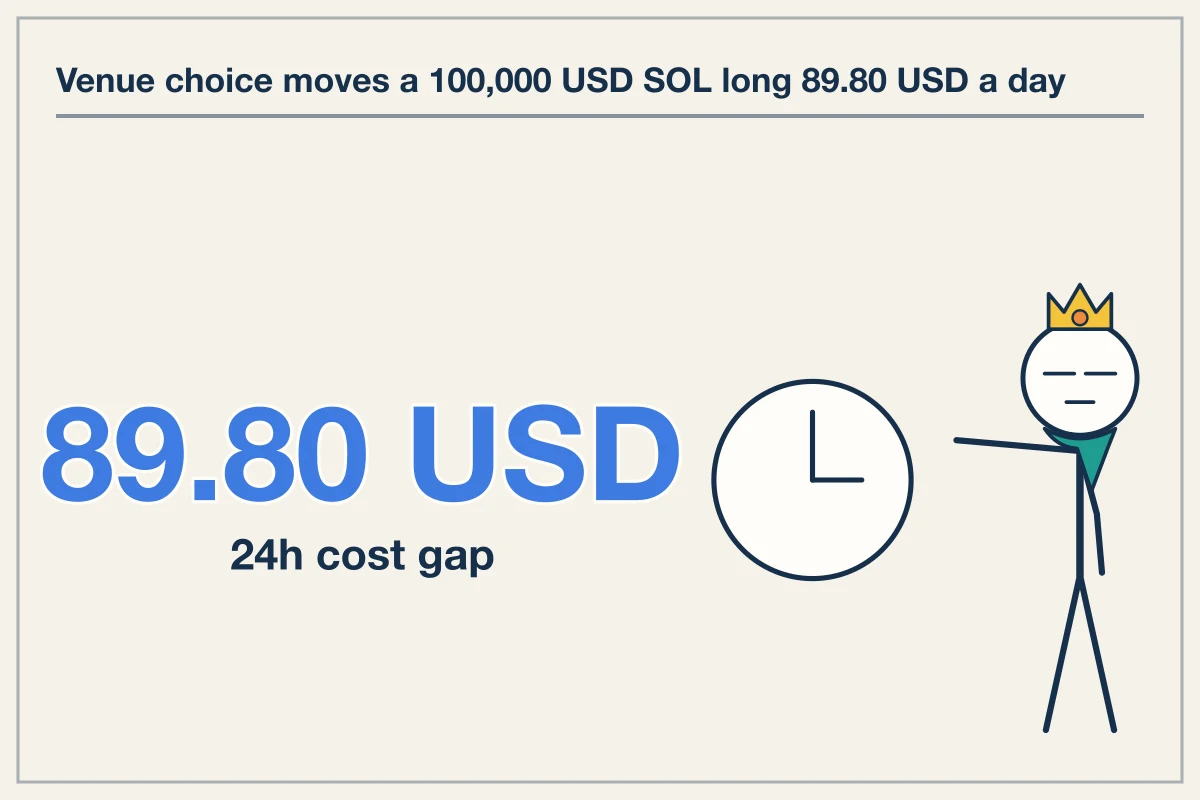
A 100,000 USD position held long in SOL perps incurs an 89.80 USD cost differential over 24 hours depending on venue selection. This variance stems from baseline taker fee schedules and live funding rate spreads across major exchanges.
Contracting Entity and Legal Separation
Before depositing margin, verify the operating company listed in the terms of service document. Exchanges operate through multiple offshore corporate entities. The entity that holds your API keys and margin balance is rarely the parent brand entity.
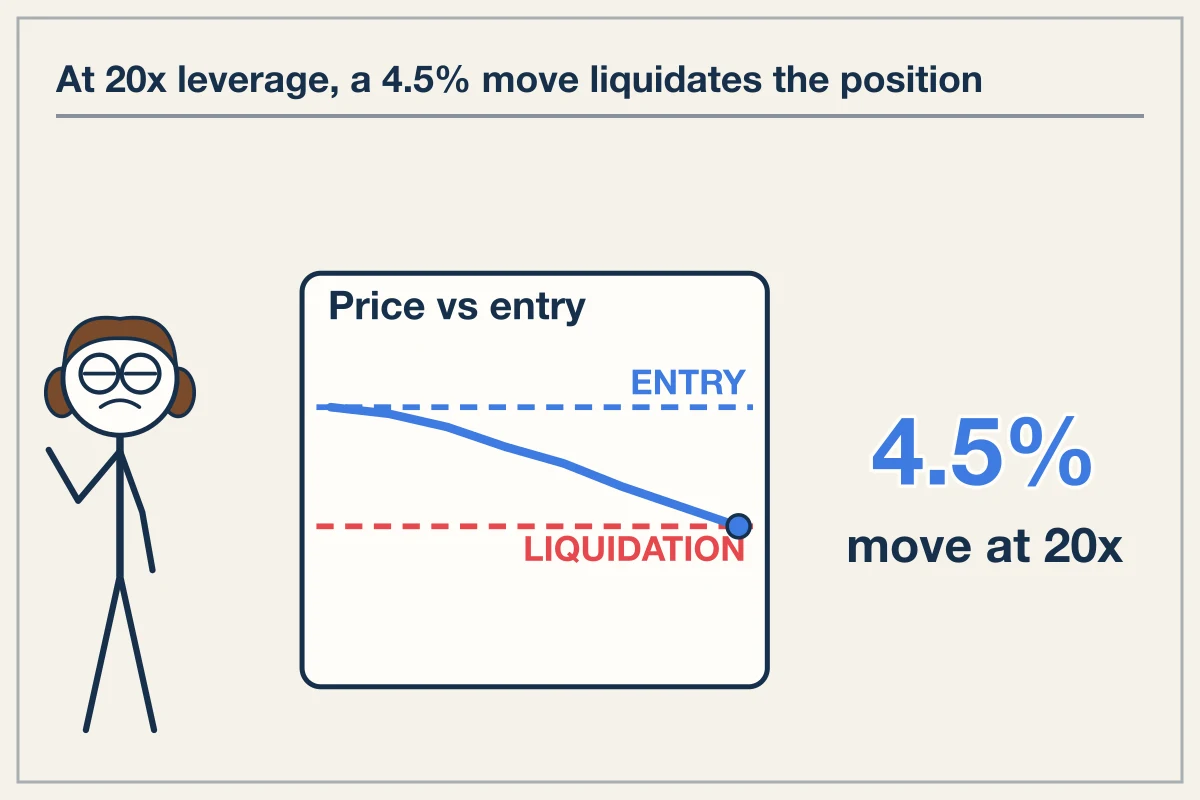
Review the clawback and loss-socialization rules in the user agreement. If the insurance fund empties during severe volatility, the exchange auto-deleverages profitable positions or haircuts balance equity. Look up the history of withdrawal halts during major market liquidations. When API access drops during extreme volatility, open positions remain exposed to market movements while orders cannot be canceled. At 20x leverage, a 4.5% price movement against your entry liquidates the position. If order routing delays prevent stop-loss execution, the position forfeits the maintenance margin directly to the liquidation engine.
Baseline Funding Rates and Carry Overhead
Holding a perpetual swap position long or short incurs a periodic funding payment every eight hours. These payments transfer directly between long and short traders based on the premium of the perpetual contract over the index spot price.
On a 100,000 USD long position in SOL, an 8-hour funding rate of +0.0100% on Bybit costs 10.00 USD per interval, or 30.00 USD per day. On OKX, the SOL funding rate is +0.0010% per 8-hour interval, which costs 1.00 USD per interval, or 3.00 USD per day. The resulting spread creates a 27.00 USD daily difference to hold the exact same position size.
| Asset | 24h Volume | OKX 8h | MEXC 8h | Bitget 8h | Bybit 8h | 8h Spread |
|---|---|---|---|---|---|---|
| ETH | 6,499,775,708 USD | +0.0056% | +0.0058% | +0.0100% | +0.0100% | 0.0044% |
| BTC | 5,497,300,849 USD | +0.0030% | +0.0085% | +0.0055% | +0.0100% | 0.0070% |
| SOL | 1,577,904,914 USD | +0.0010% | +0.0034% | +0.0079% | +0.0100% | 0.0090% |
| ZEC | 611,661,394 USD | +0.0100% | +0.0032% | +0.0083% | +0.0100% | 0.0068% |
| XAU | 524,688,020 USD | +0.0102% | +0.0050% | +0.0066% | +0.0000% | 0.0102% |
Across major pairs, OKX maintains the lowest long funding rates for ETH (+0.0056%), BTC (+0.0030%), and SOL (+0.0010%). MEXC yields the lowest rate for ZEC (+0.0032%), while Bybit offers zero funding (+0.0000%) on XAU and SNDK contracts (SNDK 24h volume: 1,414,191,135 USD).
Realized Fee Schedules at Base Tiers
Default fee tiers dictate entry and exit costs before any volume-based discounts apply. Round-trip trade costs consist of opening taker or maker fees plus closing taker or maker fees on full nominal exposure.
| Venue | Futures Maker | Futures Taker | Spot Maker | Spot Taker |
|---|---|---|---|---|
| Bitget | 0.020% | 0.030% | 0.100% | 0.100% |
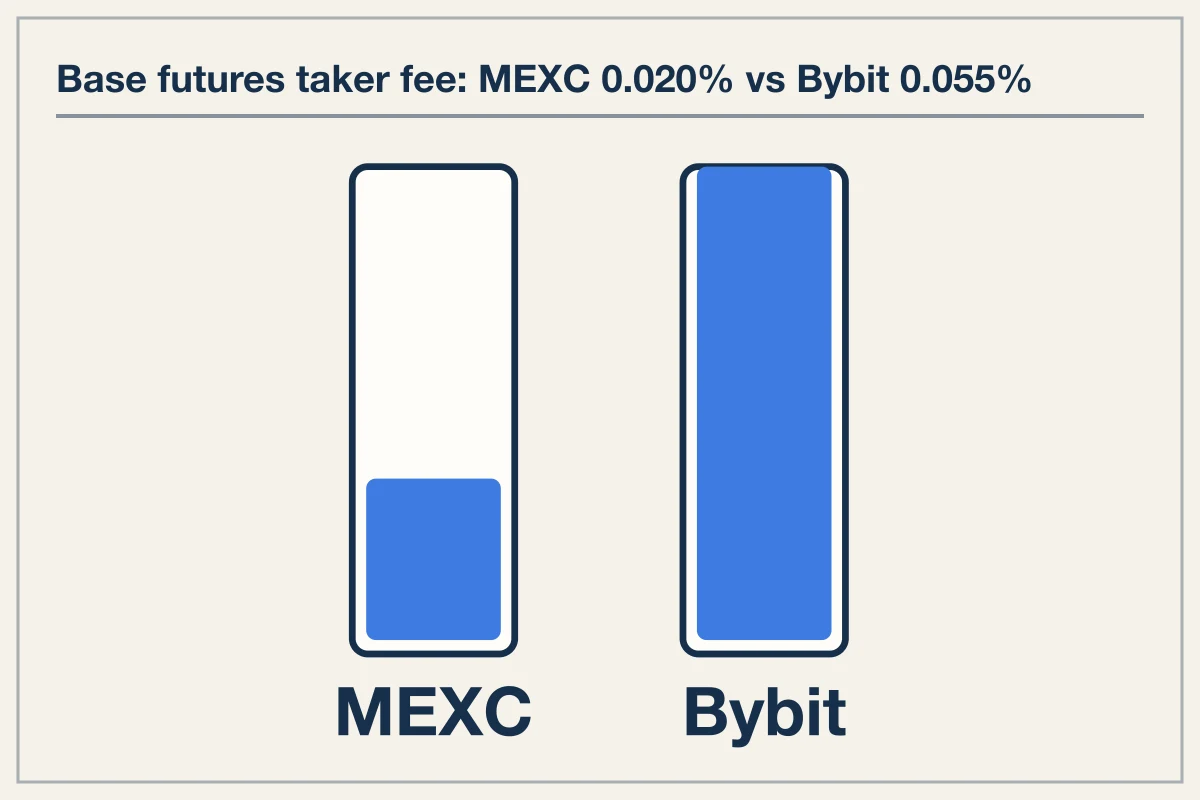
| Bybit | 0.020% | 0.055% | 0.100% | 0.100% |
| MEXC | 0.000% | 0.020% | 0.000% | 0.050% |
| OKX | 0.020% | 0.050% | 0.080% | 0.100% |
Opening and closing a 100,000 USD position generates 200,000 USD in aggregate traded volume. At default taker rates, executing this round-trip costs 40.00 USD on MEXC (0.020% taker rate), 60.00 USD on Bitget (0.030% taker rate), 100.00 USD on OKX (0.050% taker rate), and 110.00 USD on Bybit (0.055% taker rate).
For a trader executing a 100,000 USD SOL long with taker orders and holding for 24 hours:
- Bybit total cost: 110.00 USD taker fees + 30.00 USD funding = 140.00 USD total cost.
- MEXC total cost: 40.00 USD taker fees + 10.20 USD funding = 50.20 USD total cost.
The cost gap between venues for this single 24-hour trade is 89.80 USD.
Liquidation Rules and Outage Execution
When market volatility spikes, exchange infrastructure can experience engine latency or WebSocket disconnections. Inspect how each venue handles maintenance margins and liquidation penalties.
Liquidation engines close under-margined positions via market orders or pass them to backstop market makers. If the liquidation engine executes below the bankruptcy price, the remaining deficit is absorbed by the insurance fund. If the insurance fund is exhausted, auto-deleveraging (ADL) systematically closes winning positions on the opposite side of the order book. Higher leverage positions carry a higher failure rate during liquidity shocks because the buffer between maintenance margin and liquidation price narrows significantly.
Audit Checklist Before Depositing Margin
- Identify the operating offshore entity in the terms of service document.
- Review past API downtime during major market liquidation events.
- Calculate daily funding carry costs using current market rate spreads.
- Compute round-trip execution fees at your actual volume tier.
- Check the current balance of the insurance fund relative to 24-hour contract volume.