· four exchange APIs · rebuilt daily
Singapore vs Hong Kong crypto rules push perps offshore

The finding
Singapore vs Hong Kong crypto regulatory frameworks both bar retail access to crypto perpetual futures, driving derivative volume to offshore entities.
Hong Kong permits licensed spot trading for retail while MAS bans retail leverage and derivatives entirely.
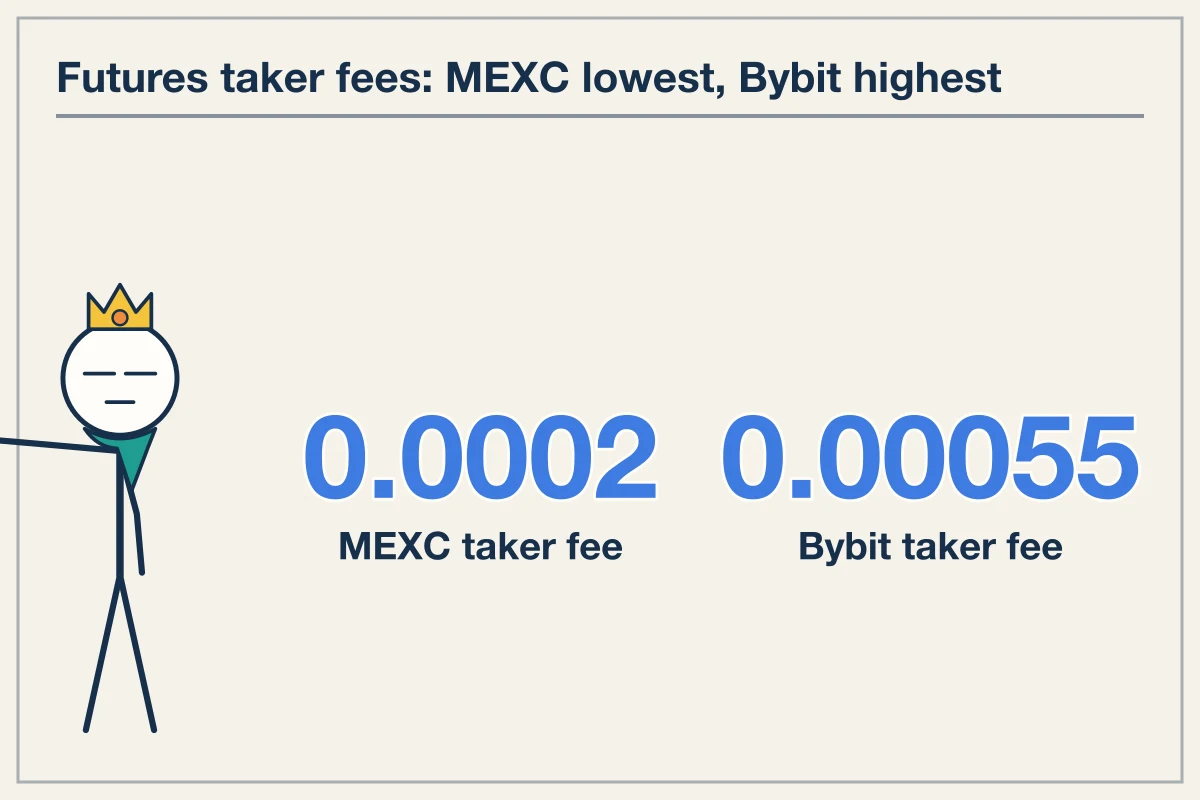
Offshore execution leaves traders paying taker fees between 0.0002 and 0.00055 on major venues.
Licensing limits in Singapore vs Hong Kong crypto markets
The Monetary Authority of Singapore (MAS) and the Securities and Futures Commission (SFC) in Hong Kong take distinct approaches to digital assets. MAS issues Major Payment Institution licenses focused on payment services and spot exchange operations. MAS explicitly prohibits retail access to margin trading, crypto derivatives, and credit-funded purchases.
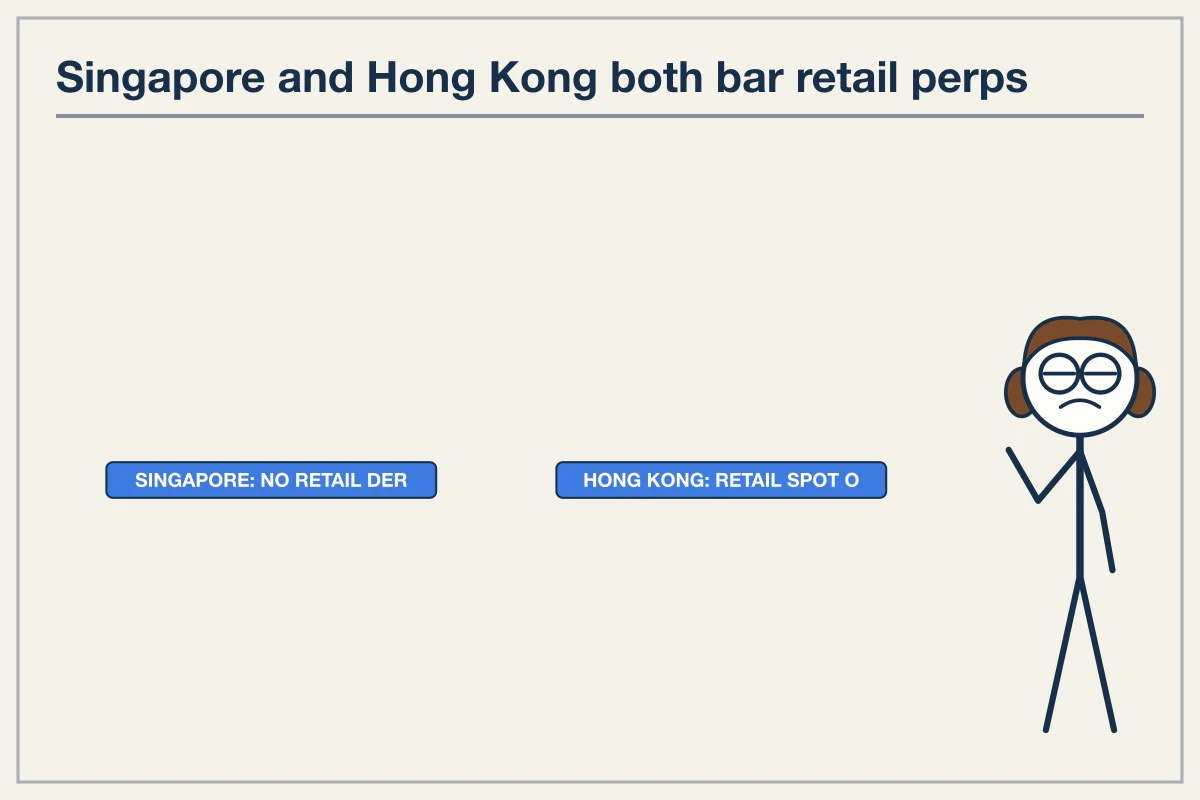
Hong Kong established its Virtual Asset Service Provider (VASP) regime under the SFC. Licensed platforms in Hong Kong offer spot trading for large-cap tokens to retail investors. However, SFC guidelines prohibit licensed platforms from offering crypto futures, perpetual contracts, or yield products to retail clients.
Where this goes wrong
Onshore entities in both jurisdictions cannot host perpetual swap orderbooks for retail accounts, so local trading accounts cannot access leverage.
Venue access and offshore perps execution
Because onshore exchanges cannot offer perpetual contracts, traders in Asia access liquidity through offshore exchange entities. Platforms such as Bybit, OKX, Bitget, and MEXC handle global derivative orderbooks outside MAS and SFC retail licensing constraints.
Traders setting up positions evaluate venue costs through two primary metrics: standard trading fees and ongoing funding settlement rates. Trading fees apply on entry and exit, while funding rates accrue every 8 hours based on premium index calculations.
Worth knowing
Holding a position across venues creates cost variance driven by execution taker fees ranging from 0.0002 to 0.00055 and 8-hour funding rate spreads.
Perpetual futures fee structures across active venues
Exchanges structure futures fees with clear splits between maker and taker orders. Spot fee rates remain higher across all platforms compared to default futures rates.
| Venue | Futures Maker Fee | Futures Taker Fee | Spot Maker Fee | Spot Taker Fee |
|---|---|---|---|---|
| Bitget | 0.0002 | 0.0003 | 0.0010 | 0.0010 |
| Bybit | 0.0002 | 0.00055 | 0.0010 | 0.0010 |
| MEXC | 0.0000 | 0.0002 | 0.0000 | 0.0005 |
| OKX | 0.0002 | 0.0005 | 0.0008 | 0.0010 |
MEXC offers the lowest baseline with a 0.0000 maker fee and 0.0002 taker fee on futures contracts. Bybit charges the highest futures taker fee among these venues at 0.00055, followed by OKX at 0.0005. A round-trip taker trade of 100,000 notional on Bybit incurs 110 in taker fees, compared to 40 on MEXC.
What to do instead
Account for entry and exit taker fees before opening short-term trades, as transaction costs can exceed the funding rate paid or received over several hours.
Live funding rate comparisons across assets
Funding rates adjust every 8 hours to align perpetual contract prices with underlying index prices. Negative rates mean short positions pay long positions. Positive rates mean long positions pay short positions.
| Asset | Bybit Rate | MEXC Rate | OKX Rate | Bitget Rate | 8h Spread | 24h Volume |
|---|---|---|---|---|---|---|
| ETH | -0.0092% | -0.0003% | +0.0004% | +0.0033% | 0.0124% | 10,530,049,701 |
| BTC | +0.0020% | +0.0034% | +0.0058% | +0.0059% | 0.0039% | 9,336,843,760 |
| SOL | -0.0113% | -0.0032% | -0.0058% | -0.0059% | 0.0081% | 1,109,728,452 |
| ZEC | +0.0100% | +0.0100% | +0.0077% | +0.0100% | 0.0023% | 1,103,705,516 |
| XRP | -0.0100% | -0.0071% | +0.0020% | +0.0007% | 0.0120% | 1,055,146,210 |
| SNDK | +0.0446% | N/A | +0.0381% | +0.0534% | 0.0153% | 676,508,723 |
Holding a long ETH position is cheapest on Bybit at a rate of -0.0092% per 8 hours, where long traders receive funding payments. The ETH funding spread across platforms is 0.0124 percentage points per 8 hours.
For BTC longs, Bybit offers the lowest positive rate at +0.0020% per 8 hours, while Bitget is the highest at +0.0059%. For SOL longs, Bybit is the cheapest venue at -0.0113% per 8 hours. On ZEC, OKX is the cheapest long venue at +0.0077% per 8 hours. On XRP, Bybit is cheapest for longs at -0.0100% per 8 hours. On SNDK, OKX is cheapest for longs at +0.0381% per 8 hours.
Can retail traders access crypto perpetual futures on licensed exchanges in Singapore or Hong Kong?
No. MAS in Singapore bans retail access to crypto margin and derivatives, and SFC rules in Hong Kong prohibit licensed retail platforms from offering perpetual contracts.
Which venue currently has the lowest futures taker fee among major offshore exchanges?
MEXC offers the lowest standard futures taker fee at 0.0002, compared to 0.0003 on Bitget, 0.0005 on OKX, and 0.00055 on Bybit.
How does ETH perpetual funding differ across Bybit and Bitget right now?
Bybit ETH funding is -0.0092% per 8 hours, meaning long positions receive funding, while Bitget ETH funding is +0.0033% per 8 hours, meaning long positions pay funding.
Which venue is cheapest for holding a long BTC perpetual position?
Bybit is currently cheapest for long BTC positions with an 8-hour funding rate of +0.0020%, compared to +0.0034% on MEXC, +0.0058% on OKX, and +0.0059% on Bitget.