· four exchange APIs · rebuilt daily
Dubai Framework Shifts Exchange Execution and Funding Costs
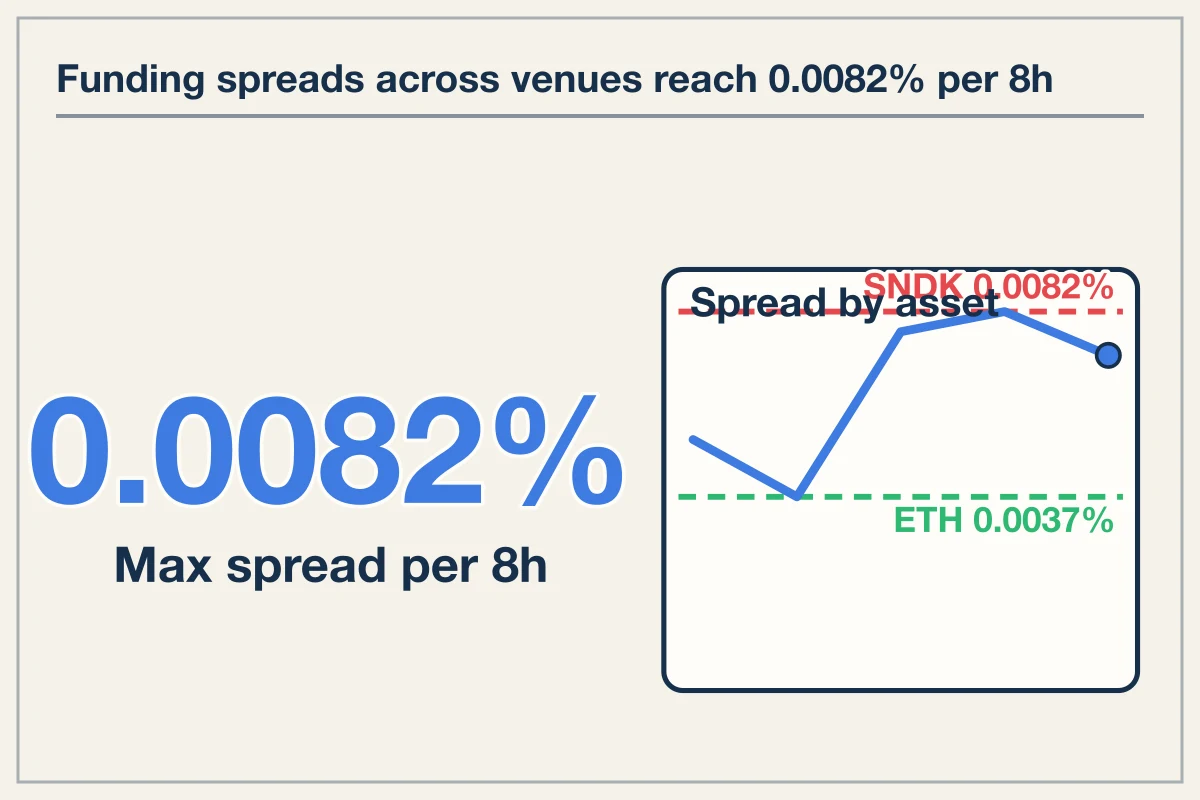
Dubai VARA rules force entity partitioning among derivatives exchanges, widening funding spreads up to 0.0082% per 8h across trading platforms.
Dubai Virtual Asset Framework and Entity Partitioning
Dubai funding rate spreads across perpetual futures platforms reach up to 0.0082% per 8-hour period following mandatory structural partitioning under Law No. 4 of 2022. The Virtual Assets Regulatory Authority (VARA) governs virtual asset service providers across mainland Dubai and free zones such as the Dubai Multi Commodities Centre (DMCC), while the Dubai International Financial Centre (DIFC) remains under separate jurisdiction. VARA established dedicated rulebooks covering compliance, market conduct, risk management, and custody rules.
These rules mandate full capital segregation of client collateral into bankruptcy-remote custody structures. To comply with local rules while preserving access to global liquidity pools, trading venues separate their corporate entities. Operations servicing institutional or regional clients pursue local authorization, while high-leverage retail derivatives products remain routed through offshore entities. This structural segregation splits order flow, driving differences in exchange fee schedules and funding rates.
Comparative Fee Schedules and Funding Spreads
Trading costs on perpetual contracts consist of execution fees and recurring 8-hour funding rate payments. Fee structures vary across maker and taker orders on each venue.
| Exchange | Spot Maker Fee | Spot Taker Fee | Futures Maker Fee | Futures Taker Fee |
|---|---|---|---|---|
| Bitget | 0.0010 | 0.0010 | 0.0002 | 0.00030 |
| Bybit | 0.0010 | 0.0010 | 0.0002 | 0.00055 |
| MEXC | 0.0000 | 0.0005 | 0.0000 | 0.00020 |
| OKX | 0.0008 | 0.0010 | 0.0002 | 0.00050 |
Funding rates balance long and short open interest every 8 hours. Divergence in order book imbalance creates cross-venue rate spreads across major perpetual assets.
| Asset | Lowest 8h Rate | Highest 8h Rate | Spread per 8h | Cheapest Venue for Longs | 24h Volume |
|---|---|---|---|---|---|
| BTC | MEXC (+0.0049%) | OKX (+0.0100%) | 0.0051% | MEXC | $7,460,866,628 |
| ETH | OKX (+0.0063%) | Bitget (+0.0100%) | 0.0037% | OKX | $7,156,513,562 |
| SOL | Bitget (-0.0096%) | OKX (-0.0019%) | 0.0077% | Bitget | $1,997,681,526 |
| SNDK | OKX (+0.0034%) | Bitget (+0.0116%) | 0.0082% | OKX | $1,294,853,535 |
| TRUMP | OKX (-0.0021%) | Bitget (+0.0050%) | 0.0071% | OKX | $1,075,260,432 |
| XAU | Bitget (+0.0070%) | OKX (+0.0109%) | 0.0039% | Bitget | $622,463,071 |
SNDK shows the widest spread at 0.0082 percentage points per 8 hours, followed by SOL at 0.0077 percentage points. On SOL, short positions pay long positions across all tracked venues, with Bitget offering the highest net payment to longs at -0.0096%.
Position Cost Calculation: 30-Day BTC Long Hold
Holding a 100,000 USDT nominal long position in BTC perpetual contracts for 30 days illustrates the total cost impact of taker fees and funding rates. The calculation assumes execution via market taker orders at entry and exit.
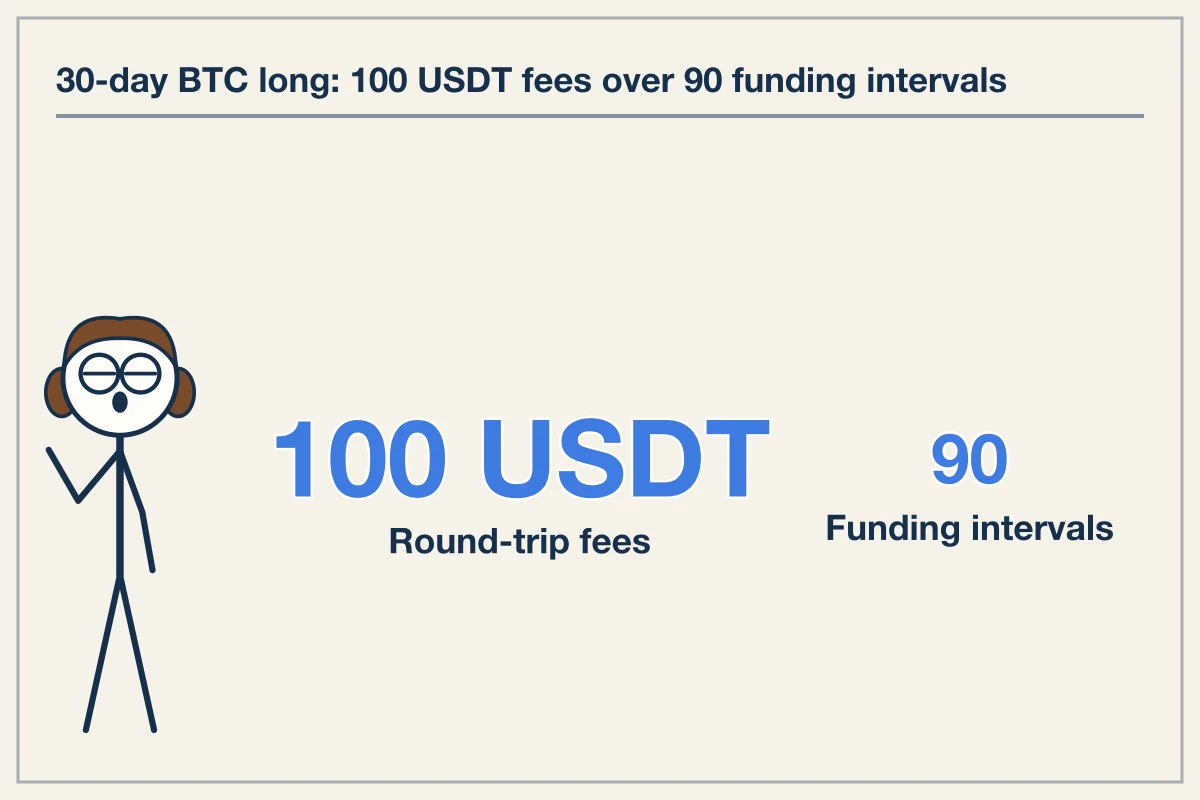
On OKX, the futures taker fee is 0.0005. Taker fee for entry is 100,000 multiplied by 0.0005, which equals 50 USDT. Taker fee for exit is 100,000 multiplied by 0.0005, which equals 50 USDT. Total round-trip execution fees equal 100 USDT.
The 8-hour funding rate on OKX for BTC is +0.0100%, or 0.000100 per interval. Over 30 days, 90 funding intervals occur. Total funding cost equals 100,000 multiplied by 0.000100 multiplied by 90, which equals 900 USDT. The combined position cost on OKX totals 1,000 USDT.
On MEXC, the futures taker fee is 0.0002. Taker fee for entry is 100,000 multiplied by 0.0002, which equals 20 USDT. Taker fee for exit is 100,000 multiplied by 0.0002, which equals 20 USDT. Total round-trip execution fees equal 40 USDT.
The 8-hour funding rate on MEXC for BTC is +0.0049%, or 0.000049 per interval. Total funding cost over 90 intervals equals 100,000 multiplied by 0.000049 multiplied by 90, which equals 441 USDT. The combined position cost on MEXC totals 481 USDT.
Holding a 100,000 USDT long BTC position on OKX costs 519 USDT more than holding the same position size on MEXC over 30 days.
Margin Maintenance and Liquidation Mechanics
Traders accessing perpetual contracts via offshore entities bypass local leverage caps, but face strict liquidation engines. Position liquidation depends on initial margin requirements and venue maintenance thresholds.
At 20x leverage, a position requires a 5% initial margin. If an exchange sets the maintenance margin threshold at 0.5%, an adverse price move of 4.5% reduces initial collateral to maintenance levels, triggering automatic liquidation.
When liquidation triggers, the platform issues a market order to close the full nominal size. On Bybit, a futures taker fee of 0.00055 applies to the closed order, deducting 55 USDT from account equity on a 100,000 USDT nominal position upon margin failure. Accounts routed to offshore corporate structures outside VARA jurisdiction operate without local dispute resolution frameworks during engine outages or liquidation events.