· four exchange APIs · rebuilt daily
AI Trading Bots Cover Static Grid Engines Operating Under High Fee Drag
Retail AI trading bots execute fixed grid logic where taker exchange fees and funding spreads consume backtested margins.
Retail products marketed as AI trading bots are deterministic execution tools operating on fixed conditional logic, grid arrays, or external signal mirroring. These systems convert high trade frequency into exchange fee drag, depleting account margin before accounting for live market slippage or venue funding spreads.
Mechanizing the AI Label
Commercial products using the AI label fall into three mechanical categories: conditional rule engines, grid bots, and signal copiers.
Conditional rule engines execute market or limit orders when technical indicators meet pre-set thresholds, such as a moving average crossover combined with a relative strength index value. The execution parameters remain static unless manually altered by the user.
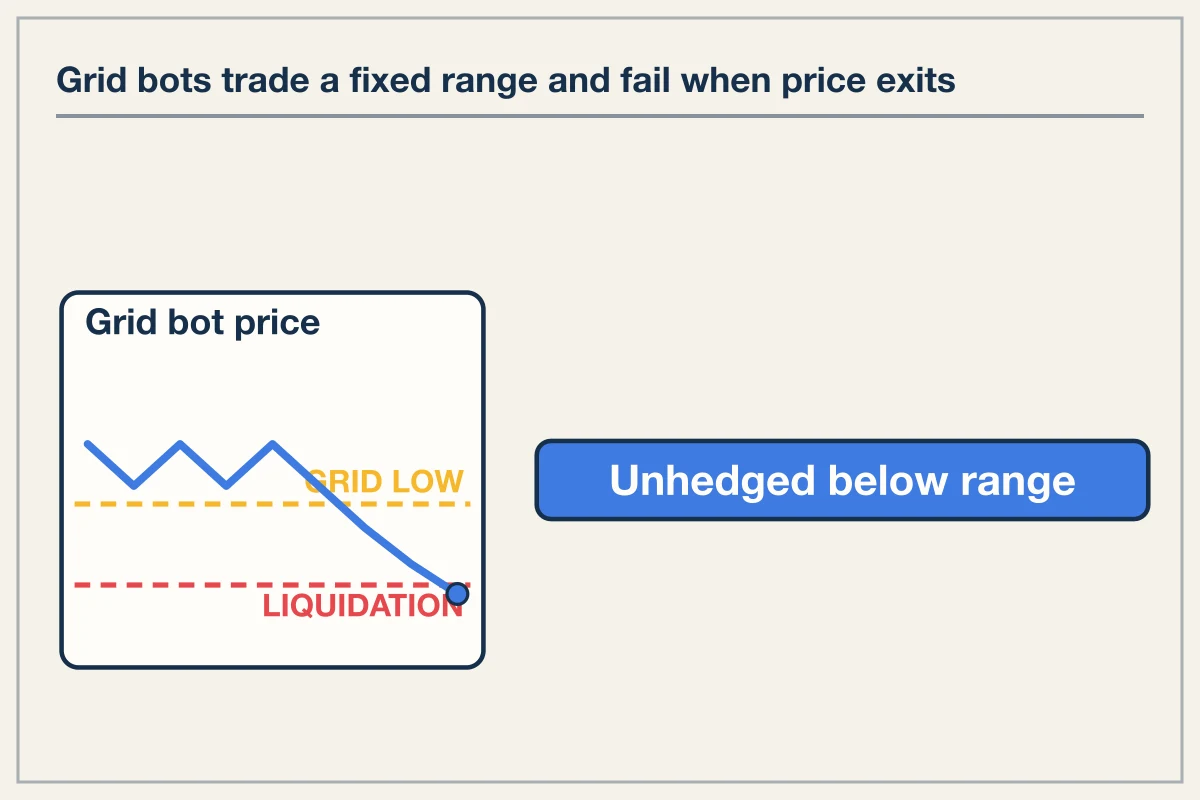
Grid bots establish a ladder of limit buy and sell orders within a fixed price range. The bot places a buy order at every lower interval and a sell order at every upper interval. The mechanism relies on price oscillation within the defined channel. If market price trends outside the range, the bot holds a fully unhedged position into liquidation.
Copy trading bots mirror the API calls of a master account. Delay between the primary trader's execution and the follower's API order placement creates systematic execution lag.
Exchange fee schedules dictate whether high-frequency grid strategies retain positive expected value.
| Venue | Spot Maker | Spot Taker | Futures Maker | Futures Taker |
| Bitget | 0.10% | 0.10% | 0.02% | 0.03% |
| Bybit | 0.10% | 0.10% | 0.02% | 0.055% |
| MEXC | 0.00% | 0.05% | 0.00% | 0.02% |
| OKX | 0.08% | 0.10% | 0.02% | 0.05% |
Why Backtests Fail in Live Markets
Backtests fail primarily due to curve fitting, omitted execution fees, and ignored funding rates. Overfitting occurs when a rule engine adjusts its input parameters—such as indicator timeframes or grid spacing—to fit historical price noise. The backtest displays high historical win rates because the parameters reflect past price paths rather than structural market inefficiencies.
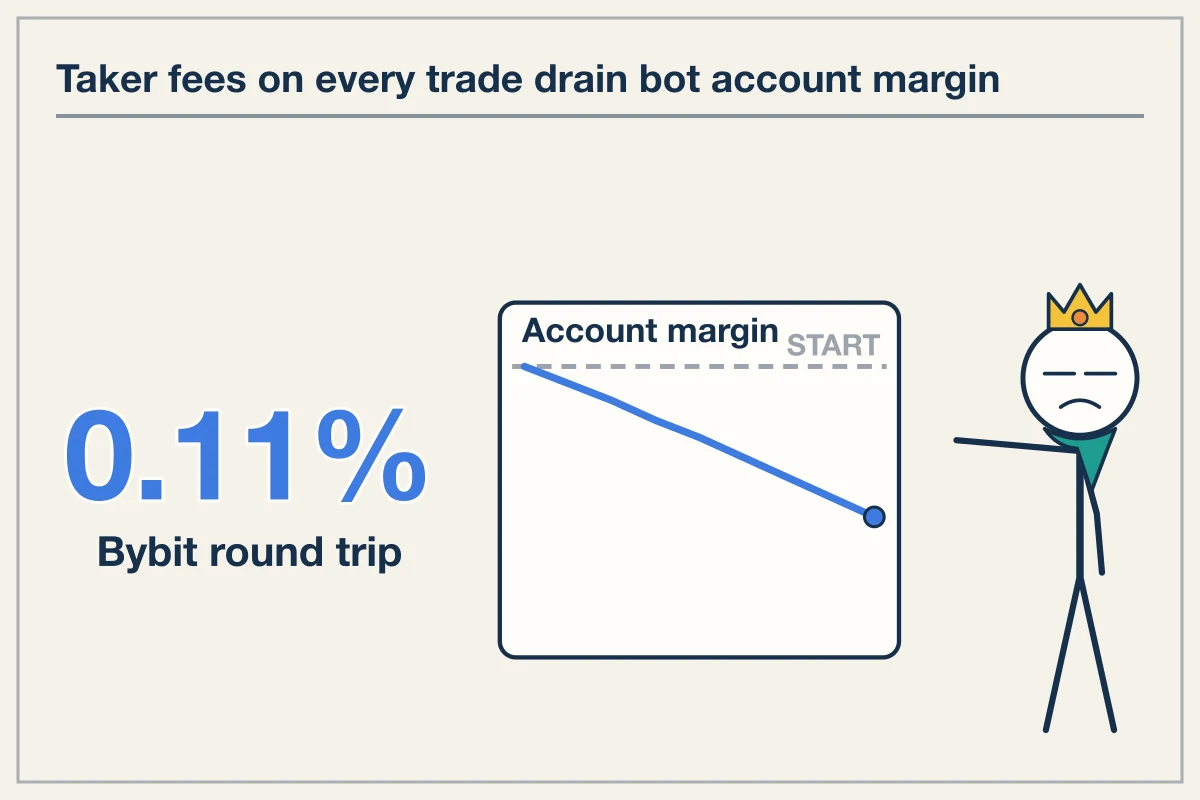
A strategy executing frequent market orders incurs taker fees on every transaction. On Bybit perpetual futures, the default taker fee is 0.055%. On a 10,000 USD position size, entering a contract costs 5.50 USD and exiting costs 5.50 USD. The total round-trip fee friction is 11.00 USD, or 0.11% of contract nominal value.
Executing 50 round-trip taker trades in a day on a 10,000 USD account balance generates 550 USD in fee drag daily. On MEXC futures, where the taker fee is 0.02%, the same 50 trades generate 200 USD in fee drag. On Bitget futures, with a taker fee of 0.03%, daily fee friction equals 300 USD. On OKX futures, with a taker fee of 0.05%, daily fee friction equals 500 USD.
Backtests that model zero slippage or use maker fee assumptions while submitting market orders misstate net performance by hundreds of dollars per day.
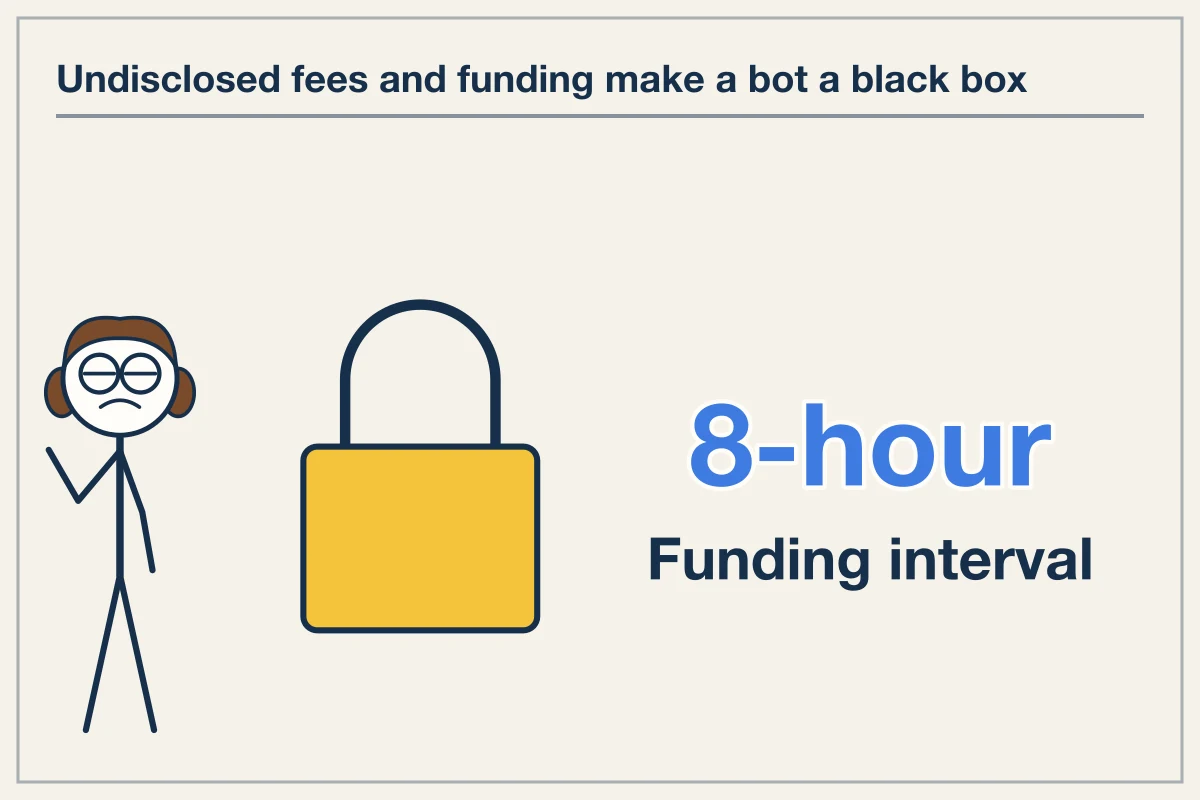
Holding perpetual futures positions adds variable funding rate expenses that backtests frequently omit. Funding rates vary across exchanges for the same underlying asset.
| Asset | OKX 8h Rate | Bybit 8h Rate | MEXC 8h Rate | Bitget 8h Rate | Spread |
| ETH | +0.0031% | +0.0087% | +0.0058% | +0.0100% | 0.0069% |
| BTC | +0.0079% | +0.0090% | +0.0100% | +0.0100% | 0.0021% |
| SOL | -0.0080% | -0.0056% | -0.0026% | +0.0059% | 0.0139% |
| ZEC | +0.0092% | +0.0100% | +0.0011% | +0.0100% | 0.0089% |
| XRP | +0.0009% | -0.0058% | +0.0039% | +0.0047% | 0.0105% |
On a 10,000 USD long SOL position held for 24 hours (three 8-hour funding intervals): Bitget charges long positions +0.0059% per 8 hours. The total daily funding cost is 1.77 USD. OKX pays long positions -0.0080% per 8 hours. The trader receives 2.40 USD in funding credits over 24 hours. Holding the long position on Bitget instead of OKX creates a performance disadvantage of 4.17 USD per 10,000 USD position size daily.
Evaluating Disclosed Systems Against Black Boxes
Evaluating an automated strategy requires four structural questions:
- What order execution type does the bot use, and are fees calculated using taker schedule rates?
- Does the signal model factor in live 8-hour perpetual funding costs across specific exchanges?
- How does the order routing engine account for book depth and latency slippage during liquidation waves?
- How many input variables were optimized during parameter selection, and was out-of-sample data tested?
Strategies that fail to detail taker fee structures, venue funding differentials, and execution latency operate as black boxes that transfer equity from trader balances to exchange order books.