· four exchange APIs · rebuilt daily
Singapore vs Hong Kong crypto rules diverge on retail perp trading
The finding
Singapore and Hong Kong regulatory policies have diverged, with retail margin restrictions pushing perpetual futures execution across four major exchanges where taker fees span 0.0002 to 0.00055.
Singapore restricts retail leverage and credit-backed crypto purchases entirely.
Hong Kong requires Virtual Asset Trading Platform licensing and limits derivatives to professional investors.
Offshore desk routing remains the primary path for leveraged perp positions in Asia.
Singapore vs Hong Kong crypto regulatory frameworks
The regulatory landscape for a Singapore vs Hong Kong crypto trader has split cleanly along derivatives and retail access lines. While both hubs seek institutional capital, local rules dictate whether a trader can access perpetual futures directly or must route orders offshore.
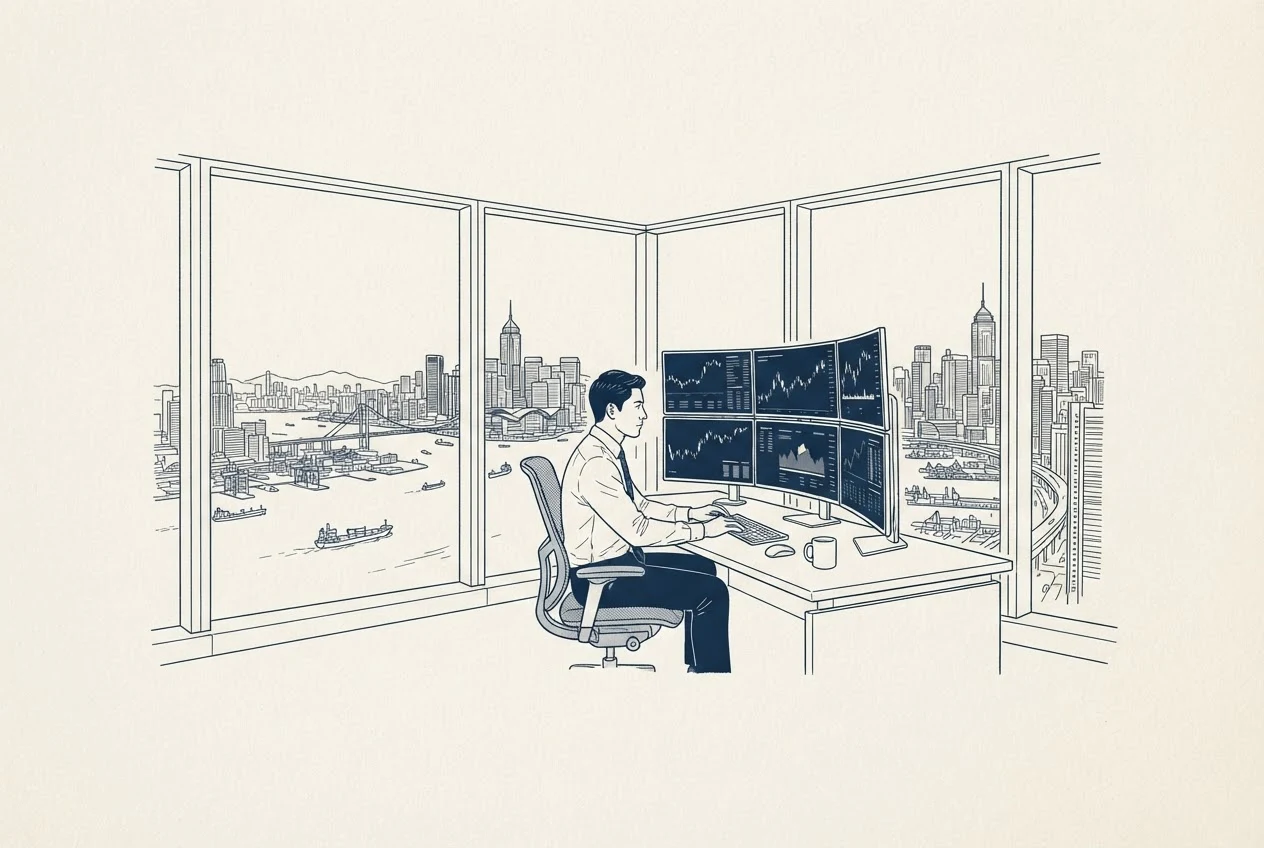
Singapore under the Monetary Authority of Singapore (MAS) enforces strict consumer protection measures. Retail investors face complete bans on margin trading, leverage, and credit card crypto purchases. Licensed Payment Services Act entities in Singapore cannot offer perpetual contracts to local retail accounts.
Hong Kong under the Securities and Futures Commission (SFC) established the Virtual Asset Trading Platform (VATP) framework. Retail traders gain access to top-tier spot assets like BTC and ETH on licensed platforms. Perpetual futures and leveraged derivatives remain restricted to institutional clients and Professional Investors with portfolios exceeding 8 million HKD.
Worth knowing
A trader operating as an individual in Singapore or Hong Kong cannot open a leveraged perpetual futures contract on a locally licensed entity without meeting Professional Investor status or routing through offshore subsidiaries.
Perpetual futures fee structures across active venues
Because local licensing excludes retail leverage, regional traders rely on major international liquidity venues. Fee structures vary across these venues, directly impacting high-turnover strategies.
| Venue | Spot Maker | Spot Taker | Futures Maker | Futures Taker |
|---|---|---|---|---|
| MEXC | 0.0000 | 0.0005 | 0.0000 | 0.0002 |
| Bitget | 0.0010 | 0.0010 | 0.0002 | 0.0003 |
| OKX | 0.0008 | 0.0010 | 0.0002 | 0.0005 |
| Bybit | 0.0010 | 0.0010 | 0.0002 | 0.00055 |
Futures taker fees range from 0.0002 on MEXC to 0.00055 on Bybit. On a 100,000 USD position, an entry order executed at market costs 20 USD on MEXC, 30 USD on Bitget, 50 USD on OKX, and 55 USD on Bybit. Rebalancing or closing the position doubles this cost.
Futures maker fees are zero on MEXC, while Bitget, OKX, and Bybit charge 0.0002. Limit order entry on a 100,000 USD position incurs 0 USD on MEXC and 20 USD on the remaining three venues.
Funding rate spreads and position holding costs
Funding rates create substantial cost variations when holding perpetual contracts across venues. Normalised 8-hour rates across active pairs show wide spreads between exchanges.

| Asset | 24h Volume (USD) | Lowest Funding Venue | Rate | Highest Funding Venue | Rate | Spread |
|---|---|---|---|---|---|---|
| ETH | 7,103,024,469 | Bybit | +0.0020% | Bitget | +0.0100% | 0.0080% |
| BTC | 6,808,223,767 | OKX | -0.0016% | Bybit | +0.0040% | 0.0056% |
| SNDK | 1,851,623,907 | Bitget | +0.0000% | Bybit | +0.0697% | 0.0697% |
| ZEC | 1,396,071,549 | MEXC | -0.0018% | Bybit | +0.0100% | 0.0118% |
| SOL | 916,732,516 | Bybit | -0.0076% | Bitget | +0.0030% | 0.0106% |
| XAU | 672,906,883 | Bybit | +0.0000% | OKX | +0.0000% | 0.0000% |
The SNDK perpetual market displays the largest absolute spread at 0.0697 percentage points per 8 hours. Holding a 100,000 USD long position on Bybit incurs a funding payment of 69.70 USD every 8 hours, totaling 209.10 USD per 24 hours. The same long position on Bitget incurs 0.00 USD in funding payments over 24 hours.
SOL perpetuals show a funding reversal. Long positions on Bybit receive 7.60 USD per 8 hours (-0.0076%), totaling 22.80 USD per 24 hours. Long positions on Bitget pay 3.00 USD per 8 hours (+0.0030%), totaling 9.00 USD per 24 hours. The daily difference between venues on a 100,000 USD SOL long position is 31.80 USD.
Where this goes wrong
Holding a long position on a venue with high positive funding during multi-day consolidations drains margin equity independently of underlying price movement.
Execution realities for Asian perp traders
Traders navigating the Singapore and Hong Kong regulatory divide face operational tradeoffs between regulatory compliance and liquidity access.
Local onshore accounts offer fiat gateways and regulatory oversight but lack perpetual futures access. Offshore venue accounts provide access to perpetual contracts across major assets, but expose traders to counterparty risk without local statutory protections.
For high-volume pairs like ETH (24h volume 7,103,024,469 USD) and BTC (24h volume 6,808,223,767 USD), funding differentials remain tighter than mid-cap assets. BTC exhibits a 0.0056 percentage point spread between OKX (-0.0016%) and Bybit (+0.0040%). On a 100,000 USD long position, OKX pays the long trader 1.60 USD per 8 hours, while Bybit charges the long trader 4.00 USD per 8 hours.
Selecting an execution venue requires weighing entry fees against multi-day funding costs based on expected holding duration.
How do Singapore and Hong Kong crypto regulations affect perpetual futures access?
Singapore bans retail margin and leverage trading on licensed venues under MAS guidelines. Hong Kong restricts crypto derivatives on VATP-licensed exchanges to Professional Investors with portfolios over 8 million HKD.
Which venue has the lowest futures taker fee for perp trading?
MEXC offers the lowest published futures taker fee at 0.0002, followed by Bitget at 0.0003, OKX at 0.0005, and Bybit at 0.00055.
What is the funding rate spread on SNDK perpetual futures?
The 8-hour funding rate spread on SNDK is 0.0697 percentage points, ranging from +0.0000% on Bitget to +0.0697% on Bybit.
Which venue is currently cheapest to hold a long BTC perpetual position?
OKX is currently cheapest for long BTC positions, with an 8-hour funding rate of -0.0016%, meaning the exchange pays long holders.