· four exchange APIs · rebuilt daily
Insolvency Filings Convert Exchange Crypto Claims into Fixed Dollar Debt
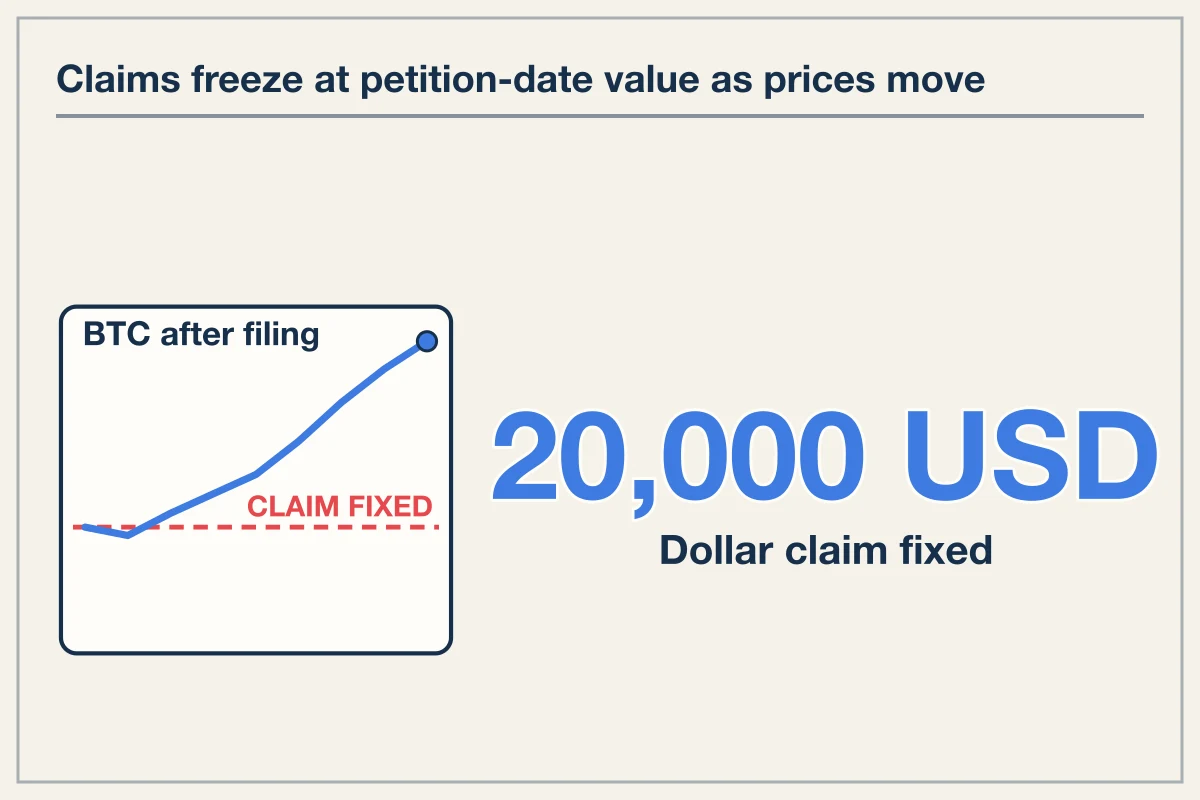
Bankruptcy filings from 2014 to 2022 show exchange collapses legally convert user token balances into general unsecured dollar claims fixed at petition date values.
Legal Reclassification of Collateral in Bankruptcy
In Chapter 11 bankruptcy proceedings, account balances are dollar-denominated as of the petition date, leaving creditors with 0% direct legal ownership of the underlying tokens on deposit. When a centralized exchange halts withdrawals and files for bankruptcy, the legal framework converts user balances into general unsecured claims.
The mechanism operates through court jurisdiction under insolvency law. Depositors do not retain property rights to specific cryptographic keys or tokens. Instead, the Terms of Service for centralized venues assign legal ownership of deposited assets to the operating entity, leaving the user with a contract obligation owed by the debtor estate.
Historical Filings and Legal Mandates
The legal mechanism converting crypto deposits into general unsecured claims appears across key historical exchange failures:
- Mt. Gox (February 2014): Filed for corporate rehabilitation in Tokyo District Court. The court converted user crypto holdings into Yen-denominated claims fixed at the market valuation on the petition date of approximately 483 USD per Bitcoin.
- Celsius Network (July 13, 2022): The U.S. Bankruptcy Court for the Southern District of New York ruled under Docket 1822 that terms of use transferred title of customer assets in Earn accounts to the debtor estate. Deposits became property of the estate, ranking users as general unsecured creditors.
- FTX Trading Ltd. (November 11, 2022): Filed for Chapter 11 in the U.S. Bankruptcy Court for the District of Delaware under Case No. 22-11068. The debtor estate calculated customer claims based on digital asset prices at the precise petition timestamp on November 11, 2022.
Mechanics of the Petition Date Valuation Trap
When an exchange becomes insolvent, a trader holding open derivative positions or collateral suffers two structural losses: valuation lock and estate haircut.
Consider an account holding 1.00 BTC as perpetual contract collateral.
- Exchange files Chapter 11 when BTC market price is 20,000 USD.
- The court fixes the dollar claim at 20,000 USD.
- Over a 24-month restructuring period, the spot market price of BTC increases to 60,000 USD.
- The bankruptcy estate determines an asset recovery rate of 70% for general unsecured creditors.
- The cash payout equals 14,000 USD (70% of 20,000 USD).
- Converted back to spot BTC at the post-restructuring market price of 60,000 USD, the payout buys 0.2333 BTC.
The nominal recovery of 70% on the petition date valuation results in an effective asset recovery of 23.33% relative to holding 1.00 BTC outside the platform. The absolute loss is 0.7667 BTC per 1.00 BTC deposited.
Current Futures Fee Structures and Live Funding Mechanics
Holding perpetual futures positions requires balancing execution costs against counterparty exposure. The table below presents current taker and maker fees alongside live 8-hour funding rates for BTC across active derivative venues.
| Exchange | Futures Maker Fee | Futures Taker Fee | BTC 8h Funding Rate | BTC 24h Market Volume |
|---|---|---|---|---|
| Bybit | 0.0200% | 0.0550% | +0.0072% | 2,089,713,417 USD |
| Bitget | 0.0200% | 0.0300% | +0.0072% | 2,089,713,417 USD |
| OKX | 0.0200% | 0.0500% | +0.0094% | 2,089,713,417 USD |
| MEXC | 0.0000% | 0.0200% | +0.0100% | 2,089,713,417 USD |
For a 100,000 USD long BTC position, funding costs vary across venues over an 8-hour interval:
- On Bybit or Bitget, an 8-hour funding rate of +0.0072% incurs a payment of 7.20 USD per 8 hours (21.60 USD per 24 hours).
- On OKX, an 8-hour funding rate of +0.0094% incurs a payment of 9.40 USD per 8 hours (28.20 USD per 24 hours).
- On MEXC, an 8-hour funding rate of +0.0100% incurs a payment of 10.00 USD per 8 hours (30.00 USD per 24 hours).
The spread between the lowest funding venue (+0.0072%) and the highest (+0.0100%) equals 0.0028 percentage points per 8 hours, representing a daily cost difference of 8.40 USD per 100,000 USD position.
Contractual Risk Realization
An open perpetual futures position relies on exchange solvency to settle margin and daily PnL. When insolvency occurs, unrealized profits and posted collateral are subordinated to bankruptcy distributions. Derivative positions are closed at petition prices, converting live trading equity into static debt claims subject to court-approved percentage payouts.