· four exchange APIs · rebuilt daily
Perpetual Futures Funding Rates Vary by Up to 0.0123 Percent
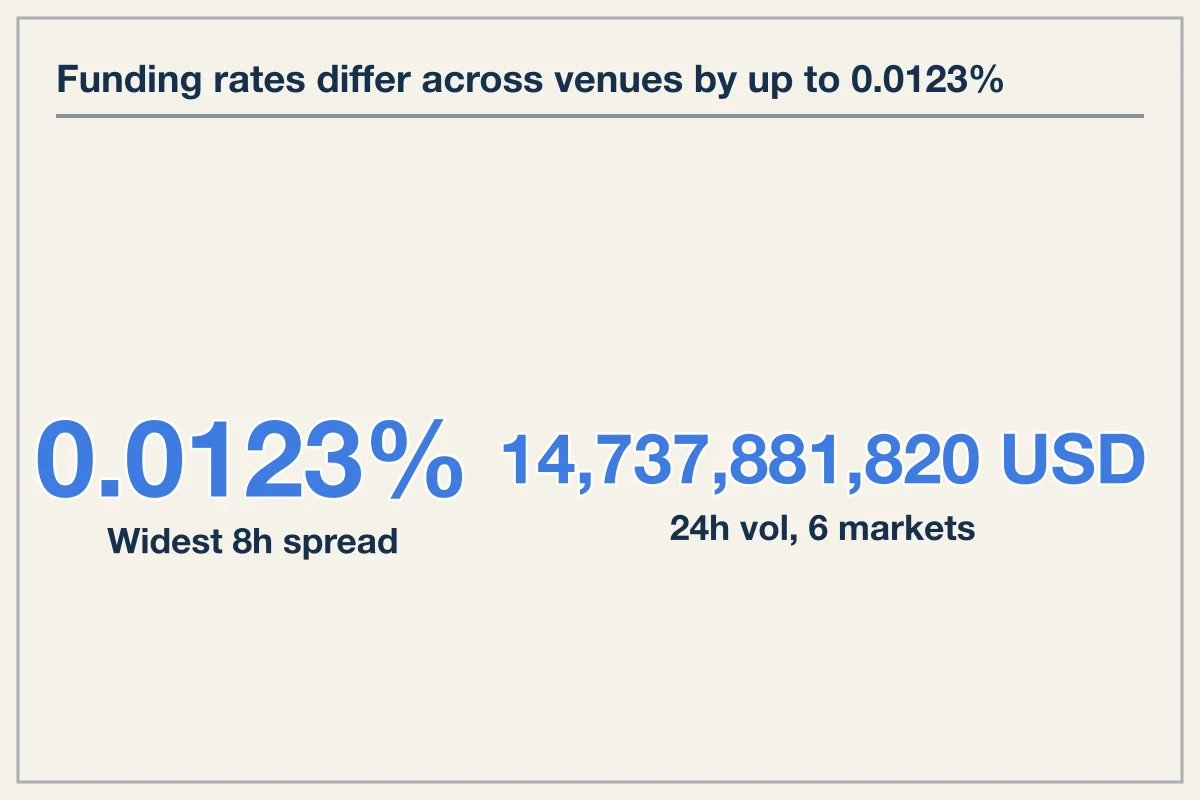
Perpetual futures tether contract prices to spot without expiration dates using peer-to-peer funding transfers that create venue fee spreads up to 0.0123%.
Settlement Mechanics and Origin
Perpetual futures settle cash flows without expiration dates, generating venue-specific funding spreads as wide as 0.0123 percentage points per eight-hour window across major assets. Economist Robert Shiller proposed perpetual futures in 1992 to enable price discovery in illiquid cash markets. Crypto exchange BitMEX adapted the design in May 2016 to create the perpetual swap for Bitcoin. Standard futures contracts converge to spot prices at a scheduled expiration date. Perpetual contracts have no expiration date and require a synthetic cash flow mechanism to track index spot prices.
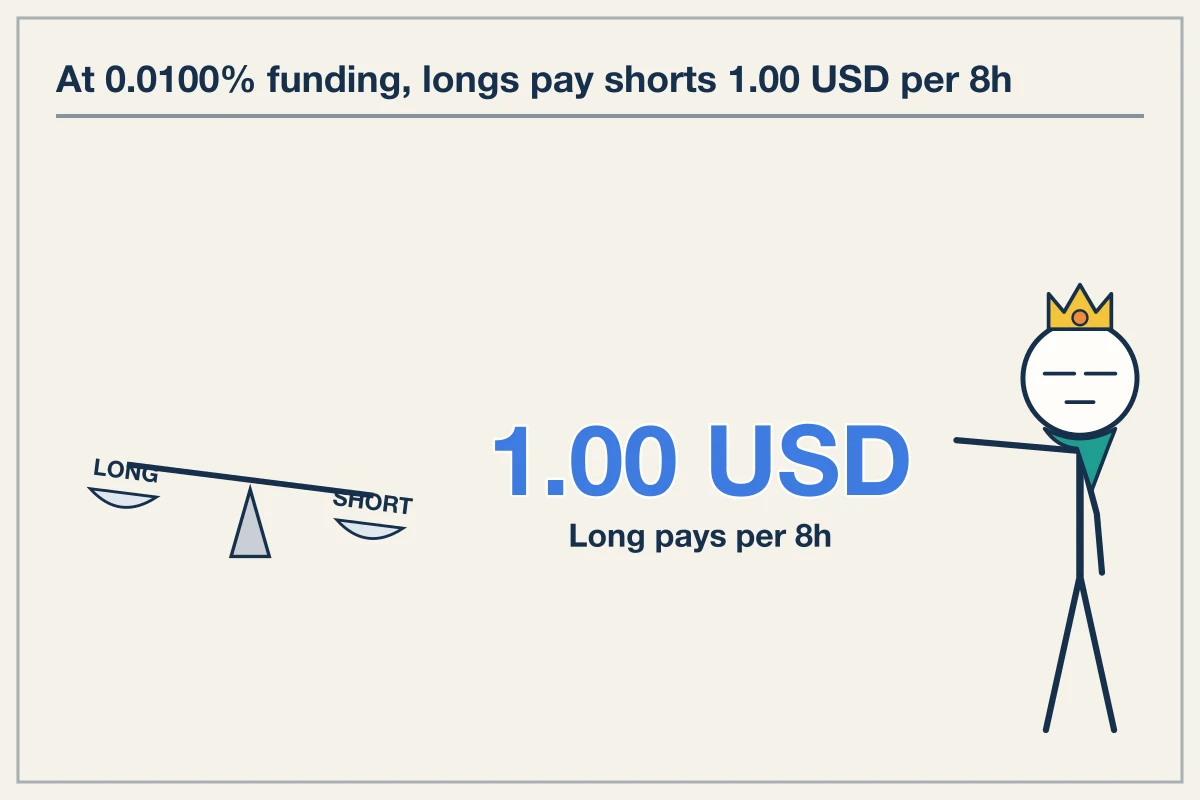
Exchanges enforce price tethering through cash transfers directly between long and short position holders. Every eight hours, positions exchange funding payments based on the deviation between the perpetual contract market price and the underlying spot index price. Exchanges do not retain funding fees. When perpetual contracts trade at a premium to spot, the funding rate is positive, requiring long positions to pay short positions. When perpetual contracts trade at a discount to spot, the funding rate turns negative, requiring short positions to pay long positions.
A positive funding rate of 0.0100% per eight-hour interval requires a trader holding a 10,000 USD long position to pay 1.00 USD every eight hours directly to short position holders, totaling 3.00 USD in daily cash drag. A negative funding rate of 0.0102% per eight-hour interval requires short position holders to pay long position holders 1.02 USD every eight hours per 10,000 USD of open position size.
Live Cross-Venue Funding Spreads
Funding rates diverge across trading venues due to structural liquidity imbalances and order book imbalances. Across six active markets totaling 14,737,881,820 USD in combined 24-hour trading volume, normalized eight-hour rate spreads alter the net cost of holding leverage.
| Asset | 24h Volume | Lowest Long Cost Venue | Lowest Long Rate | Highest Long Cost Venue | Highest Long Rate | Spread per 8h |
|---|---|---|---|---|---|---|
| ETH | 7,455,416,292 USD | Bybit | +0.0024% | Bitget | +0.0100% | 0.0076% |
| BTC | 4,798,985,307 USD | Bybit | +0.0072% | Bitget | +0.0095% | 0.0023% |
| SOL | 1,332,718,934 USD | MEXC | -0.0102% | Bitget | -0.0008% | 0.0094% |
| ZEC | 711,453,755 USD | MEXC | -0.0023% | Bybit | +0.0100% | 0.0123% |
| XRP | 456,937,245 USD | Bitget | +0.0038% | Bybit | +0.0100% | 0.0062% |
| TRUMP | 382,370,287 USD | Bitget | -0.0108% | OKX | -0.0019% | 0.0089% |
For long positions in ETH and BTC, Bybit holds the lowest current funding cost. For long positions in SOL and ZEC, MEXC offers the lowest holding cost because negative funding rates credit long accounts.
Total Position Cost Arithmetic
Holding costs consist of execution fees combined with cumulative funding rate drag. Default published futures fee schedules vary by exchange venue and order type.
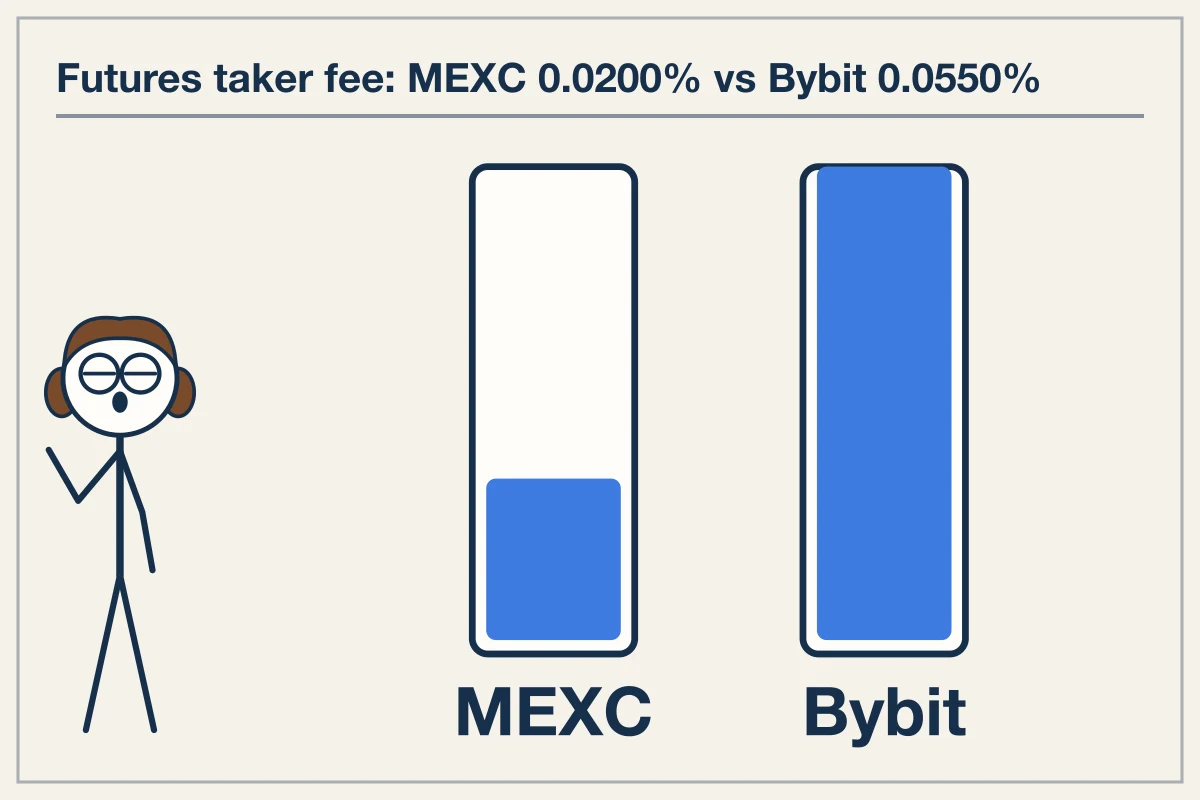
| Exchange | Futures Maker Fee | Futures Taker Fee | Spot Maker Fee | Spot Taker Fee |
|---|---|---|---|---|
| MEXC | 0.0000% | 0.0200% | 0.0000% | 0.0500% |
| Bitget | 0.0200% | 0.0300% | 0.1000% | 0.1000% |
| OKX | 0.0200% | 0.0500% | 0.0800% | 0.1000% |
| Bybit | 0.0200% | 0.0550% | 0.1000% | 0.1000% |
Consider a trader opening a 10,000 USD ETH long position held for 30 days, spanning 90 funding intervals, executing via taker market orders for entry and exit.
On Bybit: Entry taker fee: 10,000 USD multiplied by 0.00055 equals 5.50 USD. Exit taker fee: 10,000 USD multiplied by 0.00055 equals 5.50 USD. Total trading fee: 11.00 USD. Funding paid over 90 intervals at +0.0024%: 10,000 USD multiplied by 0.000024 multiplied by 90 equals 21.60 USD. Total 30-day position cost: 11.00 USD plus 21.60 USD equals 32.60 USD.
On Bitget: Entry taker fee: 10,000 USD multiplied by 0.00030 equals 3.00 USD. Exit taker fee: 10,000 USD multiplied by 0.00030 equals 3.00 USD. Total trading fee: 6.00 USD. Funding paid over 90 intervals at +0.0100%: 10,000 USD multiplied by 0.000100 multiplied by 90 equals 90.00 USD. Total 30-day position cost: 6.00 USD plus 90.00 USD equals 96.00 USD.
The venue offering lower immediate transaction fees produces a higher cumulative position cost over a 30-day holding horizon. The net execution variance equals 63.40 USD per 10,000 USD of open position size.
Margin Depletion and Liquidation Mechanics
Leverage accelerates funding fee drag against initial account collateral. At 20x leverage, opening a 10,000 USD position requires 500 USD in initial margin collateral. An adverse spot price movement of 4.5% reduces equity by 450 USD, depleting remaining margin to 50 USD and triggering automated liquidation.
Funding debits extract cash directly from available margin equity. At a positive funding rate of 0.0100% per eight hours, a 10,000 USD long position incurs a 3.00 USD daily debit. Over 30 days of sideways spot price movement, funding debits accumulate to 90.00 USD.
This 90.00 USD debit reduces initial collateral from 500.00 USD to 410.00 USD. Without any change in spot price, the effective price buffer required to trigger liquidation shrinks from a 4.5% adverse market move down to a 3.6% adverse market move. Continuous funding debits alter margin thresholds independently of underlying asset price movements.