· four exchange APIs · rebuilt daily
Dubai Licensing Framework Drives Perpetual Market Spreads
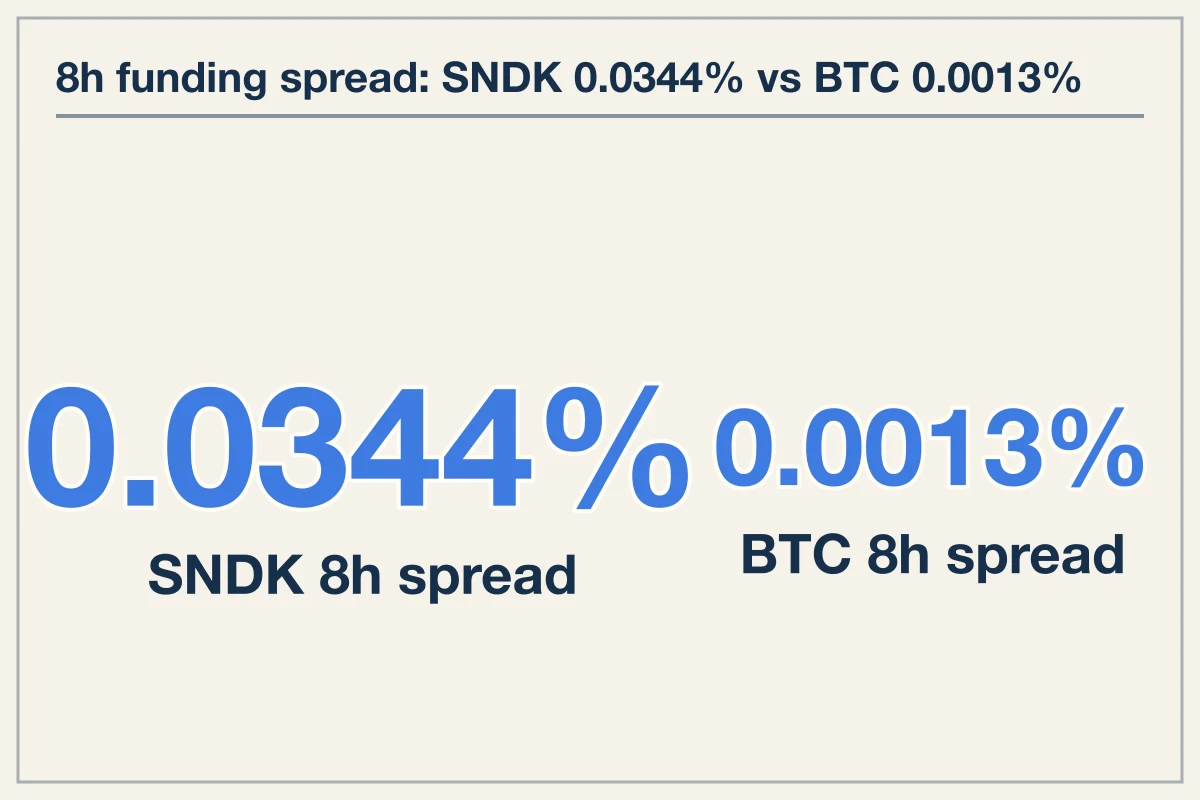
VARA regulatory mandates split exchange operations, generating funding rate spreads up to 0.0344% per 8 hours across non-domiciled perpetual venues.
Dubai's Virtual Assets Regulatory Authority framework splits exchange operations across four distinct module categories, driving 8-hour funding rate spreads on assets like SNDK up to 0.0344% across retail venues.
Law No. 4 of 2022 established the Virtual Assets Regulatory Authority (VARA) to oversee virtual asset service providers across mainland Dubai and designated free zones. The Dubai International Financial Centre (DIFC) remains separate under the Dubai Financial Services Authority (DFSA). VARA mandates separate entity structures for four activities: Exchange Services, Broker-Dealer Services, Custody Services, and Management and Investment Services.
VARA rules mandate the isolation of customer assets from corporate capital. Order matching infrastructure must be corporate-separated from proprietary market-making desks. Because exchanges cannot internalize order flow against native balance sheets without distinct legal structures, market makers operate across isolated offshore books. This separation causes pricing and funding rate divergence across global derivative venues.
Fee Schedules Across Venues
Trading venues publish baseline maker and taker fee schedules that determine round-trip execution costs:
| Venue | Spot Maker | Spot Taker | Futures Maker | Futures Taker |
|---|---|---|---|---|
| MEXC | 0.0000% | 0.0500% | 0.0000% | 0.0200% |
| Bitget | 0.1000% | 0.1000% | 0.0200% | 0.0300% |
| OKX | 0.0800% | 0.1000% | 0.0200% | 0.0500% |
| Bybit | 0.1000% | 0.1000% | 0.0200% | 0.0550% |
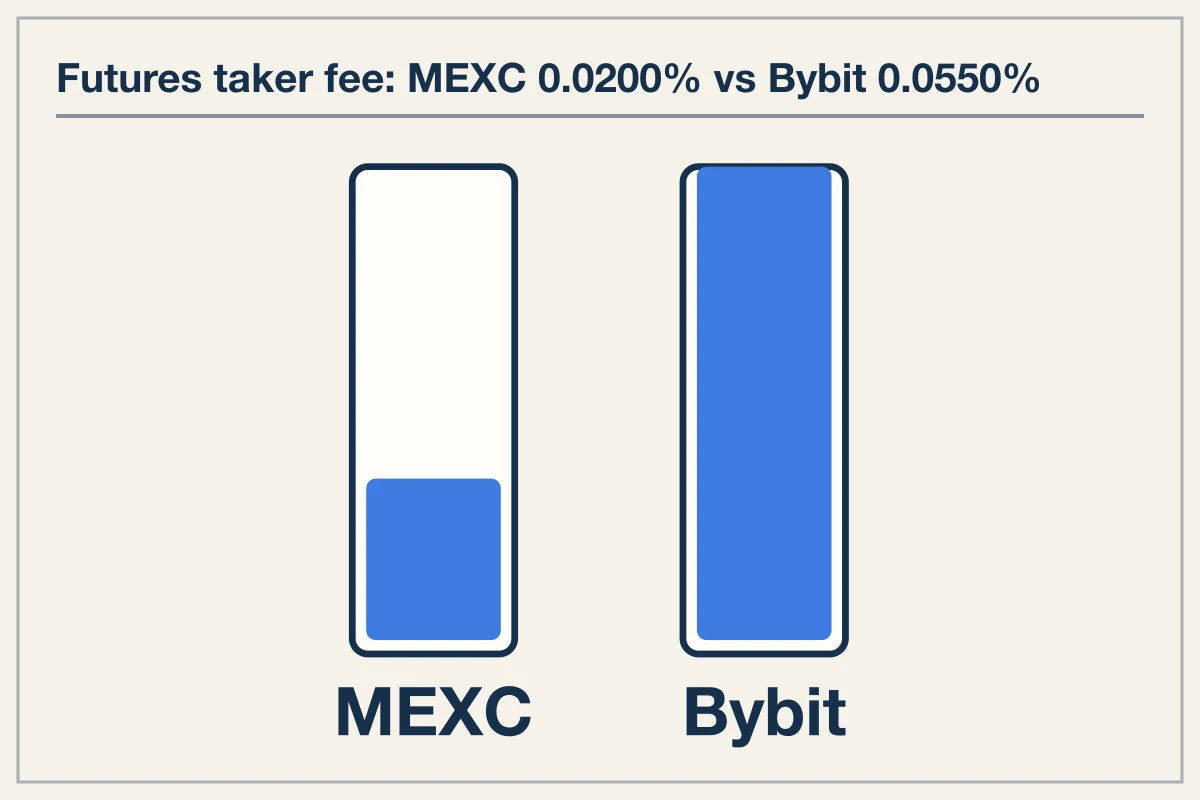
MEXC sets futures maker fees at 0.0000% and taker fees at 0.0200%. Bybit sets futures maker fees at 0.0200% and taker fees at 0.0550%. On a round-trip market order, the fee differential between Bybit and MEXC is 0.0700% of notional value.
Funding Rate Spreads Across Assets
Perpetual swaps settle funding payments every 8 hours. The table below displays normalized 8-hour rates, spreads, and 24-hour contract volumes across venues:
| Asset | Lowest 8h Rate Venue | Highest 8h Rate Venue | 8h Spread | 24h Volume |
|---|---|---|---|---|
| ETH | MEXC (+0.0022%) | Bitget (+0.0100%) | 0.0078% | $7,916,773,072 |
| BTC | Bitget (+0.0087%) | OKX / MEXC (+0.0100%) | 0.0013% | $7,479,386,701 |
| SOL | Bitget (-0.0027%) | OKX (+0.0056%) | 0.0083% | $2,128,844,654 |
| SNDK | Bitget (+0.0000%) | OKX (+0.0344%) | 0.0344% | $1,372,263,042 |
| TRUMP | OKX (-0.0033%) | Bitget (+0.0050%) | 0.0083% | $1,003,895,806 |
| XAU | OKX (+0.0000%) | MEXC (+0.0220% normalized: MEXC is +0.0022%) | 0.0022% | $574,034,929 |
High-volume contracts show structural rate variance. ETH ($7,916,773,072 24h volume) displays a 0.0078% spread between MEXC (+0.0022%) and Bitget (+0.0100%). SNDK ($1,372,263,042 24h volume) displays a 0.0344% spread between Bitget (+0.0000%) and OKX (+0.0344%).
24-Hour Position Cost Arithmetic
Consider a $100,000 long position in SNDK held for 24 hours (3 funding cycles) using taker orders for both entry and exit.
Execution on Bitget:
- Futures taker fee: 0.0300% (0.0003)
- Entry fee: $100,000 * 0.0003 = $30.00
- Exit fee: $100,000 * 0.0003 = $30.00
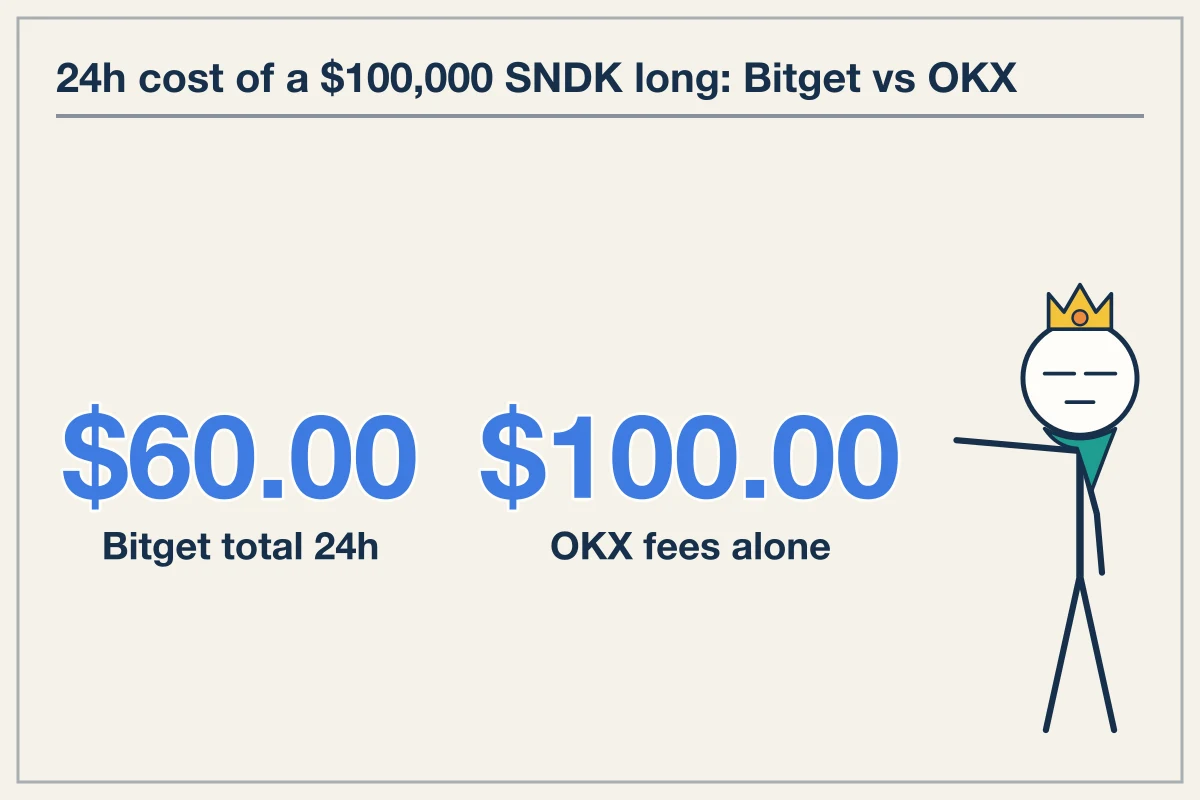
- Total execution fees: $60.00
- 8-hour funding rate: +0.0000%
- 24-hour funding cost: $100,000 0.0000 3 = $0.00
- Combined 24-hour cost: $60.00
Execution on OKX:
- Futures taker fee: 0.0500% (0.0005)
- Entry fee: $100,000 * 0.0005 = $50.00
- Exit fee: $100,000 * 0.0005 = $50.00
- Total execution fees: $100.00
- 8-hour funding rate: +0.0344%
- 24-hour funding cost: $100,000 0.000344 3 = $103.20
- Combined 24-hour cost: $203.20
Holding the $100,000 long position on OKX costs $143.20 more over 24 hours than holding the same position on Bitget ($203.20 - $60.00).
Free Zone Jurisdictions and Liquidity Mechanics
Dubai operates distinct free zone frameworks:
- Dubai Multi Commodities Centre (DMCC): Houses over 600 crypto corporate entities. Provides business licensing for software developers and proprietary trading firms, but financial market access requires VARA approval.
- Dubai International Financial Centre (DIFC): Operates an independent legal structure using common law, regulated by the DFSA. The DFSA maintains a recognized token list for institutional assets but does not clear retail derivative products.
Traders executing through Dubai entities access liquidity routed to offshore matching engines. Operational isolation does not alter order book risk engine rules. If account equity drops below maintenance margin requirements, matching engines trigger automatic liquidations. The liquidation engine closes positions via taker market orders, incurring full taker fee charges and immediate market impact losses.