· four exchange APIs · rebuilt daily
Perpetual Swap Spread Reaches 0.0142 Percent Per 8 Hours in SOL
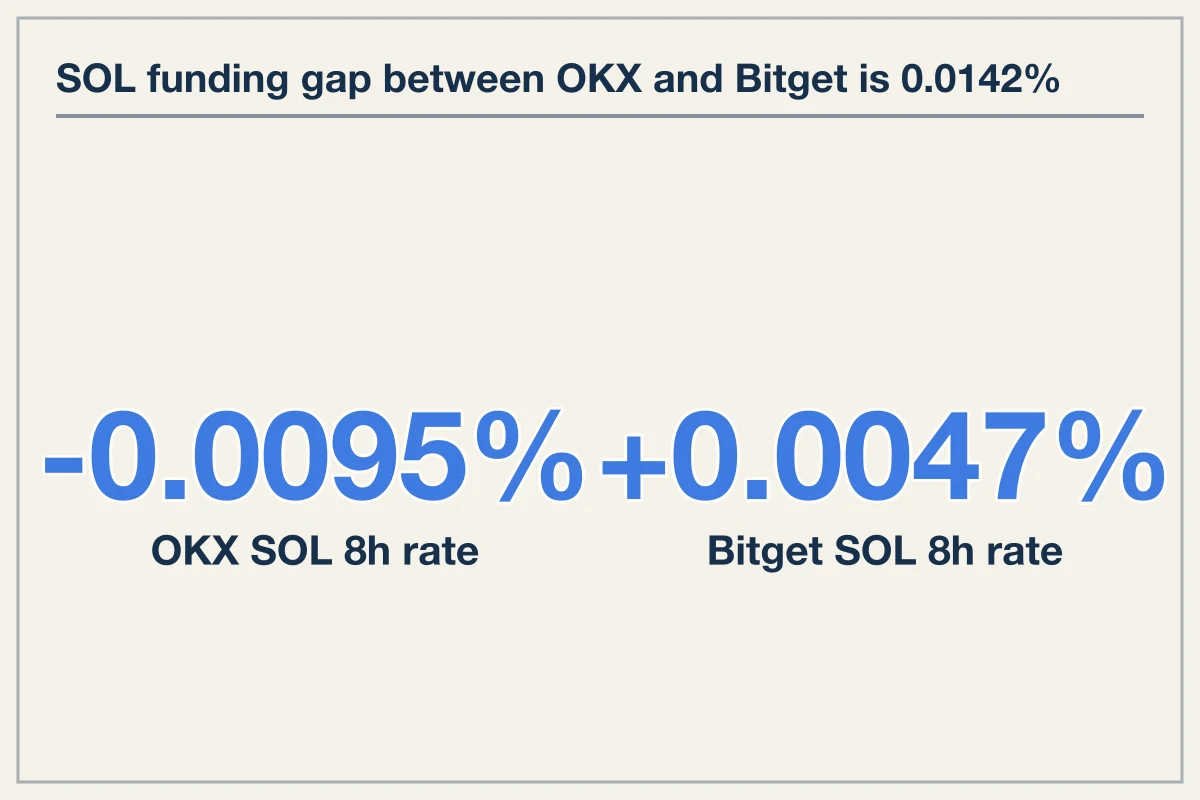
Perpetual swaps use cash transfers between longs and shorts to anchor contract prices to spot without fixed settlement dates across major exchanges.
The Perpetual Swap Mechanism
Invention and Calendar Settlement
The perpetual swap is a financial derivative created by Arthur Hayes and the BitMEX team in 2016. It is an engineered market structure rather than an inherent property of underlying assets. Traditional futures contracts require fixed calendar settlement dates where contracts expire and settle against spot prices. The perpetual contract eliminates expiration dates entirely. Traders retain open positions indefinitely as long as margin thresholds remain satisfied.
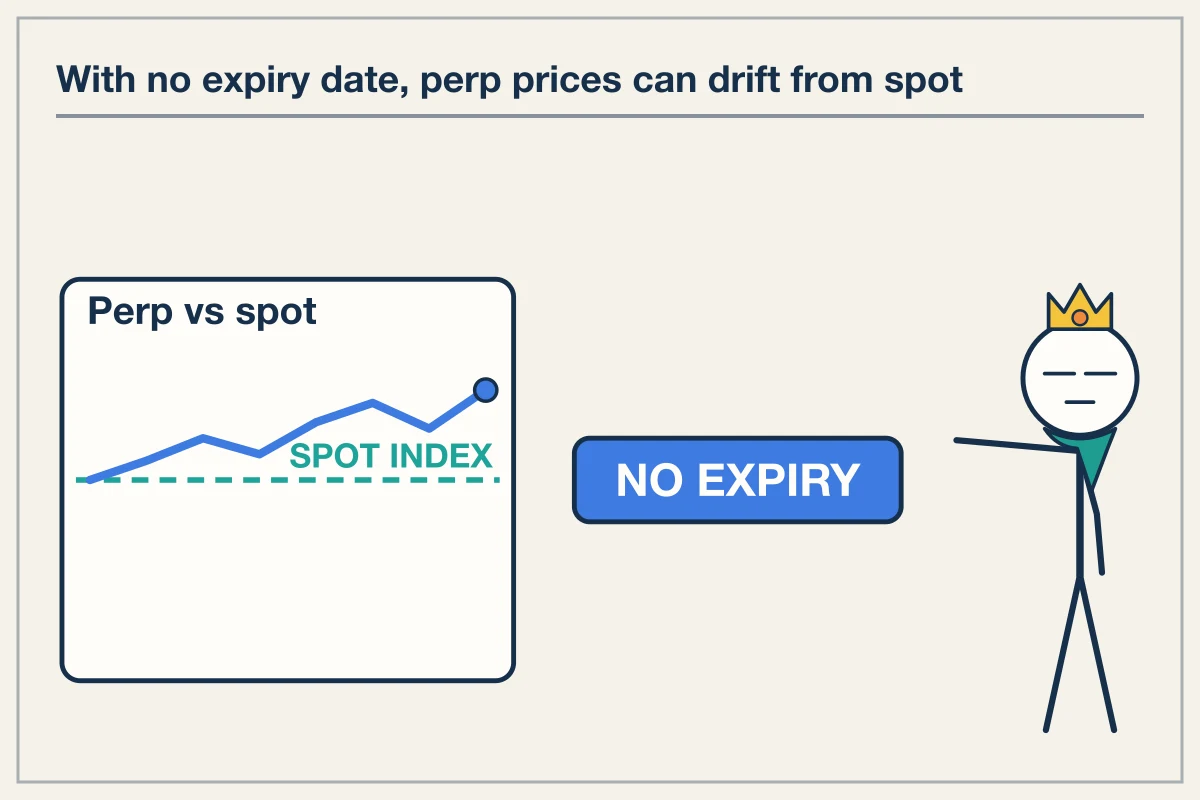
Because perpetual contracts lack a final settlement date to force price convergence, derivative prices can drift away from spot index values. To prevent persistent divergence, the contract relies on a periodic funding mechanism rather than physical delivery or cash expiration.
The Funding Rate Engine
The funding rate is a recurring cash transfer between long and short traders. Exchanges calculate the rate over fixed time windows, standardly every eight hours. When the perpetual contract trades at a premium relative to the spot index, the funding rate is positive. Long position holders pay short position holders. When the perpetual contract trades at a discount to spot, the funding rate becomes negative. Short position holders pay long position holders.
The exchange collects no portion of the funding payment. The fee moves directly between margin balances on the venue order book. The rate shifts continuously based on the relative demand for leveraged long or short exposure.
Venue Funding Rates
Funding rates vary across exchanges for identical underlying assets. Liquidity profiles, order book imbalances, and venue-specific trader positioning create rate spreads across platforms.
| Asset | 24h Volume | OKX 8h Rate | MEXC 8h Rate | Bitget 8h Rate | Spread | Cheapest Long Venue |
|---|---|---|---|---|---|---|
| ETH | $8,759,784,366 | +0.0016% | +0.0009% | +0.0100% | 0.0091% | MEXC |
| BTC | $5,842,760,729 | +0.0077% | +0.0100% | +0.0100% | 0.0023% | OKX |
| SOL | $1,555,123,257 | -0.0095% | -0.0047% | +0.0047% | 0.0142% | OKX |
| ZEC | $778,452,440 | +0.0003% | +0.0011% | +0.0100% | 0.0097% | OKX |
| XRP | $499,175,970 | -0.0006% | +0.0003% | +0.0049% | 0.0055% | OKX |
| XAU | $447,896,272 | +0.0328% | +0.0194% | +0.0169% | 0.0159% | Bitget |
The largest absolute funding spread occurs in SOL contracts, where holding a long position on OKX yields a 0.0095% credit per eight hours while holding the same long on Bitget costs 0.0047% per interval. The resulting spread of 0.0142 percentage points per eight hours translates to a 0.0426 percentage point variance over a 24-hour window.
Fee Schedules and Taker Execution Costs
Carrying costs depend on base execution fees alongside funding rates. Opening and closing a position incurs maker or taker fees defined by the exchange default fee schedule.
| Exchange | Spot Maker | Spot Taker | Futures Maker | Futures Taker |
|---|---|---|---|---|
| Bitget | 0.1000% | 0.1000% | 0.0200% | 0.0300% |
| Bybit | 0.1000% | 0.1000% | 0.0200% | 0.0550% |
| MEXC | 0.0000% | 0.0500% | 0.0000% | 0.0200% |
| OKX | 0.0800% | 0.1000% | 0.0200% | 0.0500% |
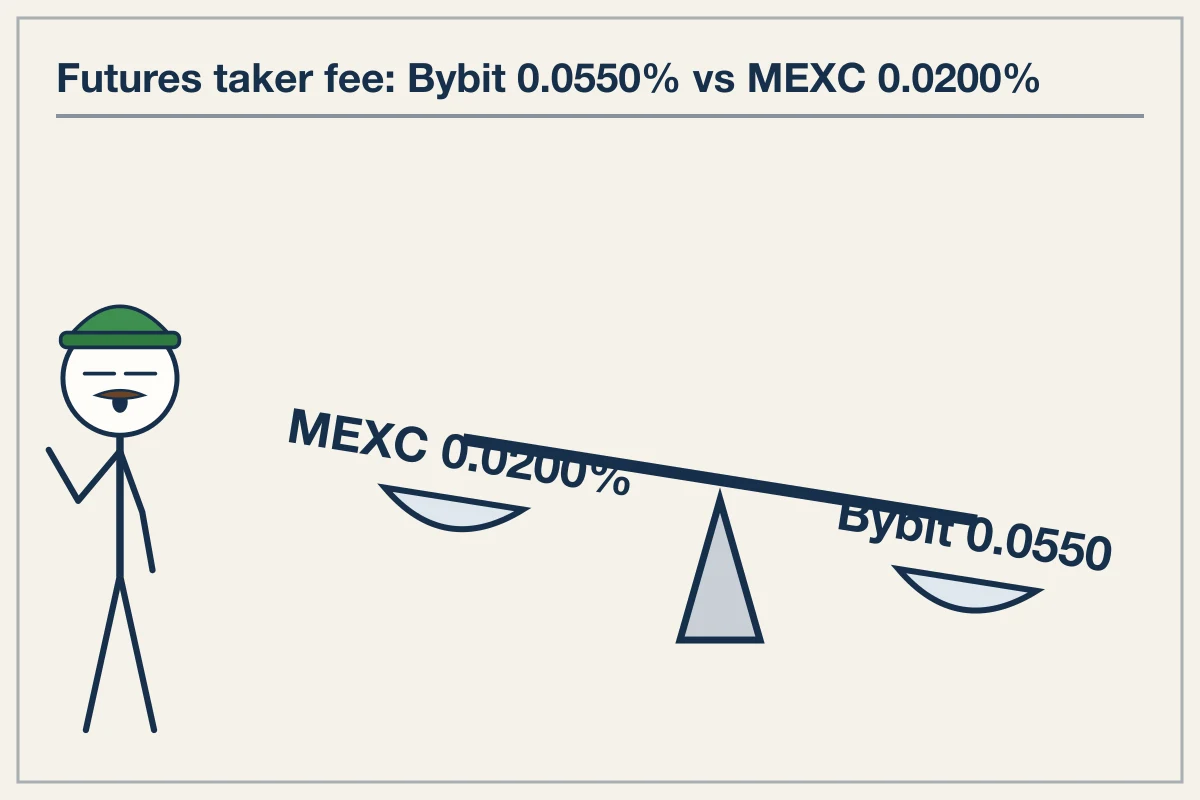
MEXC offers 0.0000% futures maker fees and a 0.0200% futures taker fee. OKX charges a 0.0500% futures taker fee, while Bybit charges 0.0550% for taker fills.
Worked Position Arithmetic
Consider a $10,000 notional long position held for 24 hours (three funding intervals) entered and exited via market orders (taker execution).
SOL Long Position Cost Calculation
On OKX:
- Entry fee: $10,000 * 0.0005 = $5.00
- Exit fee: $10,000 * 0.0005 = $5.00
- Funding payments (3 intervals at -0.0095%): $10,000 (-0.000095) 3 = -$2.85 credit received
- Net cost: $5.00 + $5.00 - $2.85 = $7.15
On Bitget:
- Entry fee: $10,000 * 0.0003 = $3.00
- Exit fee: $10,000 * 0.0003 = $3.00
- Funding payments (3 intervals at +0.0047%): $10,000 0.000047 3 = $1.41 fee paid
- Net cost: $3.00 + $3.00 + $1.41 = $7.41
The net cost difference between OKX and Bitget for holding a $10,000 SOL long for 24 hours is $0.26, as OKX funding credits offset its higher taker fee structure over three intervals.
XAU Long Position Cost Calculation
For a $10,000 notional XAU long held for 24 hours:
On OKX:
- Taker entry and exit fees: $10.00 total
- Funding payments (3 intervals at +0.0328%): $10,000 0.000328 3 = $9.84
- Net cost: $19.84
On Bitget:
- Taker entry and exit fees: $6.00 total
- Funding payments (3 intervals at +0.0169%): $10,000 0.000169 3 = $5.07
- Net cost: $11.07
Bitget reduces total carrying cost by $8.77 per $10,000 notional over 24 hours due to lower taker fees and a 0.0159% lower funding rate.
Liquidation Thresholds and Leverage Risks
Position survival requires maintaining collateral above the exchange maintenance margin requirement. Leverage amplifies price sensitivity relative to initial margin.
At 10x leverage ($1,000 collateral for a $10,000 position size), a 10.0% adverse price change completely consumes the initial margin collateral. Accounting for a 0.05% taker exit fee and maintenance margin requirements, liquidation occurs prior to a 9.5% price drop.
At 20x leverage ($500 collateral for a $10,000 position size), a 5.0% price move consumes the collateral. Taker fee deductions and maintenance margin buffers lower the liquidation threshold to approximately 4.5% adverse price movement from entry. Unfunded positions holding high positive funding rates lose margin continuously, accelerating liquidation proximity during range-bound price action.