· four exchange APIs · rebuilt daily
Exchange Insolvency Converts User Assets Into Unsecured Claims
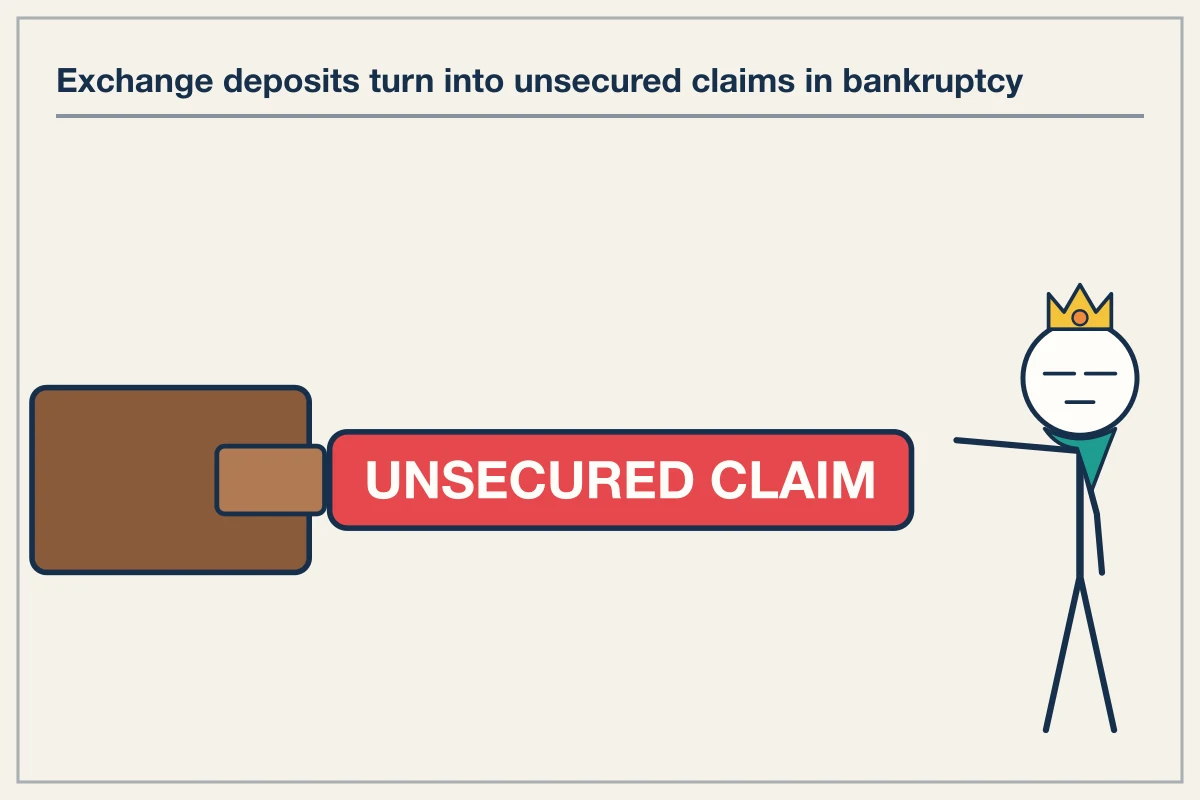
Court filings show exchange insolvencies convert custodial deposits into general unsecured claims, subjecting positions to bankruptcy administration haircuts.
Court Filings Establish Margin Deposits as Corporate Assets
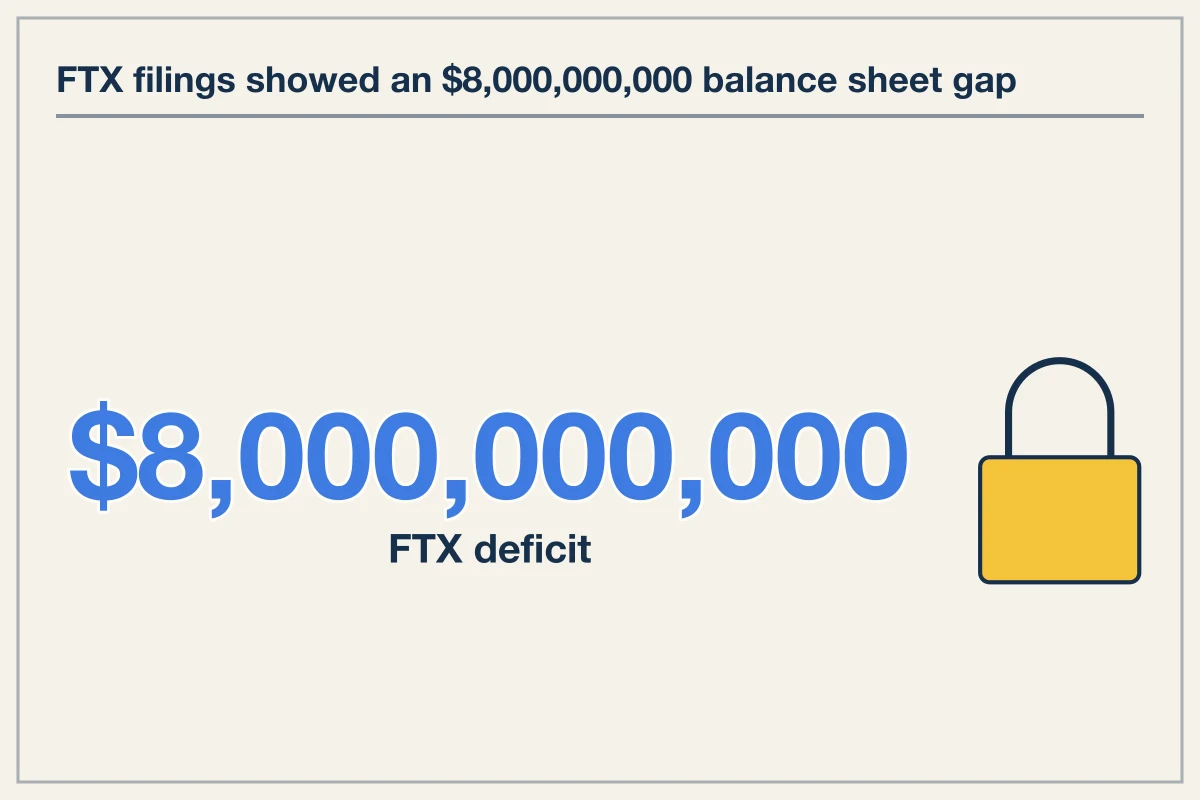
In November 2022, bankruptcy court filings revealed an $8,000,000,000 balance sheet deficit at FTX, demonstrating that customer deposits held on centralised perpetual venues function as general unsecured credit rather than isolated custodial property.
When an exchange halts withdrawals, open derivative positions are force-closed or frozen at index prices determined by the administrator. Account balances cease to operate as liquid margin. Instead, the legal framework converts user funds into general unsecured claims against the bankruptcy estate. The recovery value depends on the net asset deficit at the petition date and the total cost of legal administration.
Legal Precedents in Exchange Insolvencies
Court rulings across multiple jurisdictions confirm that standard terms of service transfer legal ownership of deposited assets to the exchange entity.
Celsius Network (July 2022)
In January 2023, Judge Martin Glenn of the US Bankruptcy Court for the Southern District of New York ruled that terms of service transferred ownership of deposited assets in Earn accounts to the debtor estate. This decision reclassified account holders with assets valued at $4,200,000,000 as general unsecured creditors.
FTX Trading Ltd. (November 2022)
Filings in the US Bankruptcy Court for the District of Delaware showed commingled customer funds transferred to Alameda Research. The bankruptcy court ruled that customer claims were fixed to the fiat value of the assets on the petition date of November 11, 2022. If BTC was priced at $16,800 on that date, a claim for 1 BTC was valued at $16,800 throughout administration, excluding subsequent spot market appreciation.
Mt. Gox (February 2014)
The exchange suspended trading after 850,000 BTC vanished from its balance sheet. Under Japanese bankruptcy administration, creditor claims were locked for years while the legal framework established liability distribution rules.
| Venue Case | Petition Date | Documented Deficit / Filing Detail | Legal Outcome for Depositors |
|---|---|---|---|
| Mt. Gox | Feb 2014 | 850,000 BTC missing | Claims locked into multi-year trustee distribution process |
| Celsius Network | Jul 2022 | $4,200,000,000 user asset pool | Court ruled deposits belonged to debtor estate under Terms |
| FTX Trading Ltd. | Nov 2022 | $8,000,000,000 balance sheet gap | Claims dollarized at petition date asset prices |
Mechanical Impact on Derivatives Positions
An exchange failure impacts open perpetual futures through three distinct steps:
- Liquidity freeze: Order matching halts, preventing position management, stop-loss execution, or margin replenishment.
- Automatic position termination: The matching engine liquidates or force-settles positions against current index prices, locking in realized PnL at the moment of shutdown.
- Conversion to dollarized claims: Net account equity moves from the exchange ledger to the legal claims register.
Consider a trader carrying a $100,000 active perp margin balance.
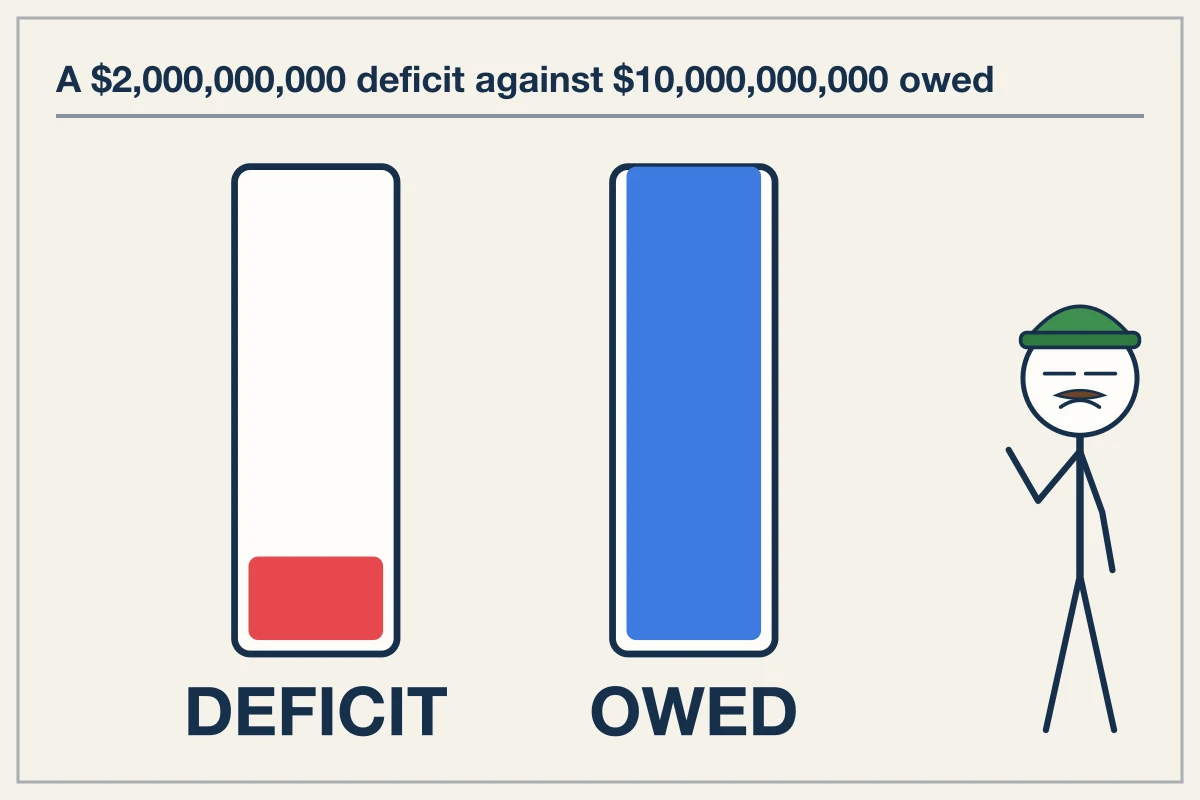
If an exchange enters bankruptcy with a $2,000,000,000 asset deficit against $10,000,000,000 in liabilities, the base asset recovery ratio is 80%. The trader's $100,000 nominal balance receives an immediate haircut of $20,000, leaving a maximum recoverable claim of $80,000.
If administration fees consume 5% of estate assets over a two-year proceeding, recoverable capital drops further. Calculation: $80,000 * 0.95 = $76,000 final cash payout.
Fixing claim values at petition date prices eliminates upside exposure. If the trader held 2 BTC as collateral valued at $16,800 per coin ($33,600 total margin value), and spot prices rise to $50,000 during bankruptcy, the claim remains capped at the original $33,600 petition value. The $66,400 price appreciation is retained by the estate structure.
Live Operational Costs Across Active Venues
While insolvency risk represents tail event execution failure, daily execution and holding costs vary across active perpetual venues. Funding rate differentials directly impact net position carry.
| Asset | Venue | 8h Funding Rate | 24h Volume | Spread vs Lowest Venue |
|---|---|---|---|---|
| ETH | mexc | +0.0006% | $8,717,409,819 | Baseline |
| ETH | okx | +0.0015% | $8,717,409,819 | 0.0009 percentage points |
| ETH | bitget | +0.0100% | $8,717,409,819 | 0.0094 percentage points |
| SOL | okx | -0.0094% | $1,517,611,877 | Baseline |
| SOL | mexc | -0.0049% | $1,517,611,877 | 0.0045 percentage points |
| SOL | bitget | +0.0044% | $1,517,611,877 | 0.0138 percentage points |
| BTC | okx | +0.0077% | $5,813,942,835 | Baseline |
| BTC | bitget | +0.0100% | $5,813,942,835 | 0.0023 percentage points |
| BTC | mexc | +0.0100% | $5,813,942,835 | 0.0023 percentage points |
Taker fee schedules alter entry and exit drag on capital.
| Exchange | Futures Maker Fee | Futures Taker Fee | Cost on $100,000 Taker Order |
|---|---|---|---|
| mexc | 0.0000% | 0.0200% | $20.00 |
| bitget | 0.0200% | 0.0300% | $30.00 |
| okx | 0.0200% | 0.0500% | $50.00 |
| bybit | 0.0200% | 0.0550% | $55.00 |
On a $100,000 SOL long position, holding on okx yields a daily funding payment of $28.20 (receiving 0.0094% every 8 hours), whereas holding the same long on bitget costs $13.20 per day (paying 0.0044% every 8 hours). The venue choice creates a $41.40 daily cash flow divergence per $100,000 of exposure.
Counterparty Risk Execution
Holding perpetual positions requires balancing order book depth against counterparty exposure. Excess margin deposited on an exchange functions as an uncompensated credit extension to the platform. Maintain on-exchange collateral strictly at the minimum threshold required to service open position margin and absorb expected price variance.