· four exchange APIs · rebuilt daily
Rollup Batches Cut L1 Posting Costs via Blob Space
Rollups compress execution costs by batching transaction data into L1 blobs while challenge windows enforce settlement finality.
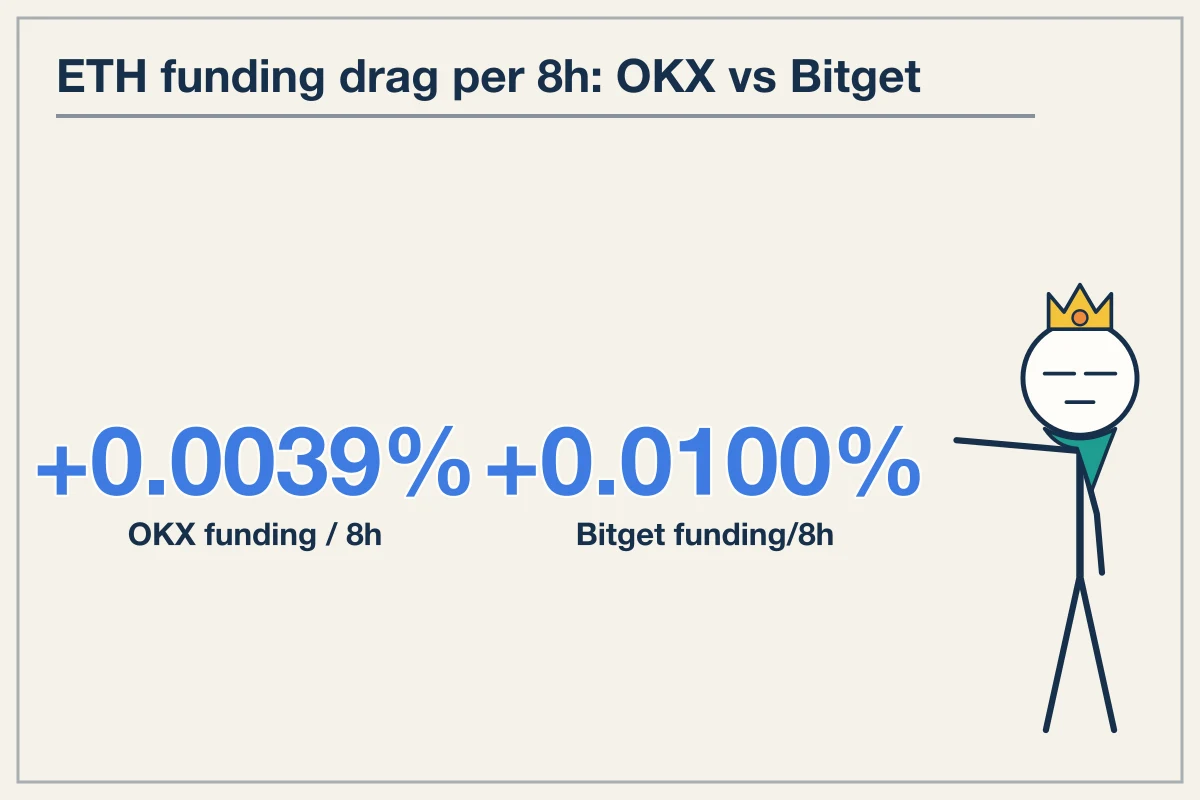
Rollup transfers reduce transaction overhead because L1 settlement costs are divided across thousands of batched operations rather than paid individually. On ETH perp venues, holding position collateral incurs variable funding drag, where OKX offers +0.0039% per 8h compared to Bitget at +0.0100% per 8h across $9,162,175,344 in 24-hour aggregate volume.
Mechanism of Rollup Transaction Costs
Rollup networks separate execution from settlement to reduce per-transaction fees. A transaction executed on a Layer 2 network incurs two distinct cost components: local execution gas and settlement posting gas.
Local execution gas covers virtual machine computation on the rollup sequencer. Because the rollup operates an isolated execution environment, this component costs a fraction of L1 gas. The settlement posting gas covers the data footprint submitted back to Layer 1 for data availability and state updates.
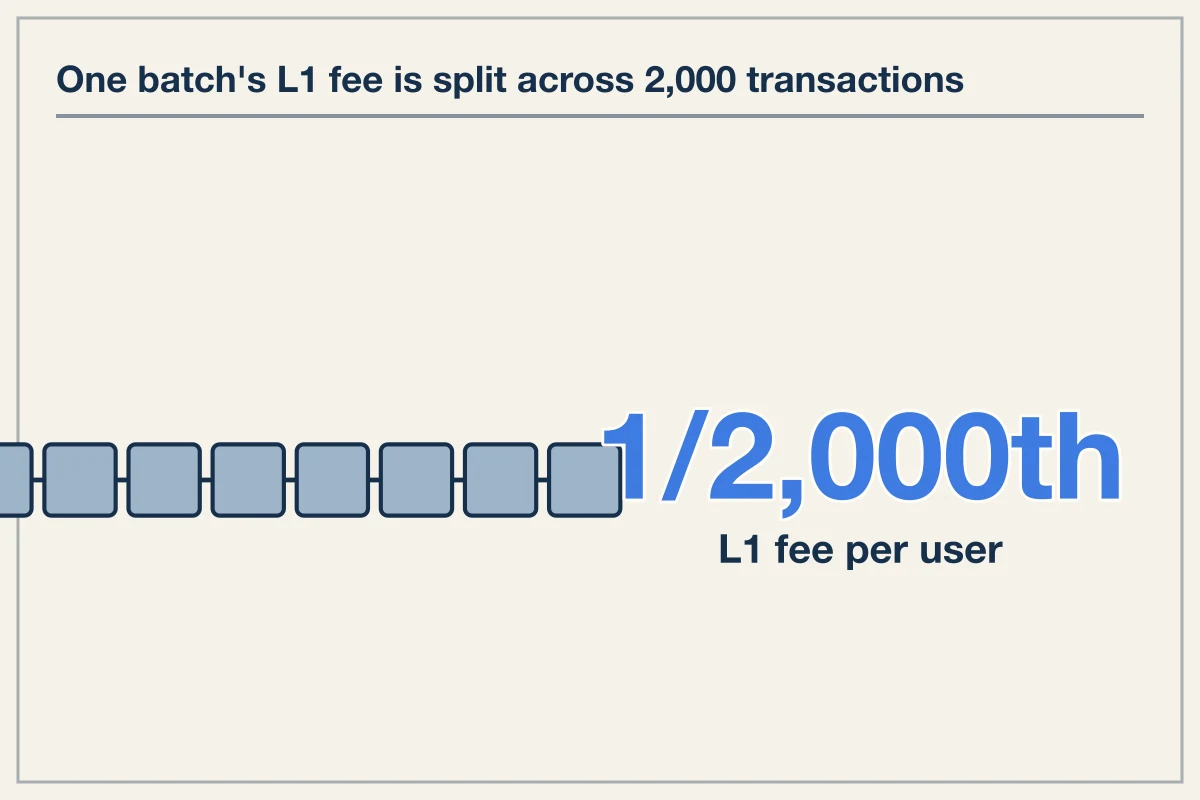
When a user submits a transfer or trade on a rollup, the sequencer processes the transaction off-chain, updates the internal L2 state, and aggregates thousands of individual transactions into a single batch. The total L1 posting cost of that batch is divided across all included transactions. If a batch contains 2,000 transactions, each user pays 1/2,000th of the base layer data payload fee.
Blob Data vs Calldata Storage Costs
Prior to blob storage integration, rollups posted batch transaction data to L1 as calldata. Calldata is permanent, non-modifiable EVM storage charged at 16 gas units per non-zero byte. Because calldata competes directly with base-layer contract execution for block space, rollup batch costs fluctuated with L1 execution spikes.
Blob data isolates data availability from execution memory. Blobs attach directly to L1 blocks as separate data sidecars. They persist on L1 nodes for approximately 18 days before being pruned, which is sufficient time for state verifiers to download and check batch validity.
Because blob space does not enter EVM execution memory, it is priced via an independent dynamic fee market. This separation reduces the data component of a rollup transaction from variable L1 execution gas rates down to a dedicated blob base fee.
Venue Execution and Holding Cost Mechanics
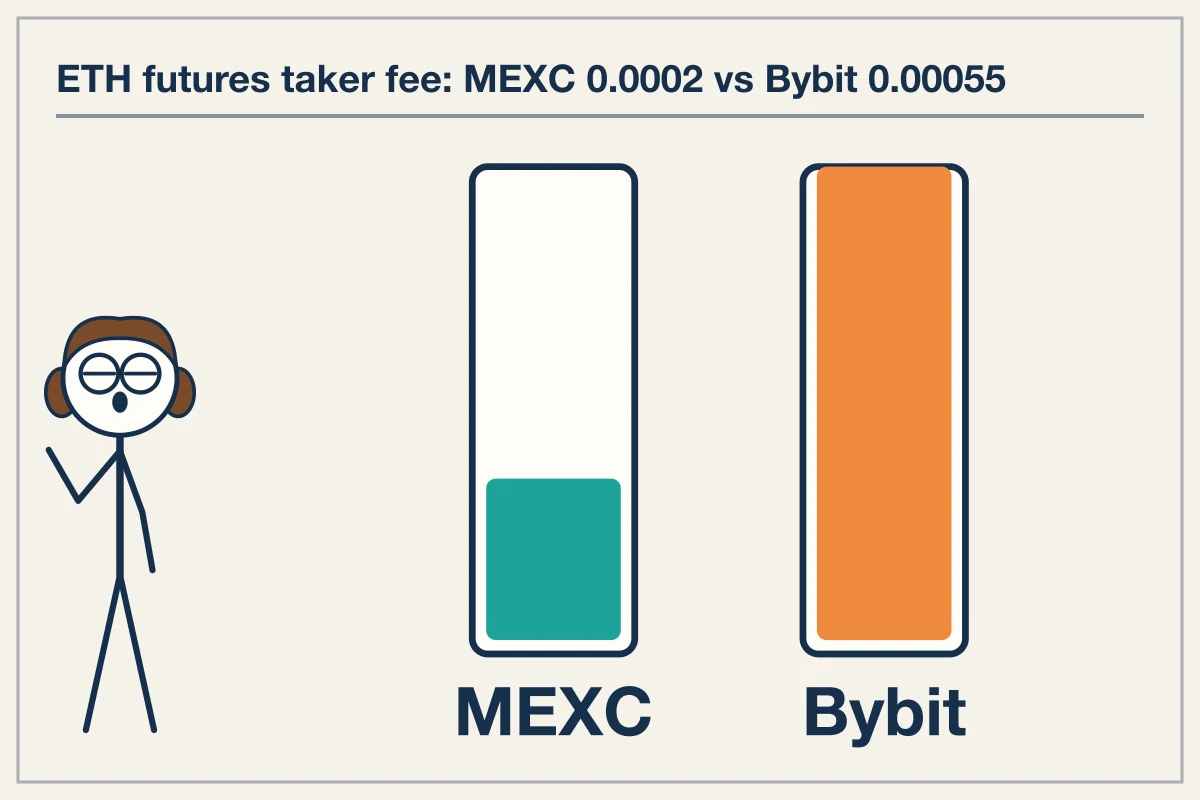
While rollups cut on-chain data costs, perpetual traders holding collateral across venues incur distinct execution taker fees and funding drag. The table below lists published futures fee schedules alongside current 8-hour funding rates for ETH across four major exchanges with $9,162,175,344 in 24-hour aggregate volume.
ETH Perpetual Drag and Execution Fees
| Venue | Futures Taker Fee | Futures Maker Fee | ETH 8h Funding Rate | 24h Funding Rate (3 Intervals) |
| Bitget | 0.0003 | 0.0002 | +0.0100% | +0.0300% |
| Bybit | 0.00055 | 0.0002 | +0.0070% | +0.0210% |
| MEXC | 0.0002 | 0.0000 | +0.0074% | +0.0222% |
| OKX | 0.0005 | 0.0002 | +0.0039% | +0.0117% |
The funding spread between OKX (+0.0039%) and Bitget (+0.0100%) is 0.0061 percentage points per 8-hour interval. Holding a long ETH position on OKX accrues 0.0117% in daily funding fees, compared to 0.0300% on Bitget.
SOL Perpetual Funding Spreads
For SOL perpetuals, which record $1,587,116,646 in 24-hour volume, funding rates diverge into negative territory on three venues.
| Venue | Futures Taker Fee | SOL 8h Funding Rate | 24h Funding Rate (3 Intervals) |
| Bitget | 0.0003 | +0.0058% | +0.0174% |
| Bybit | 0.00055 | -0.0062% | -0.0186% |
| MEXC | 0.0002 | -0.0023% | -0.0069% |
| OKX | 0.0005 | -0.0067% | -0.0201% |
The spread between OKX (-0.0067%) and Bitget (+0.0058%) is 0.0125 percentage points per 8 hours. Long positions on OKX receive funding payments from shorts, while long positions on Bitget pay funding to shorts.
Arithmetic of Short-Term vs Long-Term Fee Drag
To evaluate total cost over a given duration, combine round-trip taker fees with cumulative funding drag.
Consider a 100,000 long ETH position held for 24 hours (3 funding intervals).
On MEXC: Entry Taker Fee: 100,000 0.0002 = 20.00 Exit Taker Fee: 100,000 0.0002 = 20.00 24h Funding Cost: 100,000 (0.0074% 3) = 22.20 Total Cost: 20.00 + 20.00 + 22.20 = 62.20
On Bitget: Entry Taker Fee: 100,000 0.0003 = 30.00 Exit Taker Fee: 100,000 0.0003 = 30.00 24h Funding Cost: 100,000 (0.0100% 3) = 30.00 Total Cost: 30.00 + 30.00 + 30.00 = 90.00
On OKX: Entry Taker Fee: 100,000 0.0005 = 50.00 Exit Taker Fee: 100,000 0.0005 = 50.00 24h Funding Cost: 100,000 (0.0039% 3) = 11.70 Total Cost: 50.00 + 50.00 + 11.70 = 111.70
For a 24-hour holding period, MEXC yields a total cost of 62.20, Bitget yields 90.00, and OKX yields 111.70. Lower taker fees dominate cost structure over short holding periods, while funding rate differentials compound over extended durations.
Withdrawal Periods and Settlement Delays
Moving collateral between L2 rollups and L1 settlement layer introduces structural delays governed by proof architecture.
Optimistic Rollups assume off-chain transactions are valid by default. When a sequencer posts a state batch to L1, a 7-day challenge window opens. During this dispute period, any network participant can submit a fault proof asserting an invalid state transition. Collateral cannot be withdrawn through the native bridge to L1 until the 7-day window expires without a successful challenge.
Zero-Knowledge Rollups use validity proofs generated off-chain via cryptographic proof systems. The L1 contract verifies the validity proof upon submission. Once verified, the state root finalizes on L1. Withdrawals on ZK rollups are limited by proof computation time and batch aggregation intervals rather than a multi-day dispute window.
Third-party liquidity bridges bypass native dispute delays by providing immediate L1 liquidity in exchange for a fee. The bridge provider assumes the 7-day rollup settlement risk, effectively converting withdrawal wait times into a capital fee charged to the user.