· four exchange APIs · rebuilt daily
What are gas fees and how network congestion impacts collateral transfers
The finding
Gas fees are payments made to network validators to cover the computational energy and space required to process transactions on a blockchain.
On-chain transfers vary from fractions of a cent to tens of dollars based on current block space demand.
Understanding the breakdown between base fees and priority tips prevents stalled margin deposits.
What are gas fees and how block space pricing works
Traders moving collateral on-chain frequently ask what are gas fees before rebalancing across derivatives venues. Gas fees measure the raw computational effort required by network validators to execute a state change in a smart contract or process a transfer.
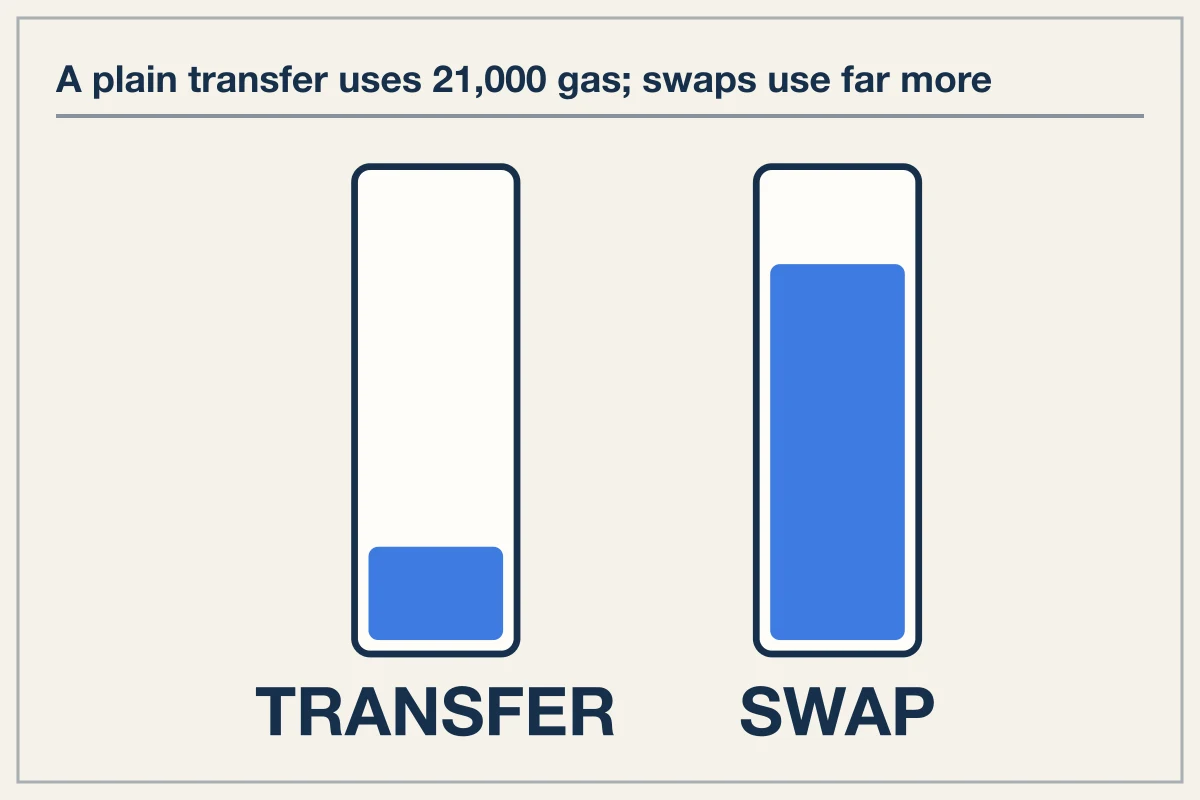
Every operation on a blockchain consumes a specific quantity of gas units. A standard native token transfer consumes 21,000 gas units, while complex smart contract interactions like decentralized exchange swaps or vault deposits consume significantly more. The total fee paid is the product of the gas units consumed and the current market price per unit of gas.
Block space is strictly limited per block. When transaction volume increases, users compete for inclusion by offering higher fees. This dynamic creates rapid price shifts where the cost of executing the exact same transaction can double within minutes during market volatility.
Worth knowing
A simple transfer uses a fixed amount of 21,000 gas units, but the price per unit shifts constantly based on block saturation.
Base fee versus priority fee mechanics
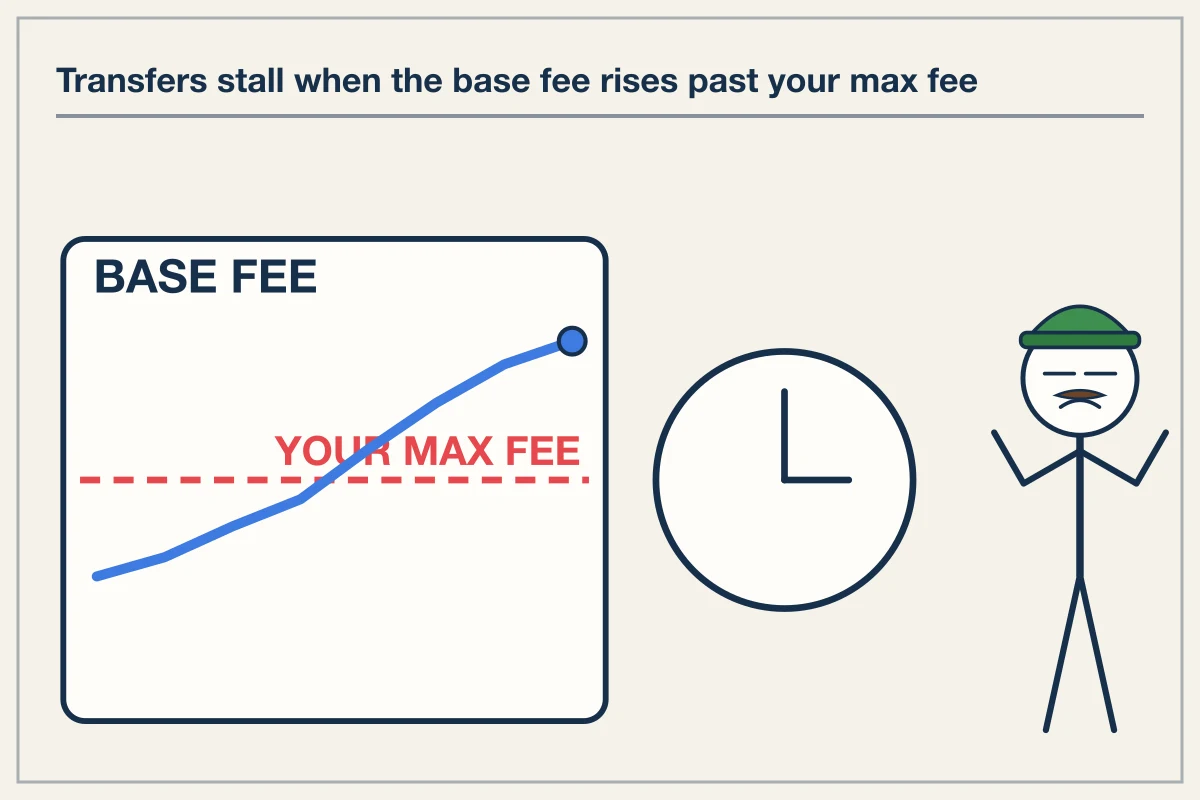
Modern network fee structures split the gas price into two distinct components: the base fee and the priority fee. The base fee is mandatory and is set automatically by the network protocol based on the fullness of the preceding block. If a block is more than 50% full, the base fee increases for the next block.
The base fee portion of the transaction cost is burned by the network rather than paid to block producers. To incentivize a validator to prioritize a transaction ahead of others in the mempool, traders add a priority fee, often called a tip.
When network congestion spikes, validators order transactions in the mempool strictly by the size of the priority fee. If your transaction carries a minimal tip during a period of high demand, validators will process higher-tipping transactions first, leaving yours pending in the queue.
Where this goes wrong
Setting a priority fee below the competitive mempool threshold leaves your transaction unconfirmed while the base fee continues to adjust upward.
Why stuck transactions are underpriced, not lost
A pending transaction that remains unconfirmed for hours is rarely lost or deleted from the network. It remains in the public mempool because its max fee per gas is lower than the current base fee required by the network.
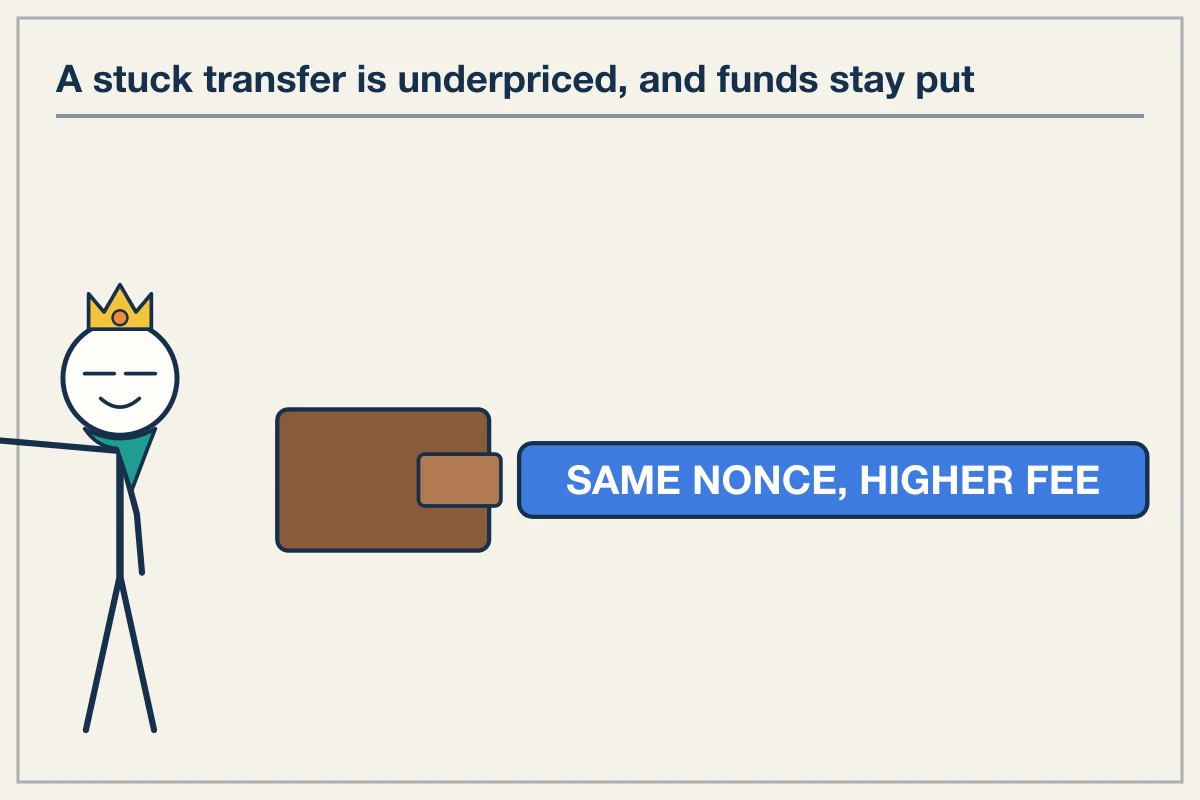
Until the base fee drops back down to match your specified maximum, or until you replace the transaction, validators will ignore it. The funds committed to an unconfirmed transaction remain in your balance on-chain, but the nonce assigned to that transaction prevents subsequent transactions from executing in order.
To resolve a stuck transfer, you must broadcast a replacement transaction with the identical nonce but a higher priority fee and max fee. Network nodes recognize the higher fee on the same nonce and replace the pending entry in the queue, unlocking your account sequence.
What to do instead
Replace a stalled transaction by broadcasting a new submission using the same account nonce with an increased priority fee.
Reading fee estimators instead of wallet defaults
Default fee suggestions inside wallet interfaces often rely on lagging historical averages. During sharp market moves, these static estimates frequently underprice the required priority fee or overpay during sudden drops in activity.
A live fee estimator displays current gas prices across three tiers: low, market, and aggressive. The critical metric to inspect is the current pending base fee alongside the 50th and 90th percentile priority tips over the last five blocks.
Comparing these numbers directly against wallet defaults prevents overpaying for routine transfers or missing a liquidation buffer while waiting for a low-fee deposit to clear. When timing is critical, manual entry of the 90th percentile priority tip ensures block inclusion in the immediate next block.
On-chain gas and venue execution costs
Rebalancing collateral across derivatives exchanges requires accounting for both network gas fees and exchange execution fees. When moving capital from on-chain storage to perpetual venues, the gas cost represents a fixed entry friction, while exchange taker fees scale directly with position size.
For example, holding positions on venues like MEXC, OKX, Bitget, or Bybit involves varying cost structures for both perpetual positions and funding settlement rates across assets.
| Venue | Futures Maker Fee | Futures Taker Fee | ETH 8h Funding Rate | SOL 8h Funding Rate |
|---|---|---|---|---|
| MEXC | 0.0000% | 0.00020% | +0.0037% | +0.0023% |
| OKX | 0.00020% | 0.00050% | +0.0044% | +0.0003% |
| Bitget | 0.00020% | 0.00030% | +0.0063% | +0.0065% |
| Bybit | 0.00020% | 0.00055% | +0.0075% | -0.0084% |
Across ETH perpetuals with 24-hour volume of $5,181,102,431, the funding rate spread between MEXC at +0.0037% and Bybit at +0.0075% equals 0.0038 percentage points per 8-hour period. On SOL, Bybit offers a negative funding rate of -0.0084% compared to Bitget at +0.0065%, presenting a spread of 0.0149 percentage points every 8 hours.
Calculating total cost requires adding on-chain gas costs to the venue's taker fee—such as 0.00020% on MEXC versus 0.00055% on Bybit—alongside expected funding payments over the holding period.
What are gas fees on blockchain networks?
Gas fees are the payments required to compensate network validators for the computational resources used to process and finalize transactions. They are determined by multiplying the gas units consumed by the current gas price per unit.
Why do gas fees change so quickly throughout the day?
Gas fees fluctuate based on network block space demand and congestion. When many users submit transactions simultaneously, competition drives up priority tips and dynamic base fees until transaction volume cools down.
How do you fix a stuck transaction that has not confirmed?
You can resolve a stuck transaction by submitting a replacement transaction using the exact same nonce with a higher priority fee and max fee. This instructs network validators to overwrite the underpriced pending transaction in the mempool.
Is a stuck transaction lost forever if the fee is too low?
No, funds in an unconfirmed transaction are not lost or spent. The transaction simply waits in the mempool until network base fees fall to match your offer, or until it is replaced or dropped by network nodes.