· four exchange APIs · rebuilt daily
Supercar Crypto Settlement Costs $250 in Taker Fees Per $250k
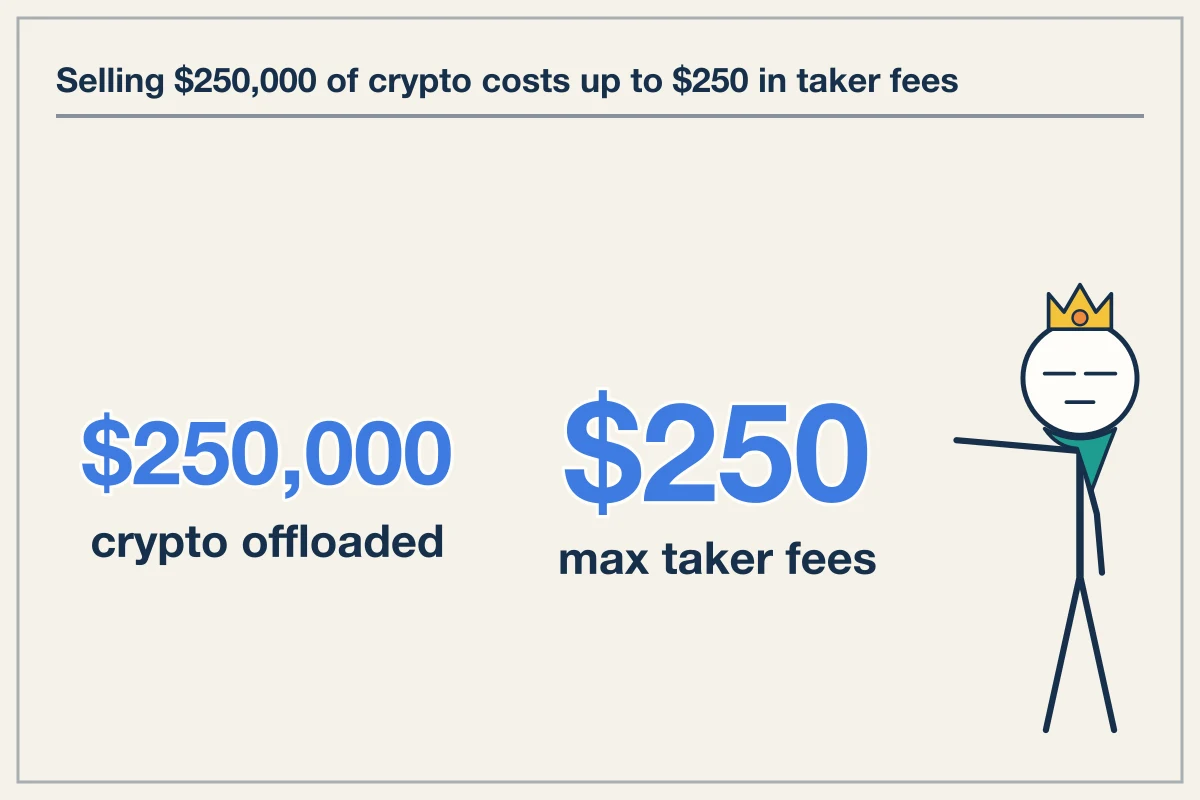
Offloading $250,000 in crypto for a supercar triggers taxable property disposal rules and costs up to $250 in venue taker fees plus wire settlement lag.
Settlement Mechanics and Taker Fee Offload
Settling a $250,000 vehicle purchase directly or through spot liquidation costs between $125 and $250 in default venue taker fees before banking clearance delays. Dealerships generally do not accept direct, on-chain wallet transfers due to compliance requirements and price volatility risk. Settlement relies on two pathways: a third-party payment gateway that locks an exchange rate for 15 minutes and liquidates to fiat immediately, or direct spot liquidation by the buyer on an exchange followed by a bank wire to the dealership.
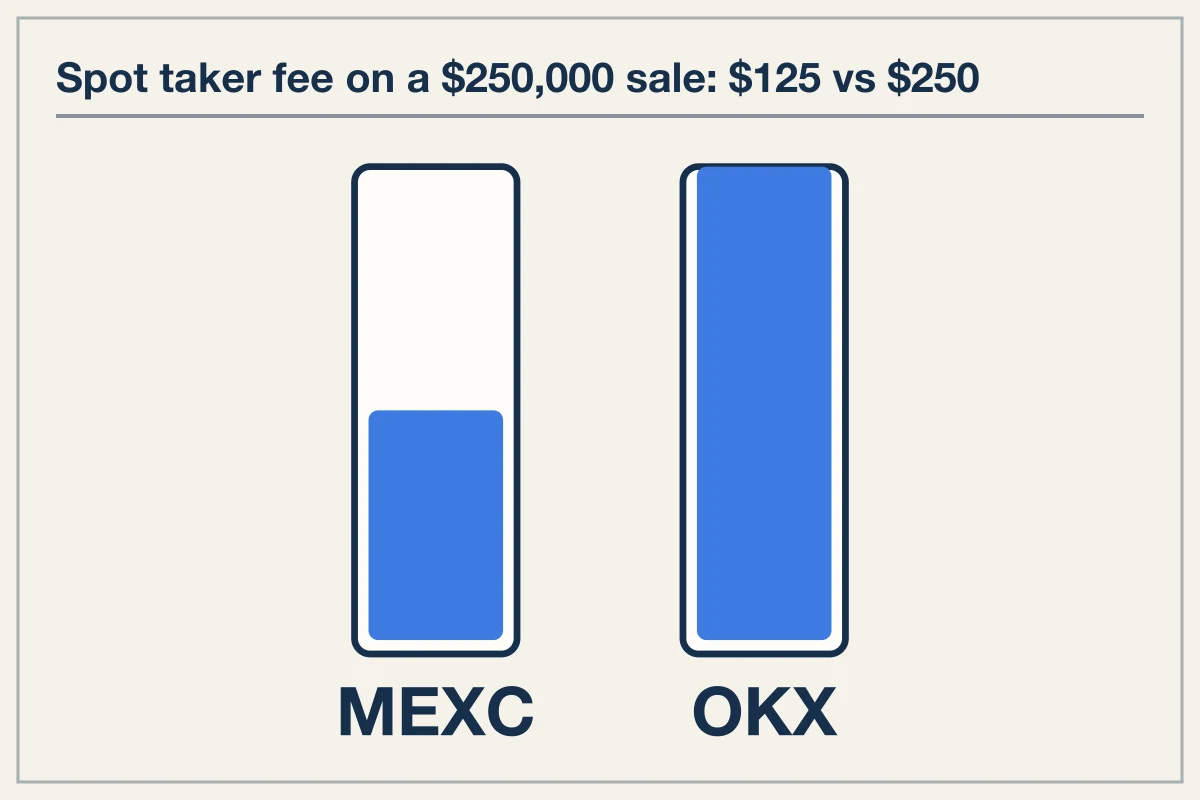
If the buyer liquidates spot assets manually to wire fiat, venue fee schedules dictate the upfront execution cost. On default fee tiers, spot taker rates range from 0.05% to 0.10%.
| Venue | Spot Maker Fee | Spot Taker Fee | Futures Maker Fee | Futures Taker Fee |
|---|---|---|---|---|
| Bitget | 0.100% | 0.100% | 0.020% | 0.030% |
| Bybit | 0.100% | 0.100% | 0.020% | 0.055% |
| MEXC | 0.000% | 0.050% | 0.000% | 0.020% |
| OKX | 0.080% | 0.100% | 0.020% | 0.050% |
Executing a $250,000 spot sale on MEXC costs 0.0005 times $250,000, which equals $125 in taker fees. Executing the same trade on OKX, Bitget, or Bybit at default spot taker tiers of 0.0010 costs $250.
Delta Hedging During Settlement Clearance
When using a payment processor or initiating a fiat wire, settlement is not instant. Banking wires require 24 to 72 hours to clear into the dealer account. A trader holding asset exposure during this clearance window can hedge price delta using perpetual futures.
Holding a perpetual futures position incurs funding payments every 8 hours. Funding rates vary across venues and underlying collateral assets.
| Asset | Venue | 8h Funding Rate | 24h Normalized Rate | 24h Volume |
|---|---|---|---|---|
| ETH | MEXC | +0.0010% | +0.0030% | $8,823,525,220 |
| ETH | OKX | +0.0012% | +0.0036% | $8,823,525,220 |
| ETH | Bitget | +0.0100% | +0.0300% | $8,823,525,220 |
| BTC | OKX | +0.0075% | +0.0225% | $5,885,793,961 |
| BTC | Bitget | +0.0100% | +0.0300% | $5,885,793,961 |
| BTC | MEXC | +0.0100% | +0.0300% | $5,885,793,961 |
| SOL | OKX | -0.0101% | -0.0303% | $1,569,056,665 |
| SOL | MEXC | -0.0045% | -0.0135% | $1,569,056,665 |
| SOL | Bitget | +0.0053% | +0.0159% | $1,569,056,665 |
For a $250,000 long ETH position held over a 72-hour wire delay on Bitget, the 8-hour funding rate is +0.0100%. Three funding intervals per day yield a daily rate of 0.0300%. Multiply $250,000 by 0.0003 to get $75 per day. Over a 3-day clearance window of 9 funding intervals, total funding paid equals $225.
If the same ETH long position is held on MEXC, the 8-hour funding rate is +0.0010%, yielding a daily rate of 0.0030%. On $250,000, daily funding is $7.50. Over 3 days of 9 intervals, total funding paid is $22.50. The venue spread to hold a long ETH position over a 3-day wire period is $202.50.
For BTC positions, OKX offers the lowest long funding cost at +0.0075% per 8h (0.0225% per 24h), resulting in a daily cost of $56.25 on a $250,000 position. Bitget and MEXC both charge +0.0100% per 8h (0.0300% per 24h), resulting in a daily cost of $75.00.
For SOL positions, OKX exhibits negative funding at -0.0101% per 8h (-0.0303% per 24h), while MEXC is at -0.0045% per 8h (-0.0135% per 24h). Bitget charges positive funding at +0.0053% per 8h (+0.0159% per 24h), making OKX the lowest-cost venue to hold a long position.
Tax Disposal Events in Major Jurisdictions
Buying a physical car directly with cryptocurrency or liquidating crypto to fiat for purchase triggers a capital gains tax disposal event in major jurisdictions including the United States, the United Kingdom, and Australia.
Tax authorities treat cryptocurrency as property rather than currency. Executing a transfer of crypto directly to a dealership or payment gateway constitutes a taxable disposition at fair market value at the exact time of the transaction.
Calculations follow a basic cost basis structure:
Capital Gain or Loss = Fair Market Value at Disposal — Adjusted Cost Basis
Assume an investor acquired 5 BTC at an adjusted cost basis of $20,000 per token, totaling $100,000. The investor transfers 5 BTC to purchase a vehicle valued at $250,000, representing a $50,000 per token fair market value.
Fair market value at disposal is $250,000. Subtracting the $100,000 cost basis leaves a taxable capital gain of $150,000. Under United States tax code, holding the asset for longer than 12 months subjects this $150,000 to long-term capital gains rates of up to 20% federal tax plus applicable net investment income tax. Holding the asset for under 12 months taxes the $150,000 as ordinary income up to the 37% federal rate.
If the venue requires spot liquidation prior to wiring, two steps occur: spot disposal triggering capital gains rules, followed by a fiat bank transfer. If slippage occurs during spot liquidation, the actual realized price becomes the fair market value for disposal calculations.
Executing a futures hedge on perps creates a separate taxable event under mark-to-market accounting depending on jurisdiction and trader classification. Realized losses or gains on the perp hedge position do not offset spot capital gains automatically on a 1:1 basis in all tax regimes without specific hedge accounting elections.
Execution Routing and Execution Drift
Offloading spot positions for vehicle purchases requires calculating venue taker fees, funding rate exposure during settlement clearance, and realized gain disposal obligations simultaneously. Spot liquidation on lower-taker venues reduces upfront conversion loss, while selecting negative or low positive funding venues reduces holding costs during bank clearance delays.