· four exchange APIs · rebuilt daily
Stop-Limit Orders Fail in Fast Moves While Post-Only Cuts Fee Drag
Post-only flags prevent maker-taker fee conversion while stop-limit orders risk non-execution during fast price moves across major futures venues.
Execution Mechanics and Fee Disparities
Crossing the order book with a market order incurs a taker fee of up to 0.055% per side, while a post-only limit order caps execution fees at 0.020% or 0.000%.
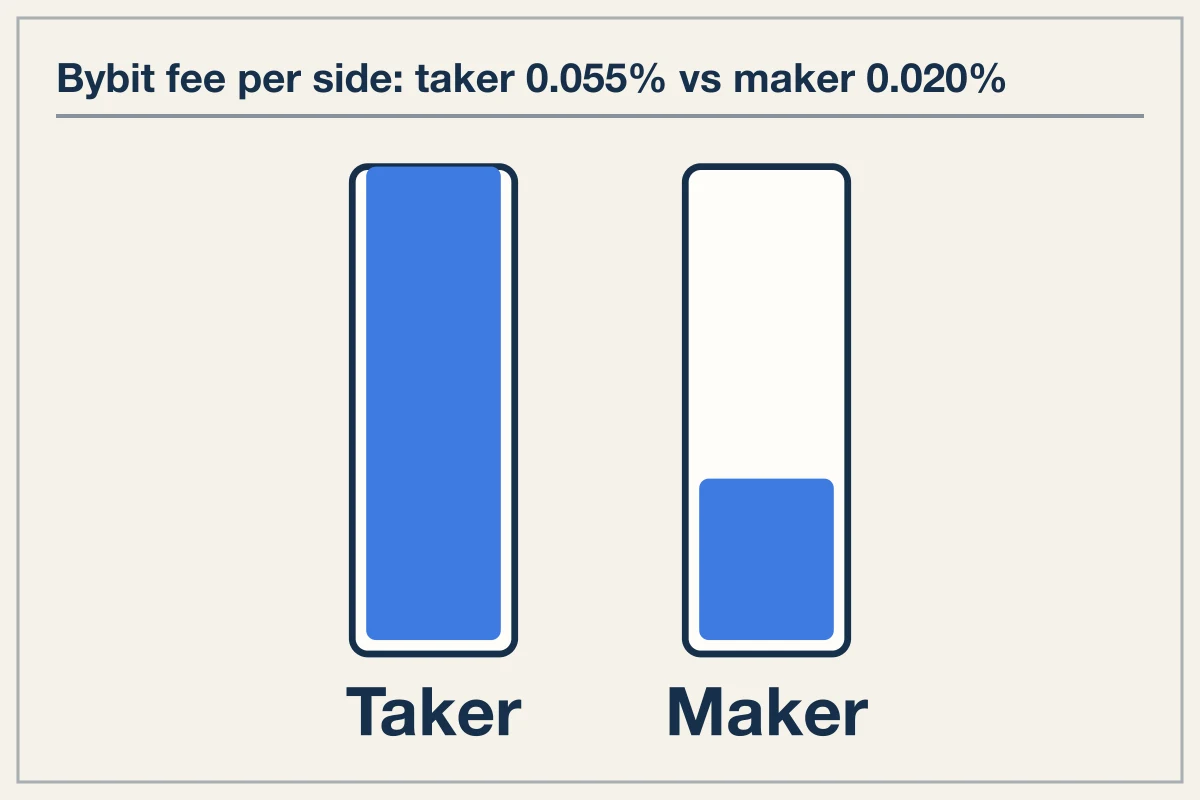
When an order matches immediately against existing liquidity in the order book, the matching engine processes it as a taker order. When an order rests on the book before matching, it acts as a maker order. Fast price action causes limit orders submitted without execution flags to cross the bid-ask spread, executing instantly as taker orders and incurring higher fee tiers.
The post-only flag instructs the matching engine to cancel the order if it would execute immediately as a taker. This prevents unintended fee escalation caused by bid-ask spread shifts between order placement and engine matching.
| Exchange | Futures Maker Fee | Futures Taker Fee | Taker Round-Trip (100,000 USD) | Maker Round-Trip (100,000 USD) | Post-Only Savings (100,000 USD) |
|---|---|---|---|---|---|
| Bitget | 0.020% | 0.030% | 60.00 USD | 40.00 USD | 20.00 USD |
| Bybit | 0.020% | 0.055% | 110.00 USD | 40.00 USD | 70.00 USD |
| MEXC | 0.000% | 0.020% | 40.00 USD | 0.00 USD | 40.00 USD |
| OKX | 0.020% | 0.050% | 100.00 USD | 40.00 USD | 60.00 USD |
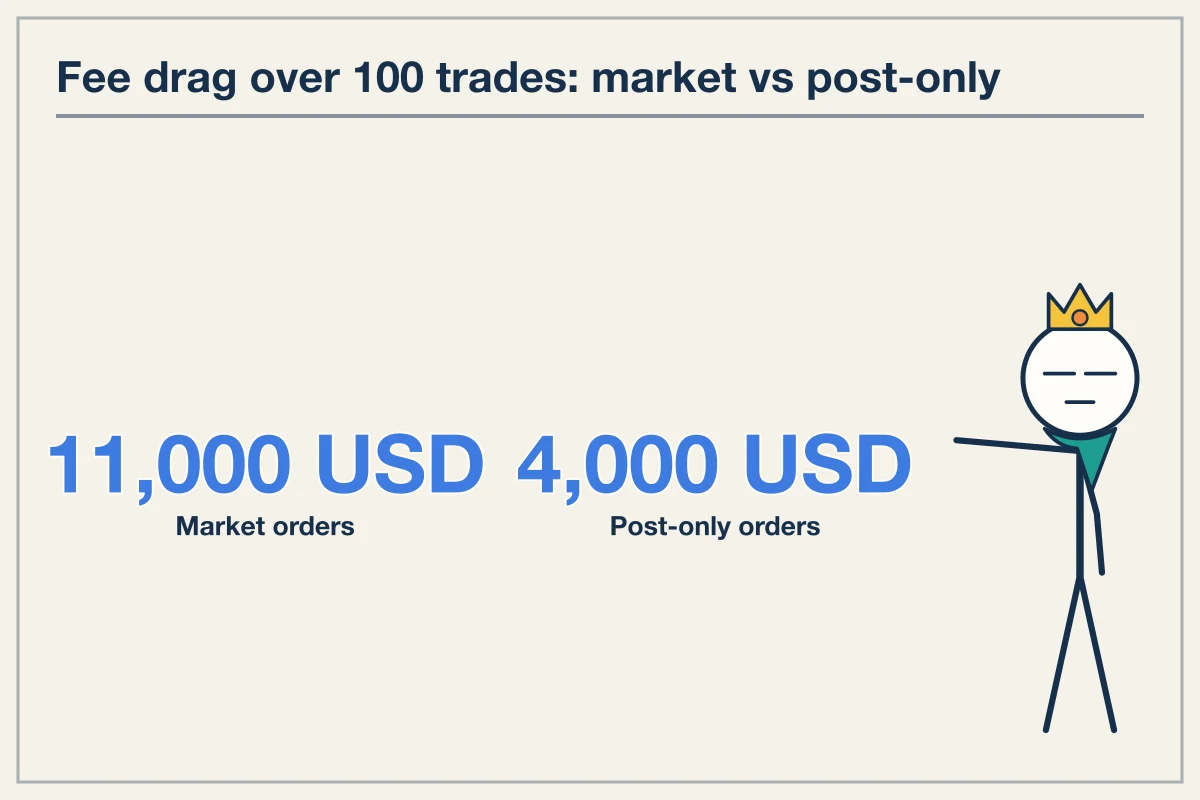
On Bybit, entering and exiting a 100,000 USD position using market orders incurs a 0.055% fee on entry (55.00 USD) and 0.055% on exit (55.00 USD), totaling 110.00 USD in fee drag. Using post-only limit orders reduces entry and exit fees to 0.020% (20.00 USD each), preserving 70.00 USD per round trip. Across 100 complete trade cycles of 100,000 USD notional volume, fee drag reaches 11,000 USD for market orders compared to 4,000 USD for post-only limit orders.
Stop-Limit Failure Modes in Fast Volatility
Stop-market orders guarantee execution at variable prices, whereas stop-limit orders guarantee price limits at the risk of total execution failure.
A stop-market order monitors the benchmark price. When the trigger threshold is reached, the venue submits a market order to the engine. The order matches against available book depth, accepting taker fees and market slippage to ensure position exit.
A stop-limit order submits a limit order at a specified limit price once triggered. If market price moves faster than the matching engine processes order placement, price moves past the limit price before the order rests on the order book.
Consider a long position of 10 ETH entered at 3,000 USD, representing 30,000 USD in notional value, with a maintenance liquidation price of 2,700 USD. To manage risk, a stop-limit order is set with a trigger price of 2,900 USD and a limit price of 2,895 USD.
During a rapid market sell-off, price moves from 2,905 USD to 2,880 USD across a single book update:
- Price breaches the 2,900 USD trigger.
- The exchange submits a limit sell order at 2,895 USD.
- The highest available bid on the book is 2,880 USD.
- The limit sell order rests unfilled at 2,895 USD because no buyers exist at or above that price.
- The order remains unexecuted as price drops to 2,700 USD, causing forced liquidation of the 30,000 USD position.
Replacing the stop-limit with a stop-market order fires a market sell at the 2,900 USD trigger. If execution slips to the 2,880 USD bid, the position closes with a realized loss of 1,200 USD (10 ETH * 120 USD price decline), avoiding complete account margin depletion at 2,700 USD.
Position Management Controls: Reduce-Only
The reduce-only flag restricts an order to decreasing or closing an existing position size.
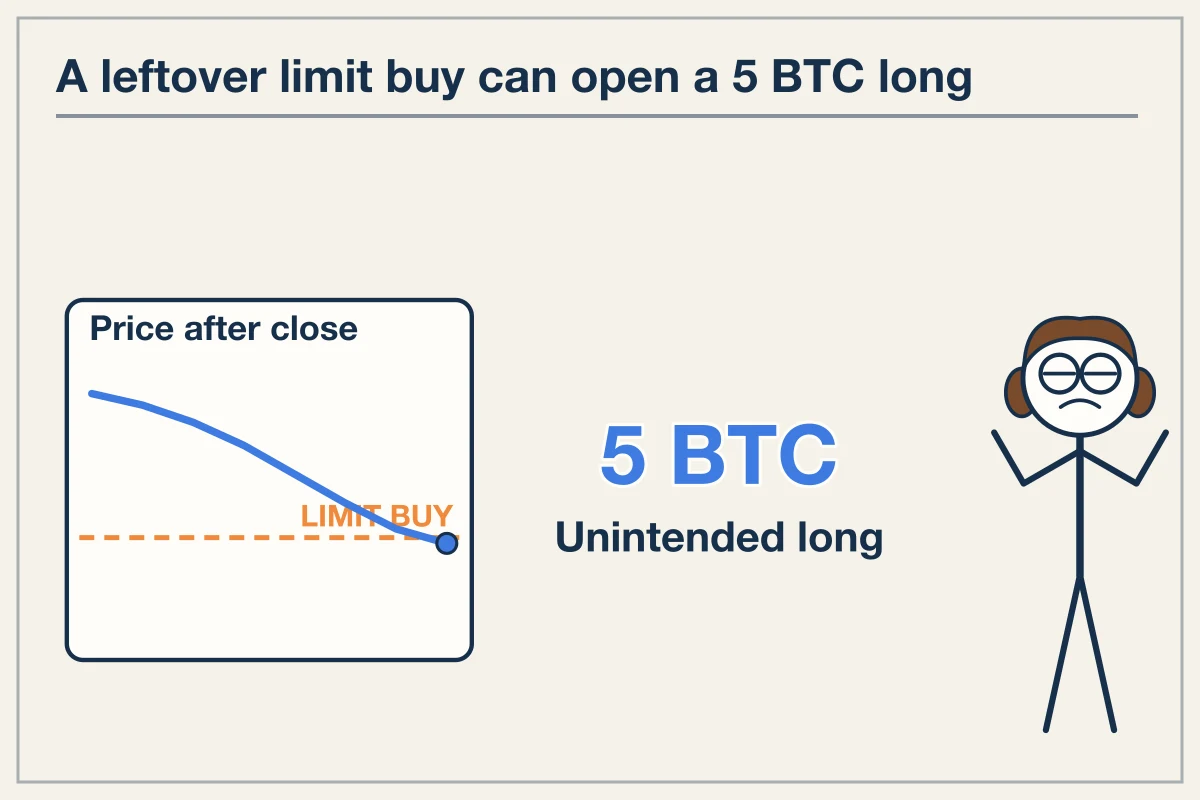
If a trader holds a short position of 5 BTC and places a limit buy order of 5 BTC to take profit, that order rests in the book until matched or cancelled. If the trader manually closes the 5 BTC short position using a market order, the resting limit buy order remains active. If price later falls to the limit price, the engine executes the order, opening an unintended 5 BTC long position.
Attaching the reduce-only flag to the limit buy order causes the exchange to cancel or downscale the order automatically once the open position drops to zero.
Live Carrying Costs Across Venues
Order execution strategy intersects directly with holding costs over time. Funding rate spreads across major exchanges offset or compound transaction fee drag.
| Asset | Lowest Funding Venue | Rate (8h) | Highest Funding Venue | Rate (8h) | 8h Spread | 24h Volume |
|---|---|---|---|---|---|---|
| ETH | OKX | +0.0028% | Bitget | +0.0100% | 0.0072% | $9,004,367,234 |
| BTC | OKX | +0.0077% | Bybit | +0.0100% | 0.0023% | $5,815,551,415 |
| SOL | OKX | -0.0088% | Bitget | +0.0057% | 0.0145% | $1,574,345,384 |
| ZEC | MEXC | +0.0015% | Bitget | +0.0100% | 0.0085% | $774,438,081 |
| XRP | Bybit | -0.0041% | Bitget | +0.0043% | 0.0084% | $505,727,323 |
| XAU | MEXC | +0.0072% | OKX | +0.0209% | 0.0137% | $504,549,644 |
On SOL perps, holding a 100,000 USD long position on Bitget incurs a positive funding payment of +0.0057% (5.70 USD) paid to short positions every 8 hours, totaling 17.10 USD daily. Holding the same 100,000 USD long on OKX receives a funding payment of 0.0088% (8.80 USD) every 8 hours, yielding 26.40 USD daily. The yield divergence between venues equals 43.50 USD per day per 100,000 USD notional.
Execution Rules in Market Stress
Stop-market orders accept bid-ask slippage and higher taker fees to eliminate the catastrophic tail risk of unexecuted resting orders during liquidity gaps. Using post-only flags on all limit entries guarantees maker fee pricing by rejecting orders that would otherwise cross shifted order book spreads during placement latency windows.