· four exchange APIs · rebuilt daily
Liquidations Trigger on Mark Price to Stop Whipsaw Losses
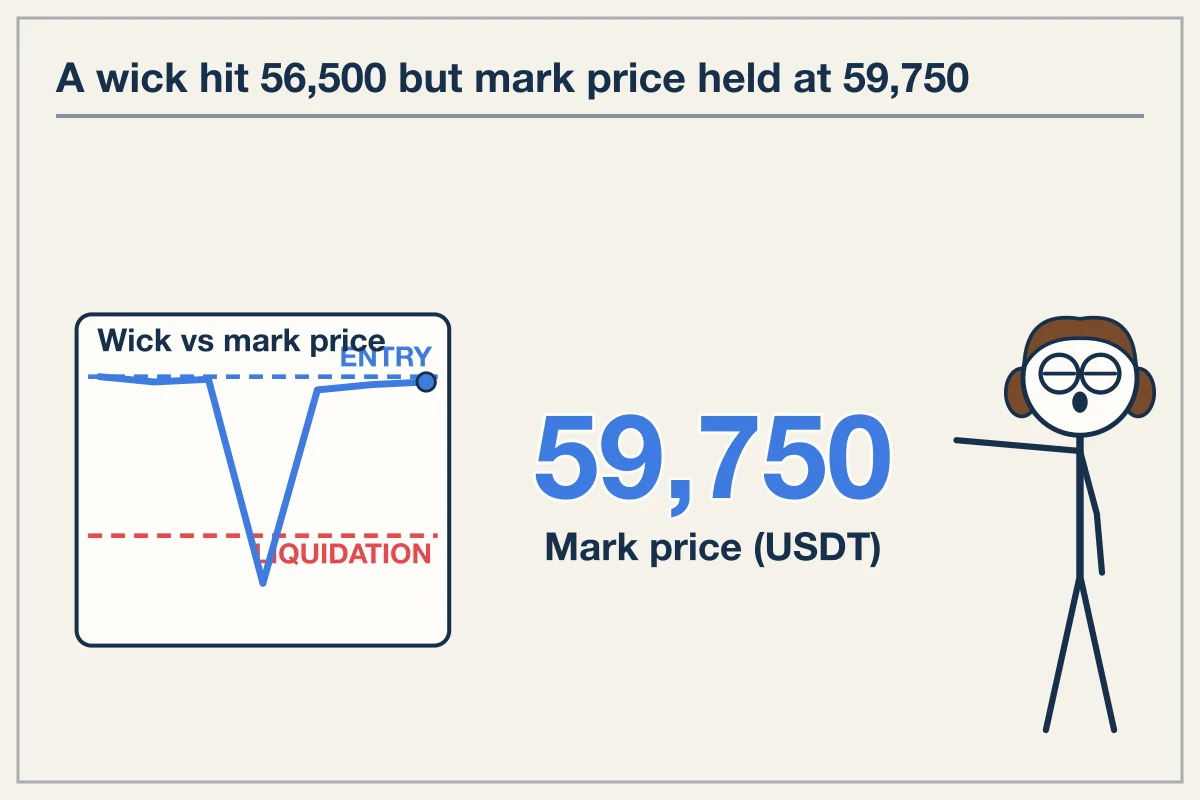
Perpetual swaps liquidate positions based on index-smoothed mark price rather than volatile order book trades to prevent cascade liquidations.
Perpetual futures exchanges evaluate liquidations against mark price instead of last traded price to prevent artificial cascades caused by order book illiquidity. A single market order can sweep a thin order book, moving the last traded price down 5% for several milliseconds. If liquidations executed on last traded price, that localized fill would force a margin call, liquidation sell orders, and further cascading liquidations. Mark price decouples margin calculations from momentary order book imbalances.
Mechanics of Mark Price Calculation
Mark price uses an index of underlying spot market prices combined with a moving average of the perpetual swap basis. The spot index takes real-time prices from major spot venues, removing the highest and lowest values to prevent single-venue manipulation.
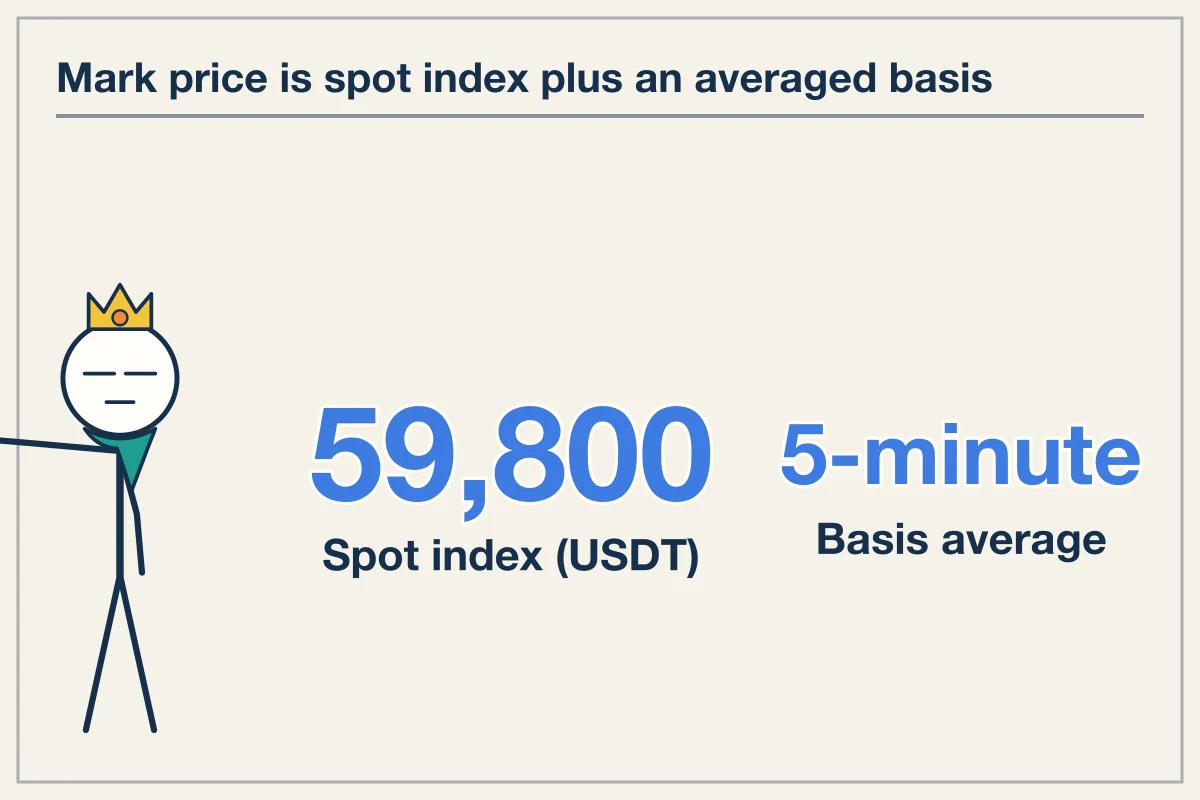
The venue adds a smoothed basis calculation to this spot index. The standard basis calculation measures the difference between the perpetual order book fair price and the spot index.
Basis = Mid Price — Spot Index
Exchanges apply an Exponential Moving Average or simple moving average over a 5-minute to 15-minute window to this basis.
Mark Price = Spot Index + Moving Average of Basis
When order book liquidity thins, mid price fluctuates rapidly, but the moving average dampens the movement. This structural lag keeps mark price near true spot market value while reflecting systemic funding bias.
Worked Example: Flash Wick Survival
Consider a trader holding a long position on 1 BTC contract purchased at 60,000 USDT using 20x leverage. Initial margin is 3,000 USDT. The venue sets the maintenance margin rate at 0.5%, requiring 300 USDT in maintenance equity.
Liquidation triggers when position equity falls below the maintenance margin. Required equity loss for liquidation = Initial Margin — Maintenance Margin Required equity loss = 3,000 — 300 = 2,700 USDT. Liquidation price threshold = 60,000 — 2,700 = 57,300 USDT.
A large market order hits the perpetual swap book, sweeping bids down to 56,500 USDT before market makers restore order book depth. The last traded price registers as 56,500 USDT.
Concurrently, spot exchanges retain deep liquidity. The spot index price remains at 59,800 USDT. The 5-minute moving average of the basis sits at negative 50 USDT.
Mark Price = 59,800 — 50 = 59,750 USDT.
The exchange liquidation engine queries the mark price:
- Last Traded Price: 56,500 USDT (Below 57,300 USDT liquidation threshold)
- Mark Price: 59,750 USDT (Above 57,300 USDT liquidation threshold)
Because margin health depends on mark price, the position remains open. The trader absorbs zero liquidation penalty fees. Had the system marked to last price, the trader would face forced market closure and a liquidation fee penalty based on the venue's taker schedule.
Venue Fee Schedules and Execution Costs
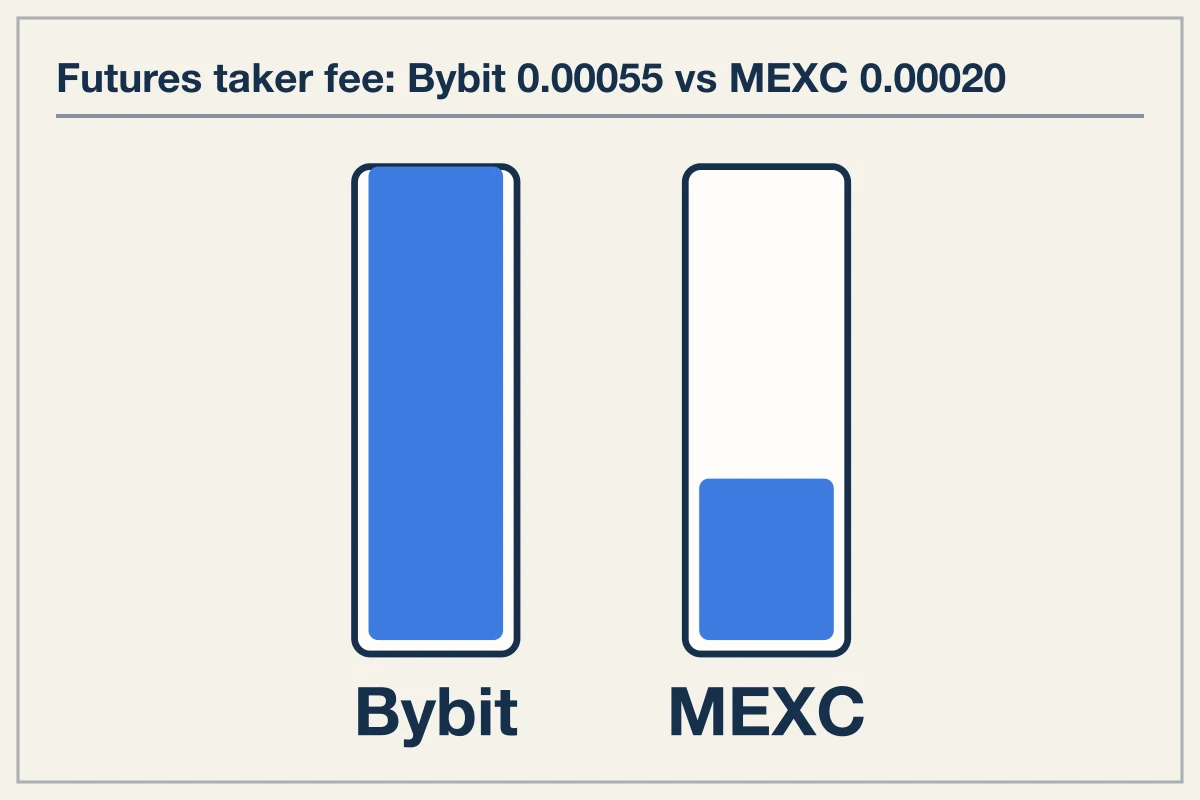
Liquidation engines execute forced closures via taker orders. The cost of liquidation includes both the price slippage and the venue taker fee. Published baseline futures fee structures differ across major venues.
| Venue | Spot Maker Fee | Spot Taker Fee | Futures Maker Fee | Futures Taker Fee |
|---|---|---|---|---|
| Bitget | 0.0010 | 0.0010 | 0.0002 | 0.00030 |
| Bybit | 0.0010 | 0.0010 | 0.0002 | 0.00055 |
| MEXC | 0.0000 | 0.0005 | 0.0000 | 0.00020 |
| OKX | 0.0008 | 0.0010 | 0.0002 | 0.00050 |
Higher taker fees accelerate capital depletion during forced liquidations. A venue charging 0.00055 futures taker fee deducts 55 USDT per 100,000 USDT forced volume, compared to 20 USDT on a venue with a 0.00020 taker fee.
Current Funding Rates Across Venues
Mark price formula incorporates funding rate differentials over 8-hour intervals. Positive funding rates push mark price above spot index price over time, while negative funding rates pull mark price below spot index price.
| Asset | Venue | 8h Funding Rate | 8h Spread | Cheapest Long Venue | 24h Volume |
|---|---|---|---|---|---|
| ETH | MEXC / OKX / Bitget | +0.0009% / +0.0016% / +0.0100% | 0.0091% | MEXC | $8,758,095,492 |
| BTC | OKX / Bitget / MEXC | +0.0078% / +0.0100% / +0.0100% | 0.0022% | OKX | $5,844,276,656 |
| SOL | OKX / MEXC / Bitget | -0.0096% / -0.0047% / +0.0047% | 0.0143% | OKX | $1,557,491,924 |
| ZEC | OKX / MEXC / Bitget | +0.0003% / +0.0011% / +0.0100% | 0.0097% | OKX | $777,724,798 |
| XRP | OKX / MEXC / Bitget | -0.0006% / +0.0003% / +0.0049% | 0.0055% | OKX | $499,310,127 |
| XAU | Bitget / MEXC / OKX | +0.0169% / +0.0194% / +0.0327% | 0.0158% | Bitget | $447,958,962 |
When funding rates diverge across venues, mark prices for the same underlying contract deviate. Holding positions on venues where funding aligns favorably with position direction avoids unnecessary basis drag against mark price.
How to Audit Your Venue's Mark Price
Exchanges display index weightings and mark price formulas in contract specifications documentation. To verify your venue's mark price mechanism:
- Access the API endpoint or contract details page for the trading pair.
- Confirm the underlying spot index exchanges. Venues using fewer than three constituent spot exchanges increase exposure to single-venue spot anomalies.
- Identify the smoothing window for the funding basis. Most venues employ a moving average calculated over 5-minute, 15-minute, or 60-minute windows.
- Monitor the mark price spread against order book last price on the trading interface. A wide spread indicates thin local liquidity or aggressive funding accrual.
If mark price strays significantly from spot index without high funding rates, the venue's order book is exhibiting persistent structural premium or discount. Check the margin ratio indicator in the trading console, as it measures remaining maintenance equity directly against mark price in real time.