· four exchange APIs · rebuilt daily
Brickell Tax Savings Are Erased By Venue Funding Rate Spreads
Florida tax benefits draw crypto capital to Brickell, but carry cost spreads across perpetual venues reach 0.0344% per 8 hours on active pairs.
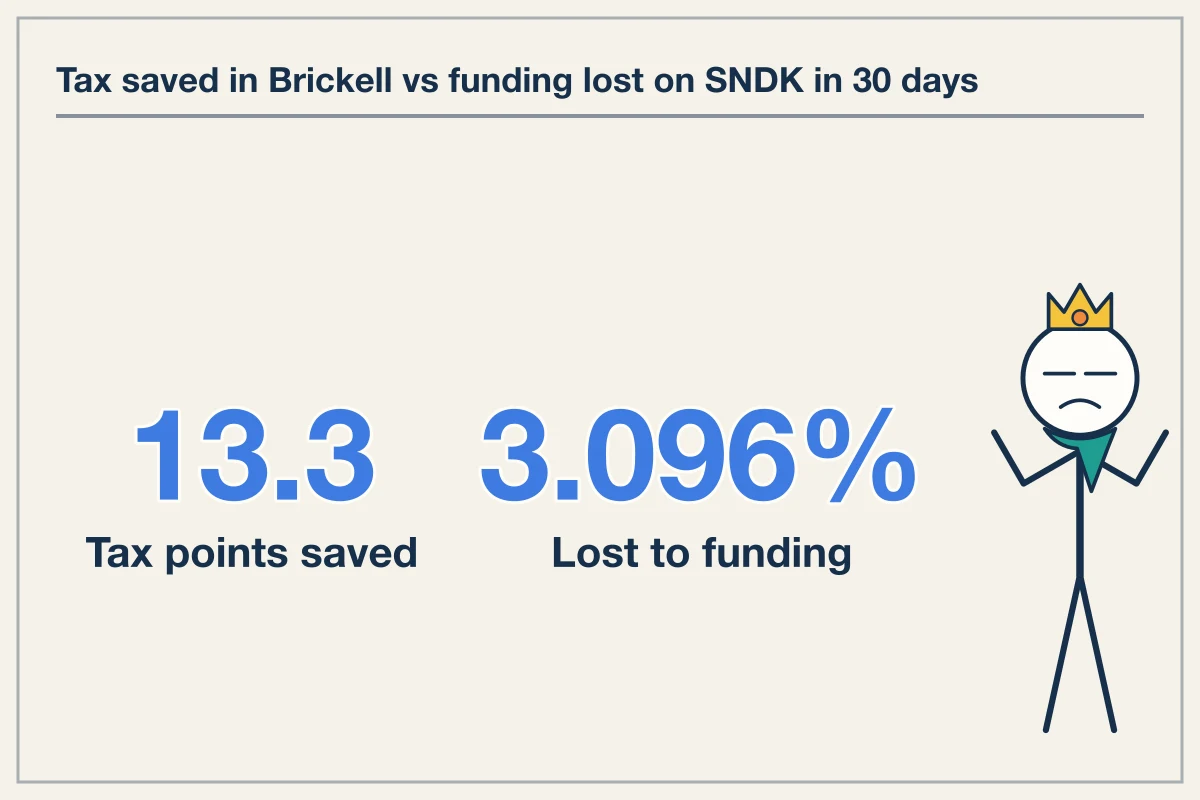
Relocating a trading operation to Miami's Brickell district saves 13.3 percentage points in state personal income tax relative to California, yet an unoptimised perpetual futures position on SNDK forfeits 3.096% of nominal value in funding rate spreads over 30 days.
Physical Capital Relocation to Brickell
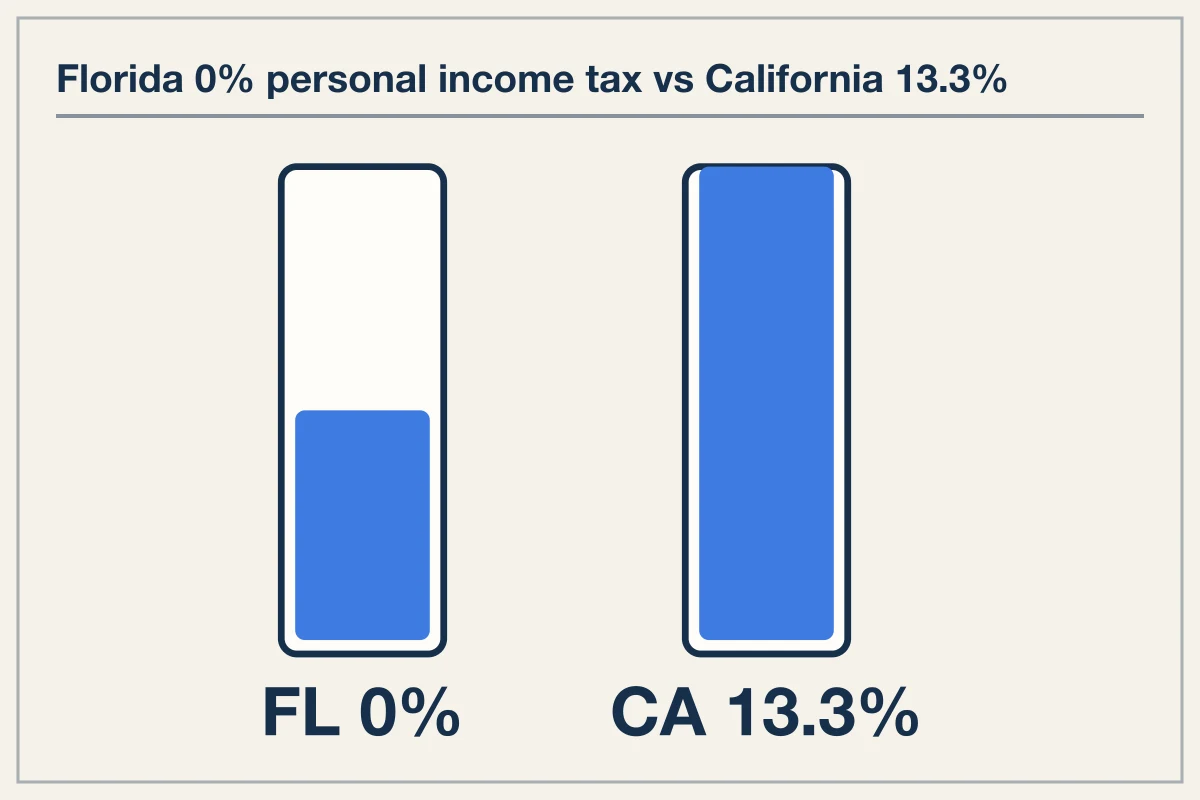
In 2021, Mayor Francis Suarez launched a targeted push to convert Brickell into a financial hub for digital asset firms. The city promoted municipal initiatives, including MiamiCoin and tax offset proposals for corporate entities. The primary financial driver was state tax policy. Florida imposes a 0% personal income tax rate and a 5.5% corporate income tax rate. By comparison, California levies a top personal income tax rate of 13.3%, while New York levies 10.9%.
Asset managers, venture funds, and trading desks moved physical operations to Brickell office towers along Brickell Avenue. Commercial real estate rents in the 33131 zip code increased as firms established offices. Physical relocation reduces local tax liabilities on realized entity income. However, physical overhead reduction does not alter position-level holding friction on perpetual futures contracts.
Venue Cost Structure and Funding Spreads
Perpetual futures mechanics enforce price tracking via funding payments exchanged between long and short position holders every eight hours. Holding costs vary across venues due to order book imbalance and local leverage demand.
The table below outlines current 8-hour funding rates across MEXC, OKX, and Bitget, alongside 24-hour trading volume.
| Asset | MEXC 8h Funding | OKX 8h Funding | Bitget 8h Funding | Funding Spread (8h) | 24h Volume |
|---|---|---|---|---|---|
| ETH | +0.0022% | +0.0066% | +0.0100% | 0.0078% | $7,920,228,179 |
| BTC | +0.0100% | +0.0100% | +0.0087% | 0.0013% | $7,483,868,892 |
| SOL | -0.0004% | +0.0055% | -0.0027% | 0.0082% | $2,128,536,252 |
| SNDK | N/A | +0.0344% | +0.0000% | 0.0344% | $1,373,531,838 |
| TRUMP | N/A | -0.0037% | +0.0050% | 0.0087% | $999,174,166 |
| XAU | +0.0022% | +0.0000% | +0.0011% | 0.0022% | $573,528,387 |
Trading fees compound initial position entry and exit costs before funding rates accrue. Default fee schedules differ significantly by venue.
| Venue | Spot Maker | Spot Taker | Futures Maker | Futures Taker |
|---|---|---|---|---|
| Bitget | 0.0010 | 0.0010 | 0.0002 | 0.0003 |
| Bybit | 0.0010 | 0.0010 | 0.0002 | 0.00055 |
| MEXC | 0.0000 | 0.0005 | 0.0000 | 0.0002 |
| OKX | 0.0008 | 0.0010 | 0.0002 | 0.0005 |
Mechanics of Venue Arbitrage Offset
On ETH, the funding rate spread between MEXC (+0.0022%) and Bitget (+0.0100%) is 0.0078 percentage points per 8-hour interval. Holding a long ETH position on MEXC minimizes funding decay relative to Bitget.
On SOL, Bitget trades at a negative funding rate of -0.0027% per 8 hours, whereas OKX trades at +0.0055%. A long position on Bitget collects funding payments, while a long position on OKX pays funding fees.
On SNDK, OKX charges long positions +0.0344% per 8-hour interval, while Bitget charges +0.0000%. The resulting spread is 0.0344 percentage points per 8 hours.
Worked Arithmetic: 30-Day Position Holding Cost
Consider a desk holding a nominal $1,000,000 long position over 30 calendar days (90 funding intervals of 8 hours each).
Case A: $1,000,000 Long Position in SNDK
- OKX Cost Calculation:
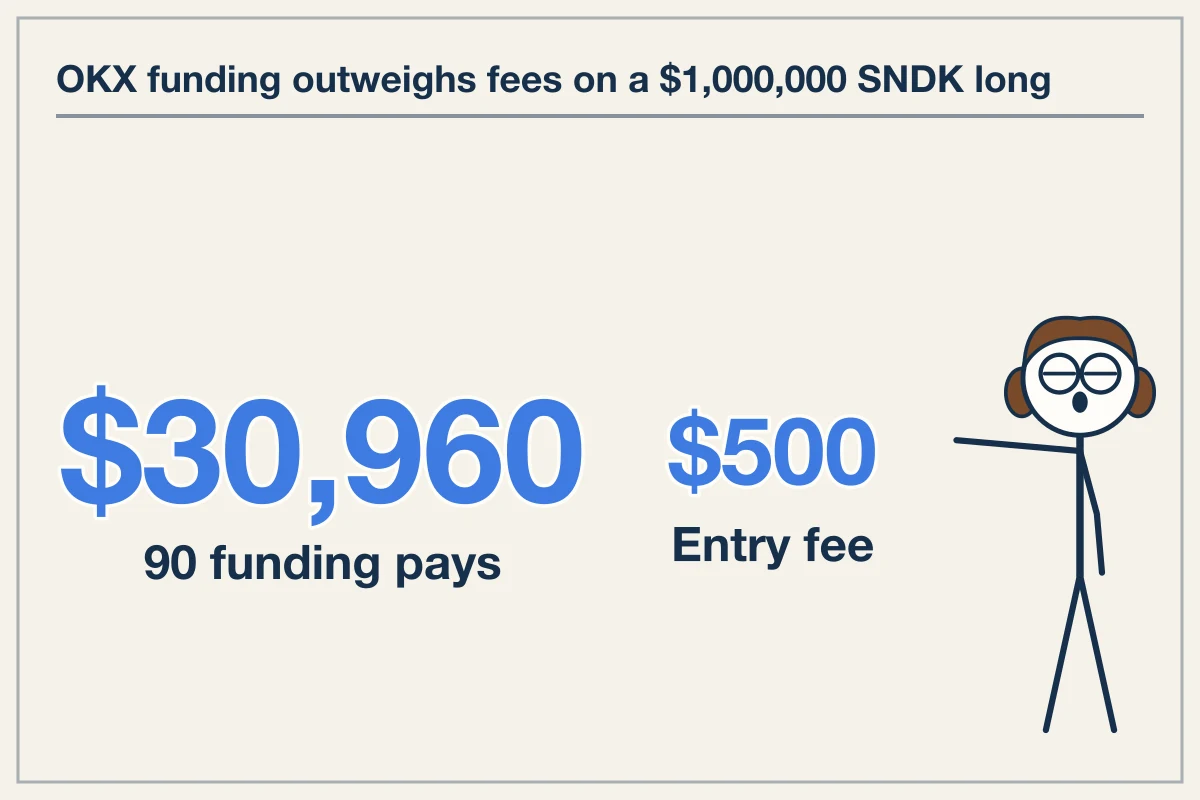
- Base futures taker entry fee: $1,000,000 \times 0.0005 = \$500$
- Base futures taker exit fee: $1,000,000 \times 0.0005 = \$500$
- Cumulative funding payments: $90 \times (0.000344 \times \$1,000,000) = \$30,960$
- Total position friction on OKX: $\$500 + \$500 + \$30,960 = \$31,960$
- Bitget Cost Calculation:
- Base futures taker entry fee: $1,000,000 \times 0.0003 = \$300$
- Base futures taker exit fee: $1,000,000 \times 0.0003 = \$300$
- Cumulative funding payments: $90 \times (0.000000 \times \$1,000,000) = \$0$
- Total position friction on Bitget: $\$300 + \$300 + \$0 = \$600$
- Net Friction Differential:
- Total cost difference: $\$31,960 - \$600 = \$31,360$
- Expressed as percentage of position size: $3.136\%$
Case B: $1,000,000 Long Position in ETH
- MEXC Cost Calculation:
- Base futures taker entry fee: $1,000,000 \times 0.0002 = \$200$
- Base futures taker exit fee: $1,000,000 \times 0.0002 = \$200$
- Cumulative funding payments: $90 \times (0.000022 \times \$1,000,000) = \$1,980$
- Total position friction on MEXC: $\$200 + \$200 + \$1,980 = \$2,380$
- Bitget Cost Calculation:
- Base futures taker entry fee: $1,000,000 \times 0.0003 = \$300$
- Base futures taker exit fee: $1,000,000 \times 0.0003 = \$300$
- Cumulative funding payments: $90 \times (0.000100 \times \$1,000,000) = \$9,000$
- Total position friction on Bitget: $\$300 + \$300 + \$9,000 = \$9,600$
- Net Friction Differential:
- Total cost difference: $\$9,600 - \$2,380 = \$7,220$
- Expressed as percentage of position size: $0.722\%$
Execution Considerations and Order Book Liquidity
Selecting a venue purely based on funding rates introduces execution slippage risks if volume is insufficient. The 24-hour volume data indicates liquidity concentration:
- ETH ($7,920,228,179) and BTC ($7,483,868,892) maintain high liquidity across venues, allowing large orders to execute near market price.
- XAU ($573,528,387) and TRUMP ($999,174,166) show lower volume pools. Executing large market orders in low-volume books causes slippage that exceeds multi-week funding rate savings.
- Leverage magnifies both funding decay and liquidation risks. A 10x leveraged position on OKX holding SNDK liquidates if price moves against the position by 10%, while funding fees erode 0.3096% of nominal position value per day.
Desk operators relocating physical headquarters to lower-tax jurisdictions like Miami reduce annual tax drag on net earnings. However, routing derivative flows without auditing venue-specific funding rates and taker fee tiers creates position drag that scales directly with holding duration.