· four exchange APIs · rebuilt daily
Trading a soxl perp exposes positions to double leverage drag
The finding
Trading a soxl perp combines 3x daily ETF reset decay with perpetual swap funding rates that charge fees up to 0.055% per taker trade.
The underlying ETF targets three times the daily return of the ICE Semiconductor Index.
Perpetual contracts on leveraged ETFs amplify both path-dependent volatility drag and venue borrowing costs.
Positions held across multiple days diverge significantly from three times the spot index move.
Understanding soxl perp contract mechanics
A perpetual contract written on SOXL tracks an asset that already contains internal 3x daily leverage. The ETF rebalances its portfolio at the end of every stock market session to match three times the daily price movement of its underlying semiconductor benchmark.
When you trade a perpetual swap on this asset, you apply exchange leverage on top of an instrument that resets its exposure daily. The contract settles continuously through funding payments between long and short traders, typically exchanging capital every eight hours.
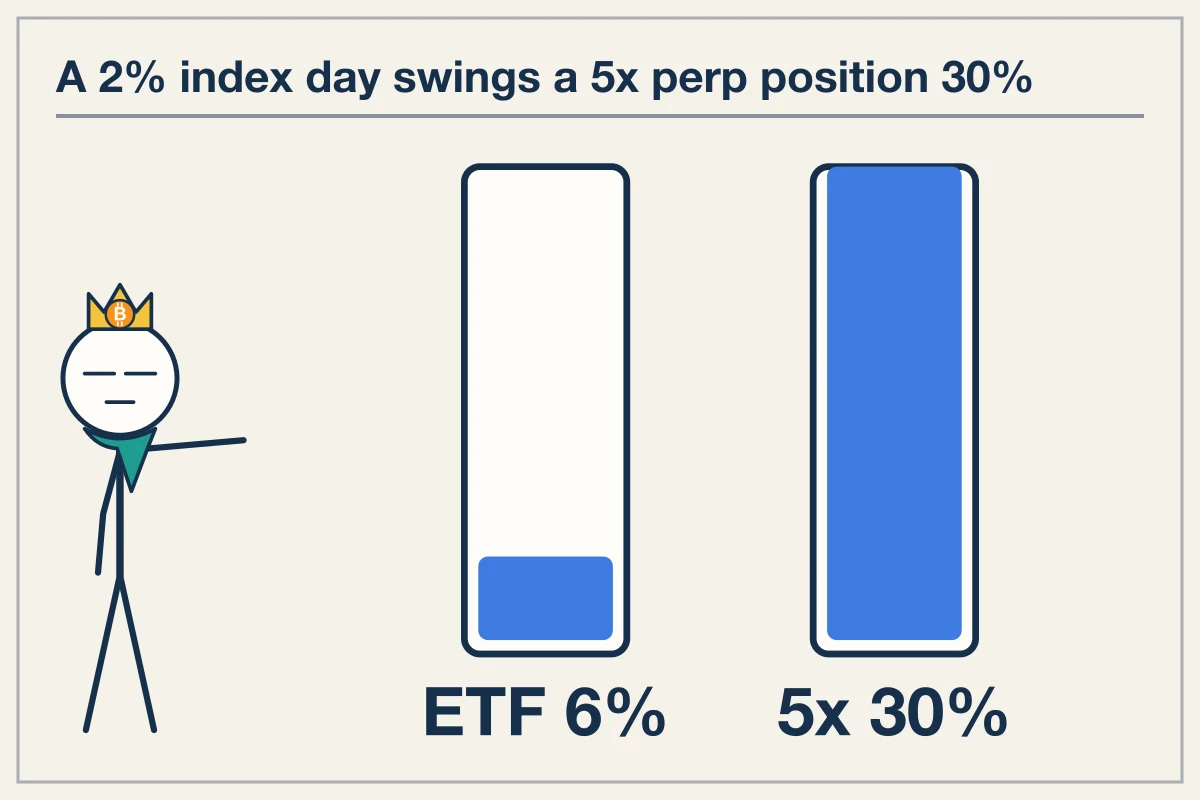
If the underlying index moves 2% in a day, the ETF moves approximately 6%. A trader holding a 5x leverage position on the perpetual contract experiences a 30% position fluctuation relative to the initial equity margin.
Worth knowing
Leveraged ETF perpetuals introduce compound leverage. Venue liquidation prices trigger based on the ETF price, which decays during sideways market conditions even if the underlying index ends at its starting price.
Daily ETF reset decay and path dependence
Leveraged ETFs suffer from volatility decay because their returns reset daily. A perpetual swap on a 3x leveraged ETF inherits this exact mathematical drag before adding funding fees.
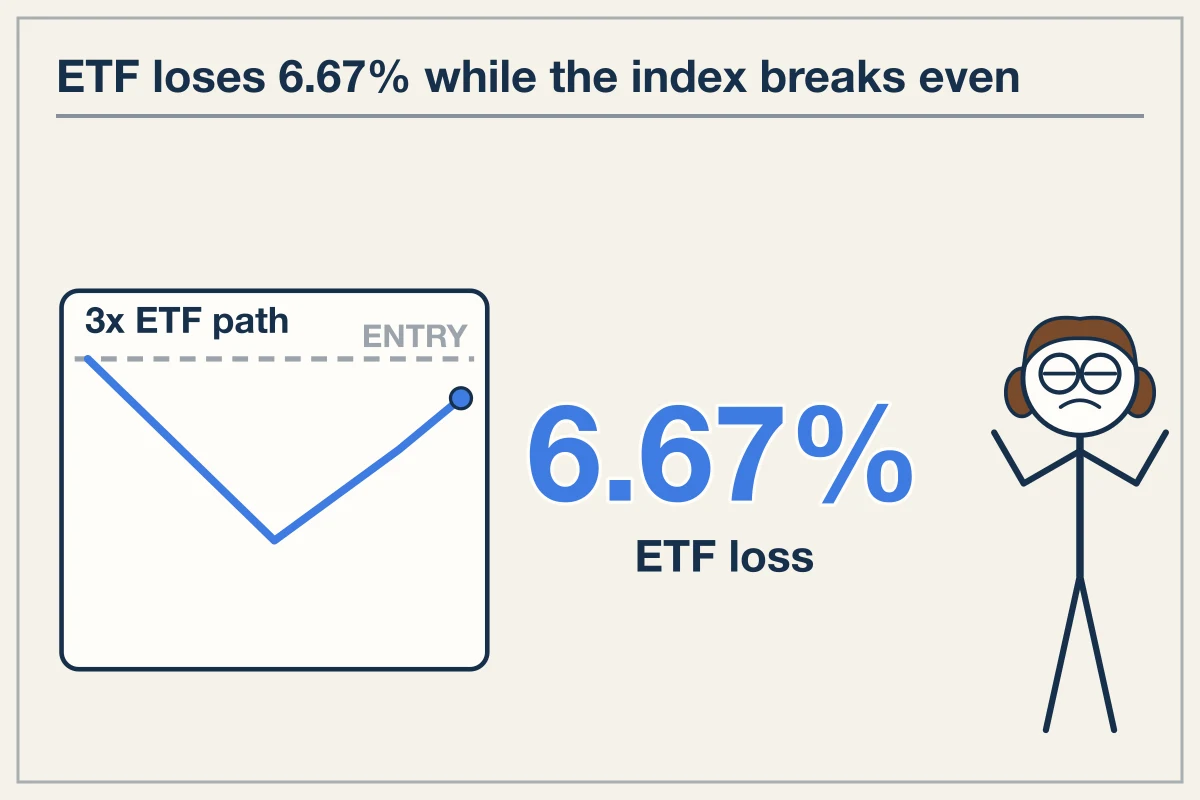
Consider a baseline example where the semiconductor index starts at 100 points. On day one, the index drops 10% to 90 points. On day two, the index rises 11.11% back to 100 points. The spot index return over two days is 0%.
The 3x leveraged ETF starts at $100. On day one, a 10% index drop causes a 30% drop in the ETF, moving its price to $70. On day two, an 11.11% index gain causes a 33.33% rise in the ETF. Multiplying $70 by 1.3333 results in $93.33.
The underlying ETF lost 6.67% while the spot index broke even. Holding a long perpetual contract on this ETF over those two days exposes the trader to that full 6.67% asset loss, plus eight-hour funding fees paid to the venue counterparty.
Where this goes wrong
Positions held during volatile, sideways market trends lose equity value through daily compounding. At 10x contract leverage, a 6.67% ETF value reduction destroys 66.7% of position margin without the underlying index moving.
Venue execution fees and funding costs
Trading perpetual swaps involves structural venue costs: opening taker or maker fees, closing fees, and ongoing funding payments. Execution costs vary directly by venue fee schedule.
| Venue | Spot Maker Fee | Spot Taker Fee | Futures Maker Fee | Futures Taker Fee |
|---|---|---|---|---|
| MEXC | 0.00% | 0.05% | 0.00% | 0.02% |
| Bitget | 0.10% | 0.10% | 0.02% | 0.03% |
| OKX | 0.08% | 0.10% | 0.02% | 0.05% |
| Bybit | 0.10% | 0.10% | 0.02% | 0.055% |
For a $100,000 nominal position, a taker order on Bybit costs $55 in execution fees on entry and $55 on exit. On MEXC, the same taker entry costs $20.
Funding rates settle every eight hours across crypto derivative platforms. On standard major perpetual markets, baseline funding defaults around +0.0100% per 8-hour period during neutral regimes. When long interest dominates, positive funding forces longs to pay shorts 0.0300% per day on full nominal position value.
What to do instead
Account for venue fee tiers and funding intervals before entering multi-day positions. Choose low-taker fee venues for active trading and check historical funding rates when holding positions across settlement cycles.
Structural failure modes for holding equity perps
Equity-based perpetual futures face distinct operational risks compared to native crypto assets. US equity markets operate on finite trading hours (9:30 AM to 4:00 PM Eastern Time), while perpetual exchanges run 24 hours a day, 7 days a week.
During off-market hours, liquidity on synthetic equity perps drops sharply. Order book depth thins out, widening the bid-ask spread. Sudden news outside market hours causes wide price gaps when US equity exchanges reopen.
If the underlying ETF opens 15% lower at the market bell, a 3x leveraged ETF drops 45% instantly. On a perpetual contract with 3x leverage, this overnight gap results in an immediate liquidation without time to adjust stops or add collateral.
How does a SOXL perp differ from buying the SOXL ETF directly?
Buying the ETF directly requires full capital or standard stock margin without ongoing funding fees. A perpetual contract allows higher leverage, operates 24/7, and charges 8-hour funding rates alongside exchange taker fees.
Why does a SOXL perp lose value when the semiconductor index moves sideways?
The underlying ETF resets its 3x target daily, creating mathematical volatility decay during choppy price action. The perpetual contract absorbs this decay while continuously accruing funding payments every eight hours.
What are the venue fees for opening a perpetual swap contract?
Taker execution fees range from 0.02% on MEXC to 0.055% on Bybit. Maker fees across most major derivative venues start at 0.02%, with MEXC offering 0.00% maker rates.
How often do perpetual swap positions pay or receive funding?
Most perpetual venues settle funding every eight hours, resulting in three settlement periods per day. The rate fluctuates based on the premium or discount between the contract price and the underlying mark price.