· four exchange APIs · rebuilt daily
Underpriced Network Fees Delay Order Settlement Across Venues
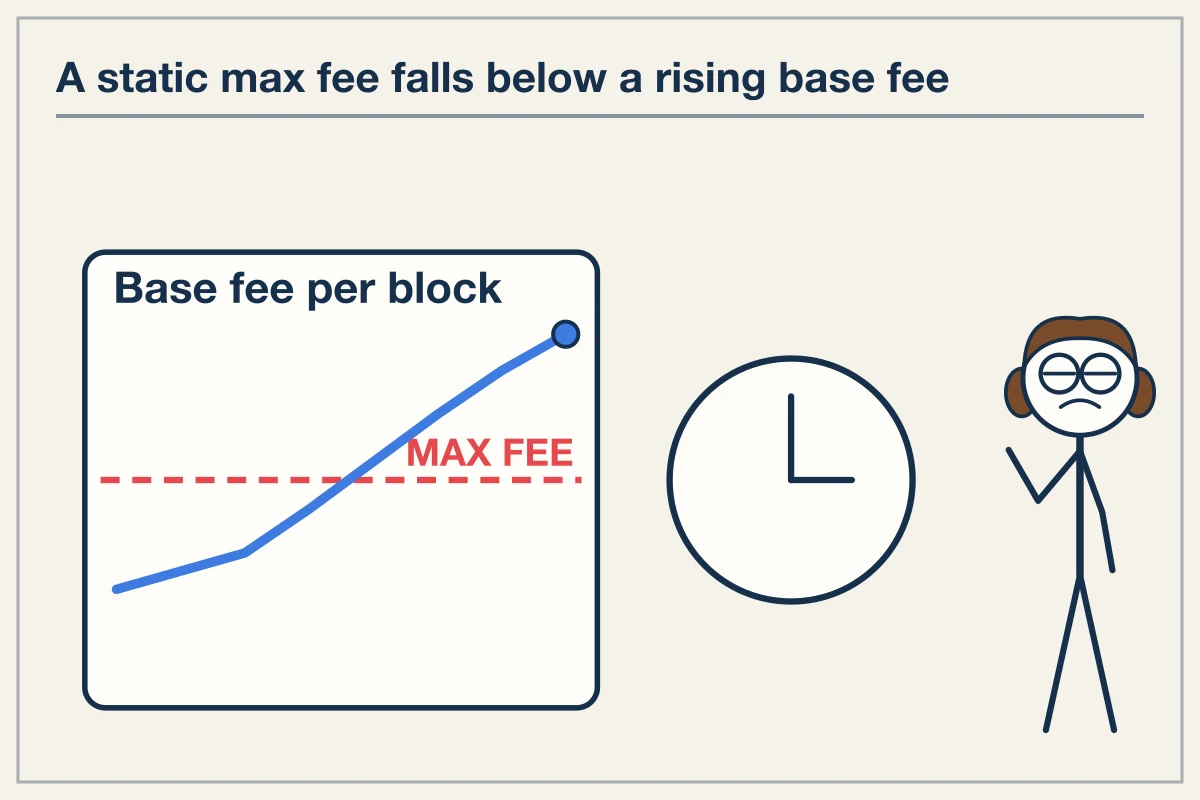
Network execution fees separate base dynamic block costs from priority tips, while perpetual venue spreads reach 0.0150 percentage points on SOL.
On ETH, holding a long position reveals an 8-hour funding spread of 0.0078 percentage points between venues, while network transaction fees adjust per block based on block space demand. On-chain fee structures split total transaction costs into a compulsory base fee and an optional priority fee. The base fee purchases computation and state access. It burns upon block inclusion. The priority fee pays the block builder directly to secure order precedence within the block queue.
When network demand increases, block space fills. If a block reaches target capacity, the protocol increases the base fee for the next block. When demand drops and blocks contain empty space, the base fee decreases. Hourly fee spikes occur when market volatility drives thousands of concurrent orders into the transaction pool. Chains with low target throughput reach capacity quickly, driving base fees upward within minutes. High-throughput chains maintain larger block capacity, absorbing volume spikes without pushing base fees to comparable levels.
Base Fee vs Priority Fee Execution
The base fee represents the floor price required for block inclusion. The priority fee acts as an auction tip. If an order specifies a total fee lower than the current network base fee, nodes discard it from the set of candidate transactions.
A transaction that remains pending for hours is unconfirmed rather than lost. It resides in the mempool, where nodes hold unconfirmed transactions. The transaction remains valid until its account nonce is superseded or its fee rate matches block inclusion thresholds. Replacing a stuck transaction requires submitting a new transaction with the same account nonce and a higher priority fee. This overwrites the underpriced entry without risking lost collateral.
Reading Fee Estimators
Wallet fee estimators display three distinct values: base fee, max priority fee, and max fee. Accepting default wallet parameters during high volatility causes execution delays because static defaults fail to track rapidly rising base fees.
- Base Fee: The mandatory cost set by the network protocol per gas unit.
- Max Priority Fee: The maximum tip paid directly to the validator for execution priority.
- Max Fee: The absolute ceiling spent per unit of computation, containing both base fee and priority tip.
Setting max fee equal to current base fee plus priority tip risks immediate transaction stalling if base fees rise while the order propagates. Setting max fee higher than current market rates does not mean paying the higher amount, as the protocol refunds any unused portion of max fee above the base fee plus priority fee.
Venue Execution and Funding Cost Structure
Off-chain perpetual trades bypass gas fees for order placement, but venue execution fees and holding costs vary significantly by exchange. On ETH perpetuals, Bitget charges a funding rate of +0.0100% per 8 hours, while OKX charges +0.0022% per 8 hours.
For a $10,000 position on ETH:
- Bitget 8-hour funding cost: 10,000 multiplied by 0.000100 equals $1.00 per interval.
- OKX 8-hour funding cost: 10,000 multiplied by 0.000022 equals $0.22 per interval.
- Spread per 8-hour interval: $0.78 per $10,000 position.
- Daily holding spread over 3 intervals: $2.34 per $10,000 position.
Trading fee schedules further impact position entry and exit costs.
Published Fee Schedules
| Venue | Spot Maker Fee | Spot Taker Fee | Futures Maker Fee | Futures Taker Fee |
|---|---|---|---|---|
| Bitget | 0.0010 | 0.0010 | 0.0002 | 0.00030 |
| Bybit | 0.0010 | 0.0010 | 0.0002 | 0.00055 |
| MEXC | 0.0000 | 0.0005 | 0.0000 | 0.00020 |
| OKX | 0.0008 | 0.0010 | 0.0002 | 0.00050 |
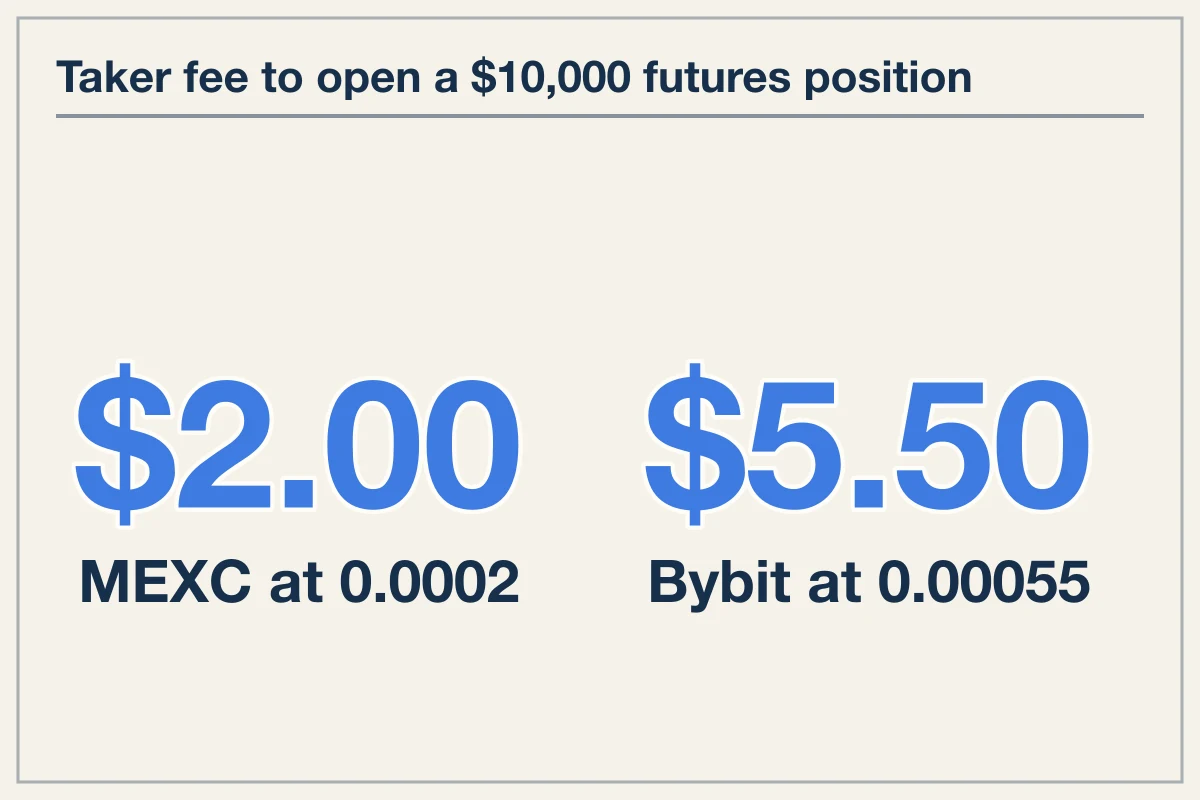
Opening a $10,000 futures taker position costs $2.00 on MEXC at a 0.0002 fee rate, compared to $5.50 on Bybit at a 0.00055 fee rate. Combining taker fees with funding distributions determines net execution efficiency.
Live Funding Rates Per 8-Hour Interval
| Asset | Cheapest Long Venue | OKX Funding | MEXC Funding | Bitget Funding | Spread | 24h Volume |
|---|---|---|---|---|---|---|
| ETH | OKX | +0.0022% | +0.0038% | +0.0100% | 0.0078% | $8,965,943,313 |
| BTC | OKX | +0.0075% | +0.0100% | +0.0100% | 0.0025% | $5,840,502,770 |
| SOL | OKX | -0.0095% | -0.0032% | +0.0055% | 0.0150% | $1,622,612,749 |
| ZEC | MEXC | +0.0041% | +0.0015% | +0.0100% | 0.0085% | $782,407,711 |
| XRP | OKX | -0.0009% | +0.0024% | +0.0040% | 0.0049% | $526,983,138 |
| XAU | MEXC | +0.0204% | +0.0060% | +0.0103% | 0.0144% | $503,082,526 |
On SOL perpetuals, OKX displays a negative rate of -0.0095%, where longs receive funding, while Bitget charges long positions +0.0055%. The resulting 0.0150 percentage point spread equals a $1.50 variance per $10,000 position every 8 hours.
Transaction Nonce Sequential Execution
In on-chain settlement, submitted transactions execute strictly in sequential order determined by account nonces. If transaction nonce N stalls due to an underpriced max fee during high volatility, transaction nonce N+1 cannot execute regardless of how high its priority tip is set.
Underpriced transactions do not consume capital while sitting in the mempool. Zero gas is deducted until a block builder includes the transaction in a valid block. Setting max priority fee appropriately prevents execution stalling while bounding maximum fee exposure.