· four exchange APIs · rebuilt daily
Autonomous Agent Execution Costs Vary by 0.0152 Percent Per 8h
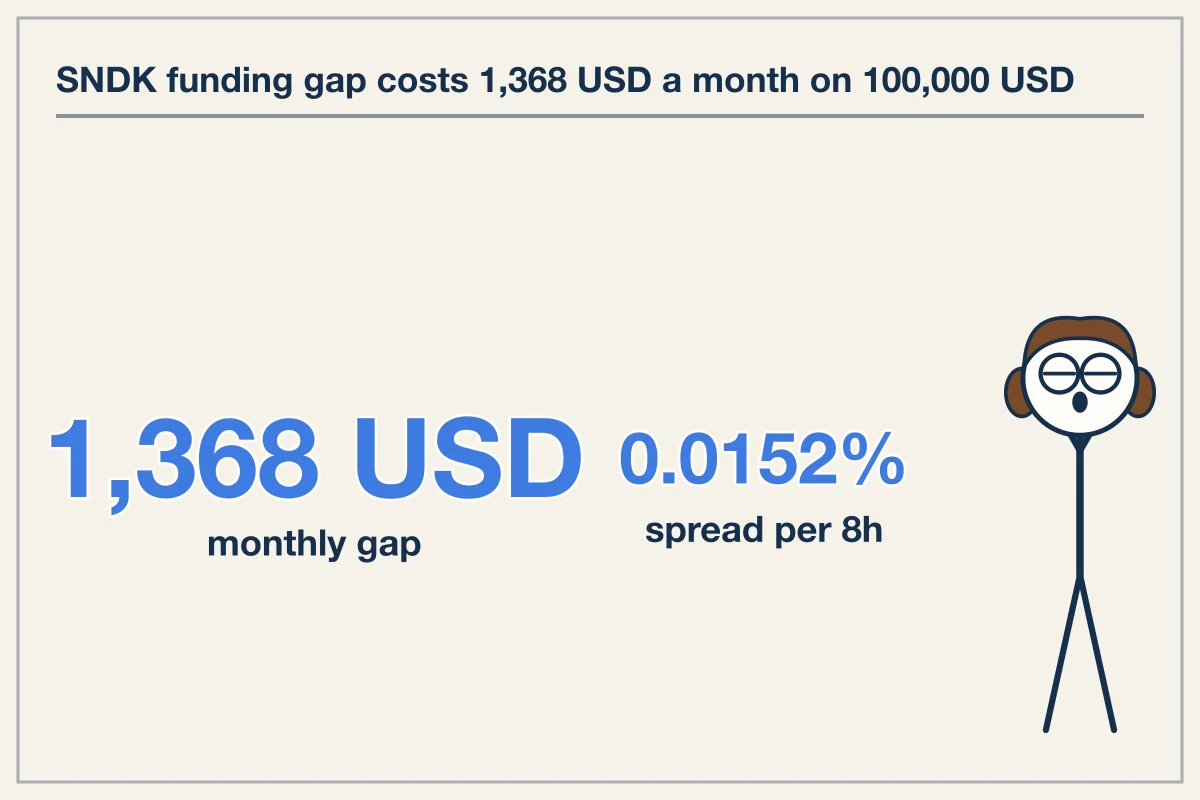
Delegated agent payments face a 0.0152 percentage point funding spread on SNDK while account abstraction key scopes lack native liability bounds.
Holding a 100,000 USD long position managed by an autonomous trading agent on SNDK incurs a 1,368 USD monthly funding discrepancy across exchanges due to a 0.0152 percentage point spread per 8-hour interval.
Autonomous agents execute trades through programmatically signed calls, but execution costs diverge depending on exchange funding mechanisms and fee schedules. When software agents manage positions autonomously, execution efficiency depends on both funding rate selection and contract account security parameters.
Market Funding Spreads and Execution Costs
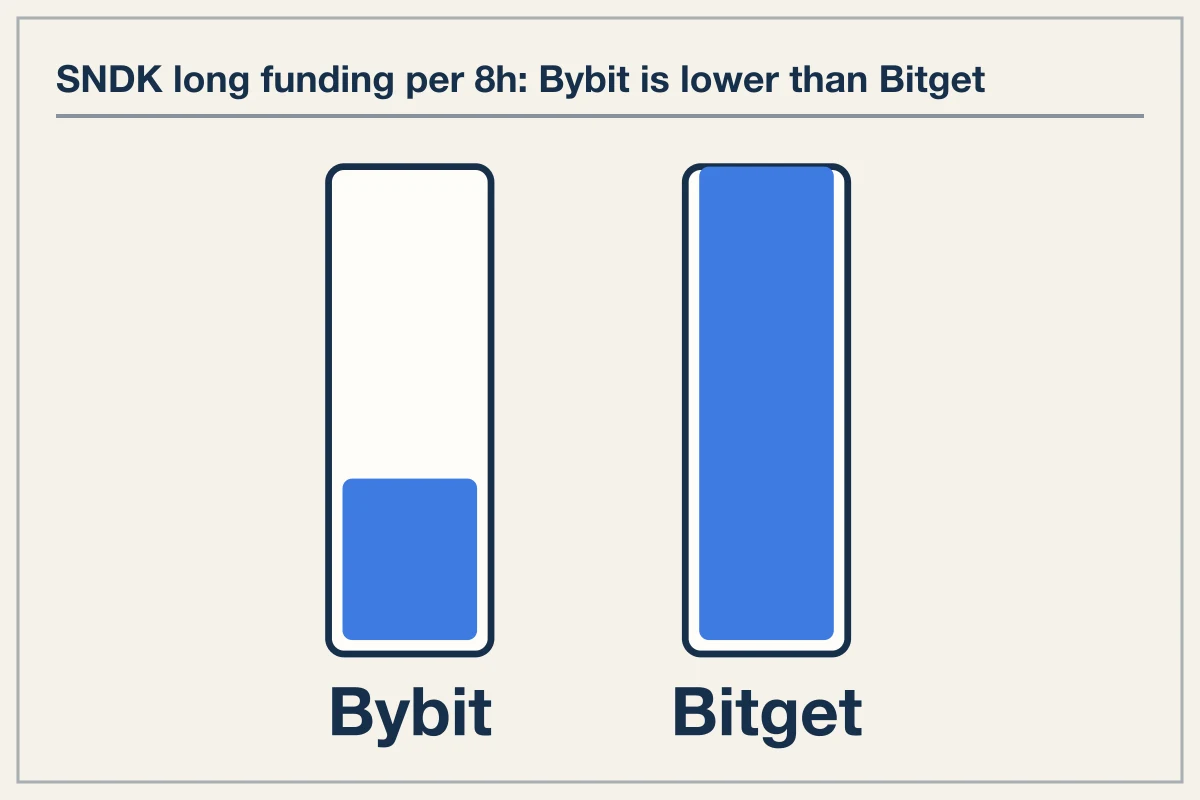
Live perpetual market data shows significant variances in funding costs per 8-hour interval across major liquidity venues. On SNDK, Bybit quotes a long funding rate of +0.0084% while Bitget quotes +0.0236%, creating an 8-hour spread of 0.0152 percentage points across a total 24-hour volume of 706,792,522 USD.
| Asset | Cheapest Long Venue | Min Funding (8h) | Max Funding (8h) | Funding Spread (8h) | 24h Volume (USD) |
|---|---|---|---|---|---|
| ETH | OKX | +0.0031% | +0.0100% | 0.0069% | 9,093,622,875 |
| BTC | Bybit | +0.0080% | +0.0100% | 0.0020% | 5,966,820,981 |
| SOL | OKX | -0.0077% | +0.0059% | 0.0136% | 1,635,247,028 |
| ZEC | MEXC | +0.0006% | +0.0100% | 0.0094% | 776,210,910 |
| SNDK | Bybit | +0.0084% | +0.0236% | 0.0152% | 706,792,522 |
| XRP | Bybit | -0.0070% | +0.0047% | 0.0117% | 527,536,191 |
In addition to funding rates, exchange fee schedules directly impact trade execution. Taker fees range from 0.0002 (0.02%) on MEXC to 0.00055 (0.055%) on Bybit.
| Exchange | Futures Maker Fee | Futures Taker Fee | Spot Maker Fee | Spot Taker Fee |
|---|---|---|---|---|
| Bitget | 0.02% | 0.03% | 0.10% | 0.10% |
| Bybit | 0.02% | 0.055% | 0.10% | 0.10% |
| MEXC | 0.00% | 0.02% | 0.00% | 0.05% |
| OKX | 0.02% | 0.05% | 0.08% | 0.10% |
Arithmetic of Agent Portfolio Drag
Consider an autonomous agent opening and holding a 100,000 USD position in SNDK perp futures for 30 days (90 funding intervals).
On Bybit, the funding rate is +0.0084% per 8 hours. The funding charge per interval equals 100,000 USD multiplied by 0.000084, which is 8.40 USD. Over 24 hours (3 intervals), funding equals 25.20 USD. Over 30 days (90 intervals), total funding cost equals 756 USD.
On Bitget, the funding rate is +0.0236% per 8 hours. The funding charge per interval equals 100,000 USD multiplied by 0.000236, which is 23.60 USD. Over 24 hours, funding equals 70.80 USD. Over 30 days, total funding cost equals 2,124 USD.
The cost difference between holding the long position on Bitget versus Bybit over 30 days is 2,124 USD minus 756 USD, which equals 1,368 USD.
Trading fees add additional friction during execution. Opening a 100,000 USD position as a taker on Bybit costs 100,000 USD multiplied by 0.00055, or 55 USD. Closing the position costs another 55 USD, totaling 110 USD in fee drag. On MEXC, opening and closing the same position as a taker costs 100,000 USD multiplied by 0.0002 per leg, totaling 40 USD.
At 10x leverage, a 10,000 USD margin allocation collateralizes the 100,000 USD position. An adverse market price movement of 10% wipes out the margin and triggers liquidation.
Shipped Standards and Execution Architecture
Autonomous crypto payment rails operate through three primary mechanisms:
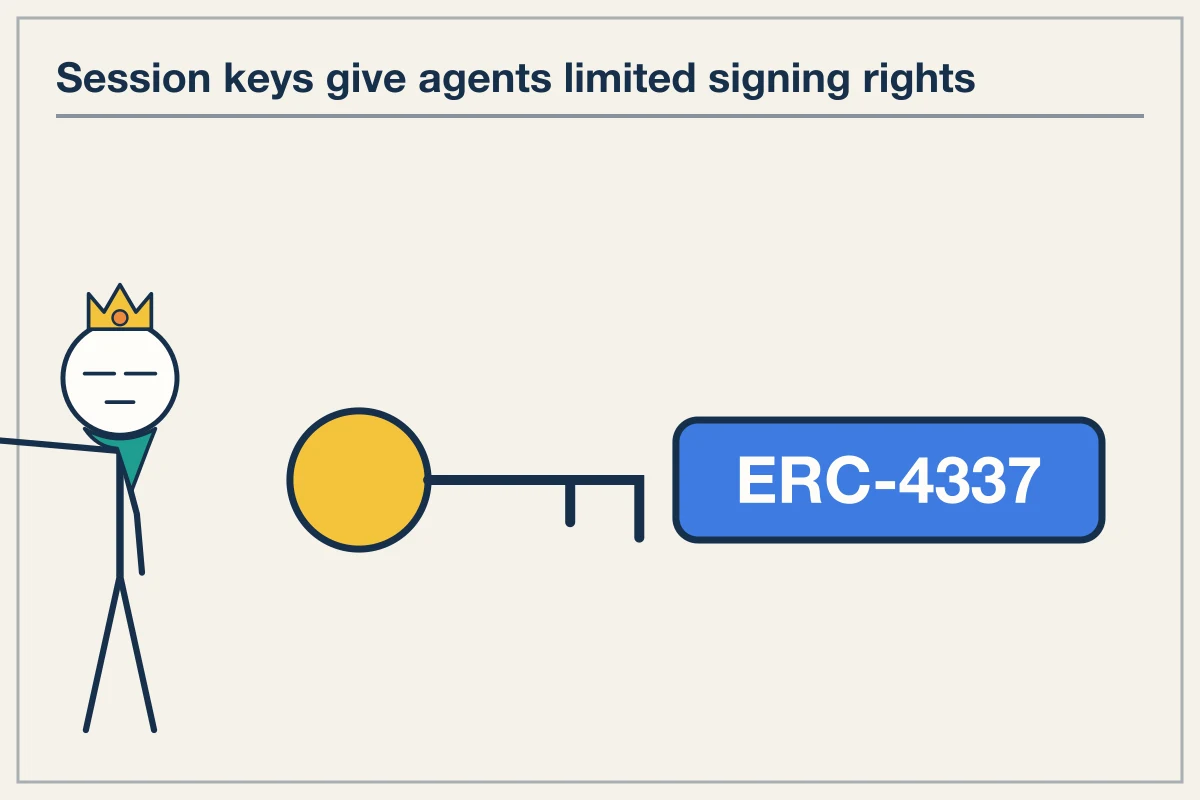
- Smart Contract Accounts (ERC-4337): Agents interact via user operations routed through account abstraction bundlers. Session key validators grant sub-key signers temporary execution rights restricted to designated contract addresses and functions.
- Modular Account Extensions (ERC-7579): Smart accounts separate validation logic from execution modules. Agents execute pre-approved function signatures without holding owner private keys.
- HTTP 402 Protocol Extensions: Service providers expose micro-payment headers where agents submit signed cryptographic proofs of payment alongside API calls to settle per-query infrastructure costs.
Unsolved Protocol Bottlenecks: Authorization, Revocation, and Liability
While account abstraction provides the framework for agent payments, critical execution risks remain unhandled at the protocol level.
Scope Limitations and Position Risk
Session key modules set parameter constraints, such as capping gas spend or single-transaction token limits. However, standard session keys cannot evaluate real-time position health, mark-to-market drift, or unrealized liquidation distance. An agent operating within its approved spend limit of 500 USD per day can still make execution decisions that lead to account liquidation if market conditions shift rapidly.
Network Asynchrony and Delayed Revocation
Revoking an agent key requires an on-chain state update. If an agent loops unexpectedly or enters an invalid trade loop, the owner must broadcast a revocation transaction. During periods of network congestion, pending agent transactions in the mempool can execute before the revocation transaction processes, resulting in full loss of allocated subaccount funds.
Legal and Execution Liability
Cryptographic smart contracts enforce execution without evaluating intent. If an autonomous agent triggers an erroneous trade sequence or misinterprets off-chain data, the loss is realized immediately on-chain. Protocol architectures contain no recourse mechanisms, insurance backstops, or error reversal functions. Capital losses caused by model failure or API execution errors fall entirely on the key delegator.