· four exchange APIs · rebuilt daily
How Does Bitcoin Halving Affect Miner Revenue?
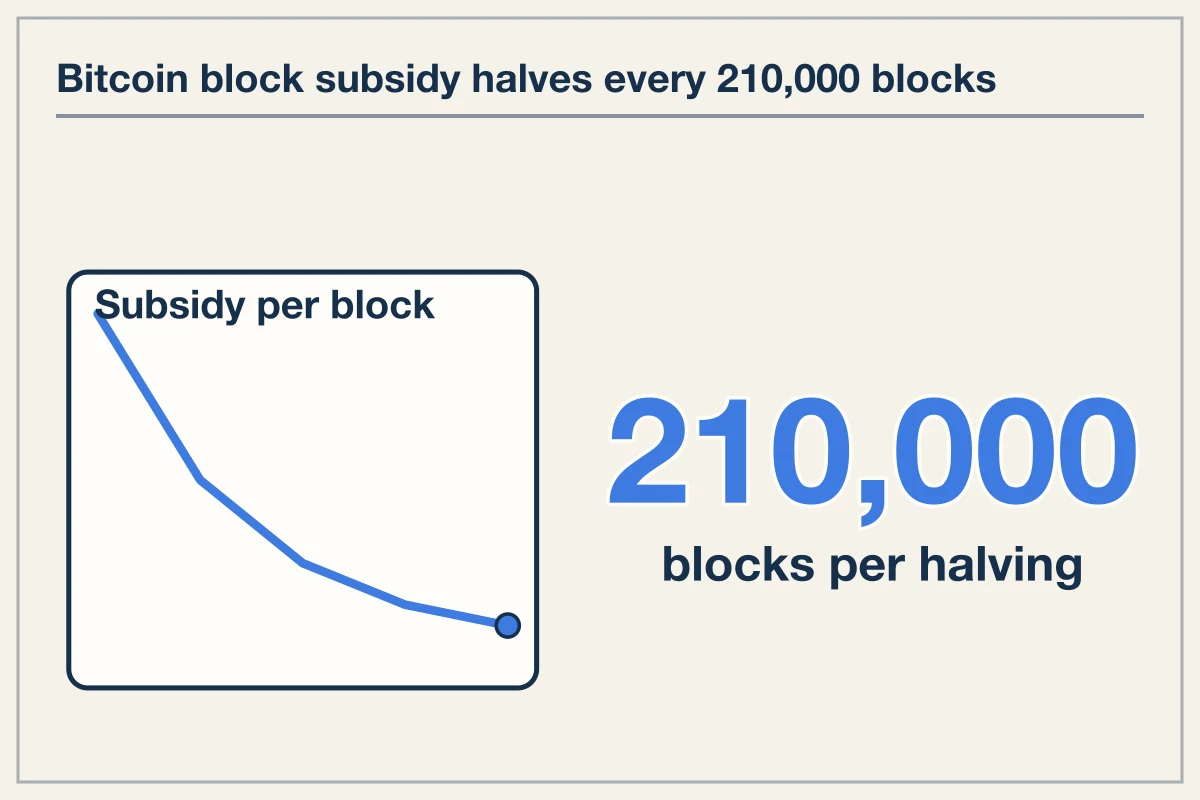
Bitcoin block reward halvings follow a coded schedule, leaving funding rate spreads across venues as the primary variable cost for perpetual long positions.
Bitcoin block subsidy decreases by 50% every 210,000 blocks according to consensus rules hardcoded in the bitcoin client codebase. At a 10-minute target block interval, 210,000 blocks require 126,000,000 seconds to mine, which equals approximately 1,458.3 days.
The initial block subsidy was 50 BTC per block. It halved to 25 BTC at block 210,000, 12.5 BTC at block 420,000, 6.25 BTC at block 630,000, and 3.125 BTC at block 840,000. Total programmatic issuance is capped at 20,999,999.9769 BTC due to standard integer division truncation in the software.
Miner Revenue Structure and Fee Share Expansion
Miner block revenue consists of two distinct components: the block subsidy and transaction fees collected from mempool inclusion.
Total Block Revenue = Block Subsidy + Transaction Fees
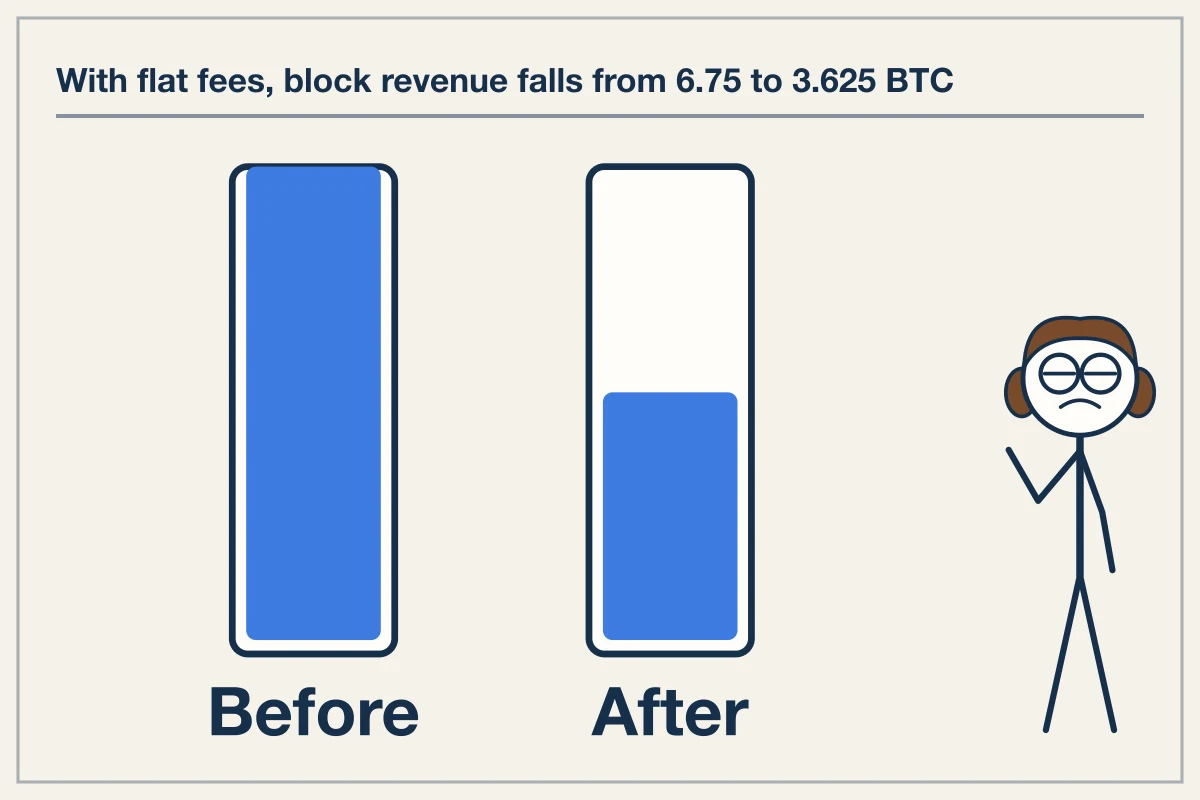
When a halving block executes, the subsidy drops by 50% instantly. If transaction fees average 0.5 BTC per block before a halving event on a 6.25 BTC subsidy, total miner reward per block is 6.75 BTC. After the halving, the subsidy drops to 3.125 BTC. If transaction fees remain unchanged at 0.5 BTC, total block reward declines to 3.625 BTC.
For miners to maintain total block revenue at 6.75 BTC without a spot price change, transaction fees per block must rise from 0.5 BTC to 3.625 BTC. That requires a 625% increase in fee collection per block. If fee demand remains flat, total block revenue drops by 46.3%, reducing miner profit margins and forcing high-cost operators off the network until mining difficulty readjusts downward.
Supply Predictability and Forward Pricing
The halving schedule is hardcoded into every validating node on the network. Because target block timing, total supply parameters, and historical block counts are open data, future issuance is deterministic.
Central banks modify money supply via unannounced policy decisions, but Bitcoin supply issuance contains zero variable surprise. In derivative markets, predictable supply schedules are reflected in forward expectations long before execution. Traders taking exposure through perpetual futures pay or receive funding rates determined by real-time leverage demand rather than unexpected supply shifts.
Perpetual Carry Costs Across Active Venues
Holding BTC exposure around supply events requires tracking venue funding rates and execution fee tiers. Current 24-hour BTC perpetual trading volume across reporting exchanges is $5,990,528,731.
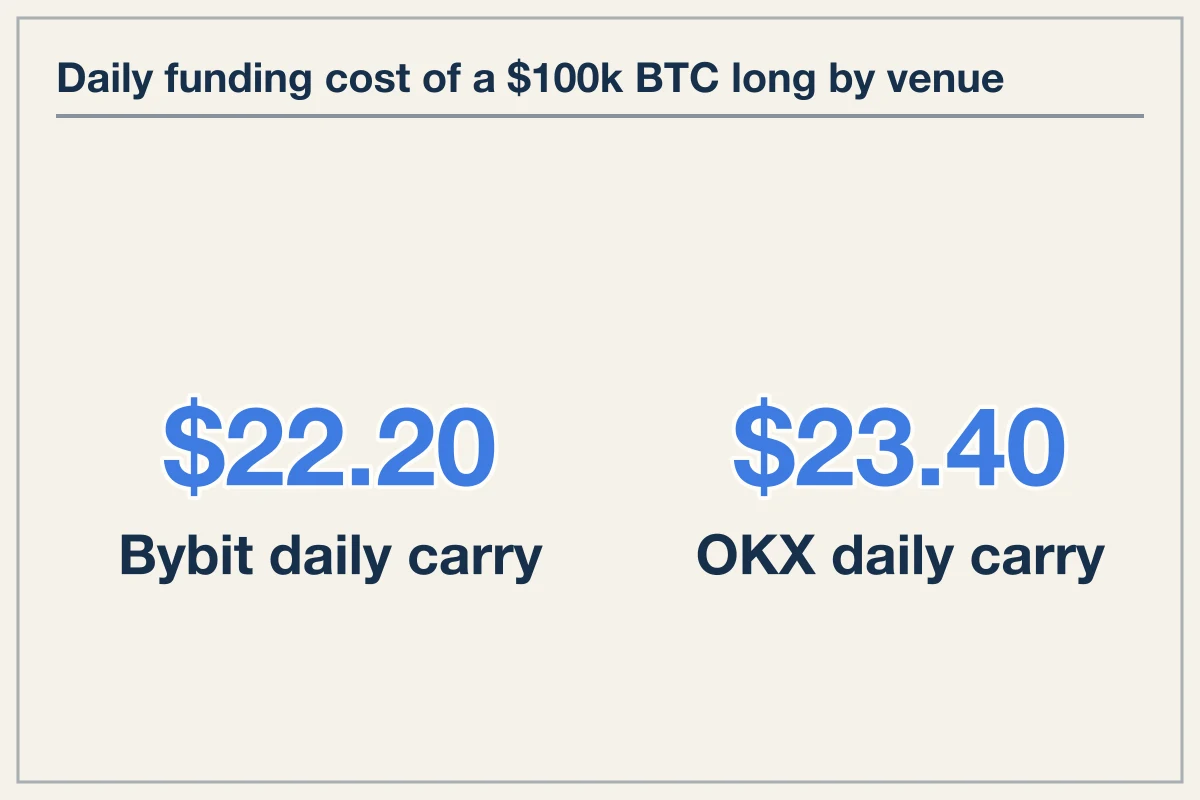
The table below details normalized 8-hour funding rates, projected daily funding costs, and published futures taker fees for a $100,000 BTC long position.
| Venue | 8h Funding Rate | Daily Funding Rate | Daily Carrying Cost ($100k Position) | Futures Taker Fee | Entry Taker Cost ($100k Position) |
|---|---|---|---|---|---|
| Bybit | +0.0074% | 0.0222% | $22.20 | 0.0550% | $55.00 |
| OKX | +0.0078% | 0.0234% | $23.40 | 0.0500% | $50.00 |
| Bitget | +0.0100% | 0.0300% | $30.00 | 0.0300% | $30.00 |
| MEXC | +0.0100% | 0.0300% | $30.00 | 0.0200% | $20.00 |
The funding spread between Bybit (+0.0074%) and Bitget or MEXC (+0.0100%) is 0.0026 percentage points per 8-hour interval, or 0.0078 percentage points daily. Holding a $100,000 long on Bybit costs $22.20 per day in funding payments, while holding the same position on Bitget or MEXC costs $30.00 per day.
Over a 30-day holding window, cumulative funding costs total $666.00 on Bybit, $702.00 on OKX, and $900.00 on Bitget and MEXC. Choosing Bybit over Bitget or MEXC reduces 30-day funding expenses by $234.00 per $100,000 position.
Execution Cost Thresholds Versus Holding Duration
Exchange fee schedules alter total trade cost depending on holding duration. Opening and closing a $100,000 position on MEXC via taker orders incurs $40.00 in round-trip fees (0.0200% entry and 0.0200% exit). The same round-trip trade on Bybit incurs $110.00 in taker fees (0.0550% entry and 0.0550% exit).
The execution penalty for entering on Bybit instead of MEXC is $70.00 ($110.00 minus $40.00). However, Bybit funding saves $7.80 per day relative to MEXC ($30.00 minus $22.20).
Dividing the $70.00 execution fee difference by the $7.80 daily funding savings yields 8.97 days. Positions closed in under 9 days accrue lower net costs on MEXC due to lower execution fees. Positions held longer than 9 days accrue lower net costs on Bybit because lower funding carry offsets the higher initial entry fee.