· four exchange APIs · rebuilt daily
Seed phrase backup mistakes that destroy private keys permanently
The finding
Storing a recovery phrase in digital form exposes 256 bits of wallet entropy to automated scrapers, making key compromise a permanent loss.
Four physical and digital storage vectors destroy access completely.
Elliptic curve cryptography provides no reset path or customer support fallback.
Hardware wallets isolate key generation and signing inside secure element chips.
Four common seed phrase backup mistakes account for almost all permanent self-custody asset loss. A seed phrase derives every private key deterministically, meaning a single leak or loss destroys account access without recourse.
The mathematical impossibility of seed phrase recovery
A BIP-39 seed phrase maps 12 or 24 words selected from a standardized 2,048-word dictionary to a 128-bit or 256-bit integer. That integer serves as the entropy seed for a deterministic cryptographic key tree. Through HMAC-SHA512 hashing and secp256k1 elliptic curve multiplication, the seed generates public and private key pairs.
No administrative layer exists above the mathematics. Traditional financial accounts rely on a centralized database where a system administrator can overwrite entries to restore access. Blockchains validate transactions solely by verifying cryptographic signatures against public keys.
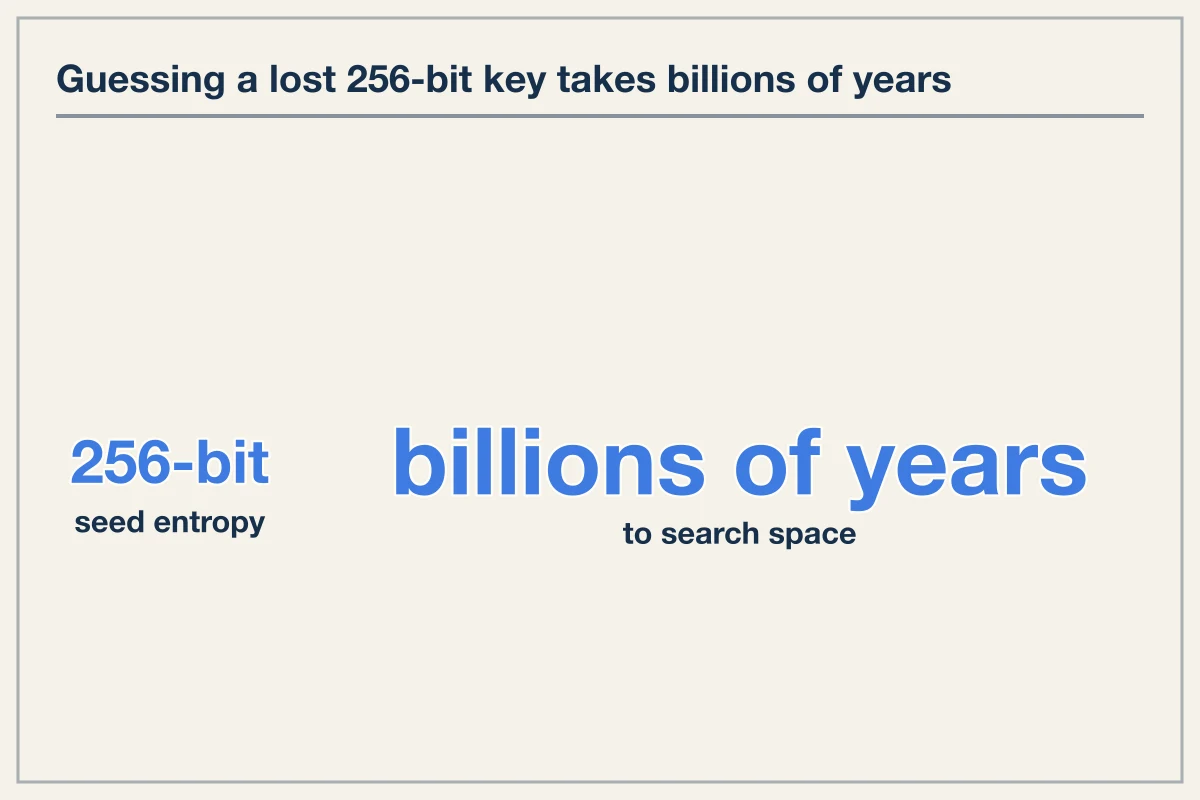
If the private key derived from the seed phrase is lost, calculating it requires searching an entropy space of 2 to the power of 256. At current world computing capacity, searching this space takes billions of years.
Where this goes wrong
Entering a 12-word seed phrase into a software wallet on an internet-connected device exposes raw entropy to process memory, where browser extensions and malware read clipboard data.
Four critical seed phrase backup mistakes
Self-custody failures stem from predictable operational errors rather than cryptographic breaches.
First, photographing a seed phrase and storing it in cloud storage exposes the text to automated Optical Character Recognition (OCR) bots. Cloud providers index images automatically. Compromised API tokens or credential leaks allow attackers to scan image metadata for BIP-39 word list matches.
Second, typing a phrase into any website or desktop form exposes keys to keyloggers and malicious web scripts. Phishing sites clone interface elements from popular wallet extensions. Once typed, script payloads submit the words to remote servers within milliseconds.
Third, relying on memory for an optional BIP-39 passphrase creates a single point of cognitive failure. A passphrase acts as an extra word, hashing the seed into an entirely different set of master keys. Forgetting a passphrase or misspelling a single character shifts the key derivation path to an empty wallet address without throwing an error message.
Fourth, storing a single paper backup in one physical building exposes funds to environmental destruction. House fires achieve temperatures above 600 degrees Celsius, incinerating paper and melting aluminum storage plates.
What to do instead
Stencil recovery words onto 304 or 316 grade stainless steel plates using letter stamps, and store redundant copies in separate physical locations.
Threat model changes under hardware security
A hardware wallet fundamentally alters key isolation by restricting private keys to a dedicated Secure Element chip. The device generates entropy locally using a physical random number generator. Private keys never cross the USB or Bluetooth interface into host computer memory.
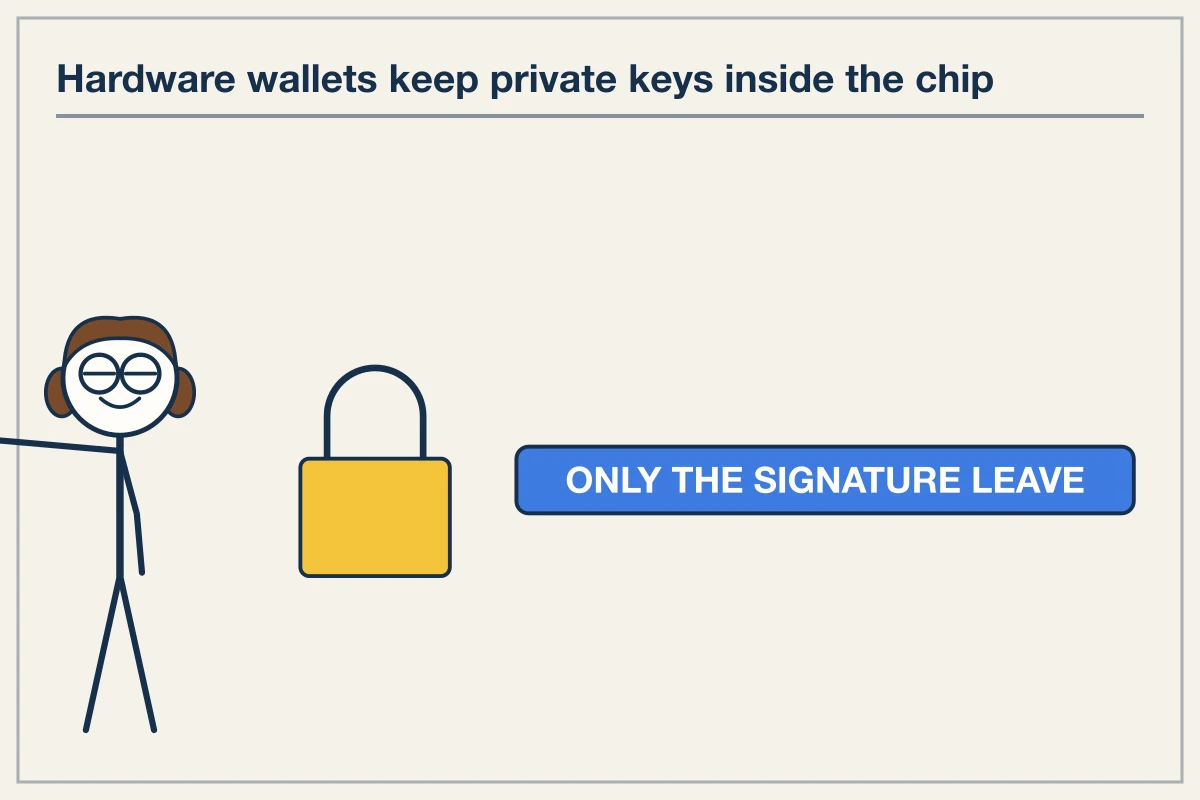
When executing a transaction or signing an off-chain message, the host computer sends the unsigned transaction payload to the hardware device. The device parses the transaction parameters, displays them on an isolated screen, and signs the payload internally using the private key. Only the finalized cryptographic signature returns to the host.
If the host operating system contains active keyloggers or malware, the attacker sees only the signed transaction broadcast. They cannot extract the underlying private key or modify the recipient address without failing signature verification on-chain.
Worth knowing
A hardware wallet does not protect assets if the recovery phrase itself was generated on a software wallet first, or if the user enters the recovery phrase into a keyboard during device restoration.
Comparing off-exchange storage and venue holding costs
Traders who move collateral off exchanges into self-custody avoid exchange credit risk, but assume complete responsibility for private key operational security. Active positions held on perpetual venues incur ongoing funding rates and trading fees, which dictate holding efficiency alongside security choices.
| Venue | Futures Maker Fee | Futures Taker Fee | BTC 8h Funding | ETH 8h Funding | SOL 8h Funding |
|---|---|---|---|---|---|
| Mexc | 0.0000% | 0.0002% | +0.0046% | +0.0037% | +0.0023% |
| OKX | 0.0002% | 0.0005% | +0.0029% | +0.0044% | +0.0003% |
| Bitget | 0.0002% | 0.0003% | +0.0031% | +0.0063% | +0.0064% |
| Bybit | 0.0002% | 0.00055% | +0.0021% | +0.0075% | -0.0084% |
Holding a long position on Bybit yields a negative funding rate of -0.0084% per 8 hours on SOL, meaning short positions pay longs. On Bitget, holding the same SOL long position costs +0.0064% per 8 hours. Mexc charges zero maker fees for futures trades, while Bybit charges 0.00055% for taker executions.
Can a seed phrase be reset if access is lost?
No. Seed phrases cannot be reset because blockchains rely on decentralized elliptic curve cryptography with no central authority or administrative database. Without the exact sequence of 12 or 24 words, deriving the underlying private keys is mathematically impossible.
Why is photographing a seed phrase dangerous?
Cloud storage services automatically upload and index images using optical character recognition routines. If your cloud account credentials or API tokens leak, automated scrapers identify BIP-39 word patterns in saved photos and drain the wallet instantly.
What happens if you forget a BIP-39 passphrase?
Forgetting a BIP-39 passphrase permanently locks access to the derived wallet. The passphrase functions as a 13th or 25th word in the key derivation function, generating a completely different address structure for every unique string entered.
How does a hardware wallet protect a seed phrase?
A hardware wallet generates and stores private keys inside an isolated Secure Element chip that never exposes key data to host memory. Transactions are transmitted to the physical device unsigned, signed internally on the chip, and returned to the computer as finalized cryptographic payloads.