· four exchange APIs · rebuilt daily
Can you get rich trading crypto or does venue friction drain capital

The finding
Leverage, execution fees, and perpetual funding payments systematically reduce expected returns for active futures traders.
Public liquidation data shows millions of dollars in liquidated positions during normal daily price swings.
Venue fee schedules set default taker costs up to 0.055% per order.
Survivorship bias masks the thousands of trading accounts that hit zero capital.
The mechanics of leverage and rapid liquidation
When asking can you get rich trading crypto, traders must evaluate structural market friction. Liquidation parameters set strict mathematical boundaries on position survival. Margin requirements define how far price can move against a trade before an exchange forcefully closes it.
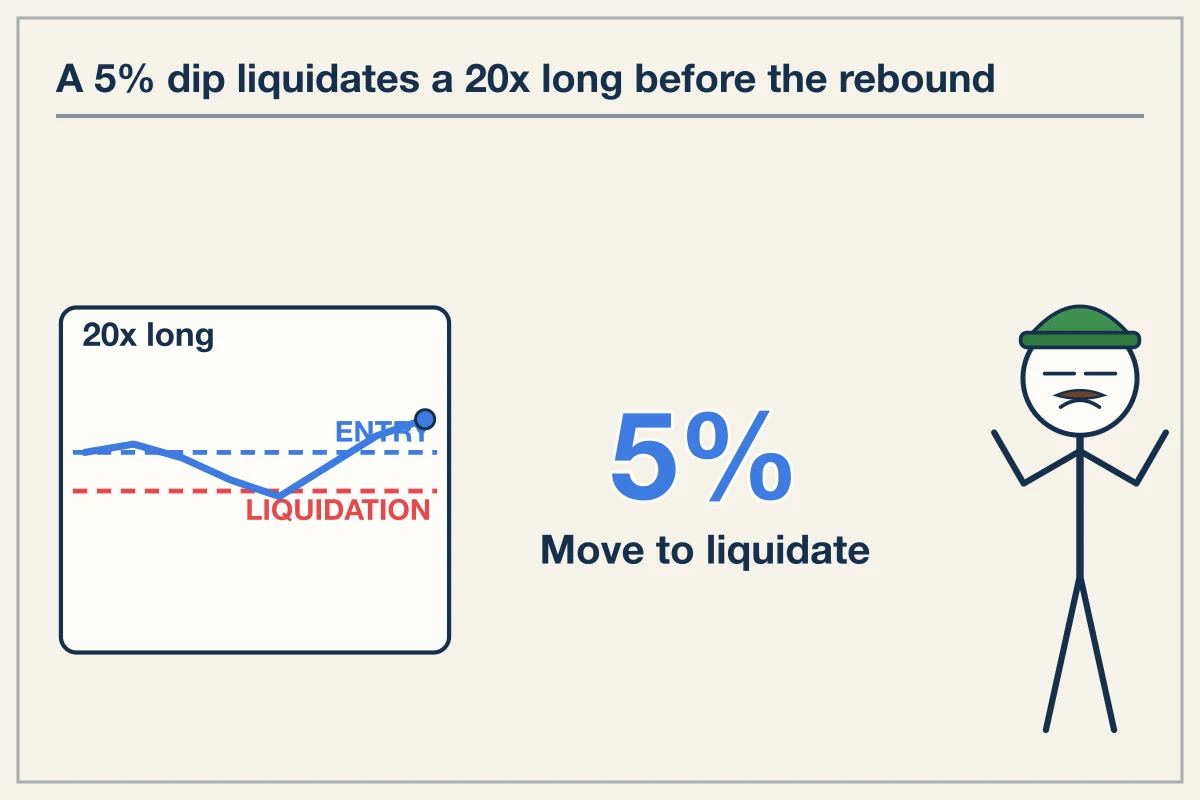
At 10x leverage, a 10% price decline against a long position triggers total liquidation. Increasing leverage to 20x reduces the required adverse move to 5%. At 50x leverage, a 2% price move wipes out the initial collateral.
Where this goes wrong
A 20x long position wiped out by a brief 5% market dip results in a permanent 100% loss of initial margin, even if price rebounds immediately after.
Market volatility frequently produces 5% intraday price swings. Bitcoin 24-hour volume routinely exceeds $5.8 billion across major venues, driving rapid order book shifts. High leverage exposes positions to liquidations driven by brief liquidity gaps rather than sustained structural trends.
Can you get rich trading crypto under fee and funding drag
Position costs extend beyond leverage limits. Perpetual futures contracts charge recurring funding rates every eight hours to align contract prices with spot markets. These rates accumulate directly against margin balances over time.
For an ETH long position, holding capital across different venues incurs varying funding rates. Bybit charges +0.0078% per 8-hour window, while Bitget charges +0.0100%. MEXC sits at +0.0097% and OKX charges +0.0099%. The spread between the cheapest and most expensive venue is 0.0022 percentage points per window.
Worth knowing
Holding an ETH long on Bitget costs 0.0100% in funding every 8 hours, whereas holding the same position on Bybit costs 0.0078%, creating a 0.0022 percentage point difference per period.
Taker fees compound this balance drain. Bybit charges a default futures taker fee of 0.055%. OKX charges 0.050%, Bitget charges 0.030%, and MEXC charges 0.020%. Opening and closing a $100,000 position on Bybit as a taker costs $110 in total execution fees, regardless of trade profitability.
Survivorship bias in published trading wins
Public screenshots of four-figure percentage returns reflect extreme tail events rather than average trader outcomes. When thousands of market participants trade at 50x leverage, probability guarantees that a small fraction will string together multiple winning trades by pure chance.
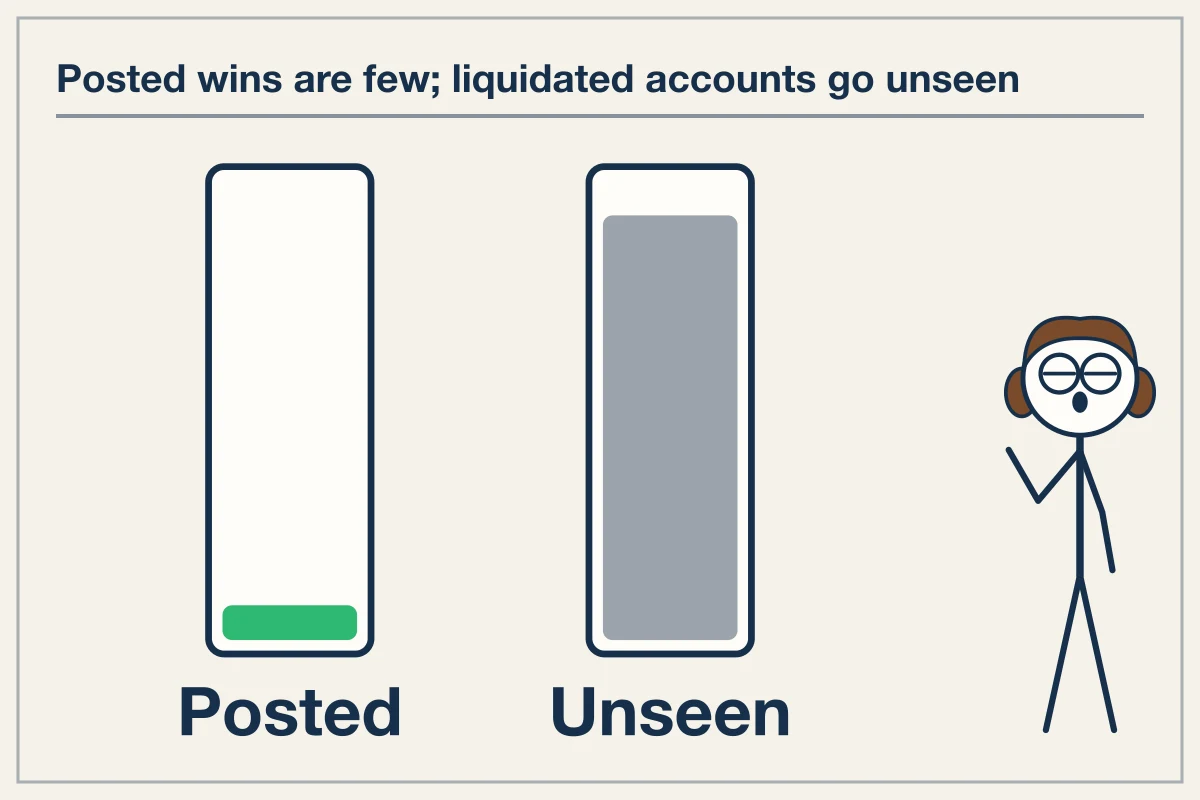
Traders who lose their margin close their accounts quietly. Exchange liquidation engines log these losses silently across global order books. High-return screenshots populate public feeds, while liquidated accounts disappear from view.
What to do instead
Evaluate trading strategies using net equity curves after accounting for full round-trip taker fees and daily funding payments across at least one hundred executions.
A strategy with a 55% win rate can remain unprofitable if fee structures and funding drag exceed the average edge. Recurring friction systematically converts positive raw price speculation into negative net equity over long horizons.
Perpetual futures fee and funding comparison
Venue selection alters the baseline cost structure of active trading. Taker fees apply to the full notionally leveraged trade size, while funding rates accrue on open position value.
| Venue | Futures Taker Fee | Futures Maker Fee | BTC 8h Funding Rate | ETH 8h Funding Rate |
| Bitget | 0.0300% | 0.0200% | +0.0060% | +0.0100% |
| Bybit | 0.0550% | 0.0200% | +0.0057% | +0.0078% |
| MEXC | 0.0200% | 0.0000% | +0.0076% | +0.0097% |
| OKX | 0.0500% | 0.0200% | +0.0063% | +0.0099% |
On SOL contracts, OKX offers the lowest long funding rate at +0.0006% per 8 hours, while Bybit charges +0.0083%. That produces a spread of 0.0077 percentage points per interval. Across a 30-day holding period, this spread translates to a 0.693% fee differential on total position size.
Trading volume remains concentrated in high-liquidity assets. BTC logs $5,880,036,337 in 24-hour volume, while ETH logs $7,914,510,442. High volume ensures order fill efficiency but does not lower published taker fees or alter fundamental liquidation math.
Can you get rich trading crypto using high leverage?
High leverage drastically reduces the margin for price movement before liquidation occurs. At 50x leverage, a 2% price move against your position clears your collateral, making long-term capital growth statistically improbable.
Why do social media trading screenshots show massive percentage returns?
Traders display successful outcomes while hiding closed accounts, losing trades, and liquidated positions. This survivorship bias presents tail-end probability distributions as repeatable trading outcomes.
How do fee schedules impact perpetual futures profitability?
Trading fees accumulate on the total leveraged position value rather than initial margin. Opening and closing a $100,000 position at a 0.055% taker fee costs $110, which reduces total account equity regardless of trade performance.
Does funding rate arbitrage eliminate position holding costs?
Spreads between venues change rapidly based on order flow and open interest. While holding ETH long on Bybit costs 0.0078% per 8 hours compared to 0.0100% on Bitget, execution fees and basis risk frequently absorb the rate differential.