· four exchange APIs · rebuilt daily
Choosing a limit vs market order crypto execution changes fees by up to 0.035%

The finding
Crossing the order book with a market order costs up to 0.055% per side while a maker limit order costs 0.02% or less.
Default futures taker fees range from 0.02% on MEXC to 0.055% on Bybit.
Using post-only flags eliminates accidental taker execution when submitting limit orders near the mid-price.
Reduce-only flags prevent unexpected position reversal when conditional orders trigger after manual exits.
Evaluating a limit vs market order crypto trade requires comparing execution certainty against taker fee penalties. Taker fees reach 0.055% per trade while maker orders cost 0.02% or less.
Fee Structure Comparison Across Derivatives Venues
Exchanges charge higher fees when an order removes liquidity from the order book. A market order executes immediately against resting liquidity, incurring the taker fee rate. A limit order rests on the book until matched, incurring the maker fee rate.
Default perpetual futures fee schedules vary across major derivative venues:
| Venue | Futures Maker Fee | Futures Taker Fee | Taker Fee Penalty |
|---|---|---|---|
| MEXC | 0.0000% | 0.0200% | 0.0200% |
| Bitget | 0.0200% | 0.0300% | 0.0100% |
| OKX | 0.0200% | 0.0500% | 0.0300% |
| Bybit | 0.0200% | 0.0550% | 0.0350% |
Fee differences compound across trading turnover. Consider a trader holding a 100,000 USD nominal position and turning it over ten times. Total executed volume equals 2,000,000 USD.
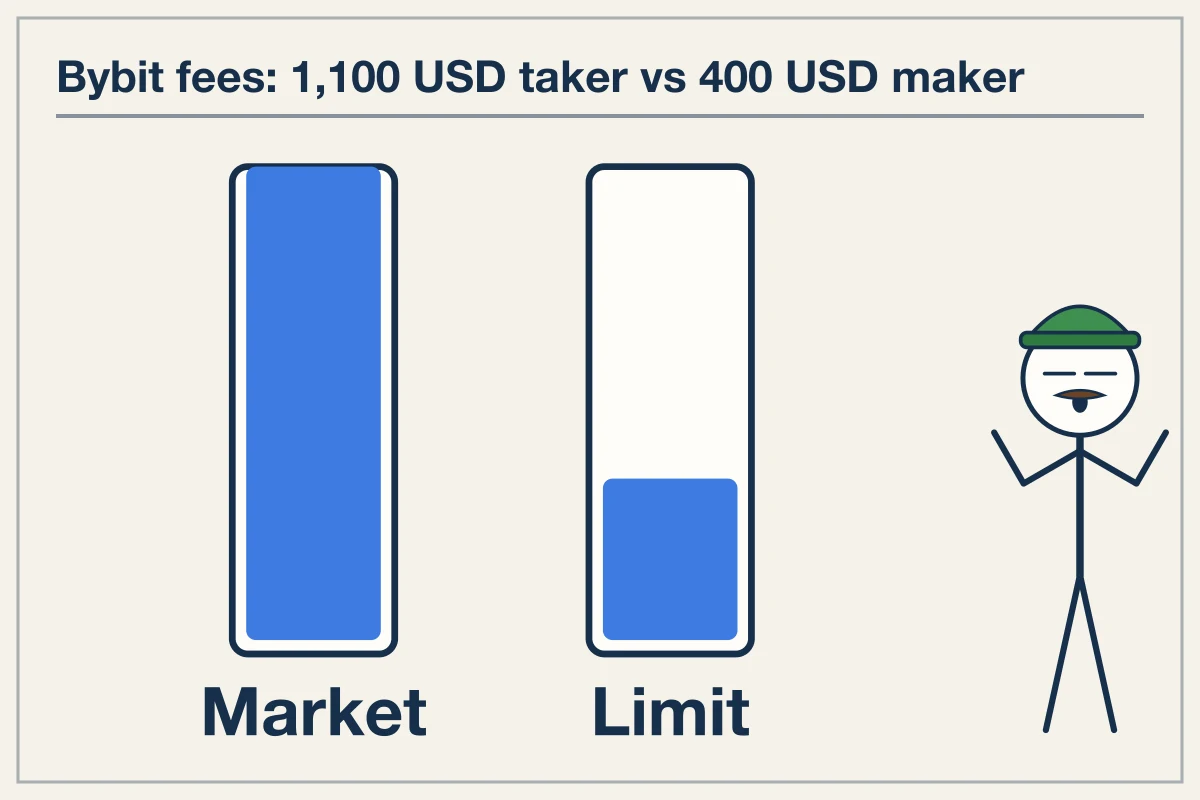
On Bybit, executing all fills via market orders generates 1,100 USD in taker fees. Executing those fills with resting limit orders generates 400 USD in maker fees. Crossing the order book costs 700 USD in fee drag on identical nominal volume.
On MEXC, taker execution on 2,000,000 USD volume costs 400 USD, while maker execution costs zero. On Bitget, taker execution costs 600 USD compared to 400 USD for maker fills.
Execution Mechanics in Limit vs Market Order Crypto Positions
Market orders match instantly against the best available prices on the order book. The execution price is not guaranteed. During low liquidity, a market order fills across multiple price levels, creating negative slippage.
Limit orders specify the exact entry or exit price. The order engine matches the trade only at the limit price or a better price. Price control is absolute, but execution is uncertain.
Worth knowing
Submitting a limit order at a price that overlaps existing book liquidity triggers immediate matching at the taker fee rate.
If market price moves away from a limit order, the trade remains unfilled. In fast-moving markets, unfilled limit orders leave traders without exposure or delay necessary exits.
Stop-Market Versus Stop-Limit Failure Modes
Conditional orders trigger when market price reaches a predetermined stop level. The choice between stop-market and stop-limit determines how the matching engine processes the trade once triggered.
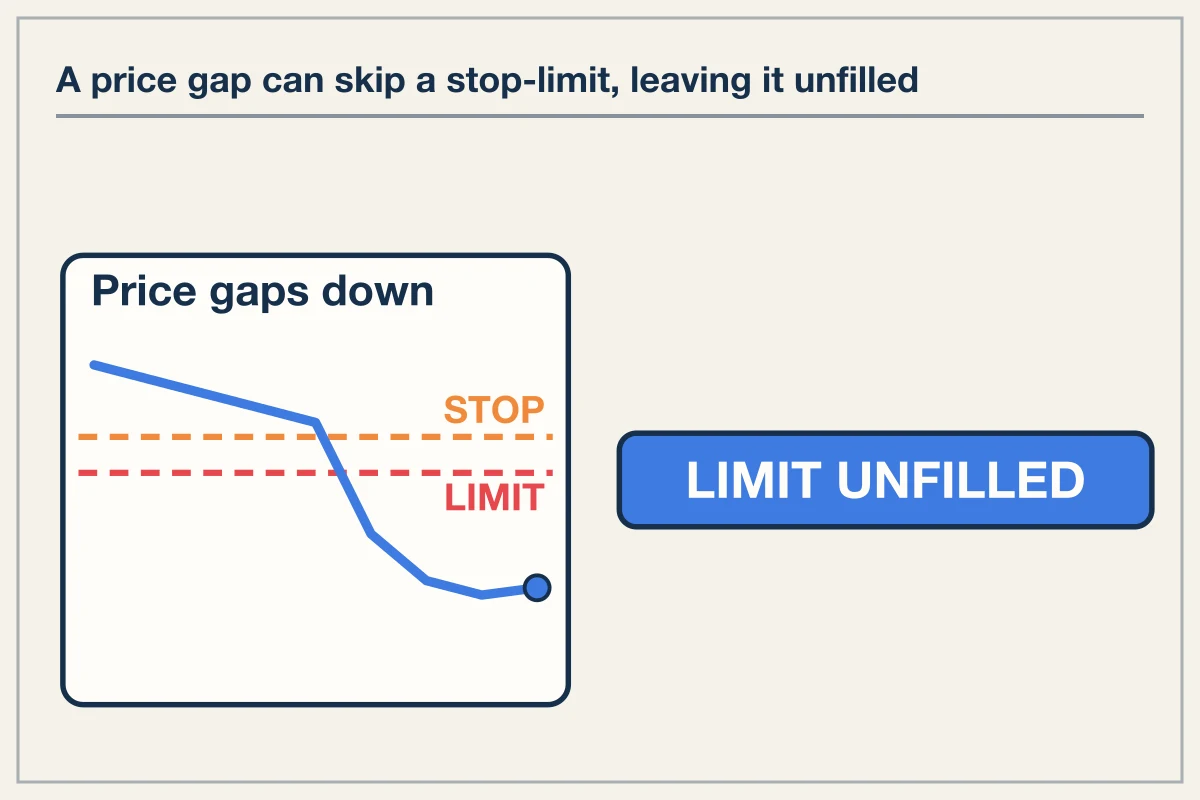
A stop-market order releases a market order instantly upon reaching the trigger price. Execution is guaranteed, but fill prices depend on available order book depth. In a liquidation cascade, slippage can push the fill price far beyond the trigger point.
A stop-limit order releases a limit order at a specified limit price when triggered. If market price gaps past the limit price before the order matches, the limit order rests on the book unfilled.
Where this goes wrong
Stop-limit orders placed near liquidation cascades frequently fail to fill, leaving unhedged positions open during sharp market drops.
When liquidations sweep the order book, bid depth evaporates. A stop-limit sell order with a limit price close to the trigger price remains open while market price falls past it. The trader retains full downside risk.
Execution Rules with Post-Only and Reduce-Only Flags
Advanced order flags modify order engine behavior to control fee status and position size changes.
Post-only flags guarantee that a limit order enters the book as a maker order. If the limit price would cause an immediate match against existing orders, the exchange cancels the order without fees.
What to do instead
Use post-only flags on market-making and range orders to ensure trades never incur taker fee rates.
Post-only prevents paying taker fees caused by rapid bid-ask movement during order entry. It forces the trader to adjust the limit price rather than accidentally taking liquidity.
Reduce-only flags restrict an order to reducing an active position. If an order with a reduce-only flag exceeds current position size, the engine automatically scales down or cancels the order.
Without reduce-only flags, resting take-profit or stop-loss orders remain active after a manual position exit. A subsequent price move fills those orphan orders, opening an unwanted inverse position.
What is the main cost difference between limit vs market order crypto execution?
Market orders incur taker fees up to 0.055%, while limit orders receive maker fees between 0.00% and 0.02%. On 2,000,000 USD in executed volume, taker execution on Bybit costs 700 USD more than maker execution.
Why do stop-limit orders fail during fast market drops?
A stop-limit order places a resting limit order once triggered. If market price jumps past the limit price before matching occurs, the order sits unfilled on the book while price continues downward.
How does a post-only order flag lower trading costs?
Post-only rejects any limit order that would match immediately as a taker order. This prevents paying taker fee rates when market volatility moves price into your order during submission.
What happens when you do not use reduce-only on exit orders?
If you close a position manually, resting stop or limit orders stay open on the book. When market price hits those levels later, the exchange fills them as new position entries.