· four exchange APIs · rebuilt daily
How Brickell Miami crypto migration reshaped capital flows

The finding
Florida's zero percent state income tax rate drove institutional trading firms to relocate to Brickell starting in early 2021.
Mayor Francis Suarez initiated the Venture Miami campaign to recruit digital asset funds.
Major hedge funds, venture firms, and market makers opened offices along Brickell Avenue.
Capital concentration in South Florida coincided with expanding off-shore perpetual futures volumes.
Florida tax incentives and the 2021 Brickell relocation wave
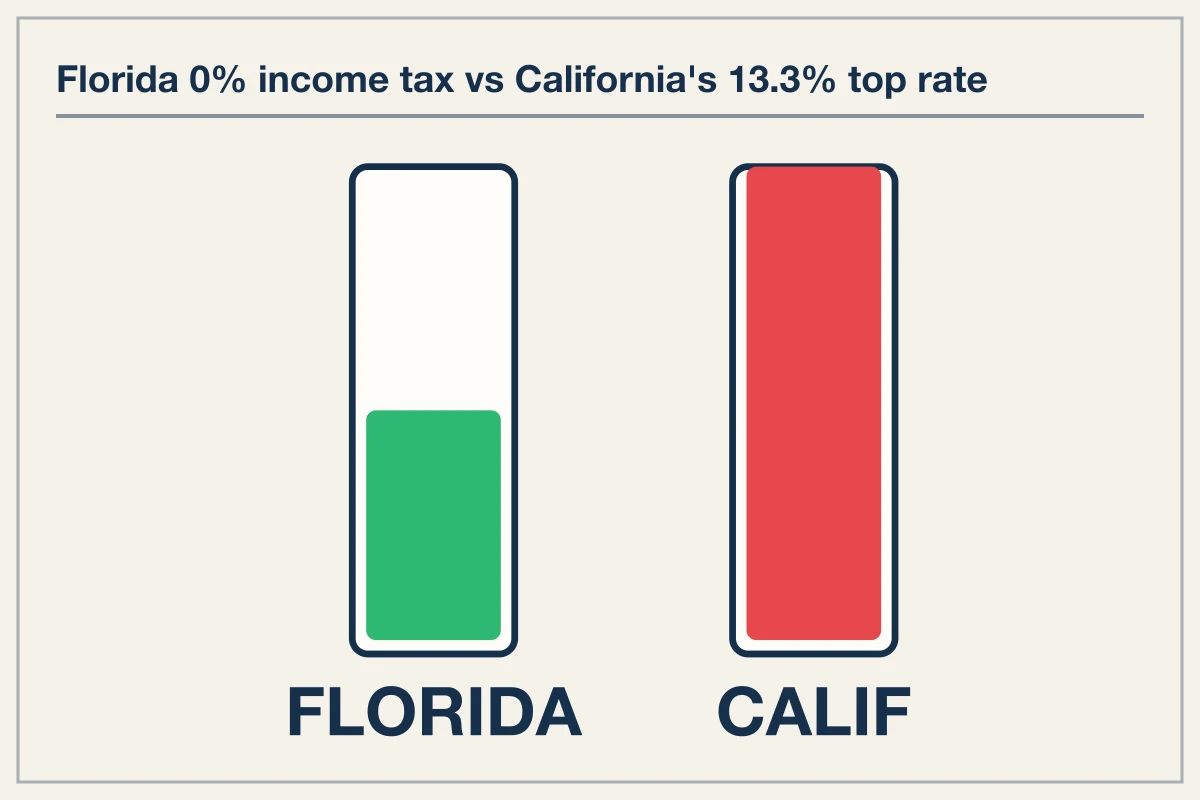
The migration of financial capital to Miami's Brickell district began with concrete fiscal policy. Florida levies a 0% personal income tax rate, compared to New York State's top rate of 10.9% and California's 13.3%. For fund partners and high-frequency desk principals, relocating primary residence and corporate management out of northern financial hubs yielded immediate net margin retention.
In early 2021, the city government launched a direct initiative to market Brickell as a financial technology capital. The administration promoted municipal payroll options in Bitcoin and encouraged local banks to hold digital assets. While municipal treasury allocations remained limited by state statutory constraints, the public policy stance signalled regulatory tolerance to fund managers.
Firms including Founders Fund, SoftBank's Latin America fund, and Blockchain.com established physical footprints along Brickell Avenue and Biscayne Boulevard. Quantitative trading desks followed, placing executive teams in Miami while keeping server colocation in Northern Virginia and New Jersey data centres.
Worth knowing
Physical relocation to Brickell changes administrative tax jurisdiction but does not alter trading latency, as matching engines remain in transatlantic data centres.
Brickell Miami crypto desk operations and venue execution
Desk managers operating from Brickell handle execution routing across global perpetual futures venues. While physical offices moved to Florida, order flow routes to off-shore liquidity pools where contracts trade continuously across digital assets and tokenised commodities.
Execution costs depend heavily on taker fees and standing funding rates across venues. Across major pairs like ETH, BTC, and XAU, fee schedules create measurable performance variances for high-turnover strategies.
| Venue | Futures Maker Fee | Futures Taker Fee | Spot Maker Fee | Spot Taker Fee |
|---|---|---|---|---|
| MEXC | 0.0000% | 0.0200% | 0.0000% | 0.0500% |
| Bitget | 0.0200% | 0.0300% | 0.1000% | 0.1000% |
| OKX | 0.0200% | 0.0500% | 0.0800% | 0.1000% |
| Bybit | 0.0200% | 0.0550% | 0.1000% | 0.1000% |
Fee structures show significant baseline divergence. MEXC charges 0.0000% maker and 0.0200% taker fees on futures contracts. Bybit charges 0.0200% maker and 0.0550% taker fees. On a $1,000,000 taker order, execution cost is $200 on MEXC compared to $550 on Bybit.
Where this goes wrong
Taker fee differentials of 0.0350 percentage points erase net yield on high-frequency arbitrage strategies within hours.
Funding rate spreads across top perpetual markets
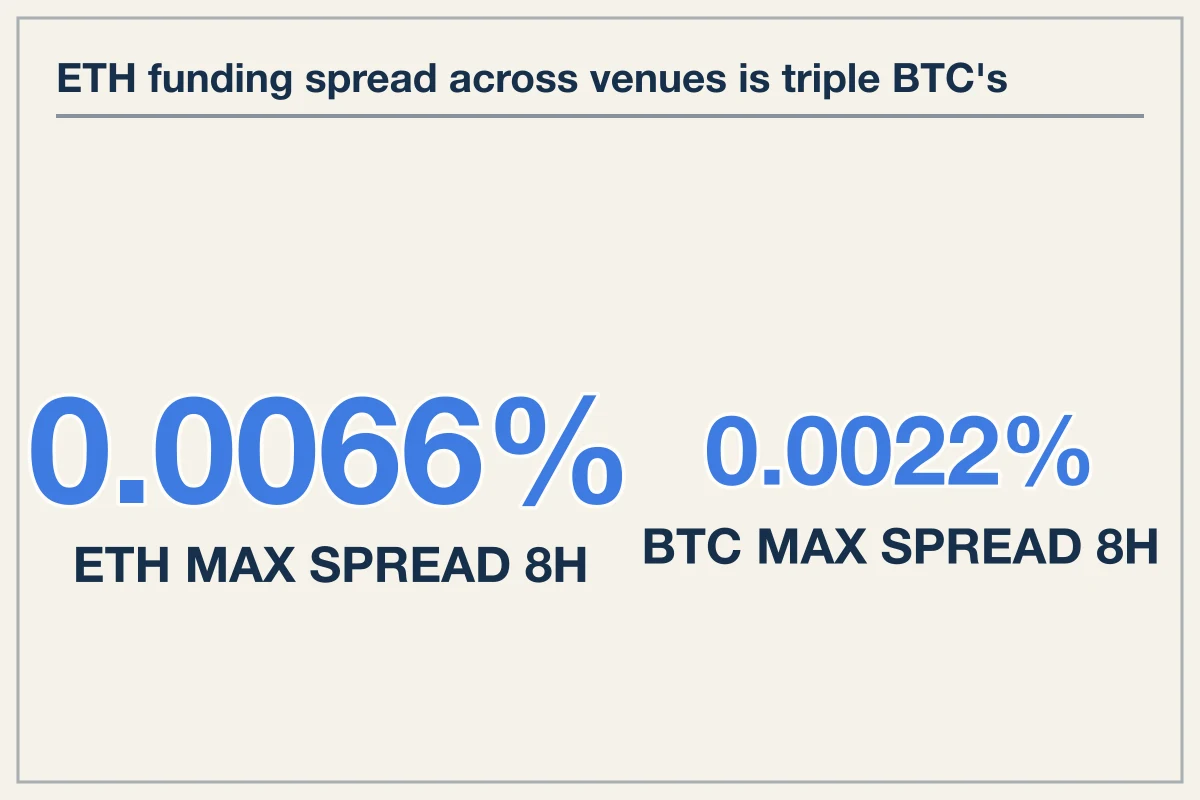
Perpetual swap holding costs differ widely across venues. Live market data shows variations in normalized 8-hour funding rates for high-volume perpetual contracts. ETH leads 24-hour volume at $7,232,903,362, closely followed by BTC at $6,948,300,466.
| Asset | 24h Volume | MEXC 8h Funding | Bybit 8h Funding | Bitget 8h Funding | OKX 8h Funding | Max Spread (8h) |
|---|---|---|---|---|---|---|
| ETH | $7,232,903,362 | +0.0034% | +0.0047% | +0.0100% | +0.0100% | 0.0066% |
| BTC | $6,948,300,466 | +0.0096% | +0.0078% | +0.0100% | +0.0100% | 0.0022% |
| SNDK | $1,638,274,290 | N/A | +0.0000% | +0.0000% | +0.0021% | 0.0021% |
| SOL | $1,332,602,757 | -0.0008% | -0.0013% | +0.0034% | -0.0016% | 0.0050% |
| XAU | $952,840,119 | +0.0278% | +0.0062% | +0.0218% | +0.0554% | 0.0491% |
| ZEC | $634,582,928 | +0.0026% | +0.0100% | +0.0100% | +0.0004% | 0.0096% |
Gold perps (XAU) show the largest funding divergence. OKX records an 8-hour funding rate of +0.0554%, while Bybit prints +0.0062%. The resulting spread is 0.0491 percentage points per 8-hour epoch. Holding a $1,000,000 long position on OKX costs $554 every 8 hours in funding payments, compared to $62 on Bybit. Over 30 days, that rate gap equals a $44,280 cost difference on the same notionally sized position.
For SOL, OKX carries a negative rate of -0.0016% per 8 hours, making it the cheapest venue to hold long positions, while Bitget charges long holders +0.0034%.
What to do instead
Calculate annualized funding drift before deploying long-term carry positions across venues.
Why did crypto firms move to Miami's Brickell district in 2021?
Brickell offered Florida's 0% state income tax alongside an explicit municipal recruitment push led by local officials. Financial firms saved significant overhead compared to operating in high-tax states like California and New York.
How does exchange taker fee variation affect perpetual trading costs?
Perpetual futures taker fees range from 0.0200% on MEXC to 0.0550% on Bybit. On high-turnover trading desks, this 0.0350% difference adds $350 in friction per $1,000,000 traded.
What is the largest live funding rate spread among major perpetual contracts?
Gold perps (XAU) exhibit the largest funding spread at 0.0491 percentage points per 8 hours between OKX (+0.0554%) and Bybit (+0.0062%). This creates a substantial holding cost variance for long positions.