· four exchange APIs · rebuilt daily
How to choose a crypto exchange with four execution checks
The finding
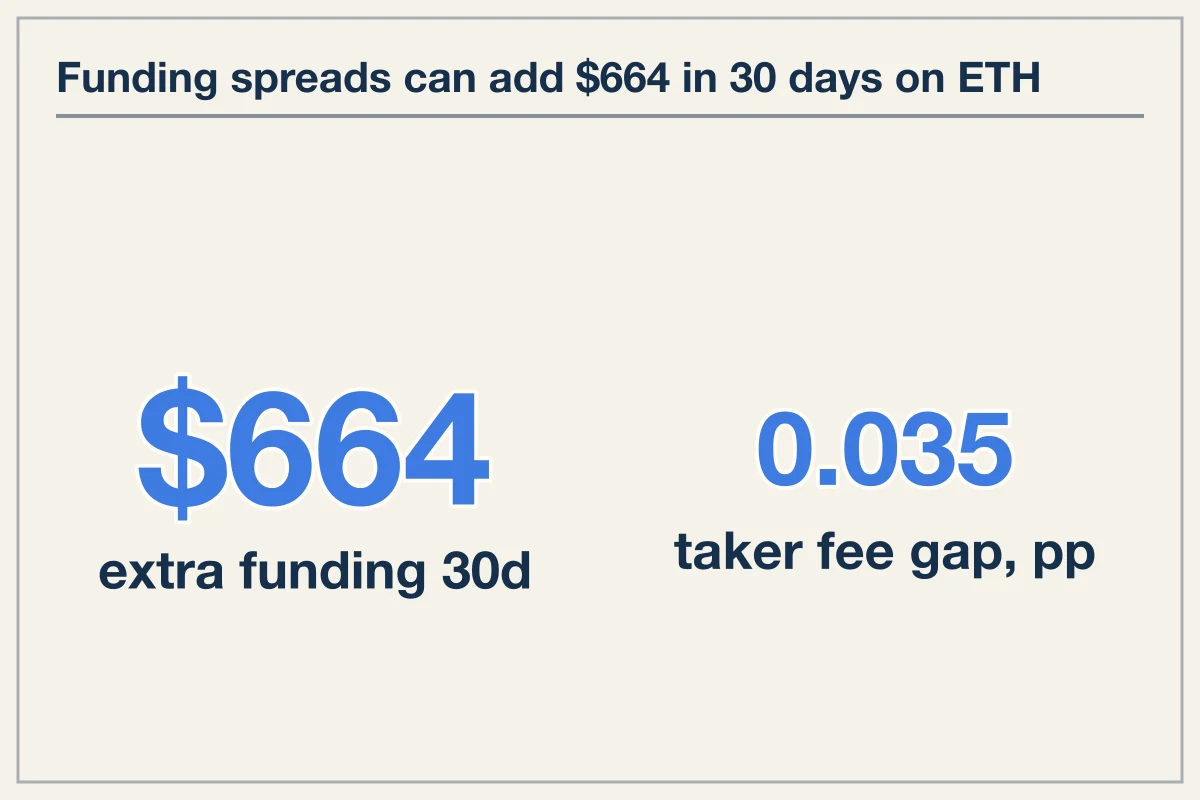
Default fee schedules vary by up to 0.035 percentage points for taker orders, while funding spreads across venues can cost an extra $664 over 30 days on a $100,000 ETH position.
Checking contracting entities, funding spreads, real fee tiers, and engine behavior in volatility isolates structural venue risks before you deposit capital.
Running these four execution checks prevents unbudgeted decay on open perpetual positions.
Deciding how to choose a crypto exchange requires looking past surface marketing to core operational mechanics. When you evaluate how to choose a crypto exchange, four structural checks determine your net cost and position safety: corporate entity isolation, net trading fees, funding rate baseline spreads, and system handling during peak volatility.
Corporate entity isolation and Terms of Service rules
Exchanges operate under multiple operating subsidiaries across legal jurisdictions. The entity serving your region dictates your legal recourse during insolvency, dispute resolution procedures, and mandatory account restrictions.
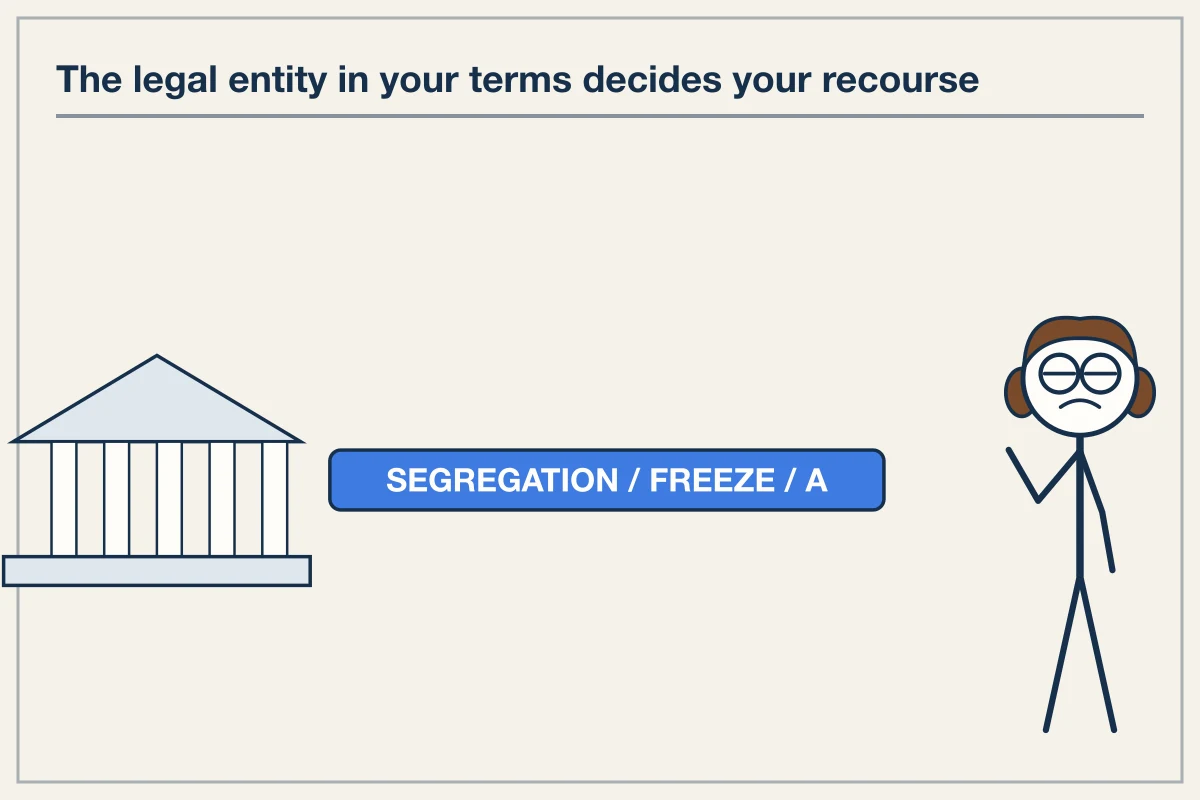
Exchanges frequently route retail perp accounts to offshore holding companies. Check the footer of the user agreement to identify the legal entity governing your agreement. Look for three specific clauses: explicit asset segregation rules, unilateral account freeze rights, and forced auto-deleveraging (ADL) terms.
Where this goes wrong
Legal terms often permit venues to adjust maintenance margin requirements without advance notice during high volatility, triggering forced liquidations on positions that were previously safe.
Verify where funds are held and whether legal ownership remains with the account holder or transfers to the balance sheet of the platform. If the terms allow rehypothecation of collateral, your capital functions as an unsecured loan to the venue.
How to choose a crypto exchange by trading costs
Base fee schedules vary significantly between venues. Taker fees on default tiers range from 0.0200% to 0.0550% for perpetual futures, while maker fees sit between 0.0000% and 0.0200%.
| Venue | Futures Maker Fee | Futures Taker Fee | ETH 8h Funding | BTC 8h Funding |
|---|---|---|---|---|
| MEXC | 0.0000% | 0.0200% | -0.0001% | +0.0062% |
| Bitget | 0.0200% | 0.0300% | +0.0011% | +0.0043% |
| OKX | 0.0200% | 0.0500% | +0.0036% | +0.0026% |
| Bybit | 0.0200% | 0.0550% | +0.0065% | +0.0042% |
To calculate total execution cost, combine base fees with 8-hour funding payments. Consider a $100,000 ETH long position held for 30 days (90 funding intervals).
On Bybit, a taker entry (0.0550%) costs $55 and an exit costs $55, totaling $110 in base fees. Funding at +0.0065% per 8 hours equals $6.50 per interval. Over 90 intervals, funding payments total $585. Total cost to hold the position is $695.
On MEXC, a taker entry (0.0200%) costs $20 and an exit costs $20, totaling $40 in base fees. Funding at -0.0001% per 8 hours pays you $0.10 per interval, totaling $9 received over 30 days. Total net cost to hold the position is $31.
Worth knowing
Real position cost is driven by holding duration: on long-term positions, a funding spread of 0.0066% per 8 hours quickly exceeds the initial execution fee.
The net cost difference between the highest and lowest fee venues on this single ETH trade equals $664 over 30 days.
Outage mechanics and auto-deleveraging queue positioning
Matching engines face extreme load during market crashes. When engine latency spikes, order cancellation requests fail or queue behind execution orders.
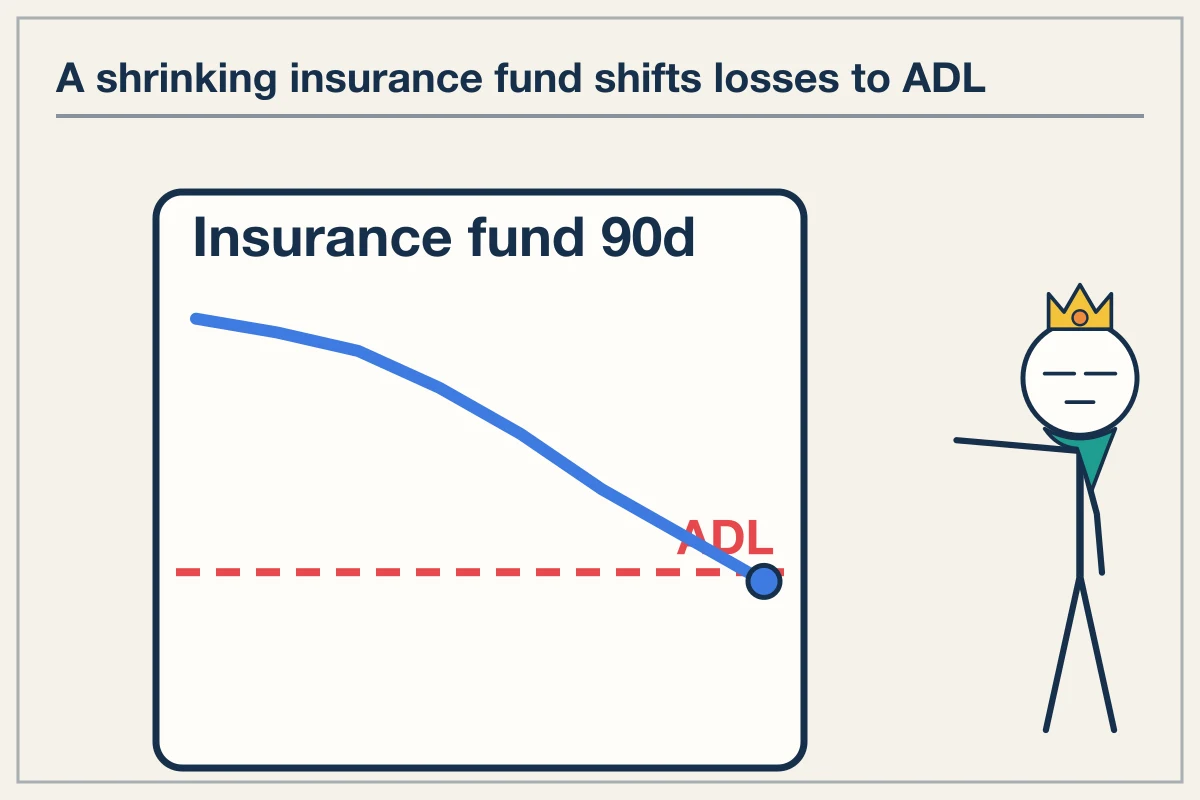
Exchanges handle liquidations using two distinct methods: internal insurance funds or direct auto-deleveraging (ADL). Inspect the published insurance fund balances over a rolling 90-day window. If an insurance fund decreases steadily during market drawdowns, the exchange will rely on ADL to close profitable opposing positions.
Check how the matching engine processes stop-loss orders during API disconnects. Certain platforms process conditional orders locally on client interfaces, meaning stop-losses fail if the client loses connection. Venues with server-side trigger engines execute conditional orders regardless of client connectivity.
Asset withdrawal limits and chain maintenance history
An exchange fee advantage is meaningless if funds cannot be withdrawn when market volatility increases. Review the historical uptime of wallet withdrawal infrastructure across key asset chains.
Exchanges frequently suspend withdrawals under the banner of wallet maintenance during high-volatility events or token launches. Cross-reference exchange status logs to count how many times withdrawals were disabled on major assets over the previous 12 months.
What to do instead
Test withdrawal channels with small transfers across multiple chains before committing large trading capital to a new account.
Verify the daily un-verified withdrawal limits and mandatory verification thresholds. Ensure withdrawal limits exceed your max target allocation so you can exit the exchange entirely within a single 24-hour window if counterparty risk rises.
How do you check if an exchange has low perpetual trading fees?
Compare the default taker and maker rates on the fee schedule alongside live 8-hour funding rates for your target asset. A low taker fee can be offset by high baseline funding rates if positions are held over multiple days.
What happens to open positions when a crypto exchange goes offline?
Open positions remain active in the order book and can trigger liquidation if the mark price moves past your liquidation price. Server-side stop-loss orders will execute normally, but client-side triggers and manual order cancellations will fail until connectivity restores.
How do funding rate differences affect holding costs across venues?
Funding rates settle every 8 hours, compounding daily holding costs. A funding rate spread of 0.0066% per 8 hours on ETH adds $6.60 per interval ($19.80 daily) in relative cost for every $100,000 of position size between the cheapest and most expensive venue.