· four exchange APIs · rebuilt daily
Perpetual Rate Spreads Cause 0.015 Percent Daily Holding Cost Gaps
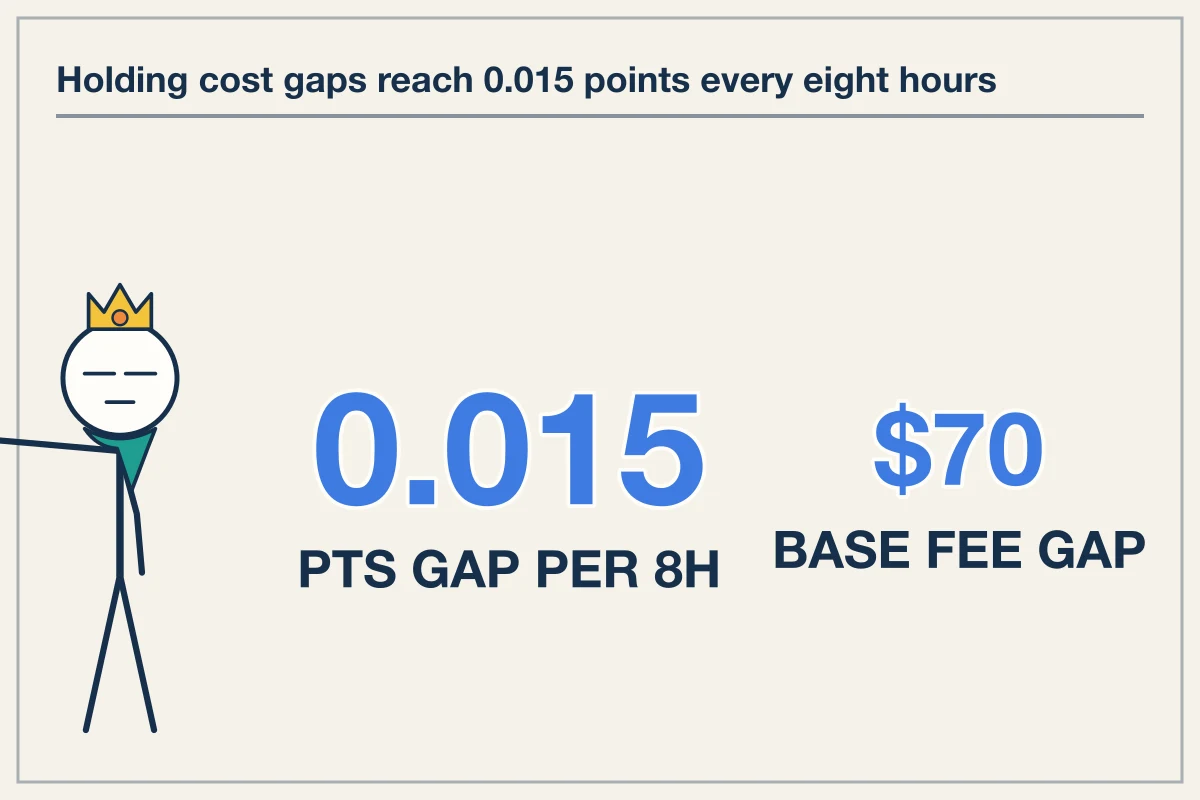
Base fee tiers and live funding spreads alter perpetual holding costs by up to 0.015 percentage points every eight hours across major derivative venues.
Execution Drag and Base Fee Schedule Gaps
Base execution fees and live funding rate disparities create holding cost gaps as wide as 0.015 percentage points every eight hours across active perpetual venues.
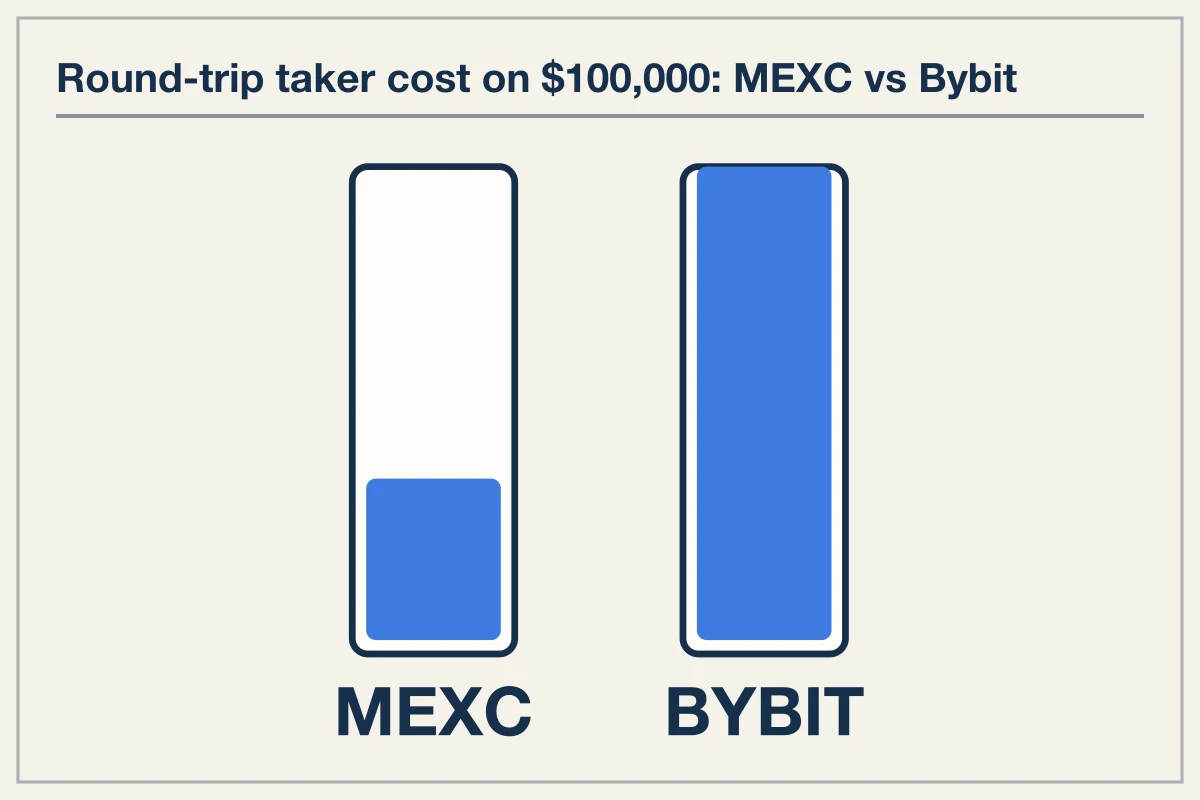
Traders operating on default fee schedules face baseline friction before order book spread and slippage are factored in. Base default fee schedules differ substantially across venues at baseline volume tiers.
| Exchange | Futures Maker Fee | Futures Taker Fee | Round-Trip Taker Cost ($100k Position) |
|---|---|---|---|
| MEXC | 0.0000% | 0.0200% | $40 |
| Bitget | 0.0200% | 0.0300% | $60 |
| OKX | 0.0200% | 0.0500% | $100 |
| Bybit | 0.0200% | 0.0550% | $110 |
A market entry and market exit on a $100,000 position on Bybit incurs a 0.055% taker fee on entry ($55) and 0.055% on exit ($55), totaling $110 in base execution cost. On MEXC, the same $100,000 position incurs a 0.02% taker fee on entry ($20) and 0.02% on exit ($20), totaling $40. The base fee differential alone generates a $70 cost gap per $100,000 traded.
Spread Crossing and Market Depth Mechanics
Order execution costs extend beyond published schedules. Crossing the bid-ask spread applies an immediate penalty on market orders.
When order size exceeds top-of-book depth, execution walks the order book. A $100,000 market order filled against an order book with $25,000 top-level liquidity fills the remaining $75,000 across higher ask levels. An average slippage of 0.02% adds $20 on entry and $20 on exit, raising total execution friction to $150 on higher-fee venues.
Eight-Hour Live Funding Rate Disparities
Perpetual futures rely on periodic funding rates to anchor contract prices to spot markets. Funding rates reflect local venue long-to-short open interest ratios and differ significantly across exchanges for the same underlying asset.
| Asset | OKX 8h Rate | MEXC 8h Rate | Bitget 8h Rate | Rate Spread | Cheapest Long Venue | 24h Volume |
|---|---|---|---|---|---|---|
| ETH | +0.0014% | +0.0009% | +0.0100% | 0.0091% | MEXC | $8,801,015,142 |
| BTC | +0.0078% | +0.0100% | +0.0100% | 0.0022% | OKX | $5,872,321,707 |
| SOL | -0.0098% | -0.0046% | +0.0047% | 0.0145% | OKX | $1,533,294,254 |
| ZEC | +0.0002% | +0.0013% | +0.0100% | 0.0098% | OKX | $776,660,404 |
| XRP | -0.0011% | +0.0002% | +0.0046% | 0.0057% | OKX | $495,473,672 |
| XAU | +0.0312% | +0.0174% | +0.0162% | 0.0150% | Bitget | $451,124,999 |
Arithmetic of Long Position Funding Drag
Negative funding rates mean short positions pay long positions. Positive rates mean long positions pay short positions.
On SOL, OKX posts an eight-hour funding rate of -0.0098%. A $100,000 long position receives $9.80 every eight hours, generating $29.40 per 24 hours. On Bitget, SOL posts an eight-hour rate of +0.0047%. A $100,000 long position pays $4.70 every eight hours, costing $14.10 per 24 hours. Across three funding intervals in 24 hours, holding the $100,000 SOL long on Bitget instead of OKX results in a $43.50 cost difference.
On XAU perps, Bitget posts +0.0162% per eight hours, while OKX posts +0.0312%. The spread is 0.0150 percentage points per interval. Over 24 hours across three intervals, a $100,000 long on OKX pays $93.60 in funding ($31.20 per interval). On Bitget, the same long pays $48.60 ($16.20 per interval). The venue gap consumes $45.00 per day per $100,000 position.
On ETH, MEXC offers the lowest rate for long holders at +0.0009% per eight hours ($0.90 per $100,000), compared to Bitget at +0.0100% ($10.00 per $100,000). Holding an ETH long on Bitget costs $27.30 more per day per $100,000 than on MEXC across $8,801,015,142 in 24-hour market volume.
Margin Friction and Forced Closure Thresholds
Unfunded capital drag impacts account health directly. Accumulating positive funding debits or paying wide taker fees reduces collateral balances continuously.
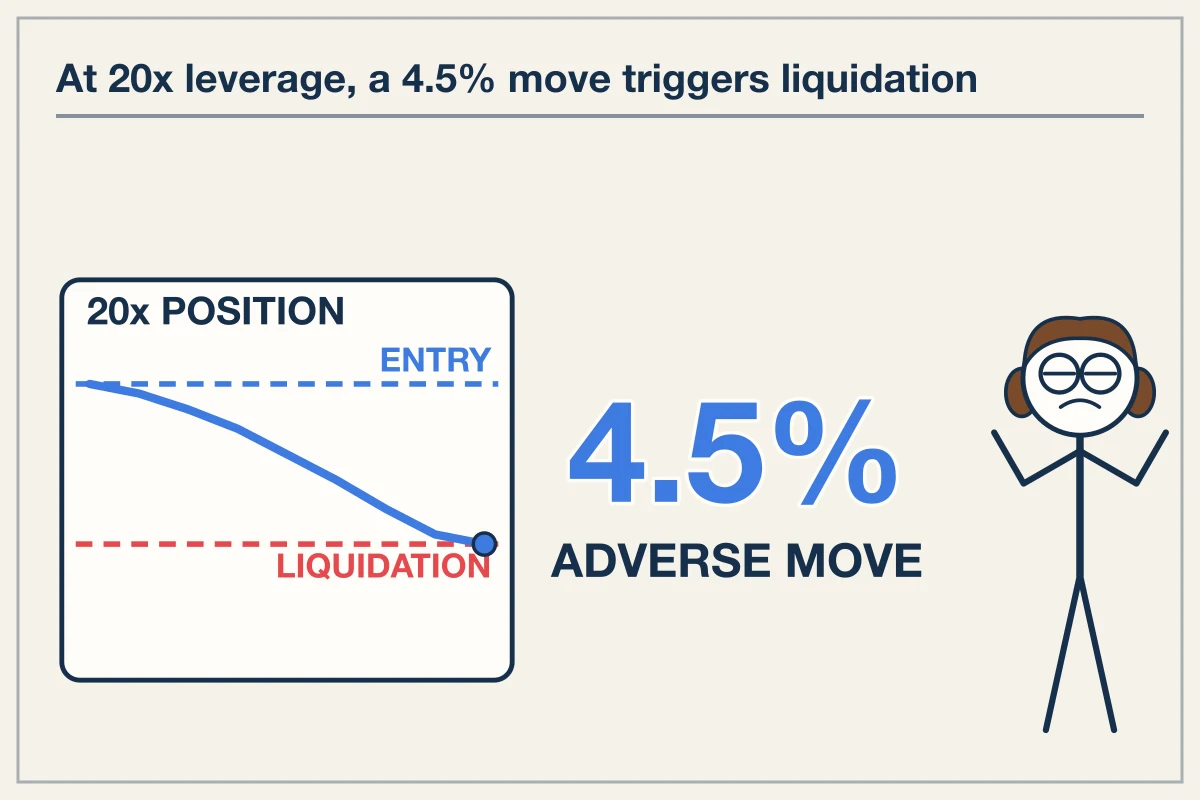
When position leverage increases, small equity drains accelerate proximity to liquidation thresholds. At 20x leverage, a 4.5% adverse price move depletes maintenance margin and triggers liquidation. Forced liquidations execute via market orders, incurring liquidation penalty surcharges on top of standard taker fees, resulting in total margin loss.