· four exchange APIs · rebuilt daily
Bitcoin Holds 1000000 Unmoved Genesis Coins as Venue Costs Diverge
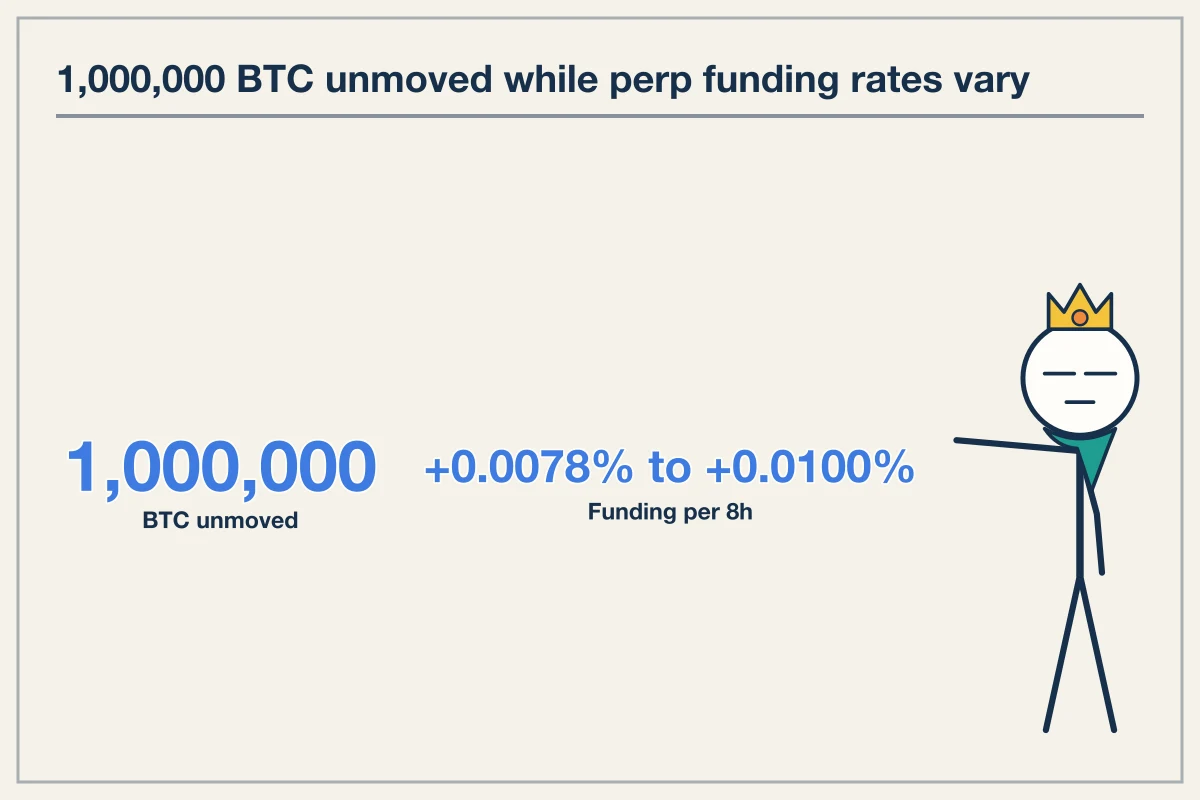
Documented facts show 1,000,000 BTC untouched since 2009 while current BTC perp funding ranges from +0.0078% to +0.0100% per 8 hours across exchanges.
Roughly 1,000,000 BTC mined during the protocol's first year remain unmoved across early addresses, while current perpetual swap positions incur daily funding charges ranging from +0.0078% to +0.0100% per 8-hour period. Perpetual contracts anchor to spot prices through 8-hour funding rate payments exchanged between long and short positions without clearing through base-layer transfers. When longs pay shorts, an open position incurs recurring cash flow drag independent of market direction or historical supply overhangs.
Consider a $100,000 BTC long position held for 30 consecutive days at current rates. On OKX, where the 8-hour rate is +0.0078%, three funding intervals per day yield a daily rate of +0.0234%. Multiplying $100,000 by 0.000234 results in a daily funding cost of $23.40. Over 30 days, total funding paid equals $702.00. On MEXC or Bitget, where the 8-hour rate sits at +0.0100%, the daily rate is +0.0300%. Multiplying $100,000 by 0.000300 gives a daily cost of $30.00, totaling $900.00 over 30 days. Opening the position on MEXC with zero futures maker fee versus taker fee of 0.0002 requires $20.00 for a $100,000 entry taker order, whereas OKX charges a 0.0005 taker fee totaling $50.00.
Documented Historical Record of Bitcoin Origin
When searching for who created bitcoin satoshi nakamoto, verifiable primary sources establish dates and cryptographic artifacts rather than real-world identities.
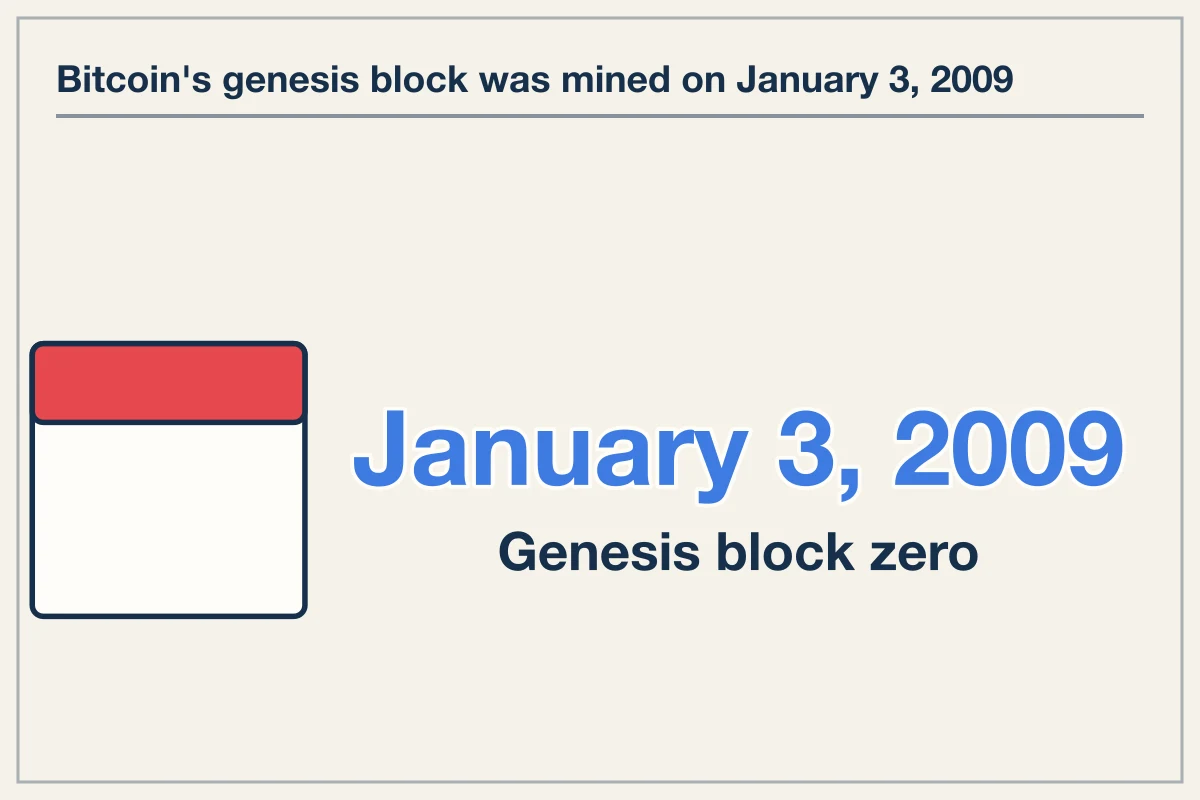
The documented record contains four key milestones:
- October 31, 2008: The publication of a nine-page whitepaper titled "Bitcoin: A Peer-to-Peer Electronic Cash System" signed under the pseudonym Satoshi Nakamoto.
- January 3, 2009: The mining of genesis block zero. Embedded inside the coinbase parameter of block zero was text quoting a London newspaper: "The Times 03/Jan/2009 Chancellor on brink of second bailout for banks."
- January 9, 2009: The release of Bitcoin version 0.1 software code.
- January 12, 2009: The first transaction on the network, where 10 BTC was sent from Satoshi Nakamoto to receiver Hal Finney in block 170.
Beyond these technical events, blockchain analysis tracks pattern activity from early mining nodes. Approximately 1,000,000 BTC was mined across early blocks attributed to the initial operator. These coins have remained untouched in their original addresses for over fifteen years. Public attribution to a verified legal identity has never been established. Assumptions regarding individual identities remain unverified claims outside the cryptographic record.
Supply Impact and Perpetual Swap Market Reality
Historical coins staying static means 1,000,000 BTC sits outside liquid circulating supply. Active derivative traders manage positions against active exchange order books rather than idle genesis wallets. Perpetual futures trades settle against live market index prices and depend on fee schedules and funding dynamics across trading venues.
The table below outlines current 8-hour funding rates, spread differences, cheapest long venues, and 24-hour trading volumes across six active perpetual swap markets.
| Market | Cheapest Long Venue | Lowest 8h Funding | Highest 8h Funding | Rate Spread (8h) | 24h Volume |
|---|---|---|---|---|---|
| BTC | OKX | +0.0078% | +0.0100% | 0.0022% | $5,792,379,138 |
| ETH | MEXC | +0.0007% | +0.0100% | 0.0093% | $8,684,770,627 |
| SOL | OKX | -0.0095% | +0.0041% | 0.0136% | $1,509,571,800 |
| ZEC | MEXC | +0.0008% | +0.0100% | 0.0092% | $761,890,211 |
| XRP | OKX | -0.0005% | +0.0050% | 0.0055% | $492,553,203 |
| XAU | Bitget | +0.0179% | +0.0350% | 0.0171% | $437,599,233 |
Across BTC perpetuals, OKX offers the lowest funding rate for long positions at +0.0078% per 8 hours, compared to +0.0100% on Bitget and MEXC. On ETH, MEXC holds the lowest long rate at +0.0007% per 8 hours, whereas Bitget charges +0.0100%, creating an 8-hour spread of 0.0093 percentage points.
Fee Schedules and Cost Structure Across Venues
Trading execution costs combine entry fees, exit fees, and ongoing funding payments. Default published fee tiers reflect distinct choices between maker and taker order types.
| Venue | Spot Maker Fee | Spot Taker Fee | Futures Maker Fee | Futures Taker Fee |
|---|---|---|---|---|
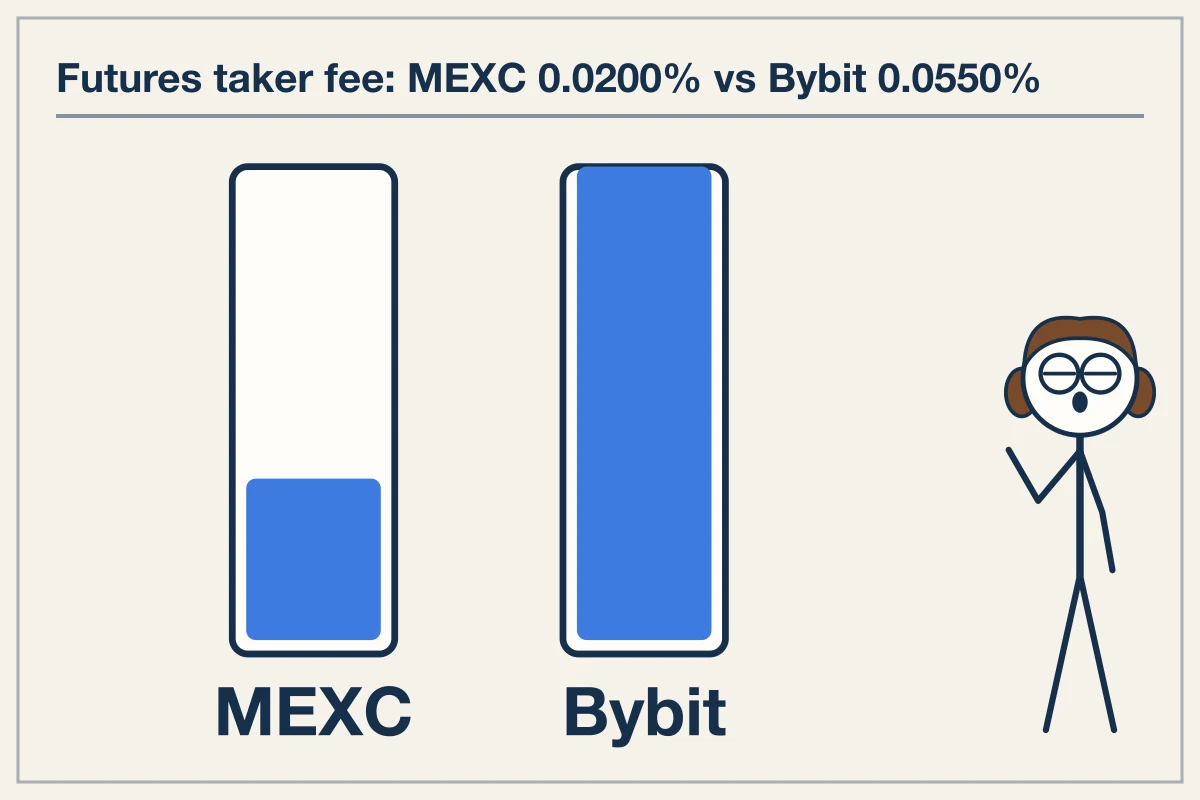
| MEXC | 0.0000% | 0.0500% | 0.0000% | 0.0200% |
| Bitget | 0.1000% | 0.1000% | 0.0200% | 0.0300% |
| OKX | 0.0800% | 0.1000% | 0.0200% | 0.0500% |
| Bybit | 0.1000% | 0.1000% | 0.0200% | 0.0550% |
Executing a taker order on a $100,000 futures position on Bybit incurs a fee of 0.0550%, equal to $55.00 on entry and $55.00 on exit assuming price parity. The same order executed on MEXC as a taker incurs a 0.0200% fee, equal to $20.00 per trade. A maker order on MEXC incurs zero futures maker fee, saving $20.00 compared to Bitget or OKX where futures maker fees sit at 0.0200% ($20.00 per $100,000 nominal trade).
Calculating Long-Term Position Carry
Holding a perpetual contract requires factoring both entry execution and cumulative funding.
For an ETH long position of $50,000 held for 14 days: On MEXC, the 8-hour funding rate is +0.0007%. Daily funding rate is three times 0.0007%, which equals +0.0021%. Daily cost on $50,000 equals $50,000 multiplied by 0.000021, yielding $1.05 per day. Over 14 days, total funding paid is $14.70. Entry taker fee at 0.0200% costs $10.00, resulting in total transaction and carry costs of $24.70.
On Bitget, the 8-hour funding rate is +0.0100%. Daily funding rate is three times 0.0100%, which equals +0.0300%. Daily cost on $50,000 equals $50,000 multiplied by 0.000300, yielding $15.00 per day. Over 14 days, total funding paid is $210.00. Entry taker fee at 0.0300% costs $15.00, resulting in total transaction and carry costs of $225.00.
The venue choice creates a $200.30 cost differential on the same $50,000 ETH position over two weeks.
Liquidation Thresholds and Maintenance Margins
Perpetual traders using leverage face liquidation risk when margin ratios decay. Liquidation occurs when position losses reduce collateral below the maintenance margin threshold.
At 20x leverage, initial margin required is 5% of nominal value ($5,000 collateral for $100,000 position size). If maintenance margin is set at 0.5%, collateral depletion occurs when position drawdown reaches 4.5%. A price adverse move of 4.5% liquidates the position, forfeiting remaining margin minus liquidation clearance fees. Accumulating funding payments reduce equity over time even if spot prices remain flat, gradually shifting the effective liquidation price closer to prevailing mark price. Checking real-time funding rates and taker fee schedules before entering leveraged positions prevents uncalculated drag on active collateral.