· four exchange APIs · rebuilt daily
Estimating how much bitcoin is lost forever

The finding
An estimated 3 million to 4 million BTC are permanently lost or unspendable, reducing effective active float to roughly 80% of nominal supply.
The genesis block 50 BTC reward is hardcoded as unspendable in the protocol codebase.
On-chain addresses holding unmoved coins for over ten years cannot be programmatically distinguished from patient cold storage.
Real tradeable liquidity on perpetual venues reflects this reduced float through funding sensitivity during supply shocks.
The mechanism behind unspendable supply
When traders ask how much bitcoin is lost forever, they are looking for the exact circulating supply available to absorb market orders. Every bitcoin exists as an unspent transaction output on the public ledger. The ledger records address state, not owner intent. A private key destroyed in a hard drive crash leaves behind an address that looks identical to a cold wallet held by an institution.
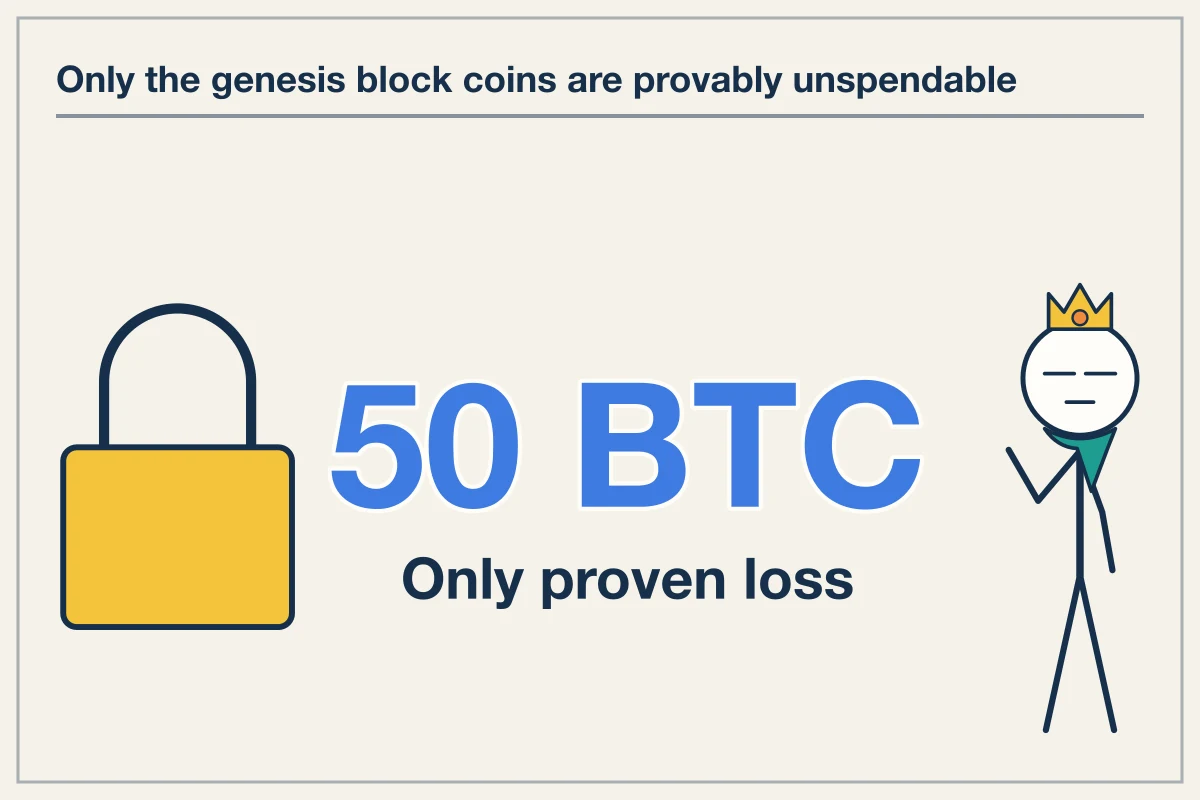
Because cryptographic key destruction leaves no on-chain fingerprint, any figure quantifying lost supply remains an estimate. Protocol rules create the only provable absolute floor: block 0 containing 50 BTC was excluded from the initial UTXO database by design and can never be spent. Beyond that 50 BTC absolute certainty, all lost coin calculations rely on inactivity thresholds and documented early operational failures.
Documented losses and key destruction events
Documented individual cases confirm multi-thousand coin supply reductions. Early mining operations treated private keys with minimal security, leading to physical drive losses and permanent wallet lockouts.
| Event or Category | Estimated Volume | On-Chain Status | Deterministic Proof |
|---|---|---|---|
| Genesis Block | 50 BTC | Excluded from UTXO database | Absolute protocol rule |
| Early Mining Inactivity (2009-2011) | 1,000,000 to 1,100,000 BTC | Unmoved since block generation | Statistical model |
| Hard Drive Landfill Incidents | 7,500 to 8,000 BTC | Single target address cluster | Known public record |
| Burn Addresses | 2,000+ BTC | Sent to provably unspendable scripts | Mathematical proof |
Worth knowing
A transaction sent to an invalid public key or an intentional burn script destroys spendability instantly, removing those coins from active float without altering the nominal circulation metric.
Calculating effective supply versus nominal supply
Nominal supply stands near 19.7 million BTC out of the 21,000,000 BTC structural cap. If 3.5 million BTC are estimated lost, the effective active supply drops to 16.2 million BTC.

Traders positioning in perpetual swaps must account for this difference when analyzing order book depth and leverage density. When effective float is 17.5% smaller than reported circulating supply, large directional spot buys impact order books faster than raw market capitalization suggests.
Where this goes wrong
Relying on nominal market capitalization to calculate market depth overstates actual liquid buffer, leading to underestimated slippage during aggressive market orders.
Perpetual funding costs across active venues
Because active float is tighter than surface metrics indicate, perpetual swap markets experience funding rate spreads across venues when open interest expands. To hold a long position on active BTC contracts today, daily funding rates vary noticeably depending on exchange execution fees and position skew.
| Exchange | 8-Hour BTC Funding Rate | Daily BTC Holding Cost | Taker Fee Rate | Maker Fee Rate |
|---|---|---|---|---|
| Bybit | +0.0028% | +0.0084% | 0.0550% | 0.0200% |
| Bitget | +0.0042% | +0.0126% | 0.0300% | 0.0200% |
| OKX | +0.0060% | +0.0180% | 0.0500% | 0.0200% |
| MEXC | +0.0069% | +0.0207% | 0.0200% | 0.0000% |
The spread across these four venues is 0.0041 percentage points per 8-hour period. Holding a long position on Bybit incurs +0.0028% per 8h compared to +0.0069% per 8h on MEXC. On a 100,000 USD position, Bybit charges 2.80 USD per 8 hours, while MEXC charges 6.90 USD per 8 hours.
What to do instead
Compare live 8-hour funding spreads before choosing a long perp venue, as venue-specific inventory imbalances alter carrying costs over multi-week holding periods.
How much bitcoin is lost forever in market analysis
Determining how much bitcoin is lost forever directly changes liquidity models. If 3,500,000 BTC are lost out of 19,700,000 BTC currently mined, 17.76% of all existing supply is inactive.
When 24-hour BTC volume across global derivative venues hits $5,835,215,094, that volume rotates across an active spot float of roughly 16.2 million coins rather than the full nominal supply. Derivatives traders who ignore lost supply overstate liquid depth and miscalculate systemic leverage concentration.
Is it possible to verify exactly how much bitcoin is lost forever?
Exact verification is impossible because an inaccessible wallet and a long-term cold storage wallet produce identical on-chain footprints. Aside from the hardcoded genesis reward of 50 BTC, all lost coin totals remain estimates based on wallet inactivity and known key losses.
Why is the genesis block reward of 50 BTC considered permanently lost?
The 50 BTC reward from block 0 was deliberately omitted from the initial UTXO database created by the original client software. Because the transaction output does not exist in the UTXO set, the protocol will reject any transaction attempting to spend it.
How does lost supply impact perpetual swap funding rates?
Lost supply reduces the effective liquid float available on spot exchanges to back collateral and satisfy spot demand. A smaller real float accelerates spot supply squeezes, driving perpetual swap funding rates positive during upward momentum.
What happens if long-dormant coins move unexpectedly?
If coins categorized as lost move on-chain, estimated active float instantly expands. This increases perceived market supply, which can dampen spot premiums and alter perpetual funding spreads across derivative venues.