· four exchange APIs · rebuilt daily
How mark price vs last price liquidation triggers stop cascading wicks

The finding
Liquidations trigger off mark price calculation, which smoothed out a 0.0225 percentage point funding spread across SOL venues today.
Main chart candles display last traded price, which reflects single aggressive market orders.
Mark price combines spot index data with a moving average of perpetual funding basis.
This separation stops short squeezes on one orderbook from wiping out margined positions.
Mark price vs last price liquidation mechanics
Your position liquidation depends on the mark price, not the last traded price shown on the main chart ticker. Understanding mark price vs last price liquidation mechanics prevents getting stopped out by single-order orderbook wicks. The last traded price is simply the last price at which a trade executed on that specific exchange orderbook. If a market buyer consumes all available ask liquidity on an orderbook, last traded price spikes higher instantly.
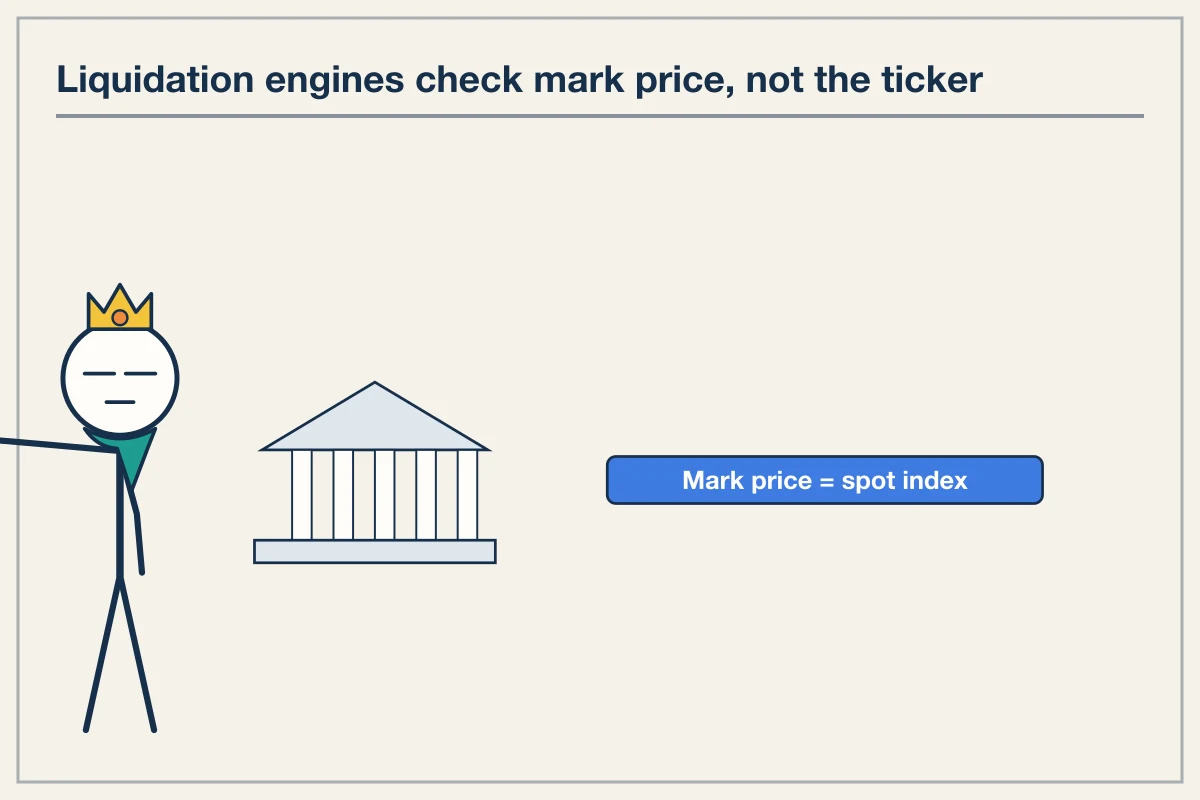
Exchanges do not evaluate maintenance margin against this volatile local figure. Instead, liquidation engines calculate account equity and margin coverage using mark price. Mark price measures the estimated fair value of the contract by pulling real-time spot prices from multiple external spot venues and adding a smoothed fair basis calculation. This prevents isolated market manipulation or thin liquidity on one venue from wiping out trader accounts.
Where this goes wrong
Setting stop-loss orders to trigger on last price leaves positions exposed to mark price liquidations if local orderbooks decouple from spot indices during rapid moves.
How mark price calculates fair market value
Mark price prevents liquidations during sharp wicks by anchoring derivative prices back to underlying spot market volume. The exchange engine queries spot exchanges to calculate an index price weighted by volume. Next, the engine calculates a moving average of the difference between the local perpetual contract price and the global spot index price. This difference represents the fair basis.
The formula takes the median across three values: Spot Index Price, Spot Index Price plus Moving Average of Basis, and Spot Index Price plus Benchmark Rate. Taking the median prevents single-exchange outages or sudden localized liquidation cascades from corrupting the mark price calculation.
When funding rates diverge across platforms, mark prices shift accordingly. On SOL contracts today, Bybit shows a live 8-hour funding rate of -0.0125%, while Bitget sits at +0.0100%. That spread of 0.0225 percentage points alters the fair basis added to the spot index on each platform, creating distinct mark price liquidation trigger points for identical entries across venues.
Worth knowing
Funding rates directly feed into the moving average basis calculation, shifting your liquidation price distance relative to underlying spot prices every eight hours.
Worked example of a wick liquidation gap
Consider an open long position on BTC with an entry price of $60,000 at 50x leverage. The position size is 10 BTC, carrying a nominal value of $600,000. Initial margin deposited is $12,000. At 50x leverage, the maintenance margin requirement is 0.5%, which equals $3,000. The position faces liquidation when accumulated account losses reduce remaining margin equity below the $3,000 maintenance threshold.
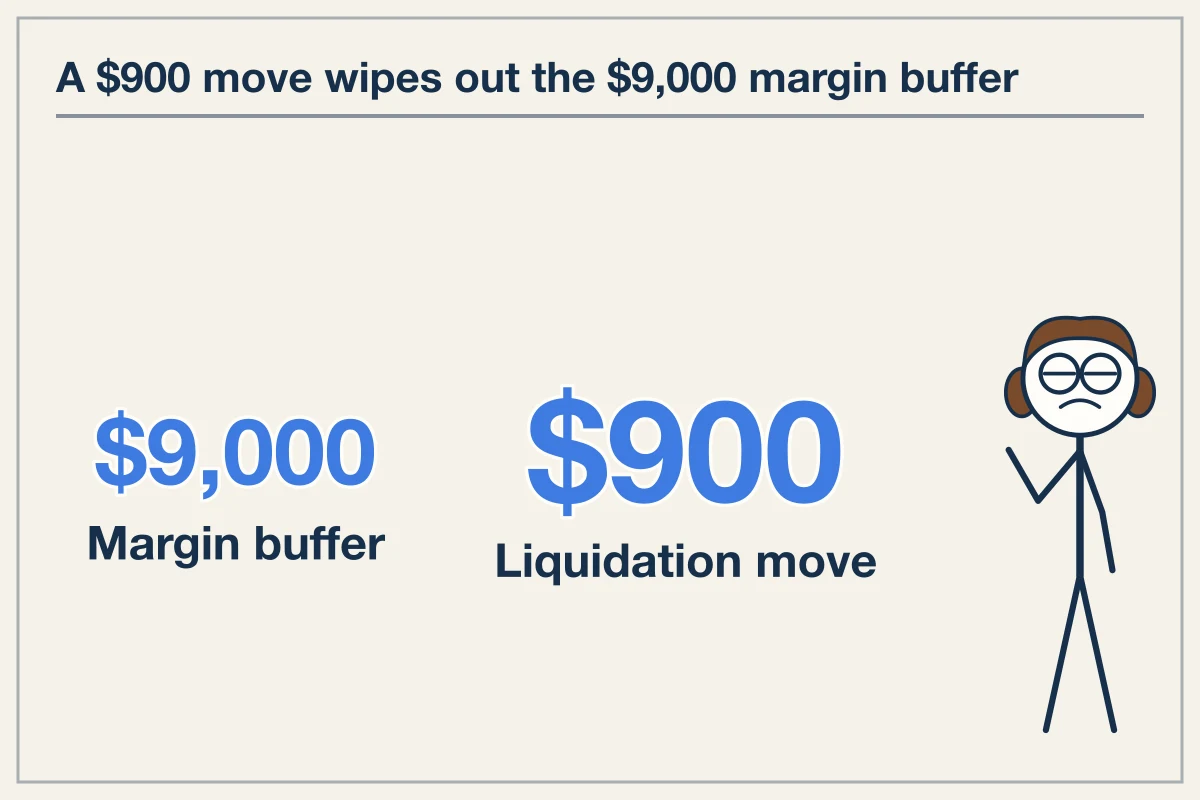
Maximum loss allowed before liquidation equals $12,000 initial margin minus $3,000 maintenance margin, leaving $9,000. Across a 10 BTC position, an adverse price move of $900 wipes out that $9,000 margin buffer. The position liquidation threshold sits at $59,100.
Suppose an aggressive sell market order sweeps the local futures orderbook, filling bids down to $58,500. The last price instantly prints $58,500 on the exchange chart. However, external spot market prices remain steady at $59,800. The calculated mark price drops only to $59,795 because the spot index average heavily weights external price stability.
Because $59,795 remains higher than the $59,100 liquidation price, the liquidation engine takes no action. The trader holds the open position despite chart candles showing an execution price $600 below their liquidation threshold.
Venue fee schedules and live funding rates
Fee deductions and funding payments directly reduce margin balances, pulling liquidation prices closer to open positions over time. Taker fees reduce entry margin equity instantly upon execution. High funding payments further erode account collateral every eight hours.
| Venue | Futures Maker Fee | Futures Taker Fee | BTC 8h Funding Rate | SOL 8h Funding Rate |
|---|---|---|---|---|
| Bitget | 0.0200% | 0.0300% | +0.0015% | +0.0100% |
| Bybit | 0.0200% | 0.0550% | +0.0095% | -0.0125% |
| MEXC | 0.0000% | 0.0200% | +0.0088% | +0.0090% |
| OKX | 0.0200% | 0.0500% | +0.0047% | +0.0052% |
24-hour traded volume stands at $10,318,628,459 for BTC futures and $1,364,979,074 for SOL futures across major derivative venues. Zero maker fees on MEXC preserve initial collateral upon entry. Bybit taker fees of 0.0550% deduct higher upfront costs from account equity, narrowing the safety margin between entry price and mark price liquidation points.
What to do instead
Select mark price as the trigger conditional index when setting manual stop-loss orders to mirror the venue engine's liquidation triggers.
Why did my position liquidate when the chart price never reached my liquidation level?
Exchange engines evaluate margin health using mark price derived from spot market averages rather than last traded prices on chart candles. A rapid mark price move on external spot venues can trigger liquidation even if local perpetual trade charts print no executed orders at that level.
What is the main difference between mark price vs last price liquidation triggers?
Last price represents the most recent transaction on a single exchange orderbook, making it vulnerable to temporary liquidity gaps. Mark price combines volume-weighted spot index prices with a moving average funding basis to determine true contract value across venues.
Can I change my liquidation trigger from mark price to last price?
Exchange risk engines mandate mark price for automated liquidation calculations to protect systemic solvency. Traders can configure manual stop-loss orders to trigger off last price, but the automated exchange engine will still liquidate positions if mark price crosses the maintenance threshold first.
How does funding rate affect mark price calculation?
Funding rates enter the moving average fair basis equation that bridges spot index pricing with perpetual contract pricing. Higher positive funding rates elevate mark price relative to spot index prices, altering account equity checks during open positions.