· four exchange APIs · rebuilt daily
Structural Edge and Venue Equity Outperform Directional Perp Trading
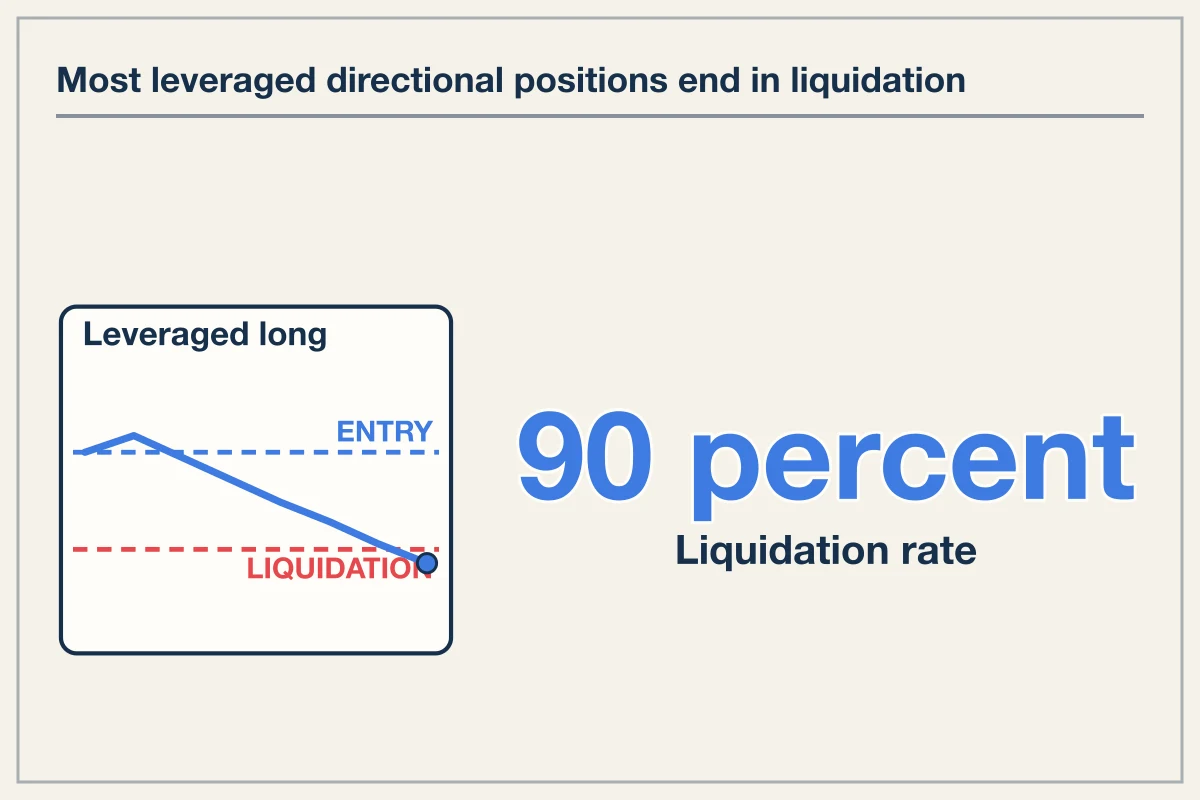
Large crypto wealth originates from venue equity, market making, and early spot holding, while leverage subjects traders to continuous funding and fee drag.
Large wealth accumulation in crypto concentrates in equity, market making, and early spot exposure, while directional leveraged positions face structural liquidation rates above 90 percent over multi-year market cycles.
Traders operating on high leverage take on non-linear liquidation risk. At 20x leverage, a 4.5 percent price move against the position reaches the liquidation threshold before accounting for maintenance margin requirements. Over multiple market cycles, asset prices experience drawdowns exceeding 50 percent, which wipes out directional positions with leverage of 2x or higher unless additional collateral is added.
Directional positions also incur ongoing friction from order execution fees and funding rates. This friction creates a negative baseline expected value for buy-and-hold perpetual futures strategies.
Execution Costs and Fee Schedule Spreads
Market participants who build persistent equity in crypto markets typically operate as liquidity providers or venue infrastructure owners rather than directional takers. Liquidity providers earn the bid-ask spread and benefit from lower fee tiers, whereas directional traders pay taker fees on entry and exit.
| Exchange | Spot Maker Fee | Spot Taker Fee | Futures Maker Fee | Futures Taker Fee |
|---|---|---|---|---|
| Bitget | 0.0010 | 0.0010 | 0.0002 | 0.00030 |
| Bybit | 0.0010 | 0.0010 | 0.0002 | 0.00055 |
| MEXC | 0.0000 | 0.0005 | 0.0000 | 0.00020 |
| OKX | 0.0008 | 0.0010 | 0.0002 | 0.00050 |
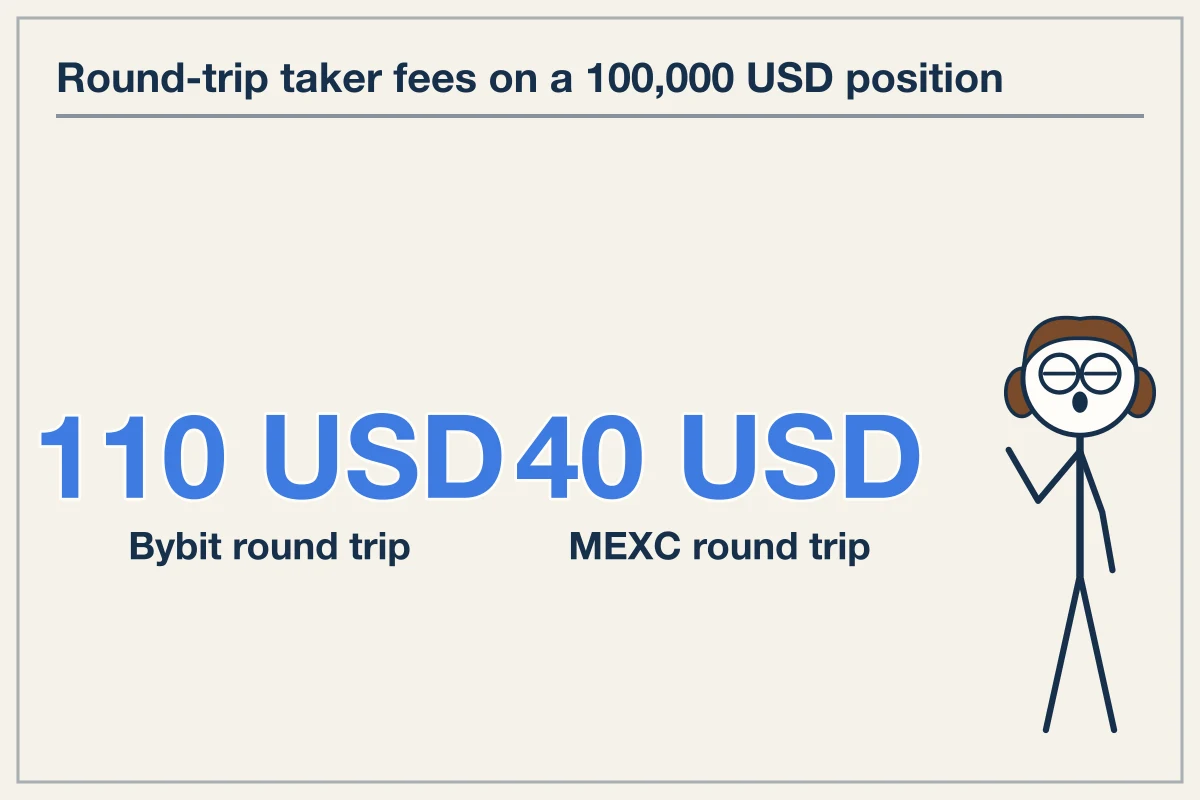
On a 100,000 USD futures position, a round-trip market order on Bybit costs 110 USD in taker fees at 0.00055 per side. On MEXC, the same round-trip market order costs 40 USD at 0.0002 per side. A market maker executing maker orders on MEXC pays zero fees.
Venue Funding Rates and Cost Dynamics
Perpetual swap contracts anchor to spot prices through funding payments exchanged directly between long and short traders every 8 hours. Holding a position across different venues results in variable holding costs.
| Asset | Cheapest Long Venue | MEXC Rate (8h) | OKX Rate (8h) | Bitget Rate (8h) | Venue Spread (8h) | 24h Volume |
|---|---|---|---|---|---|---|
| ETH | MEXC | +0.0011% | +0.0013% | +0.0100% | 0.0089% | 8,834,176,490 USD |
| BTC | OKX | +0.0100% | +0.0075% | +0.0100% | 0.0025% | 5,898,137,377 USD |
| SOL | OKX | -0.0044% | -0.0105% | +0.0053% | 0.0158% | 1,575,318,324 USD |
| ZEC | OKX | +0.0018% | +0.0003% | +0.0100% | 0.0097% | 788,001,894 USD |
| XRP | OKX | +0.0001% | -0.0017% | +0.0041% | 0.0058% | 506,450,411 USD |
| XAU | MEXC | +0.0116% | +0.0255% | +0.0133% | 0.0139% | 464,545,205 USD |
Holding a 100,000 USD long position in SOL on Bitget incurs a funding charge of 0.0053 percent every 8 hours, totaling 15.90 USD daily. Holding the same 100,000 USD long position in SOL on OKX earns a funding payment of 0.0105 percent every 8 hours, totaling 31.50 USD daily. The venue spread on SOL funding equals 47.40 USD per day per 100,000 USD position size.
For XAU, holding a 100,000 USD long position on OKX costs 0.0255 percent per 8 hours, or 76.50 USD per day. On MEXC, the same long position costs 0.0116 percent per 8 hours, or 34.80 USD per day. Selecting MEXC over OKX reduces long holding drag by 41.70 USD per day per 100,000 USD position.
Infrastructure Capture and Survivorship Bias
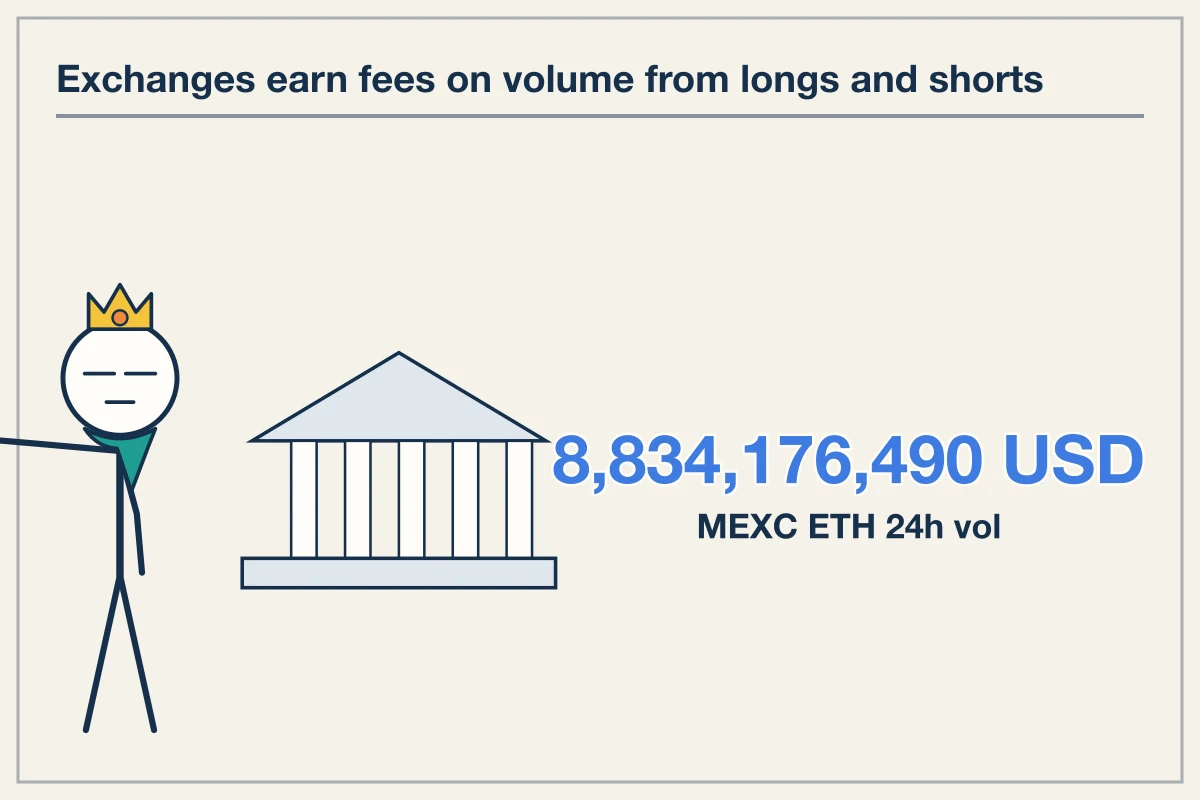
Exchanges collect fees from both long and short positions regardless of asset price direction. OKX registers 5,898,137,377 USD in 24-hour volume on BTC perps alone. MEXC records 8,834,176,490 USD in 24-hour volume on ETH perps. Infrastructure owners extract cash flow directly from transaction volume without incurring directional market risk.
Public retellings of crypto fortunes focus almost exclusively on traders who maintained long exposure during multi-thousand percent market expansions. These accounts suffer from survivorship bias. They exclude the vast majority of leveraged market participants who faced total capital loss during standard market contractions.
When volatility expands, account balances with fixed margin ratios undergo rapid liquidation. A trader maintaining a long position with high leverage during a 20 percent market correction experiences liquidation, forfeiting all accrued unrealized capital gains.
Holding perpetual futures over extended timeframes transforms structural costs—taker fees and funding interest—into continuous position drag. Position management across venues with lower funding spreads mitigates execution friction, but structural liquidation risk remains tied to chosen leverage levels.