· four exchange APIs · rebuilt daily
Visible depth overstates real market liquidity in perpetuals
Visible order book depth maps resting limit orders, but market sweeps and fee schedules alter true execution cost far beyond displayed spreads.
Order Book Structure and Execution Mechanics
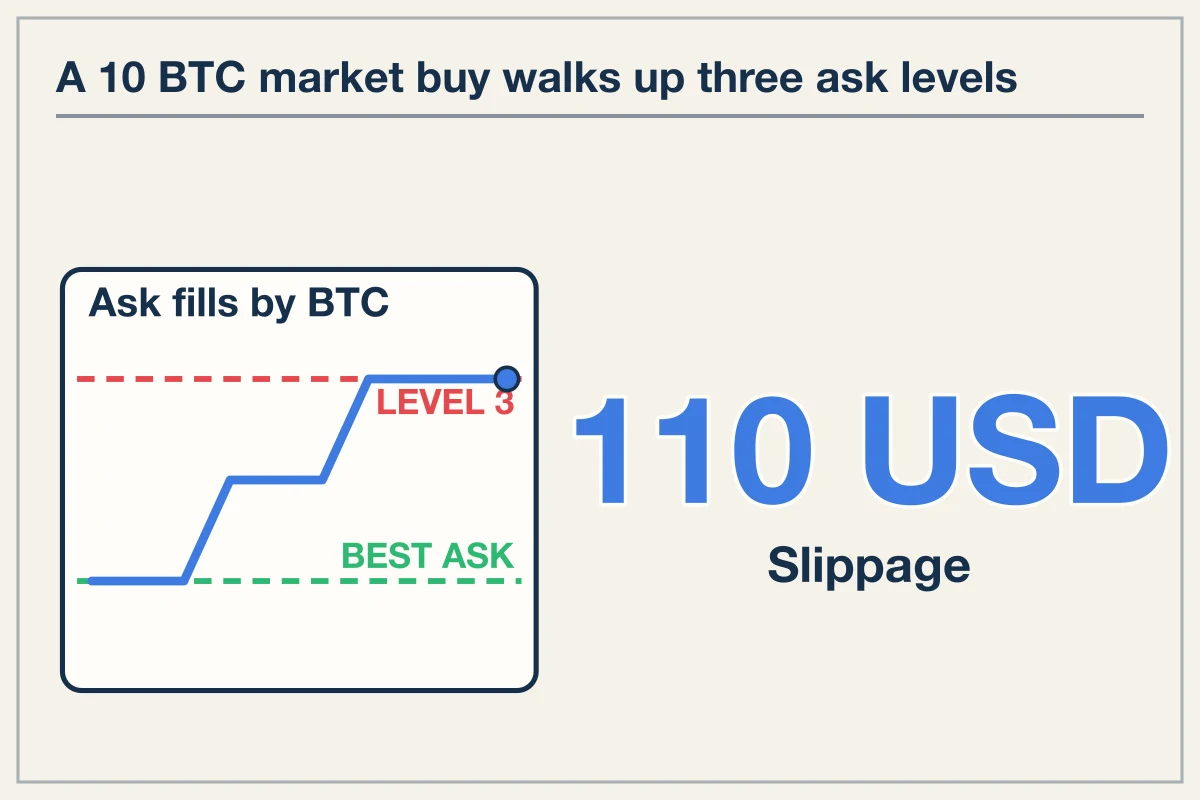
A market order for 600,000 USD nominal value in BTC perpetuals loses 110 USD to price impact before fees when sweeping three 3 BTC ask levels. Visible limit orders represent intent to trade at a specific price, but they do not guarantee execution for incoming market orders.
The order book displays active bid and ask liquidity across price ticks. Depth measures the cumulative contract volume resting at each price level. Spread measures the price gap between the highest resting bid and the lowest resting ask. Order book imbalance calculates the ratio of aggregated bid volume to ask volume within a specific distance from mid-price.
When a trader executes a market order, the matching engine fills the order against resting limit orders sequentially. If the order size exceeds the volume available at the top of the book, the order walks down the book. This creates slippage.
Worked Execution Example
Consider an order book with three ask levels:
- Level 1: 3 BTC at 60,000 USD
- Level 2: 3 BTC at 60,010 USD
- Level 3: 4 BTC at 60,020 USD
A trader submits a 10 BTC market buy order. The baseline value at the best ask (60,000 USD) is 600,000 USD.
- The first 3 BTC fill at 60,000 USD, costing 180,000 USD.
- The next 3 BTC fill at 60,010 USD, costing 180,030 USD.
- The final 4 BTC fill at 60,020 USD, costing 240,080 USD.
Total cash outlay equals 600,110 USD. The average fill price is 60,011 USD per BTC. The slippage cost is 110 USD, or 0.0183% above the best ask.
Exchange taker fees apply to the final executed value of 600,110 USD:
- On Bybit (0.055% taker fee): Taker fee is 330.06 USD. Total execution drag (slippage plus fee) is 440.06 USD.
- On OKX (0.050% taker fee): Taker fee is 300.06 USD. Total execution drag is 410.06 USD.
- On Bitget (0.030% taker fee): Taker fee is 180.03 USD. Total execution drag is 290.03 USD.
- On MEXC (0.020% taker fee): Taker fee is 120.02 USD. Total execution drag is 230.02 USD.
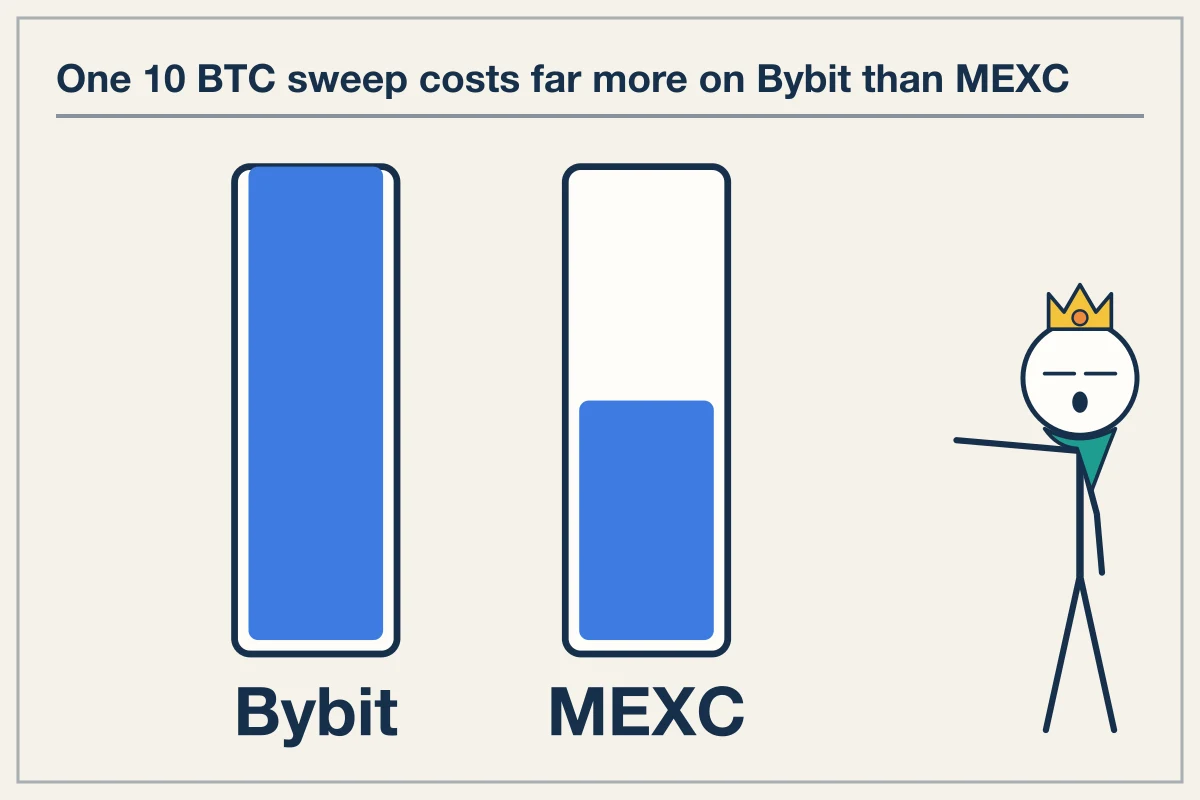
The fee choice between MEXC and Bybit changes entry cost by 210.04 USD on a single 10 BTC sweep.
Phantom Liquidity, Spoofing, and Imbalance Metrics
Resting orders do not represent committed capital. Spoofing occurs when an algorithm places large resting limit orders away from the mid-price to manipulate depth indicators. Once price moves toward those orders, the algorithm cancels them.
An order book showing 70% bid imbalance appears buyer-dominated. If 50% of those bids belong to spoofing algorithms, the effective order book is ask-dominated. Relying on raw bid-ask imbalance ratios introduces false directional signals.
Depth snapshot metrics ignore latency. High-frequency market makers cancel limit orders in sub-millisecond intervals during volatility spikes. Visible depth collapses precisely when market orders arrive.
Market Volume and Multi-Venue Funding Cost
Execution drag interacts directly with ongoing funding costs. Holding a position requires accounting for both execution taker fees and 8-hour funding payments.
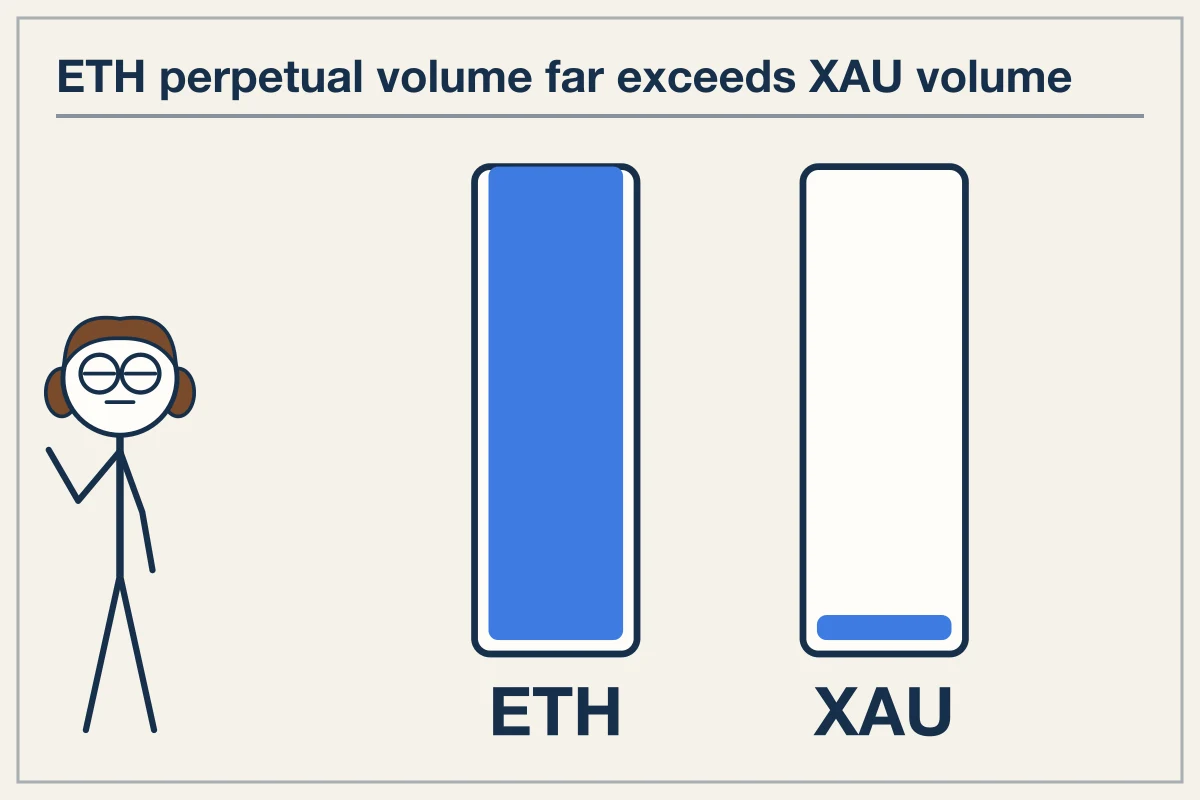
Across major perpetual pairs, daily traded volumes reflect where market depth concentrates:
- ETH 24h volume: 6,427,385,589 USD
- BTC 24h volume: 5,458,238,624 USD
- SOL 24h volume: 1,588,044,117 USD
- SNDK 24h volume: 1,413,945,632 USD
- ZEC 24h volume: 610,943,672 USD
- XAU 24h volume: 528,964,210 USD
Live 8-Hour Funding Rate Comparison
| Asset | OKX | MEXC | Bitget | Bybit | Spread (pp) | Cheapest Long |
|---|---|---|---|---|---|---|
| ETH | +0.0055% | +0.0057% | +0.0100% | +0.0100% | 0.0045% | OKX |
| BTC | +0.0029% | +0.0085% | +0.0056% | +0.0100% | 0.0071% | OKX |
| SOL | +0.0008% | +0.0032% | +0.0080% | +0.0100% | 0.0092% | OKX |
| SNDK | +0.0000% | N/A | +0.0000% | +0.0000% | 0.0000% | Bybit |
| ZEC | +0.0100% | +0.0031% | +0.0087% | +0.0100% | 0.0069% | MEXC |
| XAU | +0.0102% | +0.0052% | +0.0071% | +0.0000% | 0.0102% | Bybit |
Exchange Futures and Spot Fee Comparison
| Exchange | Futures Maker | Futures Taker | Spot Maker | Spot Taker |
|---|---|---|---|---|
| Bitget | 0.0200% | 0.0300% | 0.1000% | 0.1000% |
| Bybit | 0.0200% | 0.0550% | 0.1000% | 0.1000% |
| MEXC | 0.0000% | 0.0200% | 0.0000% | 0.0500% |
| OKX | 0.0200% | 0.0500% | 0.0800% | 0.1000% |
On BTC perpetuals, holding a 1,000,000 USD long position on Bybit costs 100 USD per 8 hours in funding (+0.0100%). Holding the same position on OKX costs 29 USD per 8 hours (+0.0029%). Over 24 hours (three funding periods), the holding cost gap is 213 USD per 1,000,000 USD long.
Execution Impact on Position Margin
Traders using market orders absorb double execution drag: market impact on the order book sweep plus the exchange taker fee.
For a 100,000 USD long position entered at 20x leverage (5,000 USD initial margin), a 0.055% taker fee (55 USD) plus a 0.020% market impact (20 USD) reduces starting position collateral by 75 USD immediately. That represents a 1.5% reduction in collateral before mark price moves a single tick.
Using limit orders eliminates slippage and drops execution costs to the maker fee rate (0.0000% to 0.0200%). However, limit orders face non-execution risk if price moves away before resting volume gets filled.