· four exchange APIs · rebuilt daily
ETF Creation Mechanisms Pass Premium Risk to Secondary Perpetuals
Cash-model spot ETFs force authorised participants to hedge cash-to-coin timing gaps on crypto exchanges, causing temporary price-to-NAV dislocations.
Cash Creation Mechanics and Custodial Routing
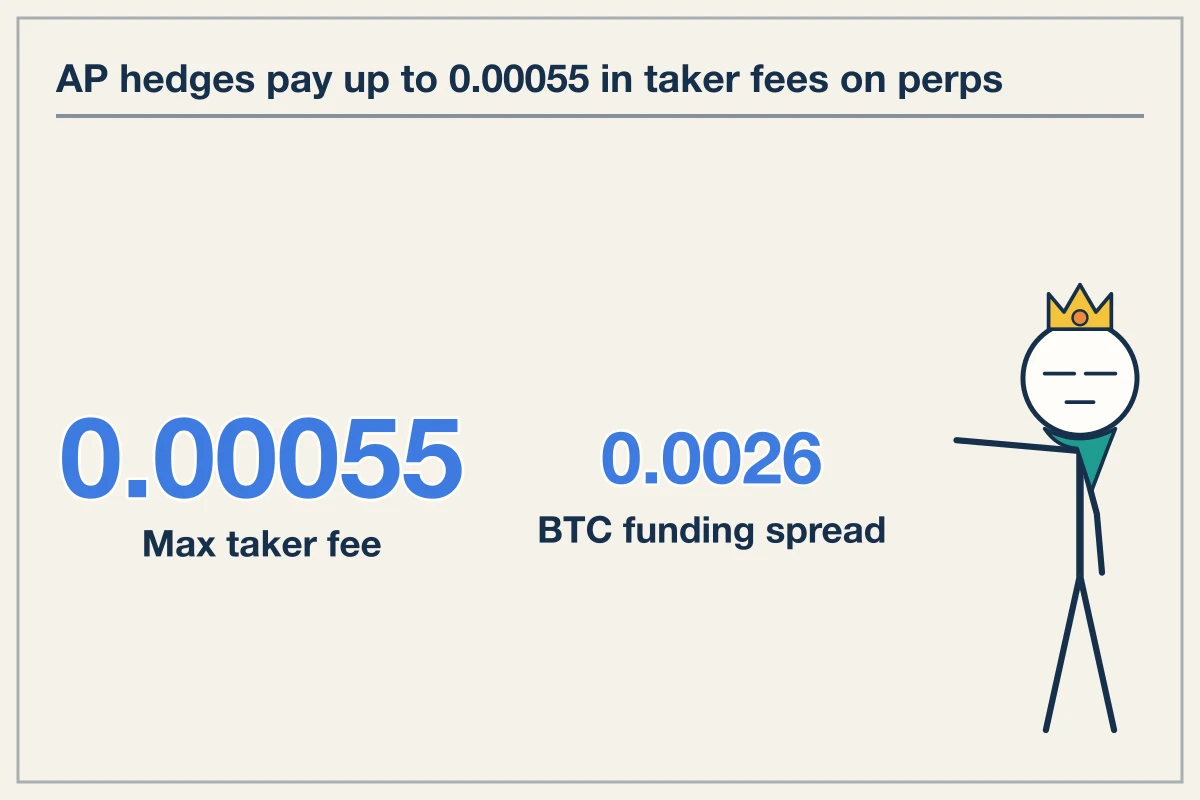
Cash-model spot ETF creations introduce market execution lags where authorized participants absorb up to 0.00055 in taker fees when hedging spot exposure against perpetual swap markets.
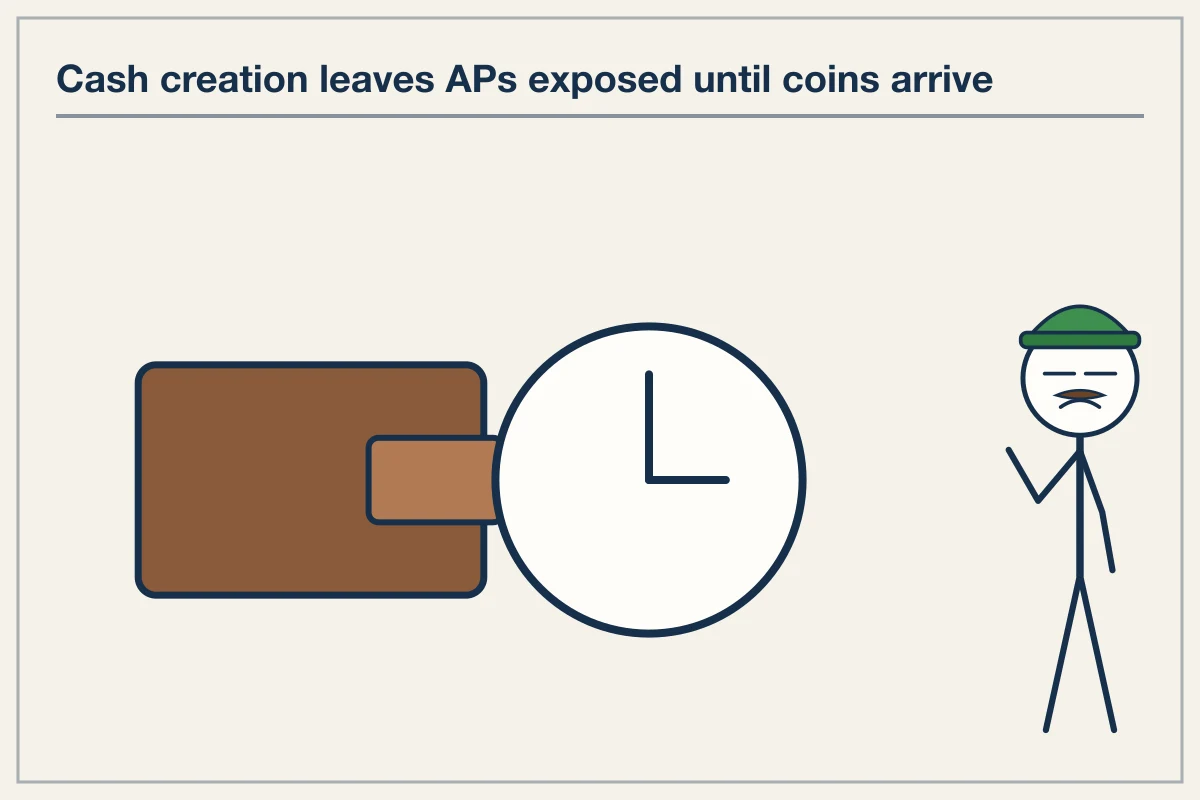
An Authorised Participant (AP) executes creation and redemption orders in defined share blocks called creation units. In traditional commodity or equity ETFs, APs deliver physical assets directly via in-kind creation baskets. Under cash-creation structures enforced for spot crypto ETFs, the AP transfers cash to the ETF sponsor rather than depositing underlying tokens directly with the custodian.
When an AP submits a creation order, the fund broker takes the cash and buys spot Bitcoin or Ethereum on external exchanges. Once purchased, the broker deposits the coins with a dedicated custodian. The issuer then mints new ETF shares and transfers them to the AP.
Because cash settlement and broker execution create a time delay between the initial creation request and final coin delivery, the AP carries market exposure. To hedge price risk during this latency window, APs place short positions on perpetual swap venues or spot order books while waiting for creation settlement.
Venue Fee Structures and Funding Discrepancies
The execution cost incurred by APs and market makers directly depends on exchange fee schedules and perpetual funding rates. Taker fees on futures venues range from 0.0002 to 0.00055 across major liquidity pools.
| Venue | Spot Maker Fee | Spot Taker Fee | Futures Maker Fee | Futures Taker Fee |
| Bitget | 0.0010 | 0.0010 | 0.0002 | 0.00030 |
| Bybit | 0.0010 | 0.0010 | 0.0002 | 0.00055 |
| MEXC | 0.0000 | 0.0005 | 0.0000 | 0.00020 |
| OKX | 0.0008 | 0.0010 | 0.0002 | 0.00050 |
When hedging spot exposure with perpetual contracts, APs also pay or receive funding rate settlements every 8 hours. BTC funding rates show noticeable variance across venues, creating uneven hedging costs for market participants.
| Venue | Normalised 8h BTC Funding | 24h Venue Volume (USD) |
| Bybit | +0.0074% | 5,985,298,522 |
| OKX | +0.0078% | 5,985,298,522 |
| Bitget | +0.0100% | 5,985,298,522 |
| MEXC | +0.0100% | 5,985,298,522 |
The BTC funding rate spread between Bybit and MEXC is 0.0026 percentage points per 8-hour window. For ETH perps, where total 24-hour volume reaches 9,125,641,312 USD, OKX sits at +0.0033% while Bitget sits at +0.0100%, representing a spread of 0.0067 percentage points per 8 hours.
Flow Metrics Versus Direct Market Demand
Daily published ETF flow numbers reflect net creation and redemption clearing rather than real-time spot order flow. A reported net inflow of 100,000,000 USD means APs minted ETF shares worth that aggregate amount to satisfy prior demand or capture share premiums.
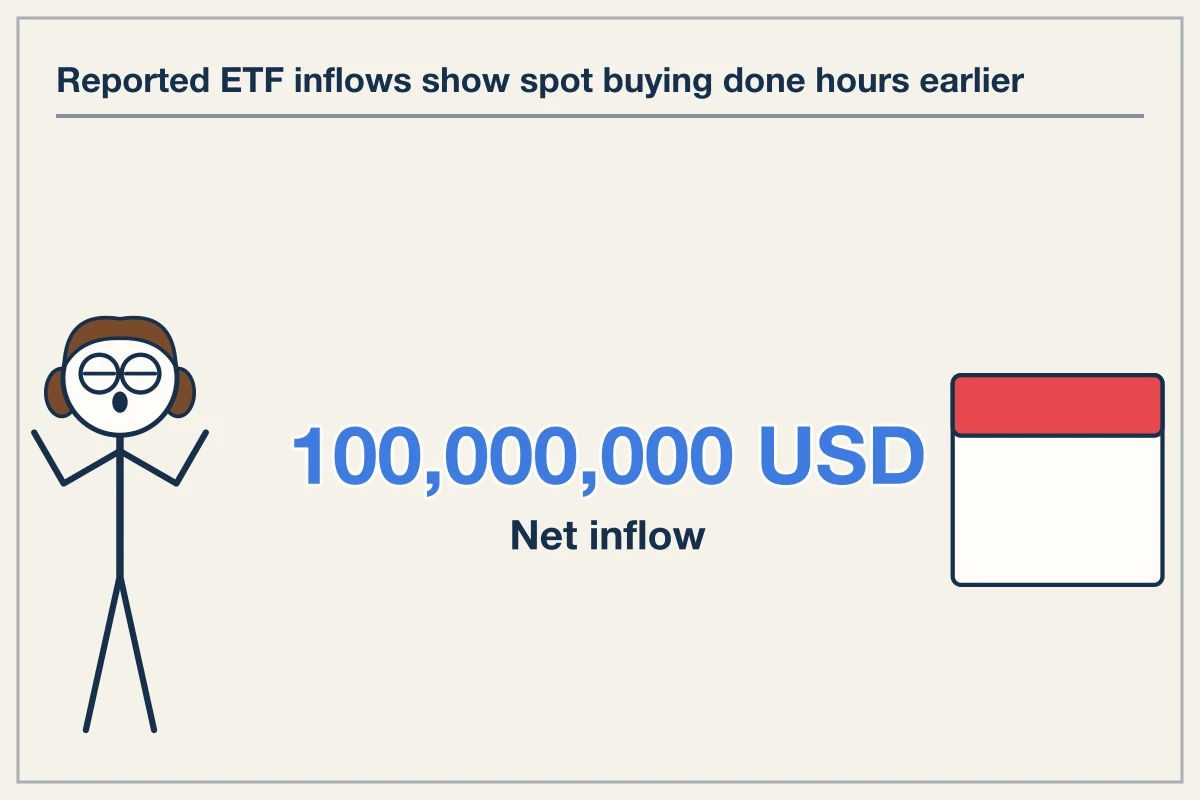
If an AP pre-hedged or accumulated spot inventory on crypto exchanges prior to submitting the creation basket, the actual spot purchasing occurred hours before the flow data appears in clearing reports. Flow figures record institutional balance sheet adjustments, not simultaneous order book market orders.
Outflow figures operate under the same structural delay. A net outflow indicates APs redeemed ETF shares for cash. The broker sells custodian-held spot crypto to raise cash, which settles back to the AP. Outflows show structural redemptions rather than instant panic selling in exchange order books.
Price to NAV Dislocations and Market Implication
Net Asset Value (NAV) represents the total benchmark value of custodian-held crypto divided by outstanding ETF shares, calculated once per trading day at equity market close. Secondary ETF shares trade continuously throughout the trading day on traditional exchanges.
When secondary trading buying pressure pushes the ETF share price above NAV, a premium forms. APs exploit this premium by shorting the ETF share, buying spot or long perps on crypto exchanges, and submitting a cash creation order to mint shares at NAV.
Arithmetic Execution Breakdown
An AP executes a 10,000,000 USD short hedge in perpetual futures to cover a cash creation window.
On Bybit, applying the futures taker fee of 0.00055 requires an upfront fee of 5,500 USD. Receiving 8-hour funding at +0.0074% on a short position yields 740 USD. The net execution drag equals 4,760 USD.
On MEXC, applying the futures taker fee of 0.0002 requires an upfront fee of 2,000 USD. Receiving 8-hour funding at +0.0100% on a short position yields 1,000 USD. The net execution drag equals 1,000 USD.
The 3,760 USD difference per 10,000,000 USD block demonstrates how venue selection alters arbitrage friction. If the ETF share premium over NAV is smaller than the combined execution drag and cash settlement delay, APs stop creating shares. The ETF share price then decouples from NAV until exchange funding rates adjust or share premiums widen enough to cover execution fees.