· four exchange APIs · rebuilt daily
How AI agent crypto payments execute and where automated trades fail

The finding
Software agents executing AI agent crypto payments face a taker fee as low as 0.0002 on MEXC, but API key permissions lack native execution boundaries.
Without protocol-level authorization limits, an unhedged trading loop burns margin balance through funding costs that reach 0.0097% per 8 hours on Bitget ETH.
What has shipped for automated execution
Integrating AI agent crypto payments into trading infrastructure currently depends on two mechanisms: exchange API keys assigned to dedicated sub-accounts, and on-chain session keys via smart contract wallets. In both setups, an autonomous software agent receives permission to sign order payloads or trigger transaction transfers without human intervention per trade.

On centralized perpetual venues, the architecture relies on REST and WebSocket endpoints. The agent evaluates market state, constructs an order payload, and signs the request using an API secret. Current implementations on venues like Bybit and OKX allow IP whitelisting and permission toggles for spot or futures trading, but they do not enforce granular financial controls such as max loss per hour or position exposure ceilings at the API key layer.
Worth knowing
API keys set to trade futures can open maximum leverage positions up to the entire account collateral unless manual sub-account margin allocations isolate the balance.
How AI agent crypto payments handle key delegation
On-chain payment rails use session keys under account abstraction standards. An agent holds a temporary key pair authorized to interact with specific contract addresses for a defined block window or token quota.
Standards proposals focus on three components:
- Session permissions that scope key activity to specific function selectors.
- Allowance limits that cap total token spend per signature.
- Expiry timestamps that revoke agent signing authority automatically.
While session keys work well for simple ERC-20 transfers, they struggle with perpetual futures contracts. Position adjustments require real-time margin management, dynamic order cancellations, and position sizing based on order book depth. A rigid session allowance cannot account for adverse price slippage or changing funding rates across different venues.
Execution cost comparison across venues
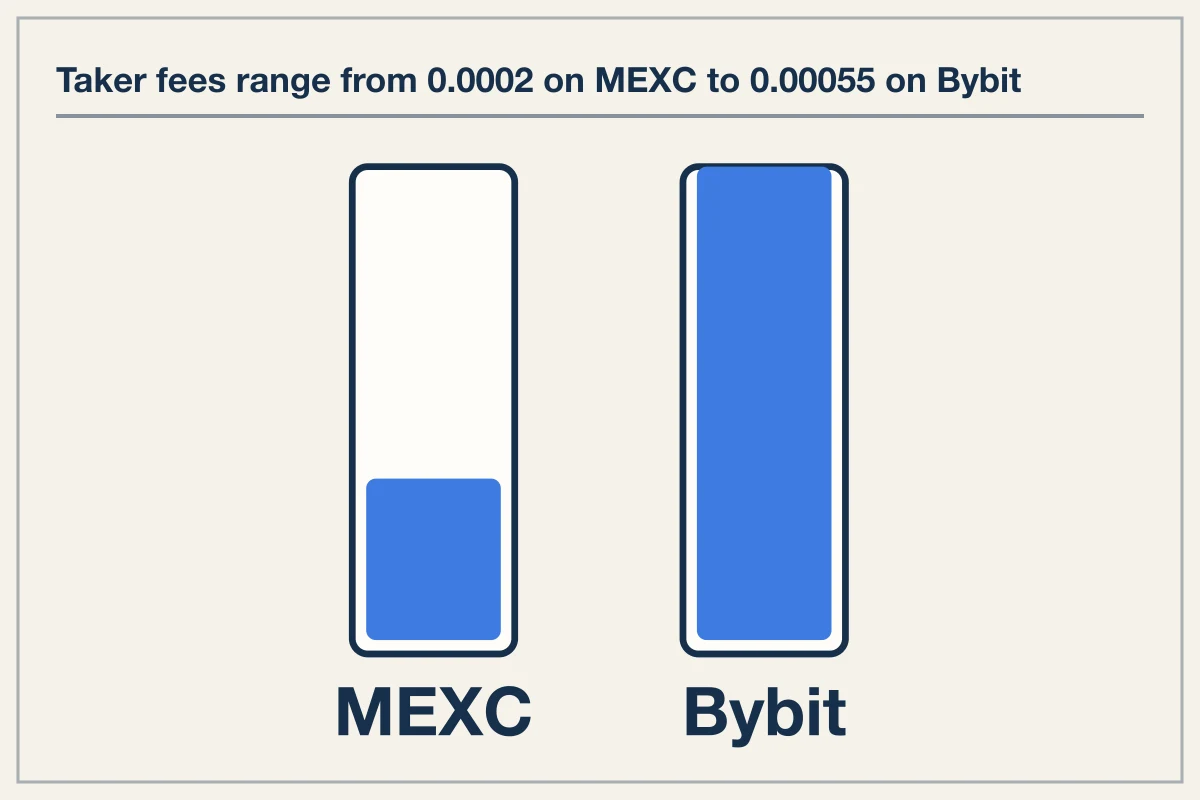
When an agent executes frequent order flow, fee structures dictate operating survival. Taker fees range from 0.0002 to 0.00055 across major perpetual exchanges, while funding rate spreads create hidden holding costs for automated strategies.
| Venue | Futures Maker Fee | Futures Taker Fee | ETH 8h Funding Rate | SOL 8h Funding Rate | ETH 24h Volume |
|---|---|---|---|---|---|
| MEXC | 0.0000 | 0.0002 | +0.0002% | -0.0104% | $7,133,817,556 |
| Bitget | 0.0002 | 0.0003 | +0.0097% | -0.0088% | $7,133,817,556 |
| OKX | 0.0002 | 0.0005 | +0.0009% | -0.0081% | $7,133,817,556 |
| Bybit | 0.0002 | 0.00055 | -0.0002% | -0.0092% | $7,133,817,556 |
If an automated agent opens a 100,000 USD long position on ETH perps:
- On MEXC, the taker fee to open is 20.00 USD (100,000 0.0002). The 8-hour funding payment costs 0.20 USD (100,000 0.000002).
- On Bybit, the taker fee to open is 55.00 USD (100,000 * 0.00055). The 8-hour funding pays the agent 0.20 USD due to the -0.0002% rate.
- On Bitget, the taker fee is 30.00 USD (100,000 0.0003), but the 8-hour funding payment costs 9.70 USD (100,000 0.000097). Over 24 hours, funding payments total 29.10 USD.
Where this goes wrong
High-frequency rebalancing loops running on high taker fee venues consume the entire margin balance through cumulative transaction fees before market directional risk impacts the trade.
Unsolved failure modes in agent payments
Three core structural issues prevent fully autonomous agent operation in derivative markets:
Authorization limits
Current infrastructure cannot evaluate context-aware authorization. An API key permitted to submit order entries cannot distinguish between a routine market-making quote and an invalid loop submitting 1,000 market orders into a thin order book.
Revocation latency
If an agent encounters a software loop or compromised prompt, shutting down authority requires active API revocation calls or manual web dashboard access. During exchange engine congestion, a delay of 30 seconds allows an unmonitored script to cycle account collateral completely.
Execution liability
Neither exchange protocols nor standard API agreements shift liability to the software provider when an agent generates incorrect trades. If an agent misinterprets market feeds and executes bad orders, liquidated collateral is unrecoverable.
What to do instead
Enforce hard sub-account balance caps and run secondary risk-daemon services outside the primary agent script to monitor position count and cut API permissions automatically.
How do AI agents sign crypto payments and perp orders?
Agents sign API requests using secret keys provided by exchange sub-accounts or sign smart contract calls using programmatic private keys allocated through session key contracts.
What prevents an autonomous trading agent from draining account margin?
Only sub-account balance limits and external monitoring scripts currently prevent total account depletion, as exchange API keys do not support native maximum drawdown or loss-rate caps.
Which exchange has the lowest taker fees for automated perp execution?
MEXC offers the lowest baseline futures taker fee at 0.0002 with 0.0000 maker fees, compared to Bybit at 0.00055 taker and 0.0002 maker.
Who is liable when an automated software agent executes an invalid order?
The account owner holds full financial liability for all trades signed by authorized API keys or wallet delegates, regardless of code bugs or bad model decisions.