· four exchange APIs · rebuilt daily
Layer 2 fees explained through L1 data posting and blob space

The finding
Rollup transactions cost less than mainnet because execution happens off-chain while transaction data is compressed into batches posted to L1.
Having layer 2 fees explained requires looking at how execution gas separates from L1 data availability gas.
Blob space introduced by EIP-4844 severed L2 fee spikes from L1 execution demand.
A native Optimistic rollup withdrawal takes 7 days to allow fault proofs before L1 settlement.
The breakdown of rollup transaction costs
An L2 transaction does not execute directly on Layer 1 mainnet. Instead, a central or decentralized sequencer accepts the transaction, orders it, and processes it in an off-chain virtual machine. The user pays two distinct components for every action: the L2 execution fee and the L1 data posting fee.
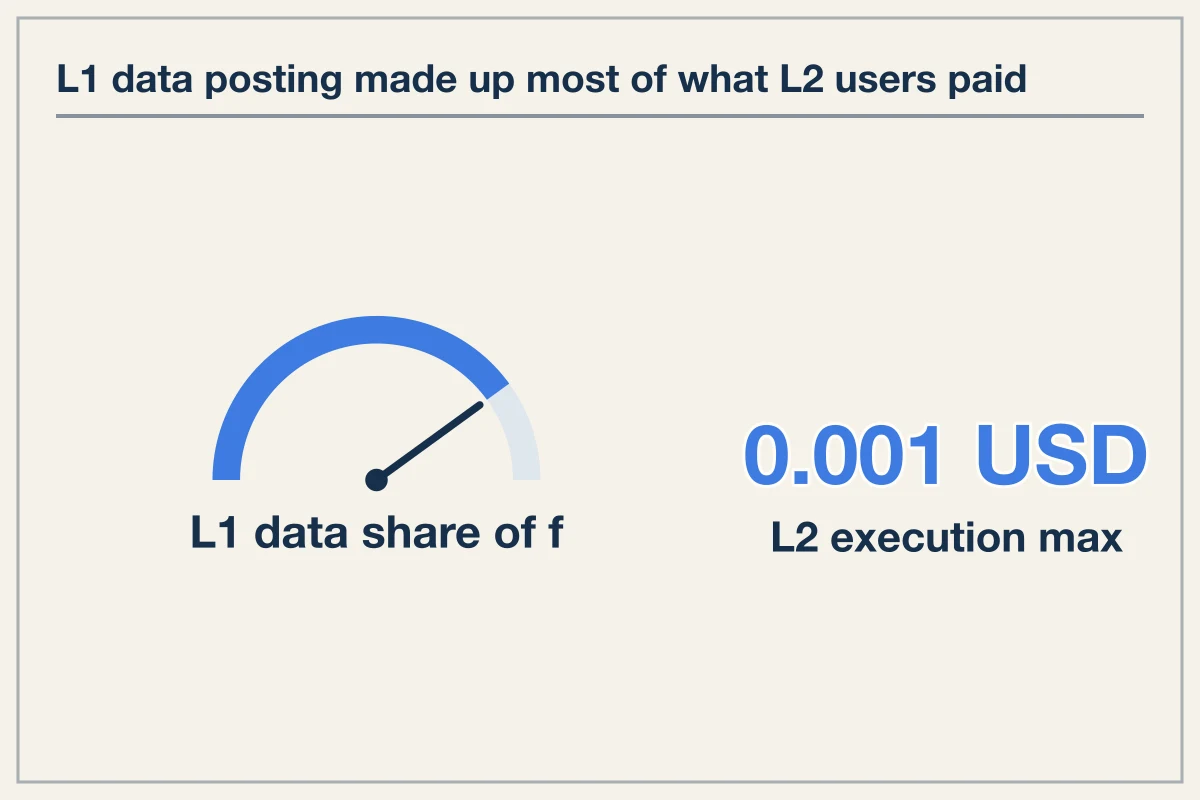
The L2 execution fee covers computation and state reads on the rollup network itself. Because L2 nodes operate with higher throughput limits than Ethereum mainnet, execution gas costs a fraction of a cent. A simple token transfer or order placement consumes minimal L2 gas, costing under 0.001 USD in computation.
The L1 data posting fee represents the cost incurred by the sequencer to publish transaction inputs or state diffs back to Layer 1. Rollups derive security from Layer 1 by ensuring that anyone can reconstruct the L2 state from data posted to mainnet. This data fee historically dominated over 80 percent of the total fee paid by an L2 user.
Worth knowing
Compressed transaction batches allow sequencers to amortize a single L1 transaction fee across thousands of L2 user actions, reducing individual data overhead.
Layer 2 fees explained across execution and settlement
To see how the arithmetic works, consider a batch containing 1,000 standard transfers. On Layer 1 mainnet, 1,000 transfers consuming 21,000 gas each at an L1 base fee of 20 gwei require a total execution spend of 0.42 ETH.
When processed on an Optimistic or ZK rollup, the sequencer executes all 1,000 transactions off-chain. Computational cost on L2 totals under 0.0005 ETH for the entire batch. The sequencer then compresses the transaction payloads into a single batch submission.
If that batch payload consumes 120,000 gas on Layer 1 to store the data, the L1 posting cost at 20 gwei equals 0.0024 ETH. Dividing 0.0024 ETH across 1,000 transactions yields an L1 data fee of 0.0000024 ETH per transfer. Adding the L2 execution fraction gives a final end-user fee of under 0.000003 ETH per transfer, compared to 0.00042 ETH on mainnet.
How blob data changed L2 cost structure
Before EIP-4844 introduced blob storage, rollups posted compressed transaction data to Layer 1 as calldata. Mainnet calldata competes directly with standard Ethereum transactions, decentralized exchange swaps, and smart contract deployments for block space. When L1 mainnet gas spiked to 100 gwei during high volatility, L2 fees rose proportionally.
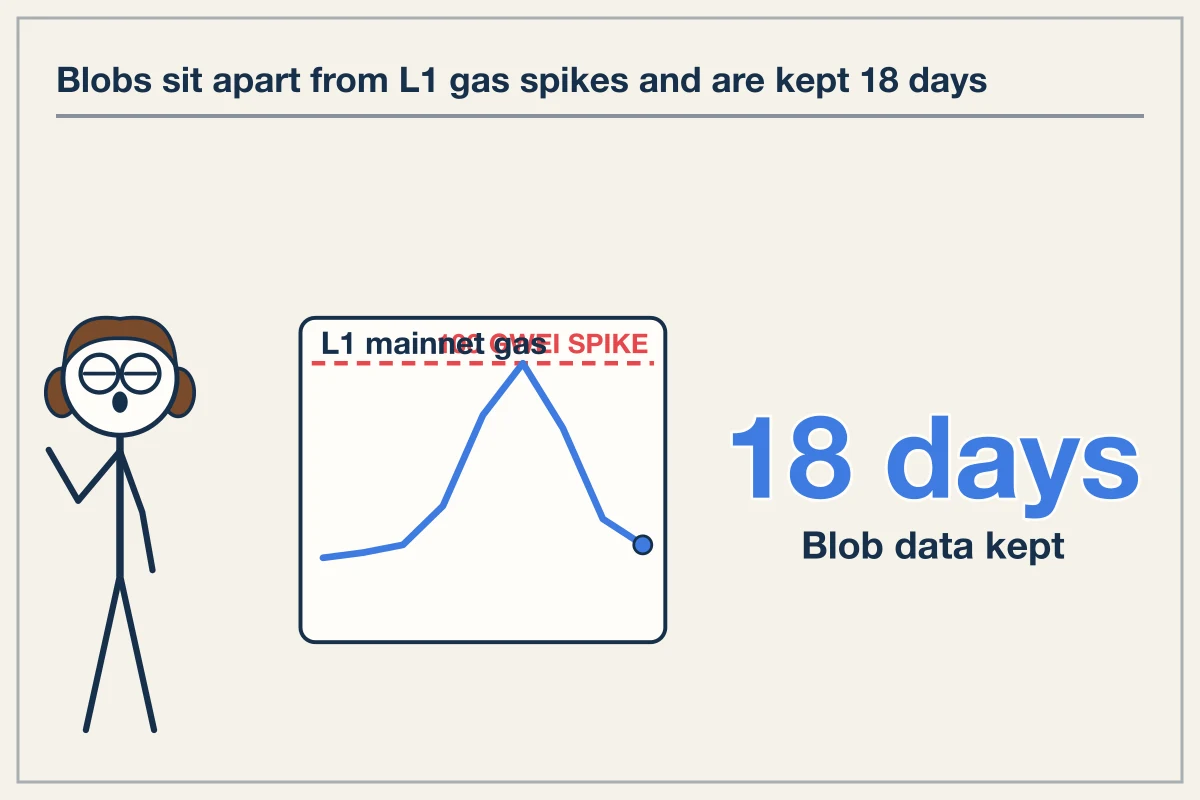
Blob data introduced dedicated storage sidecars attached to Ethereum blocks. Blobs carry data that persists for approximately 18 days before being pruned by mainnet nodes. Crucially, blob space operates on an independent fee market, separate from standard EVM execution gas.
When mainnet execution gas surges due to high L1 swap activity, the blob base fee remains unaffected unless rollup batch posting demand itself saturates target blob space. As a result, L2 transfer costs dropped to fractions of a cent, remaining stable even during mainnet congestion.
Where this goes wrong
High L2 batch submission activity can saturate target blob space per block, triggering an exponential increase in blob gas fees that elevates user transaction costs.
Bridge delays and withdrawal periods
While L2 execution is instant, moving assets back to Layer 1 mainnet involves a protocol-level delay known as the withdrawal period. The mechanics of this delay depend on whether the rollup uses Optimistic or Zero-Knowledge architecture.
Optimistic rollups assume off-chain state transitions are valid by default. To prevent malicious sequencers from submitting fraudulent state roots and stealing funds, the bridge protocol enforces a 7-day challenge window. During this 7-day withdrawal period, verifiers can submit fault proofs on Layer 1 to cancel invalid withdrawals and penalize the operator.
ZK rollups do not require a 7-day challenge window because every batch submission includes a cryptographic validity proof verified by an L1 smart contract. A ZK rollup withdrawal settles as soon as the batch and its corresponding proof finalize on Layer 1, typically taking between 15 minutes and a few hours.
To avoid the 7-day Optimistic bridge delay, traders frequently use third-party liquidity bridges. These fast bridges front funds on Layer 1 immediately from a liquidity pool, taking on the 7-day settlement risk themselves in exchange for a fee.
What to do instead
Use fast liquidity bridges for routine asset transfers to avoid locking capital for 7 days, but verify bridge fee tiers to prevent high costs on large transfers.
Trading overhead across central and rollup venues
When managing positions across centralized venues or L2 orderbooks, traders evaluate exchange fee schedules alongside settlement costs. Centralized exchanges eliminate L2 gas overhead entirely, but charge variable maker and taker fees alongside funding rates for perpetual futures.
The table below details current futures maker fees, taker fees, and 8-hour ETH funding rates across four major centralized derivatives venues.
| Venue | Futures Maker Fee | Futures Taker Fee | ETH 8h Funding Rate |
| Bitget | 0.0200% | 0.0300% | +0.0039% |
| Bybit | 0.0200% | 0.0550% | +0.0022% |
| MEXC | 0.0000% | 0.0200% | +0.0007% |
| OKX | 0.0200% | 0.0500% | +0.0033% |
On MEXC, holding a long position in ETH incurs a funding fee of +0.0007% per 8-hour window, while Bitget charges +0.0039%. Over a 30-day holding period comprising 90 funding intervals, an ETH long position on Bitget incurs a cumulative funding cost of 0.351%, whereas the same position on MEXC costs 0.063%.
Why are layer 2 fees so much lower than mainnet fees?
Layer 2 networks process computation off-chain and compress hundreds of transactions into a single batch posted to Layer 1. This splits the L1 data submission cost across all transactions in the batch rather than requiring each user to pay full L1 execution gas.
What changed for layer 2 fees after blob space was added?
Blob space created a separate data availability market that does not compete with mainnet smart contract execution. Rollups store batch data in temporary blobs rather than expensive mainnet calldata, insulating L2 transaction costs from L1 gas spikes.
Why does a native Optimistic rollup withdrawal take 7 days?
Optimistic rollups rely on a 7-day challenge window to give network verifiers time to submit fault proofs against fraudulent state roots. Funds remain locked on the L1 bridge contract until this dispute period expires without a valid fraud challenge.
How do fast liquidity bridges eliminate the withdrawal delay?
Fast bridges use third-party liquidity providers on Layer 1 who instantly pay out the user on mainnet. The liquidity provider assumes the 7-day settlement delay on the native rollup bridge in exchange for a liquidity fee charged to the trader.