· four exchange APIs · rebuilt daily
How MiCA crypto regulation changes perpetual futures access
The finding
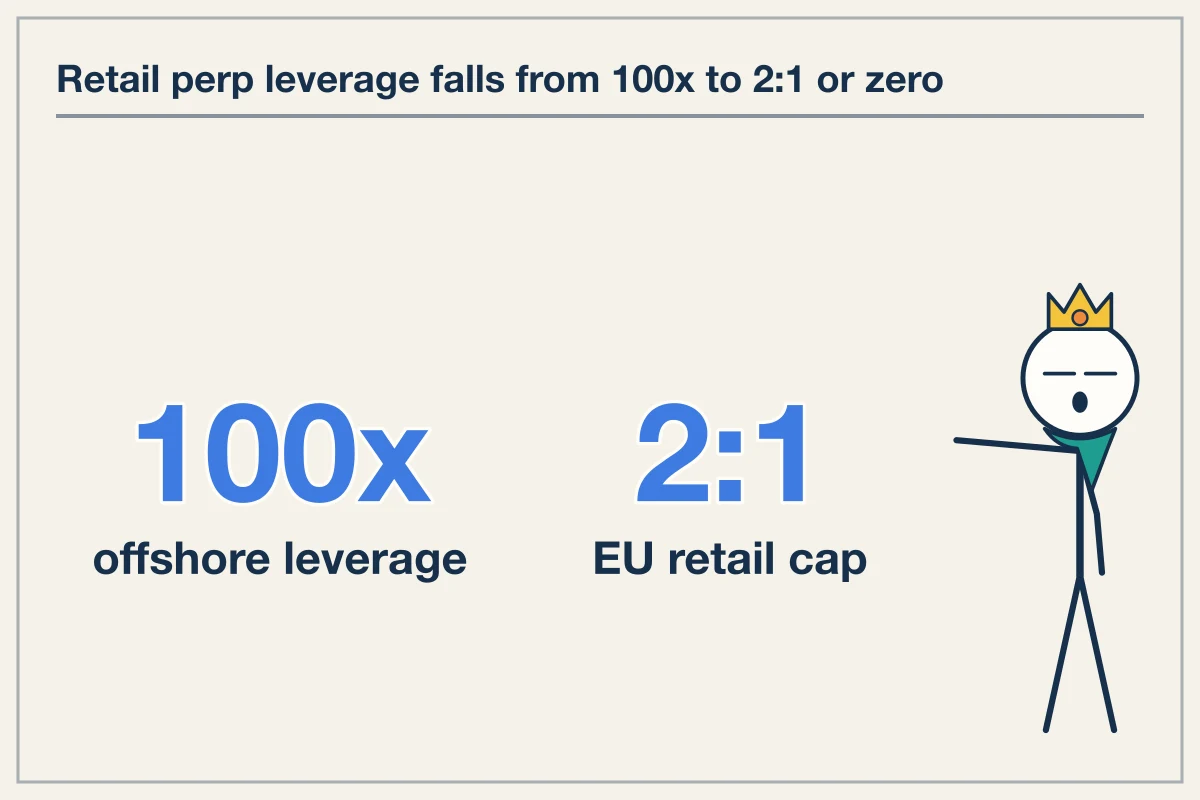
Regulatory enforcement across four major hubs reduces retail crypto perp leverage from 100x to as low as 2:1 or zero.
Hong Kong bans retail crypto derivatives entirely under SFC rules.
Singapore prohibits leverage for retail accounts under MAS guidelines.
Dubai limits high-leverage derivative access strictly to qualified institutional investors under VARA.
How MiCA crypto regulation impacts retail access
Under MiCA crypto regulation, European Union traders face strict venue access rules that push crypto derivatives onto regulated MiFID II venues with a 2:1 leverage cap. This framework fundamentally alters how exchanges serve retail traders compared to offshore hubs.
Regulation EU 2023/1114, known as MiCA, entered into force in June 2023 and applies fully by December 2024. MiCA establishes rules for Crypto-Asset Service Providers (CASPs) offering spot trading and custody. However, perpetual futures and other crypto derivatives fall under the existing Markets in Financial Instruments Directive II (MiFID II) framework.
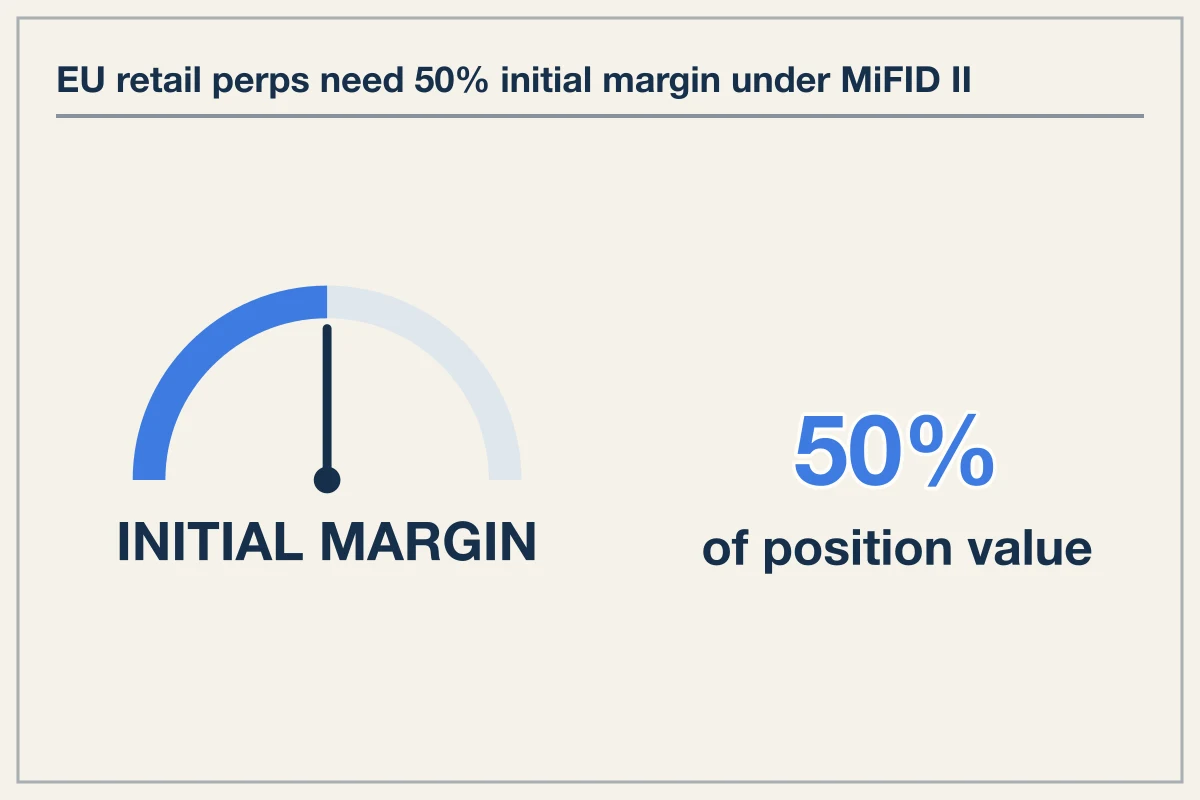
Under European Securities and Markets Authority (ESMA) product intervention measures, regulated platforms offering derivative CFDs or perpetuals to retail clients must enforce a 2:1 leverage cap. Initial margin requirements sit at 50% of the position value. Reverse solicitation provisions under MiCA Article 61 strictly limit third-country exchanges from soliciting EU retail users without a physical local license.
Worth knowing
While MiCA regulates spot crypto assets directly, perpetual futures fall under existing MiFID II derivatives rules, enforcing strict suitability checks and a maximum 2:1 leverage limit for retail traders.
Retail derivative bans in Hong Kong and Singapore
Asian financial centers have separated retail spot asset access from speculative derivative markets through strict licensing mandates.
Hong Kong introduced its Virtual Asset Service Provider (VASP) framework under the Anti-Money Laundering Ordinance on June 1, 2023. Enforced by the Securities and Futures Commission (SFC), licensed exchanges may offer spot trading only in large-cap assets like BTC and ETH to retail investors. The SFC explicitly bans licensed platforms from offering crypto futures, perpetual contracts, or yield products to retail users.
In Singapore, the Monetary Authority of Singapore (MAS) published final regulatory measures for Digital Payment Token (DPT) services in late 2023 under the Payment Services Act. MAS guidelines prohibit DPT service providers from offering margin trading, leverage, or credit facilities to retail customers. Retail clients cannot use credit cards or leverage to fund positions.
Where this goes wrong
Bypassing local regulatory restrictions via VPNs or non-KYC accounts exposes positions to sudden account freezing, collateral forfeiture, or emergency liquidation without recourse.
Dubai VARA rules and client classification
Dubai established a bespoke regulatory framework for virtual assets under the Virtual Assets Regulatory Authority (VARA) Full Market Product Regulations published in February 2023.
VARA categorizes market participants into Retail Investors, Qualified Investors, and Institutional Investors. Under the Virtual Asset Derivatives Services Regulations, authorized venues can offer perpetual futures, but high-leverage products are restricted by client tier.
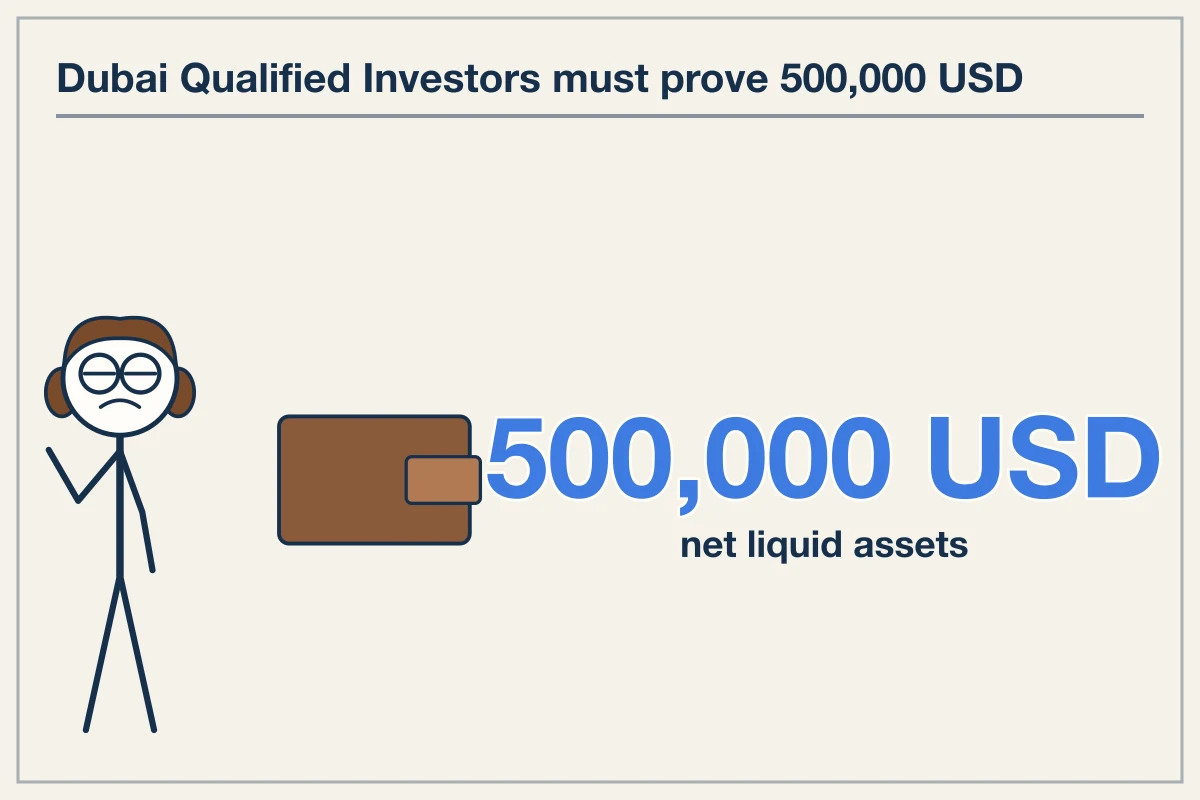
Retail clients face strict annual volume caps and mandatory suitability questionnaires before trading derivatives. Qualified Investors must prove net liquid assets of 500,000 USD or demonstrate extensive institutional derivative trading experience. High-leverage perp accounts are reserved for Qualified or Institutional categories, isolating retail capital from liquidation cascades.
Execution fees and funding spread across platforms
Regulatory restrictions fragment global liquidity pools. Compliant regional venues maintain separate order books from offshore platforms, resulting in distinct fee structures and funding rate differentials for the same trading pairs.
| Venue | Futures Maker Fee | Futures Taker Fee | BTC 8h Funding Rate | ETH 8h Funding Rate |
|---|---|---|---|---|
| MEXC | 0.0000% | 0.0200% | +0.0049% | +0.0008% |
| Bybit | 0.0200% | 0.0550% | +0.0052% | +0.0022% |
| OKX | 0.0200% | 0.0500% | +0.0088% | +0.0033% |
| Bitget | 0.0200% | 0.0300% | +0.0081% | +0.0039% |
The live spread on BTC 8-hour funding across these venues reaches 0.0039 percentage points.
Consider a trader holding a long position of 10 BTC at an index price of 60,000 USD, creating a total position size of 600,000 USD.
On OKX, paying a funding rate of +0.0088% every 8 hours costs 52.80 USD per interval, which equals 158.40 USD per day. On MEXC, paying a funding rate of +0.0049% costs 29.40 USD per interval, which equals 88.20 USD per day. The funding cost difference between these two venues amounts to 70.20 USD daily, accumulating to 2,106.00 USD over a 30-day holding period.
What to do instead
Calculate 30-day cumulative funding costs alongside taker fee tiers across venues before opening long-term directional perpetual positions.
Practical consequences for position sizing
Regulatory leverage constraints change initial margin requirements and structural liquidation risk.
Under an unconstrained 100x leverage regime, a trader opens a 100,000 USD position using 1,000 USD in margin. Liquidation occurs after a 1% price move against the position. Under a 2:1 leverage cap mandated by European regulations, that same 100,000 USD position requires 50,000 USD in initial collateral. Liquidation occurs only after a 50% adverse market movement.
The restriction on retail leverage forces traders to maintain higher cash reserves on compliant exchanges. Lower maximum leverage reduces default frequency during volatility events, but increases the capital required to achieve equivalent position sizes.
How does MiCA crypto regulation affect leverage limits for retail perpetual futures trading?
MiCA crypto regulation works alongside MiFID II rules, which limit retail leverage on crypto derivatives to 2:1 within the European Union. Non-EU venues without local authorization cannot legally market or offer derivative products to EU retail residents.
Can retail traders in Hong Kong trade crypto perpetual futures under SFC rules?
No, the Hong Kong SFC VASP framework completely prohibits retail access to crypto futures and perpetual contracts. Retail accounts on licensed platforms are restricted exclusively to spot trading of large-cap assets like BTC and ETH.
What leverage is permitted for retail crypto trading under Singapore MAS guidelines?
Singapore MAS guidelines prohibit licensed payment service providers from granting leverage, margin financing, or credit facilities to retail customers. Retail clients must fund spot crypto trades in full using personal cash reserves.
What is required to trade crypto perps under Dubai VARA regulation?
Under VARA regulations, high-leverage crypto derivatives are restricted to Qualified or Institutional Investors. Qualified status requires demonstrating 500,000 USD in net liquid assets or documented professional trading experience.