· four exchange APIs · rebuilt daily
Limit Execution Saves 3.5 Basis Points Over Market Orders On Bybit
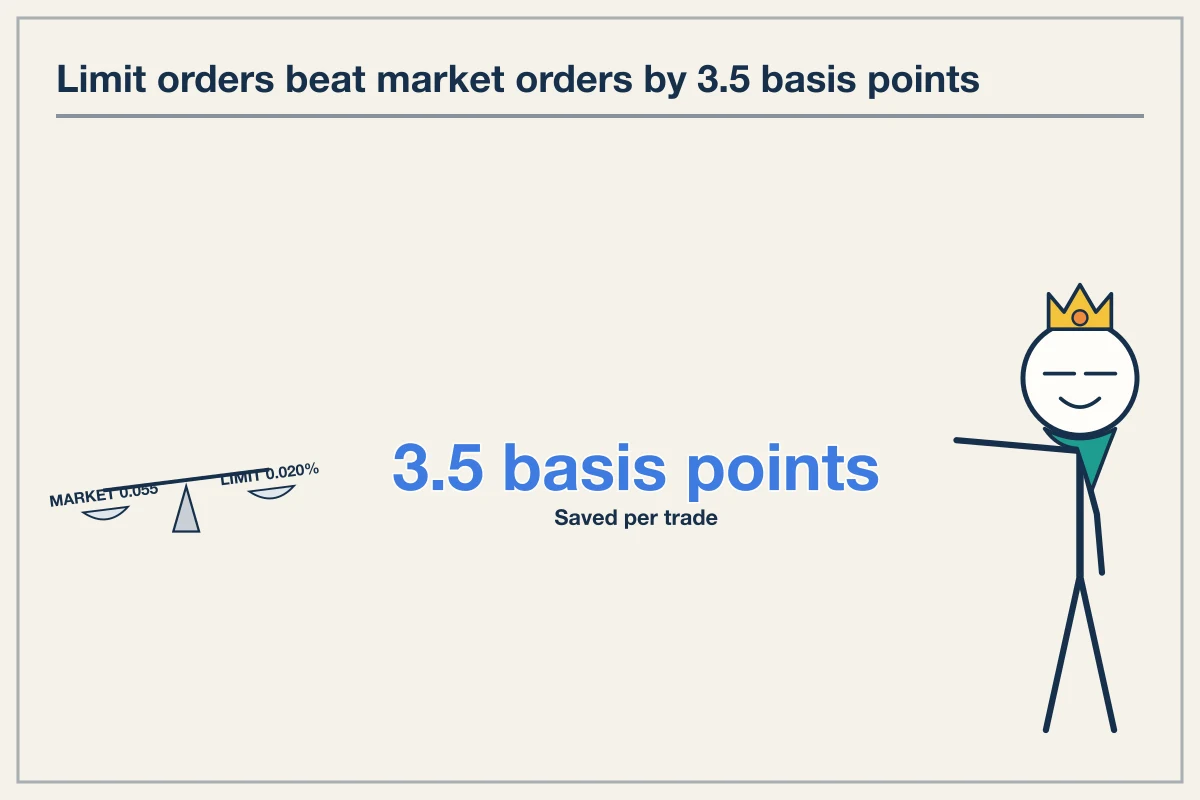
Limit orders save up to 3.5 basis points per trade over market orders, but order slippage exceeding that threshold negates the fee advantage.
Default Execution Costs Across Venues
Market orders consume liquid order book depth and pay higher fees, while passive limit orders add depth and receive lower rates. On Bybit, takers pay 0.055 percent per trade while makers pay 0.020 percent. This creates a 0.035 percent execution penalty per leg, or 0.070 percent across a complete round trip.
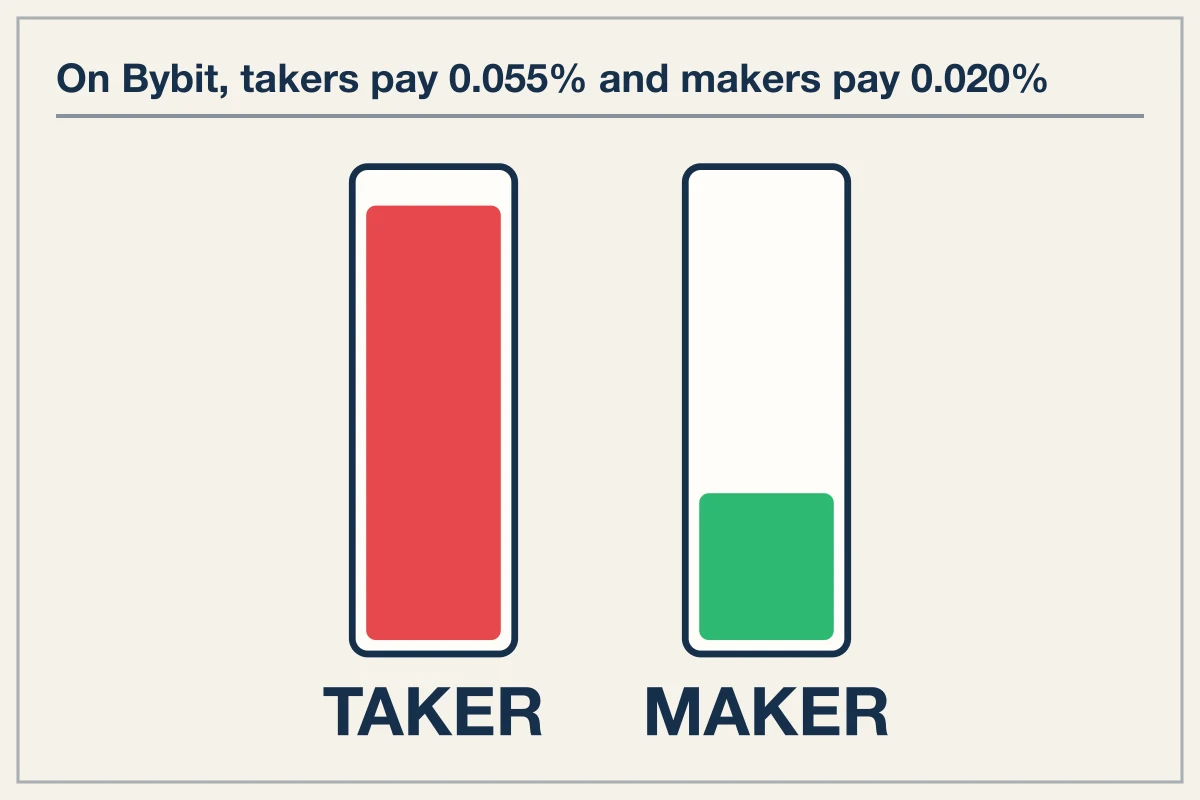
Exchange fee structures dictate the baseline drag on active trading strategies. The table below outlines default futures fee schedules across four major venues.
| Exchange | Futures Maker Fee | Futures Taker Fee | Single-Leg Spread | Round-Trip Taker Cost |
|---|---|---|---|---|
| Bitget | 0.020% | 0.030% | 0.010% | 0.060% |
| MEXC | 0.000% | 0.020% | 0.020% | 0.040% |
| OKX | 0.020% | 0.050% | 0.030% | 0.100% |
| Bybit | 0.020% | 0.055% | 0.035% | 0.110% |
On OKX, a market order costs 0.050 percent versus 0.020 percent for a limit order. The single-leg gap is 0.030 percent. On MEXC, maker fees are zero percent while taker fees are 0.020 percent, yielding a 0.020 percent single-leg gap. Bitget maintains the narrowest fee gap at 0.010 percent, charging 0.020 percent for makers and 0.030 percent for takers.
Worked Arithmetic: The Cost of Turnover
Consider a trader taking a $100,000 nominal position size in perpetual futures.
Using market orders on Bybit:
- Entry fee: $100,000 multiplied by 0.00055 equals $55.00.
- Exit fee: $100,000 multiplied by 0.00055 equals $55.00.
- Total round-trip fee: $110.00.
Using limit orders on Bybit:
- Entry fee: $100,000 multiplied by 0.00020 equals $20.00.
- Exit fee: $100,000 multiplied by 0.00020 equals $20.00.
- Total round-trip fee: $40.00.
The fee differential on Bybit for a $100,000 position is $70.00 per round trip. If this position turns over ten times per day, aggregate daily fees reach $1,100 for taker orders compared to $400 for maker orders. The cumulative drag equals $700 per day per $100,000 of daily turnover.
On OKX, the same $100,000 round trip costs $100.00 for taker execution and $40.00 for maker execution, generating a $60.00 differential. On MEXC, taker execution costs $40.00 round trip while maker execution costs $0.00, generating a $40.00 differential. On Bitget, taker execution costs $60.00 round trip compared to $40.00 for maker execution, generating a $20.00 differential.
The Slippage Threshold
Limit orders do not guarantee execution. When price moves away from a limit order before filling, the trader faces adverse selection or must chase the market with a cross-spread order.
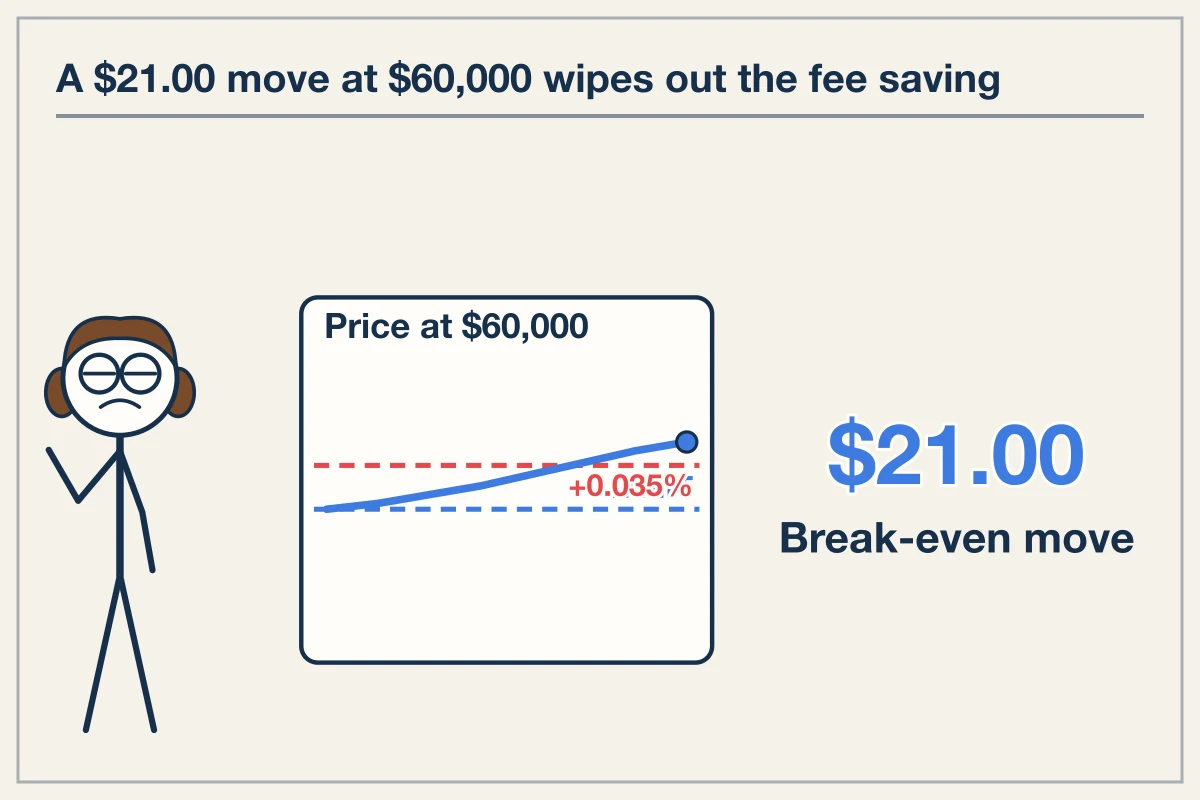
The fee saving defines the maximum allowable price movement before market execution becomes mathematically preferable. On Bybit, the maker saving is 0.035 percent per order leg. If placing a limit order causes the fill price to degrade by more than 0.035 percent due to queue delay or market movement, the execution slippage exceeds the fee saving.
For an asset priced at $60,000, a 0.035 percent price movement equals $21.00. If a passive order posted at $60,000 fills only after the market moves against the order by $21.50, the effective cost of the maker order ($20.00 fee plus $21.50 adverse fill) exceeds the cost of an immediate market order ($55.00 fee).
On OKX, the slippage threshold is 0.030 percent ($18.00 on a $60,000 asset). On MEXC, the slippage threshold is 0.020 percent ($12.00 on a $60,000 asset). On Bitget, the slippage threshold is 0.010 percent ($6.00 on a $60,000 asset).
Funding Drag Relative to Fee Structure
Execution fees represent a one-time transaction drag, whereas funding rates represent a continuous holding drag. Position costs depend on both execution choice and venue funding rates.
| Asset | Venue Spread (8h) | Min Venue (Rate) | Max Venue (Rate) | 24h Volume |
|---|---|---|---|---|
| ETH | 0.0093% | MEXC (+0.0007%) | Bitget (+0.0100%) | $8,644,132,788 |
| BTC | 0.0026% | OKX (+0.0074%) | Bitget (+0.0100%) | $5,771,929,633 |
| SOL | 0.0140% | OKX (-0.0096%) | Bitget (+0.0044%) | $1,495,051,097 |
| ZEC | 0.0100% | MEXC (+0.0000%) | Bitget (+0.0100%) | $754,972,191 |
| XRP | 0.0062% | OKX (-0.0005%) | Bitget (+0.0057%) | $486,548,361 |
| XAU | 0.0190% | Bitget (+0.0190%) | OKX (+0.0380%) | $428,491,083 |
For a $100,000 long ETH position held for 24 hours across three funding intervals:
- MEXC funding cost: $100,000 multiplied by 0.000007 multiplied by 3 equals $2.10.
- Bitget funding cost: $100,000 multiplied by 0.000100 multiplied by 3 equals $30.00.
- Daily funding difference: $27.90.
The $27.90 daily funding spread on ETH between MEXC and Bitget exceeds the Bitget round-trip maker-taker fee difference of $20.00. Holding a long ETH position on Bitget for 24 hours incurs more excess funding drag than the total round-trip taker fee penalty on that exchange.
For SOL, the funding spread across venues is 0.0140 percent per 8 hours, yielding a daily spread of 0.0420 percent ($42.00 per $100,000 position). For XAU, the funding spread reaches 0.0190 percent per 8 hours, or 0.0570 percent daily ($57.00 per $100,000 position).
Execution Realities
High-frequency turnover amplifies maker fee discounts, making limit execution essential on platforms like Bybit and OKX where taker fees are higher. Conversely, long holding periods shift total position drag away from order execution and toward venue funding spreads. When execution delay introduces more than 1.0 to 3.5 basis points of adverse price drift, immediate taker fills provide cheaper total trade resolution than unfilled limit orders.