· four exchange APIs · rebuilt daily
How a crypto liquidation cascade works across perpetual swap order books

The finding
A crypto liquidation cascade accelerates when forced taker orders consume bid depth, driving the mark price past the bankruptcy price of nearby positions.
The venue's risk engine takes control of underwater accounts and executes immediate market orders.
When order book liquidity cannot absorb these fills, slippage triggers adjacent liquidation prices down the order stack.
Mark price triggers in derivative markets
A crypto liquidation cascade begins when the mark price reaches a position's liquidation threshold. Perpetual swap venues calculate mark price using an index of underlying spot prices combined with a moving average of the contract basis. This prevents isolated order book manipulation from liquidating traders prematurely.
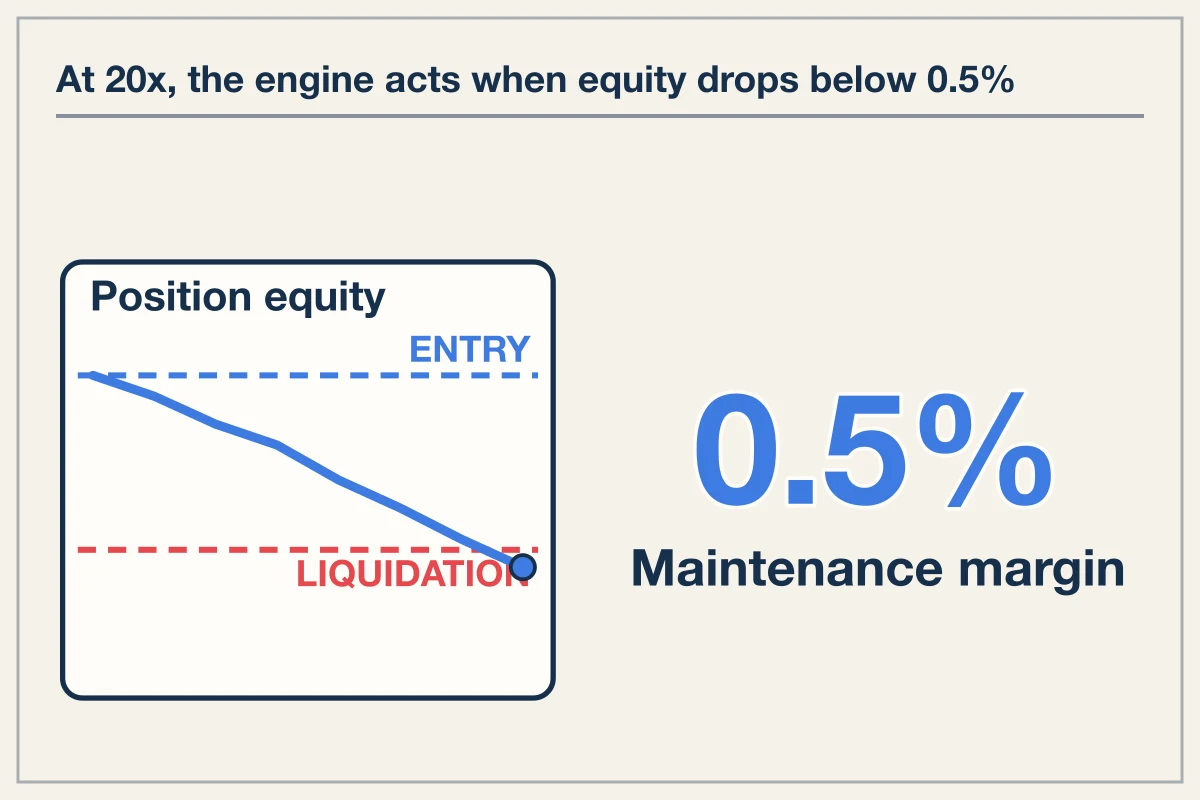
When market volatility moves the index price down, position equity declines. If account equity falls below the maintenance margin requirement, the exchange risk engine marks the account for forced closure. Maintenance margin is significantly lower than initial margin; for example, a 20x leverage position requires 5% initial margin and 0.5% maintenance margin.
The liquidation engine acts when equity crosses the 0.5% threshold. It revokes user access, cancels open orders, and prepares to exit the open contract size.
Anatomy of a crypto liquidation cascade on the order book
When the liquidation engine takes control of an underwater long position, it closes the contract by placing immediate sell taker orders into the order book. These forced market orders match directly against standing limit bids.
Where this goes wrong
A position marked to fair price can still liquidate during spot volatility if order book depth thins out, forcing market orders to fill deeper into the book than expected.
If aggregate market bids within 1% of mid-price total $5 million, and $12 million of long positions hit liquidation thresholds simultaneously, the engine sweeps through all available bids down to lower price levels.
This aggressive selling depresses the contract price on the local order book. Because the mark price calculation factors in contract trade prices alongside spot index data, the local price drop drags the mark price lower. This updated mark price crosses the maintenance margin line for the next tier of long positions, generating a second wave of market sell orders.
Insurance funds and auto-deleveraging mechanics
The liquidation price sits above the bankruptcy price. The bankruptcy price is the exact market level where total position loss equals the trader's initial margin deposit.
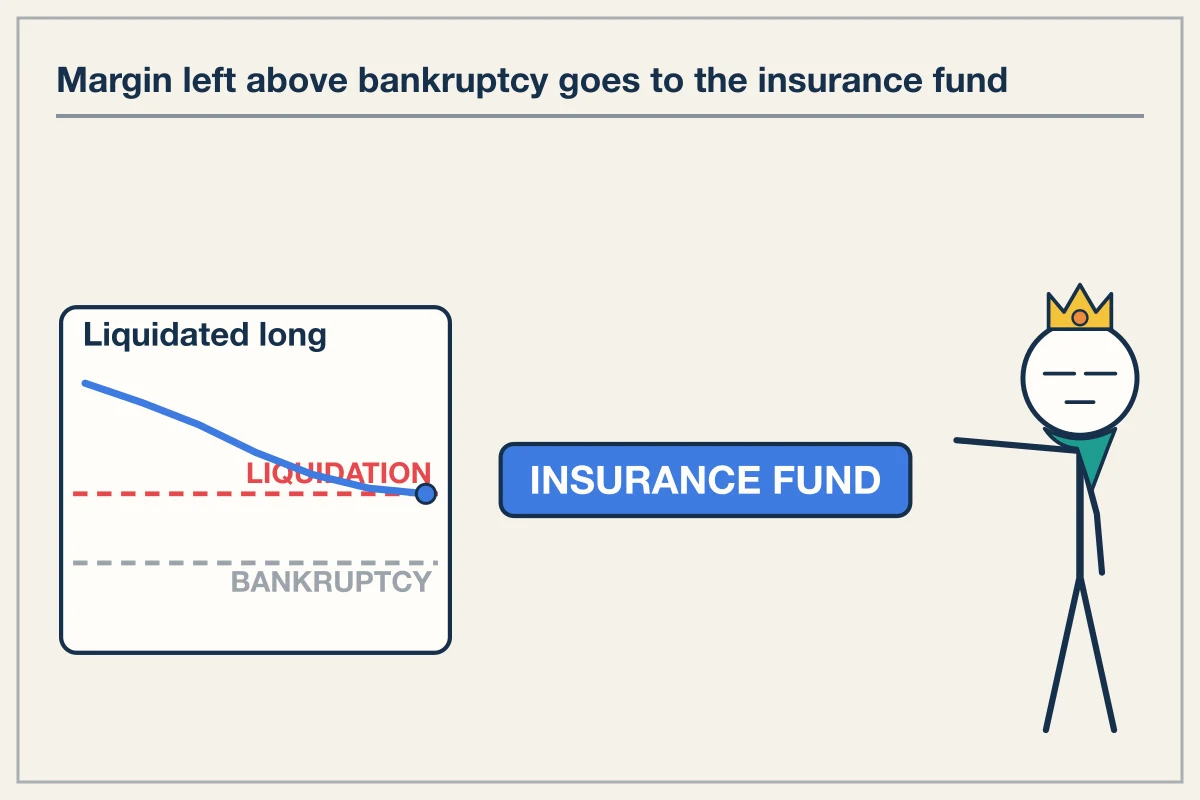
When an engine liquidates a long contract above its bankruptcy price, the trade generates a surplus. The exchange collects this remaining margin balance as a clearance fee and transfers it into the venue insurance fund.
Worth knowing
Auto-deleveraging does not execute market orders on the book; it matches the bankrupt position directly against the highest-ranked profitable trader's position at the bankruptcy price.
During rapid cascades, slippage forces engine market orders to fill below the bankruptcy price. The position incurs negative equity. The insurance fund absorbs this deficit to keep the overall venue solvent without penalizing winning counterparties.
If severe slippage drains the insurance fund balance, the venue activates Auto-Deleveraging (ADL). ADL ranks profitable opposing positions by leverage and return, then forcibly closes them at the bankrupt trader's bankruptcy price to clear the balance sheet.
Venue execution fees and live holding costs
Liquidation engines execute forced closures as taker orders, subjecting the account to the venue's taker fee structure. Higher taker fees reduce the equity returned to the trader or retained by the insurance fund.
The table below compares published futures fee schedules and live 8-hour funding rates across major perpetual swap venues.
| Venue | Futures Maker Fee | Futures Taker Fee | BTC Funding (8h) | ETH Funding (8h) | SOL Funding (8h) |
|---|---|---|---|---|---|
| MEXC | 0.0000% | 0.0200% | +0.0050% | +0.0007% | +0.0014% |
| Bitget | 0.0200% | 0.0300% | +0.0081% | +0.0039% | -0.0071% |
| OKX | 0.0200% | 0.0500% | +0.0088% | +0.0033% | -0.0003% |
| Bybit | 0.0200% | 0.0550% | +0.0052% | +0.0022% | -0.0084% |
What to do instead
Account for taker fees when setting stop-loss orders above maintenance margin thresholds to ensure voluntary exits execute before engine takeover.
Worked liquidation math and slippage impact
Consider a trader holding 10 BTC long at $60,000 with 20x leverage. The total position size is $600,000, requiring $30,000 initial margin. The venue sets the maintenance margin at 0.5%, or $3,000.
Liquidation triggers when equity falls to $3,000. This occurs when position loss reaches $27,000 ($30,000 initial margin minus $3,000 maintenance margin). A $27,000 loss across 10 BTC equals a price decline of $2,700 per coin. The liquidation price is $57,300.
Bankruptcy occurs when losses reach $30,000, representing a $3,000 price drop. The bankruptcy price is $57,000.
When mark price hits $57,300, the risk engine submits a market sell order for 10 BTC. If bid depth is thin, the market order fills at an average price of $56,800.
At a $56,800 fill, total position loss equals $32,000 ($3,200 per BTC). Because initial margin was $30,000, the position ends in $2,000 of negative equity. At Bybit, the engine also assesses a 0.055% taker fee on the $568,000 liquidated value, adding $312.40 to the cost. The insurance fund pays $2,312.40 to cover the negative equity and taker execution fee.
What triggers a crypto liquidation cascade on a perpetual swap exchange?
A cascade triggers when falling prices breach the maintenance margin of clustered positions, forcing the exchange engine to submit automated taker sell orders. These orders sweep order book bids, pushing the mark price down further and unlocking subsequent liquidation thresholds.
How does an insurance fund stop a liquidation cascade from affecting profitable traders?
The insurance fund absorbs negative equity when liquidated positions fill beyond their bankruptcy price. By paying out deficits from past clearance fees, the venue avoids bankrupting the clearing house or resorting to auto-deleveraging.
What happens when an exchange insurance fund is exhausted during a cascade?
When the insurance fund cannot cover negative equity deficits, the venue triggers auto-deleveraging (ADL). ADL automatically closes opposing positions held by high-leverage, high-profit traders at the bankruptcy price of the liquidated accounts without hitting the open order book.
Why do taker fee schedules matter during forced liquidations?
Liquidation engines execute forced closes as market taker orders, charging the account the full taker fee rate. Higher taker fees reduce the margin buffer between liquidation price and bankruptcy price, making negative equity events more likely during thin market conditions.