· four exchange APIs · rebuilt daily
Proof of Reserves Misses Off-Chain Liabilities and Snapshot Capital
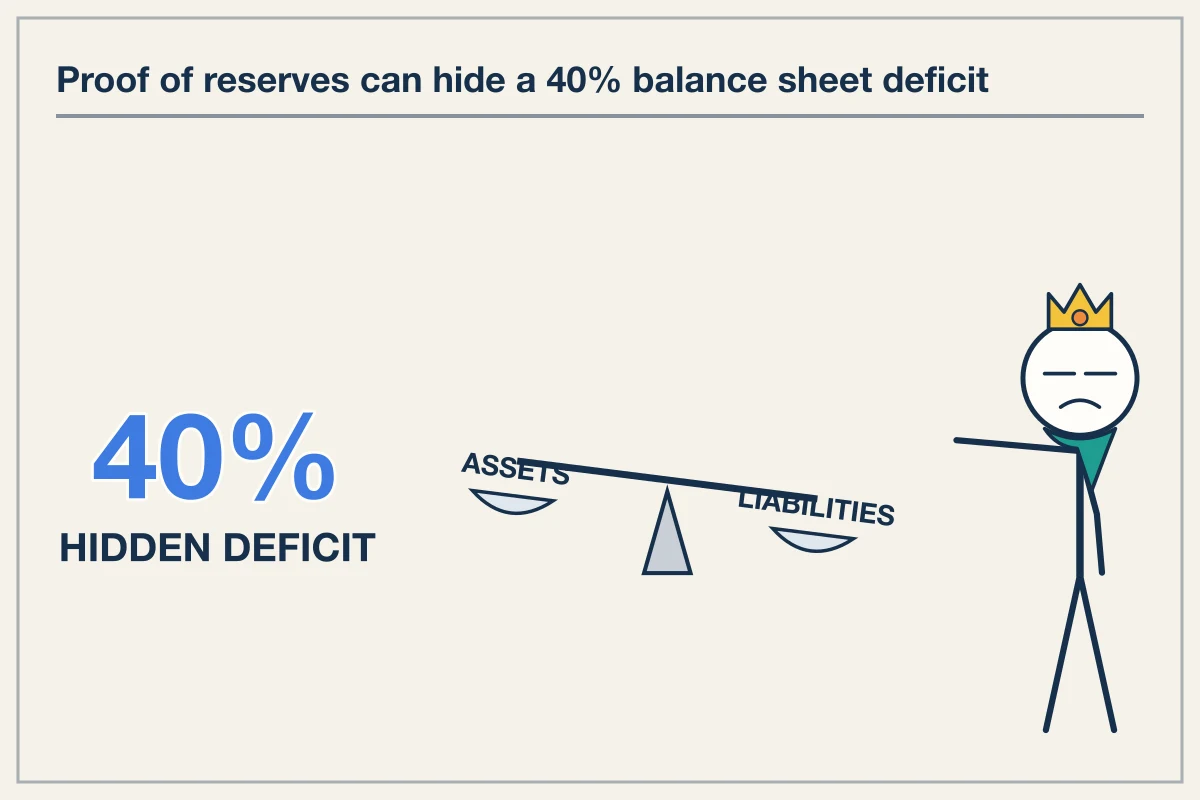
Point-in-time proof of reserves attestations verify on-chain asset ownership while omitting off-chain liabilities, encumbrances, and borrowed snapshot capital.
A point-in-time proof of reserves attestation can obscure a 40% balance sheet deficit through off-chain liabilities and temporary snapshot loans.
How Merkle Tree Verification Functions
Exchange proof of reserves systems publish two separate components: a cryptographically verifiable summary of user deposits and proof of on-chain wallet control.
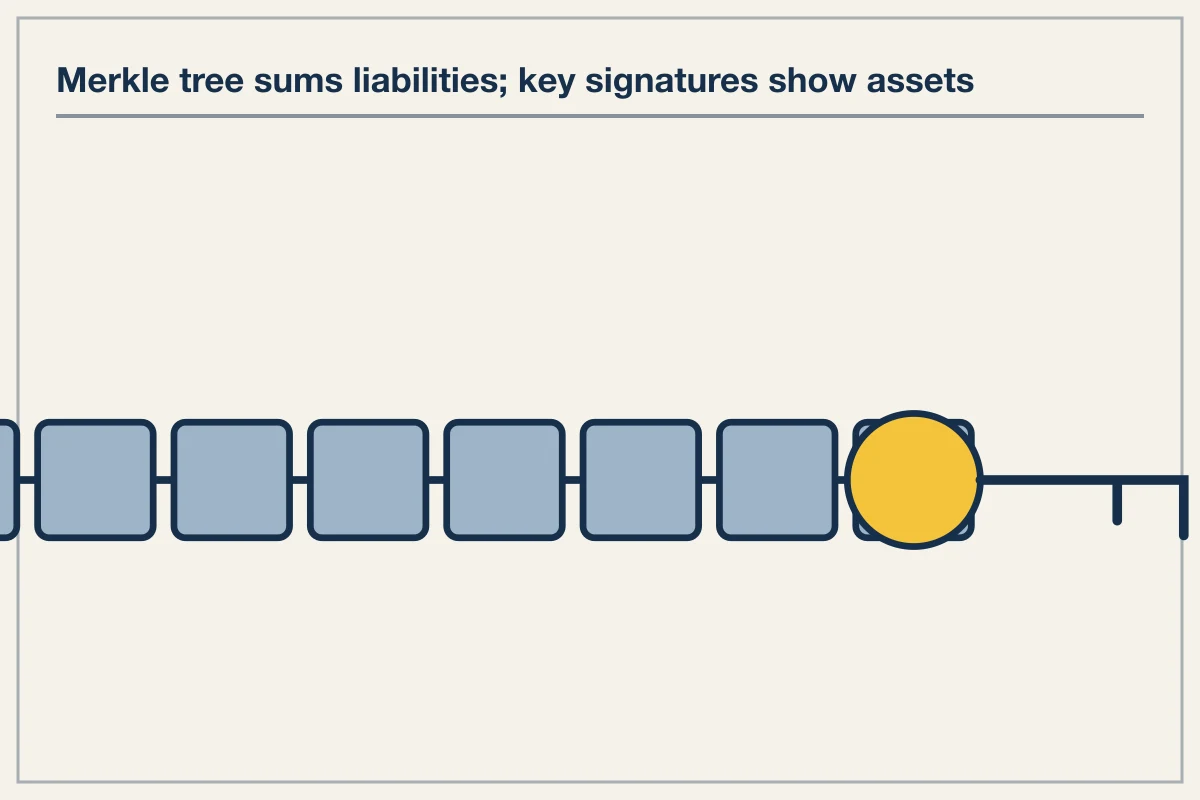
To prove liabilities, the venue hashes each user account identification tag and net balance into a leaf node. Leaf nodes pair recursively up a Merkle tree until resolving into a single Merkle root hash. The exchange publishes this root hash. A user verifies inclusion by requesting their specific cryptographic branch and hashing their balance up to the published root.
To prove assets, the exchange signs a public message with the private keys controlling designated blockchain addresses. The sum of balance holdings across these signed addresses is compared directly against the aggregate liability sum from the Merkle tree. When total signed wallet assets equal or exceed the total Merkle liabilities, the exchange reports a reserve ratio of 100% or higher.
Structural Vulnerabilities of Self-Reported Reserves
Omitted Liabilities and Negative Leaves
A Merkle root mathematically proves that a specific account is included in the tree. It does not prove that all platform accounts are included. If an exchange leaves high-balance institutional accounts out of the tree generation script, total calculated liabilities drop without altering the validity of the remaining leaves.
Furthermore, standard Merkle trees permit negative values. An exchange operator can insert dummy accounts with negative balances into the tree. A leaf with a negative 20,000,000 USD balance reduces the calculated root liability total by 20,000,000 USD. Unless every individual user inspects their leaf and the verification architecture uses zero-knowledge sum proofs to enforce non-negative constraint rules at every node, negative leaves remain undetected.
Snapshot Borrowing and Encumbered Capital
Asset attestations are point-in-time snapshots taken at a single block height. An exchange facing an asset shortfall can borrow capital from institutional lenders, decentralized finance pools, or OTC desks immediately prior to the snapshot block.
Once the on-chain signature and balance verification complete for that block, the exchange returns the borrowed funds. The snapshot displays full reserve coverage, but the assets leave the exchange wallets within hours. The attestation mechanism cannot determine whether wallet assets are unencumbered or collateralized against external obligations.
Off-Chain Debts and Unhedged Exposure
Perpetual futures venues maintain dynamic liability exposure. User account balances change constantly based on unrealized profit and loss, open positions, and funding payments. Standard static snapshots do not capture off-chain credit lines, outstanding corporate debt, regulatory fines, or unhedged market maker liabilities incurred off-chain.
Worked Example: Falsifying a 100% Reserve Ratio
Consider an exchange with 100,000,000 USD in actual user liabilities and 60,000,000 USD in actual spot assets, leaving a real asset deficit of 40,000,000 USD.
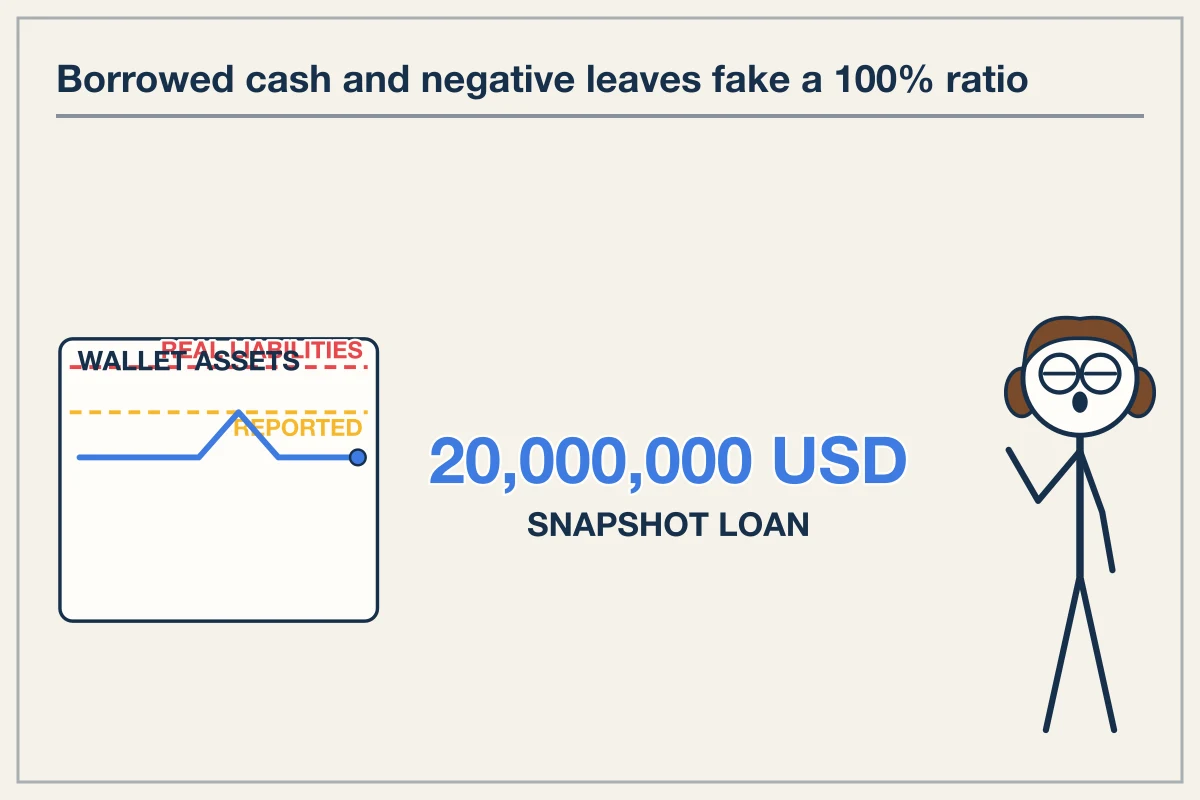
- The exchange generates a Merkle tree for liabilities. It inserts concealed negative balance leaves totaling minus 20,000,000 USD. The tree outputs an aggregate liability sum of 80,000,000 USD. That is 100,000,000 USD real liabilities minus 20,000,000 USD dummy offset.
- One hour before the snapshot block, the exchange borrows 20,000,000 USD in spot assets via a short-term credit line and deposits it into its public cold wallet.
- Total wallet assets at the snapshot block equal 80,000,000 USD. That is 60,000,000 USD spot assets plus 20,000,000 USD borrowed capital.
- The exchange publishes the snapshot. Assets of 80,000,000 USD divided by liabilities of 80,000,000 USD equals a published reserve ratio of 100%.
- Two hours after the snapshot block, the exchange repays the 20,000,000 USD loan.
Actual remaining spot assets fall back to 60,000,000 USD against 100,000,000 USD in actual user liabilities. The real reserve ratio is 60%, but the published attestation reports 100% coverage.
Venue Fee Schedules and Funding Rate Overhead
Attestations do not reflect execution costs or holding drag for active perpetual positions. Traders evaluating venues must compare default fee schedules alongside funding rates.
Default Futures Fee Schedules
| Venue | Spot Maker Fee | Spot Taker Fee | Futures Maker Fee | Futures Taker Fee |
|---|---|---|---|---|
| Bitget | 0.100% | 0.100% | 0.020% | 0.030% |
| Bybit | 0.100% | 0.100% | 0.020% | 0.055% |
| MEXC | 0.000% | 0.050% | 0.000% | 0.020% |
| OKX | 0.080% | 0.100% | 0.020% | 0.050% |
Live Normalised 8-Hour Funding Rates
| Asset | Cheapest Venue for Long | Funding Rate Spread (8h) | 24h Volume |
|---|---|---|---|
| ETH | OKX (+0.0035%) | 0.0065 percentage points | 9,130,559,924 USD |
| BTC | Bybit (+0.0066%) | 0.0034 percentage points | 5,995,825,755 USD |
| SOL | OKX (-0.0071%) | 0.0130 percentage points | 1,572,344,015 USD |
| SNDK | Bybit (+0.0040%) | 0.0168 percentage points | 804,534,069 USD |
| ZEC | MEXC (+0.0001%) | 0.0099 percentage points | 774,283,375 USD |
| XAU | MEXC (+0.0116%) | 0.0135 percentage points | 535,770,049 USD |
On an ETH perpetual position, holding a long on Bitget (+0.0100% per 8h) costs 0.0065 percentage points more per 8-hour interval than holding on OKX (+0.0035% per 8h). On a 100,000 USD position, that funding differential equals 6.50 USD every 8 hours, or 19.50 USD per day in excess holding fee.
Requirements for Solvency Verification
Evaluating solvency requires independent cryptographic guarantees rather than self-reported static snapshots. Valid proof requires zero-knowledge sum proofs that guarantee zero negative leaves, real-time continuous wallet monitoring to detect loan repayments, and third-party audit attestations covering off-chain liabilities and debt encumbrances. Without these three controls, a proof-of-reserves snapshot functions solely as a marketing document.