· four exchange APIs · rebuilt daily
What Did Satoshi Nakamoto Leave on the Bitcoin Ledger?

The finding
Roughly 1,000,000 bitcoins mined in 2009 remain unmoved, while no cryptographic signature has ever linked a real-world identity to Satoshi Nakamoto.
The whitepaper was published on October 31, 2008.
The genesis block launched on January 3, 2009.
Identity attribution remains unproven on the public ledger.
The cryptographic record of Satoshi Nakamoto
The pseudonym Satoshi Nakamoto published the paper titled Bitcoin: A Peer-to-Peer Electronic Cash System on October 31, 2008. The software client went live on January 3, 2009, when block 0 was generated.
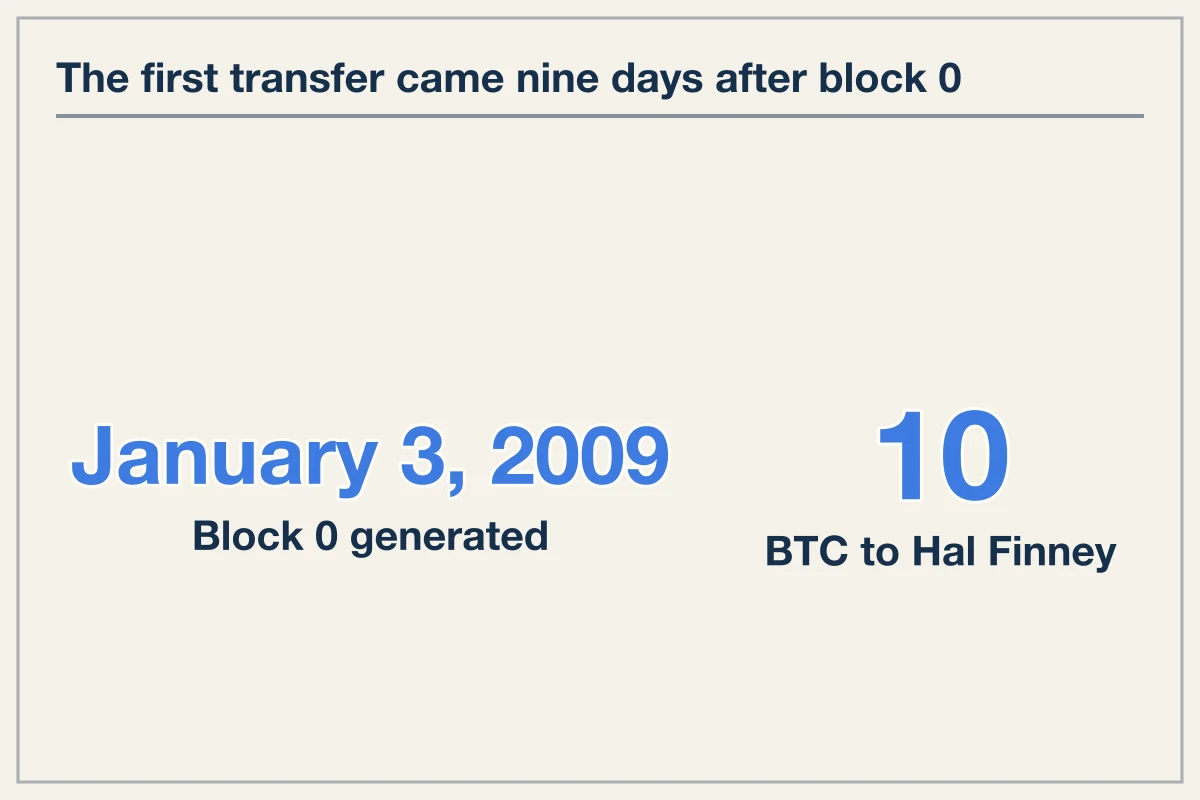
Block 0 contained an arbitrary text string in its coinbase parameter: "The Times 03/Jan/2009 Chancellor on brink of second bailout for banks". This timestamp established that the network started on or after that date. Nine days later, on January 12, 2009, block 17 recorded the first transaction: 10 bitcoins sent from Nakamoto to developer Hal Finney.
Worth knowing
Signing a plain text message using the private key corresponding to block 0 or block 9 remains the only cryptographic method to prove control over the founding keys.
Nakamoto continued communicating via the BitcoinTalk forum and email until late 2010. Control over the code repository was handed to developers in December 2010. The last public message from the persona occurred on April 26, 2011, stating a move to other projects.
Who created bitcoin satoshi nakamoto ledger footprint
On-chain analysis of early block rewards reveals a single dominant miner active from block 1 through early 2010. This miner maintained a constant hash rate, leading to an accumulated stash estimated at roughly 1,000,000 bitcoins across thousands of key pairs.
None of the coinbase transactions from these identifiable early blocks have ever been spent. The outputs sit at public addresses where any movement is publicly visible to all network participants instantly.
| Asset Metric | Primary Ledger Value |
|---|---|
| Whitepaper Date | October 31, 2008 |
| Genesis Block Date | January 3, 2009 |
| First Peer Transfer | January 12, 2009 (10 BTC) |
| Estimated Unspent Founder Supply | ~1,000,000 BTC |
| Genesis Text Inscription | The Times 03/Jan/2009 Chancellor |
Where this goes wrong
An unexpected movement of these 1,000,000 early coins would flood liquid spot order books, causing immediate spot price disruption and triggering liquidations across leveraged derivatives venues.
No circumstantial evidence, textual analysis, or public testimony substitutes for a signed message from an early private key. Identity claims without cryptographic verification fail to satisfy the trust model of the underlying network.
What to do instead
Treat every non-cryptographic claim of creator identity as unverified commentary until accompanied by an on-chain signature from an early block address.
Verified facts versus unproven identity theories
The public record contains documented communications, source code commits, and ledger entries. It does not contain legal identity documentation, IP addresses tied to physical locations, or signed state documents.
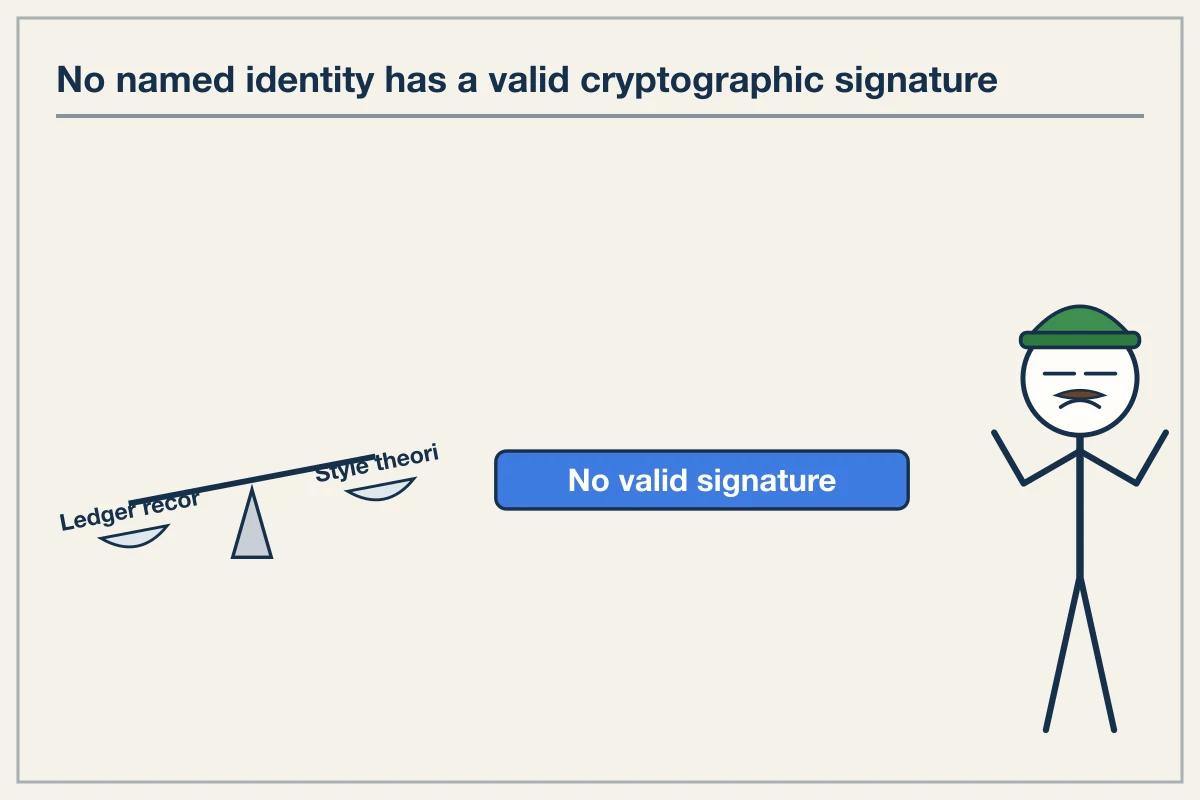
Several individuals have been named publicly in journalistic investigations and legal proceedings. None of these claims have been backed by a valid cryptographic signature using keys attached to the early 2009 mining blocks.
Attribution theories rely on stylistic analysis of written English, timezone analysis of commit histories, or overlapping technical interests in cryptography mailing lists. These methods produce plausible hypotheses but zero absolute proof.
The ledger treats all unspent transaction outputs identically regardless of who generated them. The system operates on mathematical verification rather than identity trust.
Holding Bitcoin positions across perpetual venues
Traders holding perpetual swap positions on Bitcoin pay or receive funding fees every eight hours depending on market skew. Venue selection dictates execution drag and holding costs for these positions.
The table below shows default perpetual fee tiers and live 8-hour funding rates for Bitcoin across major derivative platforms.
| Venue | Futures Maker Fee | Futures Taker Fee | Normalized 8h BTC Funding | 24h Contract Volume |
|---|---|---|---|---|
| Bybit | 0.0200% | 0.0550% | +0.0028% | $5,830,234,609 |
| Bitget | 0.0200% | 0.0300% | +0.0041% | $5,830,234,609 |
| OKX | 0.0200% | 0.0500% | +0.0060% | $5,830,234,609 |
| MEXC | 0.0000% | 0.0200% | +0.0070% | $5,830,234,609 |
Holding a long position on Bybit currently costs +0.0028% per 8-hour window in funding fees. The spread between the lowest funding venue (Bybit) and highest funding venue (MEXC) sits at 0.0042 percentage points per 8 hours.
Over a 30-day holding period, a long position on MEXC pays 0.6300% in raw funding rate fees. The same long position on Bybit pays 0.2520% over the same 30-day period, excluding compound effects. Execution costs must also account for taker fees, which range from 0.0200% on MEXC to 0.0550% on Bybit.
Did Satoshi Nakamoto ever move the initial block reward from block 0?
No, the 50 BTC reward from the genesis block cannot be spent due to how block 0 was hardcoded into the original client database. All subsequent early block rewards remain unspent in their original addresses.
Has anyone ever proven they are Satoshi Nakamoto using a cryptographic key?
No individual has produced a valid signature using private keys associated with the genesis block or early 2009 coinbase outputs. Cryptographic proof remains completely absent from all identity claims.
How many bitcoins does Satoshi Nakamoto hold on the public ledger?
Blockchain analysis estimates roughly 1,000,000 bitcoins belong to the early single-miner pattern linked to Nakamoto. These coins sit spread across thousands of distinct public addresses that have shown zero outgoing transactions since 2009.
What is the primary risk associated with the early Satoshi Nakamoto coins?
The main market risk is supply overhang if these addresses ever execute a transfer. Because these coins have been idle for over fifteen years, any unexpected spend would destabilize order book depth and trigger systematic derivative liquidations.