· four exchange APIs · rebuilt daily
Where are retail crypto perpetual futures banned?
MiCA, VARA, MAS, and SFC frameworks restrict retail perpetual futures, forcing retail position holders onto offshore venues facing taker fees up to 0.055%.
Licensing Requirements and Market Access Constraints
Four regulatory frameworks dictate global access to perpetual futures contracts: the EU Markets in Crypto-Assets Regulation (MiCA, Regulation EU 2023/1114), the Dubai Virtual Assets Regulatory Authority framework (VARA 2023), the Singapore Payment Services Act (PSA 2019, amended April 2024), and the Hong Kong Securities and Futures Commission VASP regime (SFC 2023). Each framework establishes strict boundaries regarding which entities may offer leveraged derivatives and which client classifications may trade them.
Framework Rules and Text Requirements
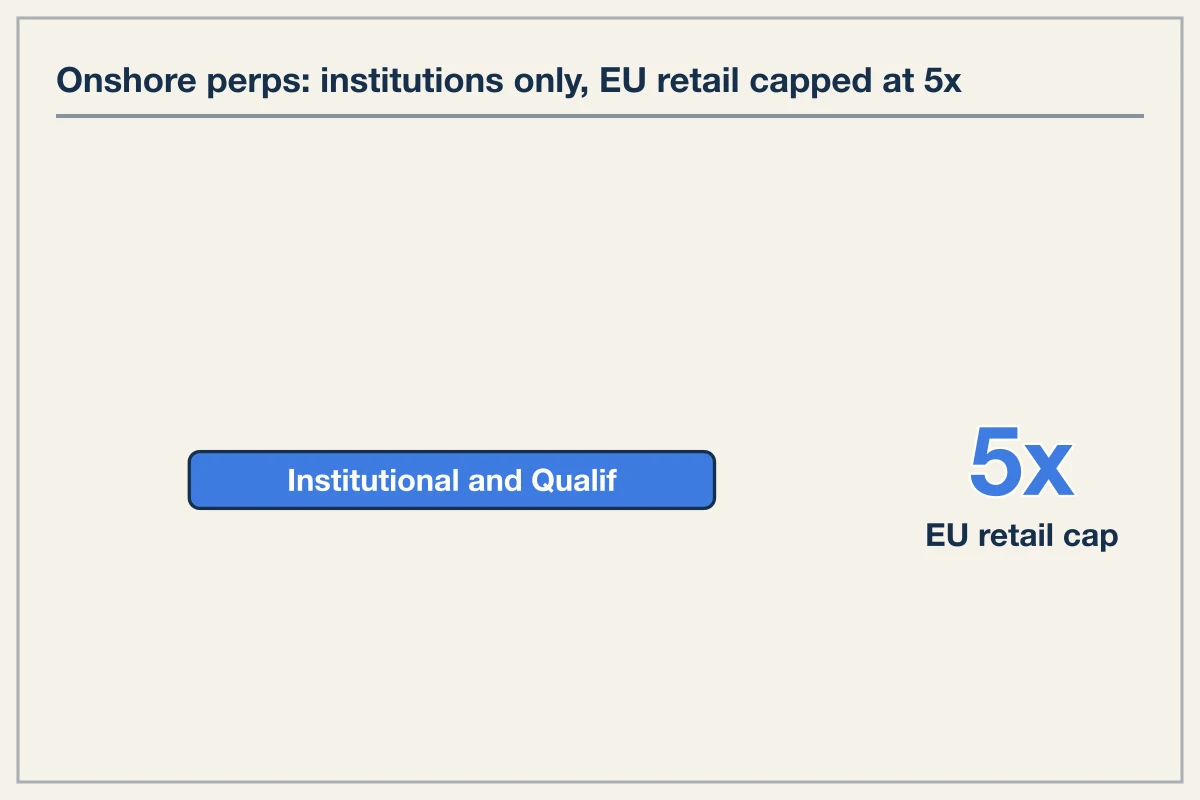
- EU MiCA (Regulation EU 2023/1114, passed May 2023): MiCA establishes authorization rules for Crypto-Asset Service Providers (CASPs) but explicitly excludes financial derivatives tied to crypto-assets. Crypto perpetual futures fall under the Markets in Financial Instruments Directive II (MiFID II, Directive 2014/65/EU). Under Article 61 of MiCA, reverse solicitation rules prohibit offshore venues from targeting EU residents without explicit local licensing. Retail traders accessing derivatives under MiFID II face strict leverage caps, typically capped between 2x and 5x, along with mandatory appropriateness assessments.
- Hong Kong SFC VASP Regime (effective June 1, 2023): Operating under the Anti-Money Laundering and Counter-Terrorist Financing Ordinance, licensed Virtual Asset Trading Platforms (VATPs) may only provide spot trading in highly liquid tokens to retail investors. Perpetual futures contracts are categorized as complex financial derivatives and are prohibited for retail accounts on licensed domestic exchanges.
- Singapore MAS Framework (Payment Services Act 2019, amended April 2024): Digital Payment Token (DPT) service providers licensed by the Monetary Authority of Singapore cannot offer margin trading, perpetual futures contracts, or credit lines to retail clients. Perpetual futures access on onshore platforms is restricted to accredited institutional investors.
- Dubai VARA Regulations (Virtual Assets and Related Activities Regulations, Feb 2023): VARA mandates dedicated Exchange or Broker-Dealer authorization for virtual asset derivatives. Derivatives trading is restricted to Institutional and Qualified Investors. Qualified Individual Investors must maintain a liquid net worth of at least 20,000,000 AED ($5.4 million) or demonstrate verified derivatives trading experience to access leverage.
Jurisdiction Access Rules
| Jurisdiction | Regulatory Framework | Retail Perpetual Futures Permitted? | Investor Qualification Threshold | Reverse Solicitation Enforcement |
|---|---|---|---|---|
| European Union | MiCA (2023/1114) / MiFID II | No (restricted under MiFID II) | MiFID II Professional Client Status | Strict Article 61 enforcement |
| Hong Kong | SFC VASP Regime (2023) | No | Professional Investor ($8M HKD assets) | Complete ban on unlicensed marketing |
| Singapore | MAS PSA (2019 / 2024) | No | Accredited / Institutional Investor | Strict prohibitions on local promotion |
| Dubai | VARA Regulations (2023) | Restricted | Qualified Investor (20M AED net worth) | Strict territorial enforcement |
Friction and Cost Mechanics on Offshore Venues
Because domestic regimes in Hong Kong, Singapore, Dubai, and the EU restrict retail perpetual futures, market participants route leverage demand to offshore entities. Holding a perpetual futures position on these venues incurs entry and exit trading fees plus funding payments every 8 hours.
Published Fee Schedules and Live Funding Rates
| Venue | Spot Maker | Spot Taker | Futures Maker | Futures Taker | BTC 8h Funding | ETH 8h Funding | SOL 8h Funding |
|---|---|---|---|---|---|---|---|
| OKX | 0.0800% | 0.1000% | 0.0200% | 0.0500% | +0.0079% | +0.0035% | -0.0070% |
| Bybit | 0.1000% | 0.1000% | 0.0200% | 0.0550% | +0.0066% | +0.0070% | -0.0062% |
| MEXC | 0.0000% | 0.0500% | 0.0000% | 0.0200% | +0.0100% | +0.0072% | -0.0022% |
| Bitget | 0.1000% | 0.1000% | 0.0200% | 0.0300% | +0.0100% | +0.0100% | +0.0058% |
Position Cost Arithmetic
Holding a $100,000 BTC long position for 24 hours (3 funding intervals) using market orders (taker execution) yields differing baseline costs across venues based on fee schedules and live rates.
- MEXC:
- Entry taker fee: 0.0200% of $100,000 = $20.00
- Exit taker fee: 0.0200% of $100,000 = $20.00
- 24h funding cost (3 x +0.0100%): 0.0300% of $100,000 = $30.00
- Total 24h position cost: $70.00
- Bitget:
- Entry taker fee: 0.0300% of $100,000 = $30.00
- Exit taker fee: 0.0300% of $100,000 = $30.00
- 24h funding cost (3 x +0.0100%): 0.0300% of $100,000 = $30.00
- Total 24h position cost: $90.00
- OKX:
- Entry taker fee: 0.0500% of $100,000 = $50.00
- Exit taker fee: 0.0500% of $100,000 = $50.00
- 24h funding cost (3 x +0.0079%): 0.0237% of $100,000 = $23.70
- Total 24h position cost: $123.70
- Bybit:
- Entry taker fee: 0.0550% of $100,000 = $55.00
- Exit taker fee: 0.0550% of $100,000 = $55.00
- 24h funding cost (3 x +0.0066%): 0.0198% of $100,000 = $19.80
- Total 24h position cost: $129.80
Practical Leverage and Liquidation Mechanics
Regulatory restrictions directly alter position exposure thresholds. On licensed domestic venues operating under MiFID II or VARA rules, leverage limits cap positions at 2x to 5x. At 5x leverage, a 20% price move against the position causes total margin loss.
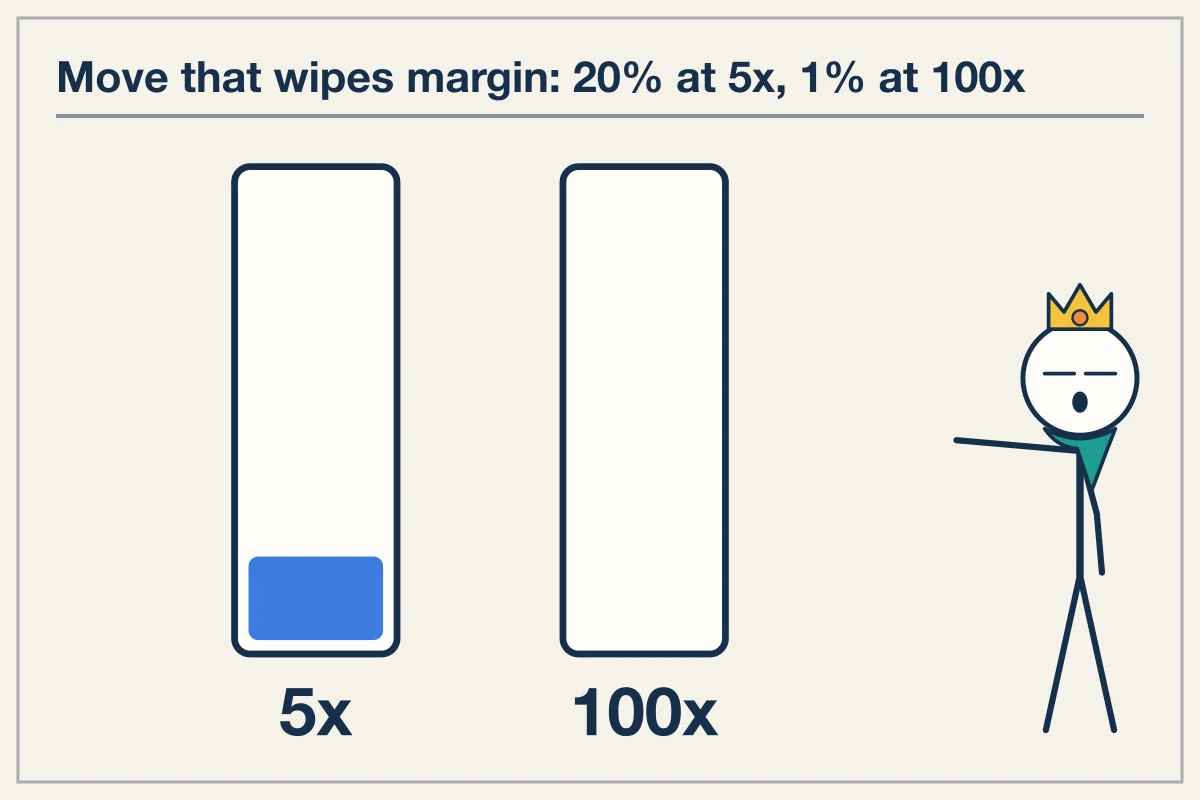
Offshore venues permit up to 100x leverage on major contracts. At 100x leverage, a 1% price move against the position triggers liquidation. While offshore execution permits high position sizing relative to posted capital, total transaction costs scale relative to nominal position size, meaning a 0.055% taker fee on a 100x leveraged position equals 5.5% of initial margin on entry and 5.5% on exit.