· four exchange APIs · rebuilt daily
TRON and Arbitrum cut stablecoin transfer rails costs below one dollar
The finding
Arbitrum and TRON settle stablecoin transfers between major exchanges in under two minutes for less than $1.00 in network fees.
Ethereum mainnet transfers average $12.00 to $25.00 in combined exchange withdrawal fees and gas costs.
Deposit confirmation requirements on receiving venues add two to fifteen minutes depending on chain finality.
Traders move liquidity between derivative venues using stablecoins because fiat rails operate on banking hours and native assets like ETH or BTC carry delta risk during transit. A ten-minute transfer in a volatile market can shift your collateral value by several percentage points before the deposit credits to your margin account. Stablecoins eliminate price exposure while in transit, but the choice of asset and underlying chain determines your actual fee, settlement speed, and counterparty exposure.
Reserve backing and structural depeg mechanics
Tether (USDT) and USD Coin (USDC) account for over 80% of perpetual futures collateral. Both issue tokens against fiat reserves, but their asset backing and risk profiles differ when redemptions spike.
USDT backs its supply primarily with short-term US Treasury bills, reverse repurchase agreements, and money market funds, alongside smaller allocations to corporate bonds, precious metals, and bitcoin. USDC holds reserves entirely in cash at regulated US banks and short-duration US Treasuries managed through a dedicated BlackRock fund.
A depeg occurs when secondary market trading prices diverge from the $1.00 primary redemption value. This happens when market participants doubt an issuer can process redemptions at parity, or when liquidity venues experience sudden imbalance. In May 2022, USDT fell to $0.95 on secondary exchanges during the collapse of TerraUSD as panic drove $10 billion in redemption requests within a week. Tether honored redemptions at $1.00 at the contract level, bringing market pricing back to parity once redemptions processed.
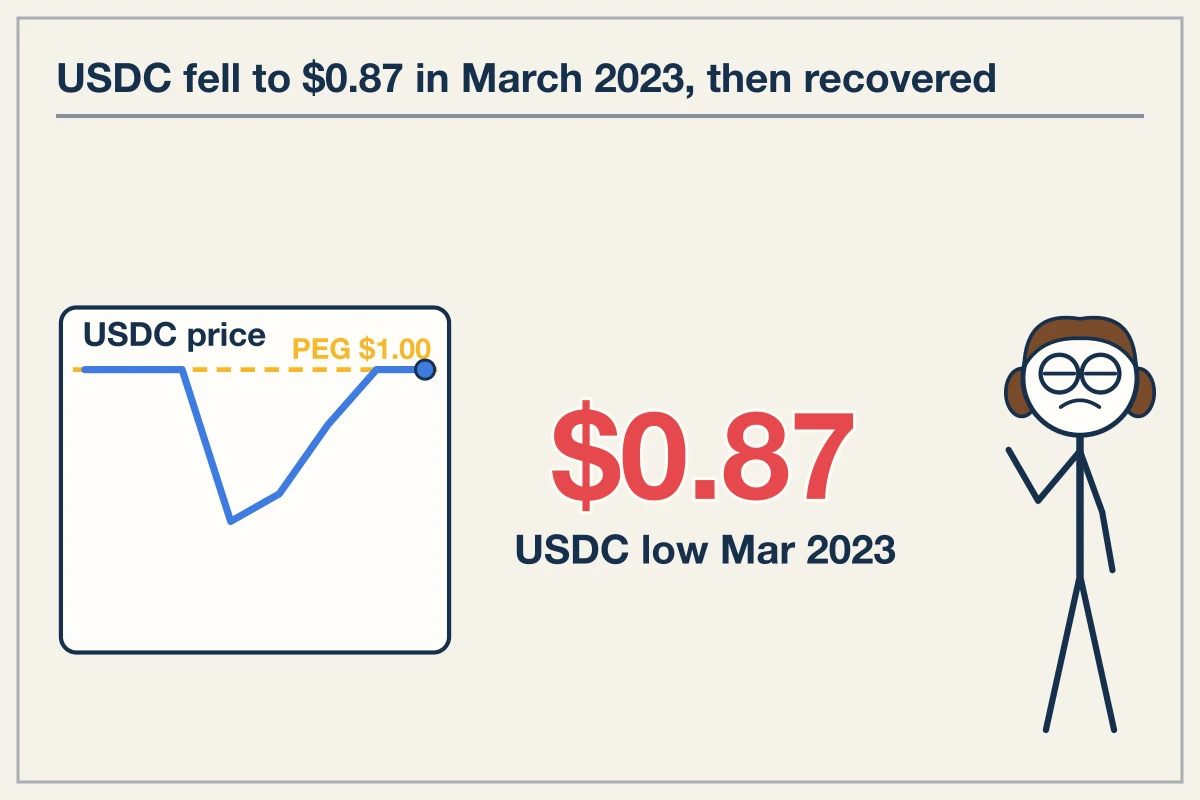
In March 2023, USDC depegged to $0.87 after Circle disclosed that $3.3 billion of its cash reserves were held at Silicon Valley Bank when FDIC receivership was announced. The token recovered to $1.00 three days later when federal regulators backed all depositor funds.
Where this goes wrong
Converting depegged collateral on secondary venues during market stress can permanently burn 2% to 13% of your transfer value through order book slippage before primary redemption arbitrage clears the discount.
Evaluating stablecoin transfer rails across networks
Exchanges assign different withdrawal fees and deposit confirmation thresholds to each network. Moving stablecoins requires matching your venue options against network fees and required block finality times.
| Network | Native Token | Average Settlement Time | Exchange Confirmations Required | Typical Exchange Withdrawal Fee |
|---|---|---|---|---|
| Ethereum (ERC-20) | ETH | 3 to 6 minutes | 12 to 32 blocks (~3 to 6 min) | $5.00 to $15.00 |
| TRON (TRC-20) | TRX | 1 to 2 minutes | 19 to 30 blocks (~1 min) | $1.00 to $2.00 |
| Arbitrum One | ETH | 1 to 2 minutes | 100 to 200 blocks (~1 min) | $0.10 to $1.00 |
| Solana | SOL | 10 to 30 seconds | 32 slots (~15 seconds) | $0.50 to $1.00 |
Ethereum ERC-20 remains the default collateral rail on legacy exchanges, but high base fees make small transfers unviable. TRON TRC-20 carries wider exchange adoption across global perpetual venues, maintaining predictable $1.00 to $2.00 flat withdrawal rates. Arbitrum One provides Layer 2 security anchored to Ethereum while reducing transfer overhead below $0.50. Solana offers the lowest latency, though exchange node maintenance occasionally pauses deposits during high-throughput events.
Worth knowing
Exchanges enforce distinct block confirmation counts per chain; Solana requires 32 slots before crediting deposits, whereas Ethereum mainnet often requires up to 64 blocks on larger transfers to prevent double-spend risks from reorgs.
The total cost of reallocating collateral
When shifting margin across venues to capture a funding spread or avoid liquidation, the total cost equals the withdrawal fee plus trading fees on both sides of the trade.
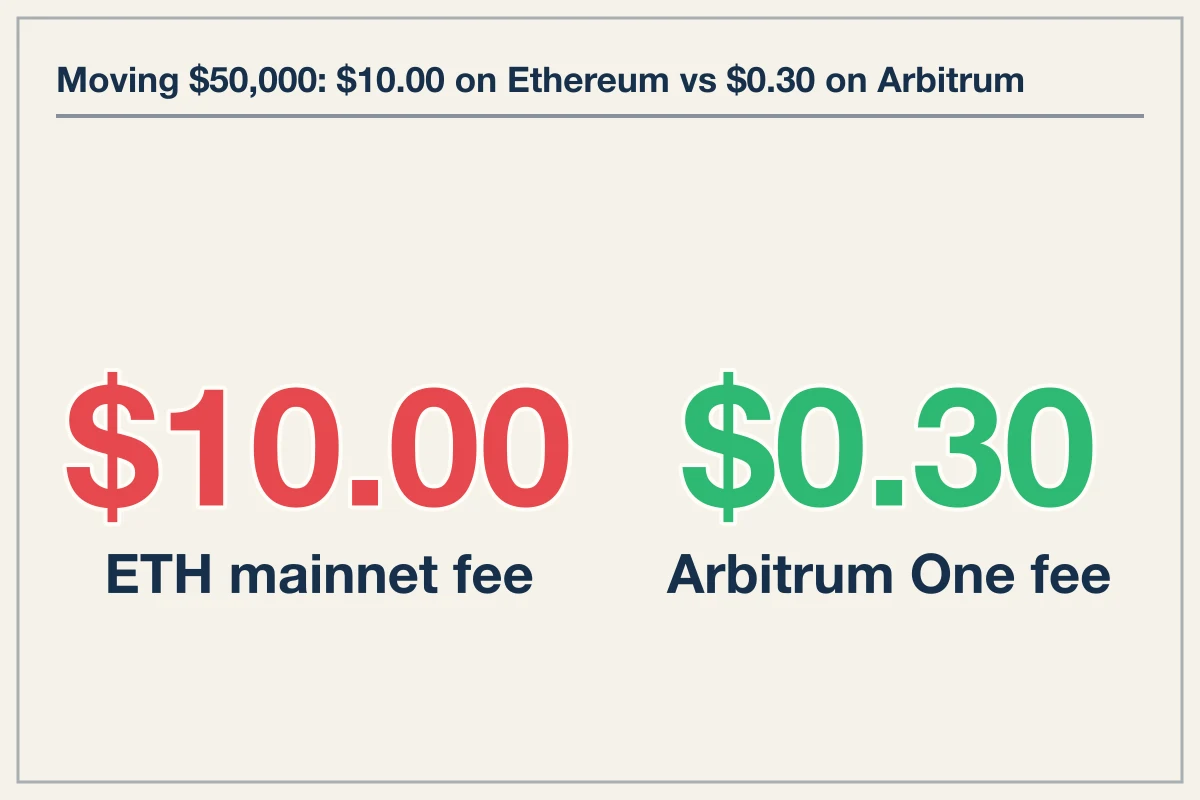
Consider moving $50,000 in USDT collateral from Bybit to MEXC to shift an ETH long position where MEXC funding is +0.0037% per 8h compared to Bybit at +0.0075% per 8h.
On Ethereum mainnet, Bybit charges a flat $10.00 USDT withdrawal fee. Moving the same collateral via Arbitrum One costs $0.30 USDT. The network transfer via Arbitrum settles and credits at MEXC in roughly two minutes.
Executing the order re-entry involves exchange fee tiers. Bybit futures taker fee sits at 0.00055, while maker fee is 0.0002. MEXC futures taker fee is 0.0002, with a 0.0 maker fee.
Closing a $50,000 position on Bybit at taker costs $27.50 ($50,000 multiplied by 0.00055). Reopening on MEXC as a maker costs $0.00 ($50,000 multiplied by 0.0). Total execution cost plus Arbitrum transfer fee equals $27.80.
Using Ethereum ERC-20 for the same sequence raises total cost to $37.50. On a $50,000 position, the funding rate differential between Bybit (+0.0075%) and MEXC (+0.0037%) saves $1.90 per 8-hour interval ($50,000 multiplied by 0.00038%). The re-allocation costs are recovered after 15 funding intervals (5 days) on the Arbitrum rail, compared to 20 intervals (6.6 days) on Ethereum mainnet.
What to do instead
Keep small secondary stablecoin balances on your primary backup exchange to execute immediate counter-trades while main transfers sit in network deposit queues.
Which stablecoin network rail is cheapest for moving margin between exchanges?
Arbitrum One and Solana offer the lowest transfer costs, generally ranging from $0.10 to $1.00 in exchange withdrawal fees. TRON TRC-20 remains the most widely supported low-cost rail across Asian derivatives venues at a flat $1.00 to $2.00 fee.
How long does a stablecoin transfer take to become usable collateral on an exchange?
Overall credit time equals network block propagation plus internal exchange database confirmations. Most venues credit TRON, Arbitrum, and Solana deposits within two minutes, while Ethereum ERC-20 takes three to six minutes depending on block confirmation settings.
What happens if a stablecoin depegs while I hold it as futures margin?
Exchanges value cross-margin accounts based on index pricing for the stablecoin or a hardcoded $1.00 rate depending on venue rules. If an exchange uses real-time market index pricing and a stablecoin drops to $0.90, your effective margin equity falls by 10%, which can instantly trigger liquidations on high-leverage positions.