· four exchange APIs · rebuilt daily
SFC enforcement actions alter perpetual futures execution fees and venue risk
The finding
An SFC enforcement action can force fast position unwind via market orders, turning a 0.02% maker fee into a 0.055% taker execution cost while order books thin.
Unlicensed perpetual futures platforms face domain blocks, public warning lists, and mandatory regional offboarding.
Traders with open derivatives exposure on target exchanges risk sudden access loss and wider bid-ask spreads during distress windows.
How SFC Enforcement Impacts Exchange Access and Derivatives Depth
When the Securities and Futures Commission executes enforcement steps against an offshore platform, the primary mechanism is domain blocking combined with public investor alerts. Unlicensed Virtual Asset Trading Platforms (VATPs) targeting local users are placed on alert lists, prompting regional internet service providers to restrict endpoint access.
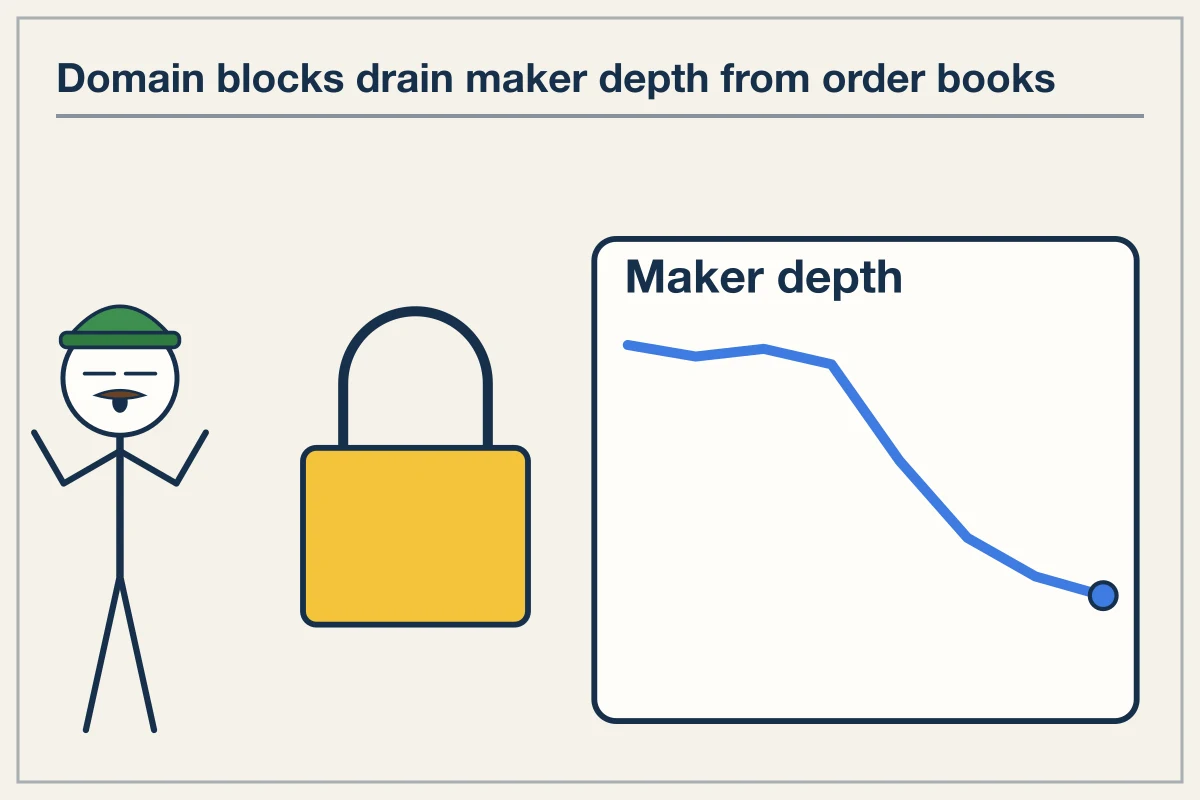
When domain access drops unexpectedly, traders reliant on direct interface execution cannot manage limit order books effectively. They are forced to route emergency exit orders through API endpoints, backup proxies, or automated position closures.
This access friction disrupts normal order book liquidity. Market makers pull quotes to avoid toxic flow during regulatory announcements, widening bid-ask spreads on perpetual contracts. A platform experiencing regulatory actions loses maker depth rapidly, increasing the price impact for any trader reducing leverage.
Where this goes wrong
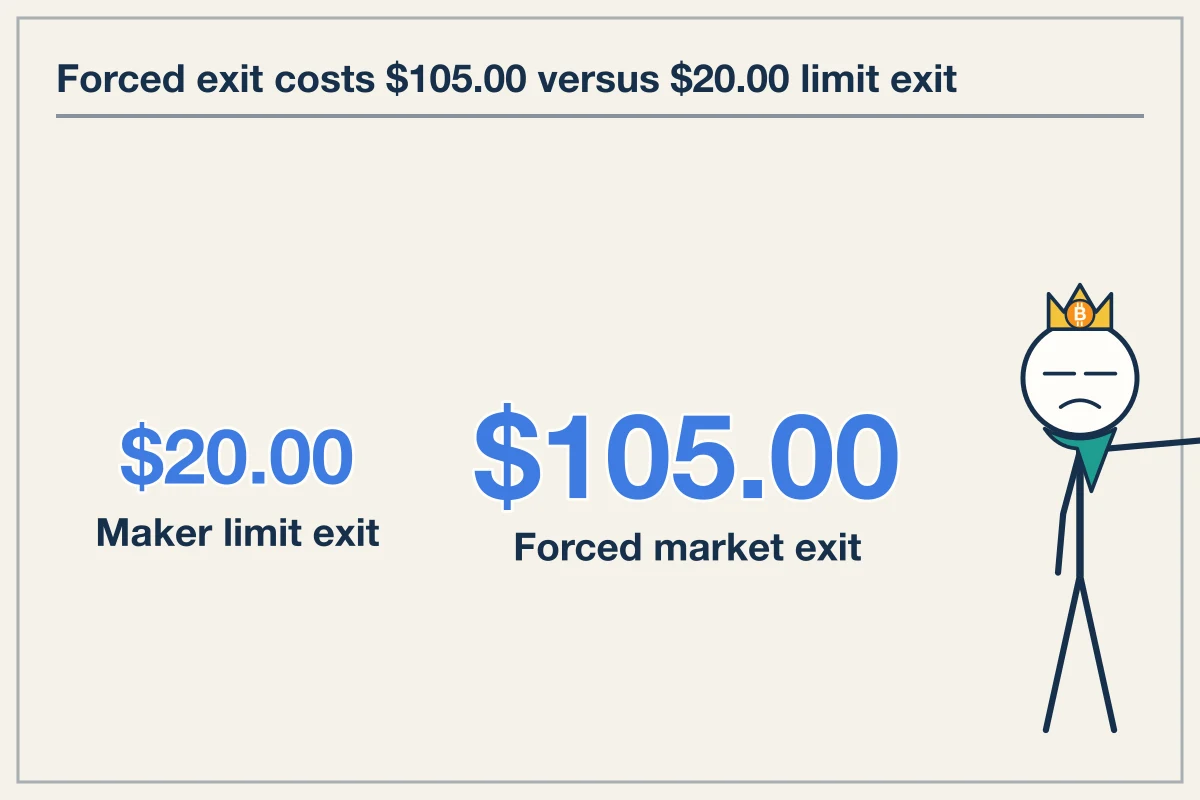
Access restrictions applied during regulatory updates force traders into market orders. Exiting a $100,000 position on Bybit via a taker market order costs $55 in execution fees alone, compared to $20 for a maker limit order, before accounting for spread slippage.
The Cost of Forced Position Closures
The financial loss from regulatory disruption comes from fee tier shifts and order book slippage. Under normal conditions, a trader manages leverage using maker limit orders. During an enforcement event, time constraints force market orders that pay full taker fees.
Consider a open long position of $100,000 in nominal value on an unlicensed venue facing domain blocks.
- Baseline limit exit fee on Bybit (0.020% maker): $20.00.
- Forced market exit fee on Bybit (0.055% taker): $55.00.
- Market impact slippage in a thinned order book (estimated 0.050%): $50.00.
- Total execution loss on emergency exit: $105.00.
The total cost to exit rises by 425% compared to a passive limit order placed in a calm market. For venues with standard taker rates like OKX (0.050% taker) or Bitget (0.030% taker), forced taker exits still double or triple standard entry costs. Across high-volume markets like Bitcoin perpetuals ($6,956,191,527 daily volume across reported desks) or Ethereum ($6,264,193,267 daily volume), localized enforcement creates abrupt execution discrepancies between venues.
Worth knowing
API access often remains functional for several hours after web domain blocking begins. Maintaining active API key pairs across alternative infrastructure limits execution delays if primary web interfaces are blocked.
Venue Comparison Under Regulatory Divergence
Trading costs differ substantially between major offshore perpetual futures desks. When enforcement splits user access, funding rates and fee structures diverge as positions are rebalanced across venues.
| Exchange | Spot Maker Fee | Spot Taker Fee | Futures Maker Fee | Futures Taker Fee | BTC Funding (8h) | ETH Funding (8h) |
|---|---|---|---|---|---|---|
| Bitget | 0.100% | 0.100% | 0.020% | 0.030% | -0.0008% | +0.0004% |
| OKX | 0.080% | 0.100% | 0.020% | 0.050% | +0.0003% | +0.0014% |
| Bybit | 0.100% | 0.100% | 0.020% | 0.055% | +0.0061% | +0.0100% |
| MEXC | 0.000% | 0.050% | 0.000% | 0.020% | +0.0023% | +0.0046% |
Fee tiers show distinct cost profiles. MEXC offers 0.000% maker and 0.020% taker rates on futures, making it the cheapest immediate execution venue for market orders. Bybit carries the highest default taker charge at 0.055%.
What to do instead
Distribute perpetual futures margin across multiple independent exchanges with different regulatory setups to avoid capital lockups during venue-specific access blocks.
Funding Rate Spreads Across Venues
Enforcement actions alter local balance sheets, creating wide spreads in 8-hour funding rates across exchanges. When capital leaves one platform due to regulatory pressure, open interest drops and funding shifts.
For Bitcoin, current live 8-hour funding ranges from -0.0008% on Bitget to +0.0061% on Bybit. The spread across venues is 0.0069 percentage points per 8-hour settlement. Holding a long position on Bitget yields a credit, whereas holding the same long position on Bybit incurs a payment.
The effect is wider on Ethereum perpetuals:
- Bitget: +0.0004% per 8h
- OKX: +0.0014% per 8h
- MEXC: +0.0046% per 8h
- Bybit: +0.0100% per 8h
The spread for ETH derivatives is 0.0096 percentage points per 8 hours.
Calculating the holding cost for a $100,000 long ETH position over 30 days (90 funding cycles):
- On Bitget: $100,000 multiplied by 0.000004 equals $0.40 per 8 hours. Over 90 intervals, total funding paid is $36.00.
- On Bybit: $100,000 multiplied by 0.000100 equals $10.00 per 8 hours. Over 90 intervals, total funding paid is $900.00.
The venue choice results in an $864.00 difference in holding cost per $100,000 over one month. When regulatory actions strain platform access, these funding rate gaps widen further as capital shifts to compliant or accessible venues.
What happens to open positions during an SFC enforcement action?
Open perpetual futures positions remain live on the exchange order book, but local access to the management interface may be restricted by domain blocks. Traders must use direct API execution or proxy routing to manage or close positions before forced liquidation windows apply.
How much does a forced taker exit cost compared to a standard limit exit?
On Bybit, a forced taker market exit costs 0.055% compared to the standard 0.020% maker fee. On a $100,000 contract, execution costs increase from $20 to $55, excluding order book spread slippage.
Does SFC enforcement alter perpetual funding rates on offshore exchanges?
Yes. As capital exits an unlicensed exchange under regulatory pressure, open interest drops and long-short balance shifts, driving funding rates away from global averages. The current spread for ETH funding spans 0.0096 percentage points per 8 hours between Bitget and Bybit.
Which venue currently has the lowest funding cost for holding long ETH positions?
Bitget offers the lowest long ETH holding cost at +0.0004% per 8 hours, compared to +0.0014% on OKX, +0.0046% on MEXC, and +0.0100% on Bybit.