· four exchange APIs · rebuilt daily
The cheapest exchange to hold perpetual positions depends on asset funding
The finding
Funding spreads between venues reach 0.0300% per 8 hours, making the cheapest exchange to hold perpetual positions vary by asset.
Execution fees are paid twice per trade.
Funding settlements occur three times every day for the life of the position.
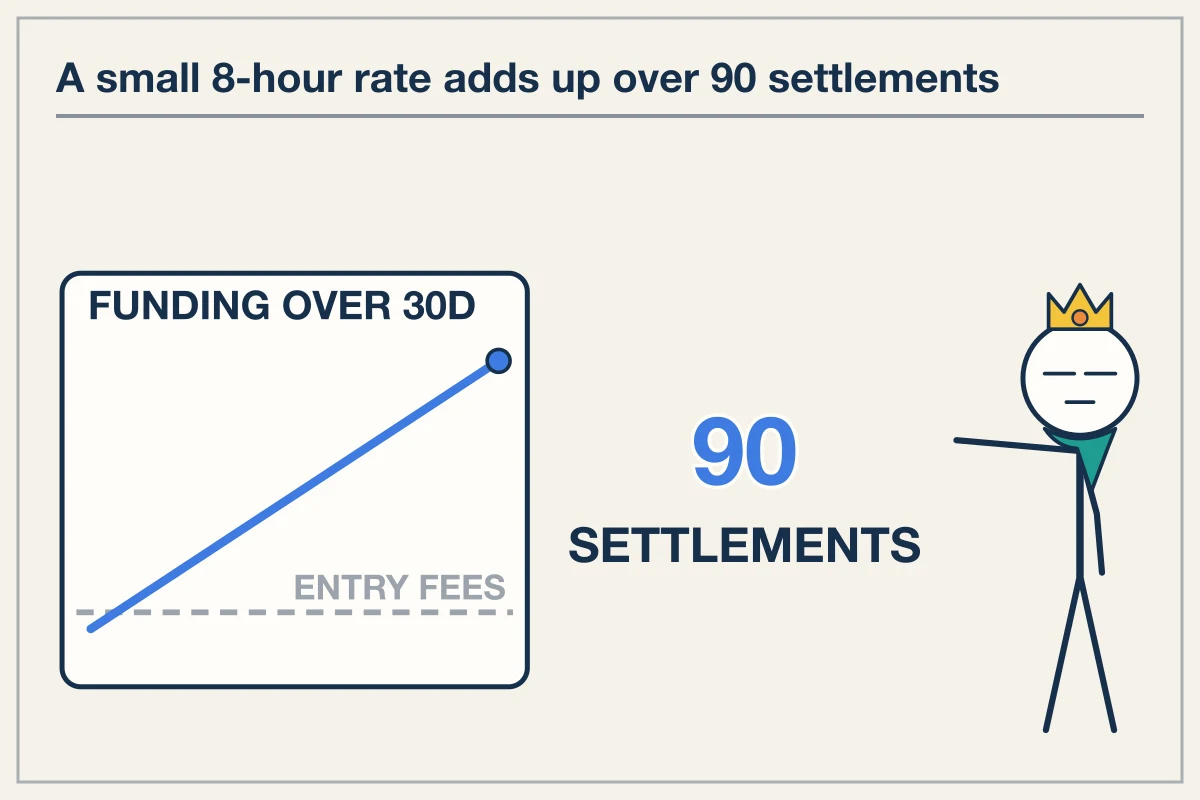
A trader holding a position for 30 days pays or receives 90 consecutive funding payments.
Finding the cheapest exchange to hold perpetual contracts
A perpetual swap tracks spot index prices through a funding rate mechanism. Every eight hours, longs pay shorts when the rate is positive, and shorts pay longs when the rate is negative.
Exchange funding rates diverge because order books carry distinct structural imbalances. One venue hosts institutional market makers running market-neutral hedges, while another carries retail traders heavily skewed toward long leverage. Arbitrageurs trade across venues to flatten these differences, but capital inefficiencies, margin requirements, and execution risks keep the spreads open.
Over a single 8-hour window, a rate difference of 0.0050% appears small. Over a month of holding, 90 funding settlements accumulate. A small baseline shift in 8-hour funding becomes the primary cost driver of the position, completely overriding the initial entry and exit trading fees.
Worth knowing
Local order book bias creates persistent funding spreads across exchanges that cross-venue arbitrage does not close.
Live funding rates and 30-day holding costs
At current rates, funding costs vary widely across major venues. For a 10,000 USD long position held for 30 days (90 settlements), the baseline cost or credit differs significantly by exchange and asset.
The table below normalizes current 8-hour funding rates and calculates the 30-day dollar cost or credit for a 10,000 USD long position. Negative rates indicate that the long position receives a payment.
| Asset | Exchange | 8-Hour Rate | 30-Day Rate (90 Periods) | 30-Day Cost on 10,000 USD Long | 24h Volume |
|---|---|---|---|---|---|
| ARB | Bybit | -0.0200% | -1.8000% | +180.00 USD (Credit) | 365,024,334 USD |
| ARB | Bitget | +0.0100% | +0.9000% | -90.00 USD (Cost) | 365,024,334 USD |
| ARB | MEXC | +0.0100% | +0.9000% | -90.00 USD (Cost) | 365,024,334 USD |
| ARB | OKX | +0.0100% | +0.9000% | -90.00 USD (Cost) | 365,024,334 USD |
| ZEC | Bitget | -0.0146% | -1.3140% | +131.40 USD (Credit) | 787,151,167 USD |
| ZEC | Bybit | +0.0100% | +0.9000% | -90.00 USD (Cost) | 787,151,167 USD |
| BTC | Bybit | -0.0018% | -0.1620% | +16.20 USD (Credit) | 2,128,138,083 USD |
| BTC | Bitget | +0.0062% | +0.5580% | -55.80 USD (Cost) | 2,128,138,083 USD |
| DOGE | OKX | -0.0009% | -0.0810% | +8.10 USD (Credit) | 476,680,824 USD |
| DOGE | Bitget | +0.0100% | +0.9000% | -90.00 USD (Cost) | 476,680,824 USD |
| ETH | Bybit | +0.0050% | +0.4500% | -45.00 USD (Cost) | 3,100,177,764 USD |
| ETH | MEXC | +0.0099% | +0.8910% | -89.10 USD (Cost) | 3,100,177,764 USD |
| SOL | MEXC | +0.0067% | +0.6030% | -60.30 USD (Cost) | 741,095,663 USD |
| SOL | Bitget | +0.0100% | +0.9000% | -90.00 USD (Cost) | 741,095,663 USD |
On ARB, Bybit charges longs -0.0200% per 8 hours, while Bitget, MEXC, and OKX charge +0.0100%. A trader holding a 10,000 USD ARB long on Bybit earns 180 USD over 30 days. Holding that exact same long position on Bitget costs 90 USD over the same period. The venue difference for ARB is 270 USD on a 10,000 USD position.
On ZEC, Bitget pays longs +0.0146% per 8 hours (-0.0146% funding rate), yielding a 131.40 USD credit over 30 days. On Bybit, a ZEC long pays 90 USD. The 30-day spread on ZEC equals 221.40 USD.
Where this goes wrong
Entering a position strictly to capture negative funding rates subjects capital to underlying asset price drops that trigger account liquidation.
Execution commissions versus funding decay
Traders often select venues by comparing published maker and taker fee schedules. Default futures trading commissions across these venues are structured as follows:
- Bitget: 0.0200% maker, 0.0300% taker
- Bybit: 0.0200% maker, 0.0550% taker
- MEXC: 0.0000% maker, 0.0200% taker
- OKX: 0.0200% maker, 0.0500% taker
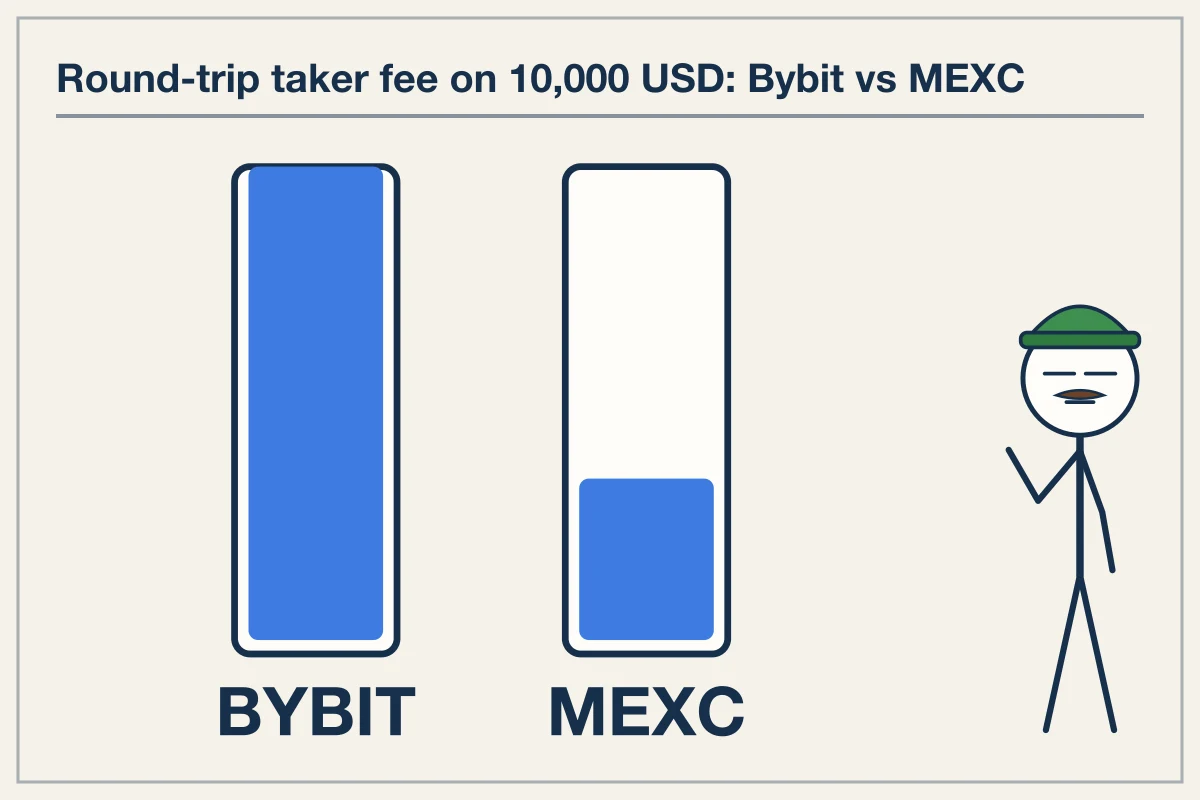
Opening and closing a 10,000 USD position using market orders (taker) on Bybit incurs a round-trip fee of 0.1100%, or 11.00 USD. On MEXC, that same round trip costs 0.0400%, or 4.00 USD. The upfront execution fee difference between the highest and lowest cost venue is 7.00 USD.
On an ETH long position, MEXC offers a lower taker fee (0.0200% versus Bybit's 0.0550%), saving 7.00 USD on execution. However, MEXC's current ETH funding rate is +0.0099% per 8 hours, compared to Bybit's +0.0050%. Over 30 days, holding ETH on MEXC costs 89.10 USD in funding, while Bybit costs 45.00 USD.
The 44.10 USD funding penalty on MEXC erases the 7.00 USD execution fee savings within five days of holding. For positions held longer than a week, funding rates determine total execution and holding efficiency.
What to do instead
Calculate the break-even holding duration by dividing the round-trip fee difference by the daily funding rate spread before choosing an execution venue.
What makes holding identical perpetual positions cost different amounts across exchanges?
Exchange funding rates reflect local order book imbalances between leverage buyers and sellers. When an exchange carries more long open interest than short open interest, its local funding rate rises relative to other venues.
Which exchange is the cheapest exchange to hold perpetual long positions right now?
The cheapest venue depends entirely on the asset. Currently, Bybit is the cheapest venue to hold long positions in ETH, BTC, and ARB, while Bitget is cheapest for ZEC, MEXC is cheapest for SOL, and OKX is cheapest for DOGE.
How much money does exchange funding rate selection save over a month?
On a 10,000 USD position held for 30 days, funding rate spreads between venues range from 29.70 USD on SOL to 270.00 USD on ARB.
Does a lower trading fee schedule make up for a higher funding rate?
No. Round-trip trading fees are paid once and range from 4.00 USD to 11.00 USD per 10,000 USD traded, whereas funding settles 90 times per month and accumulates to over 200 USD in holding drag.